Kelia Mayorga, Hugo Arias-Flores, Carlos Ramos-Galarza, Isabel L. Nunes (2022). Digital Storytelling to Help Improve Reading comprehension. In: Human Factors and Systems Interaction. AHFE Open Access, vol. 52, pp. 419–423. https://doi.org/10.54941/ahfe1002184
Information and communication technologies have transformed the world, especially if they are aimed at promoting reading in children in their first years of learning. The problems generated by deficiencies in reading comprehension in the student body affect their school performance and their progress in the upper years, creating demotivation and low levels in their school performance. The objective of the research proposal is to design a virtual classroom with digital narratives as support to improve reading comprehension in the student body. Digital narratives are a technological resource that can be applied pedagogically, combining content with visual and auditory material, taking advantage of the functionality of virtual classrooms such as Google Classroom, in which the proposal was designed. It is concluded that teachers must identify the problems that their students present in the reading process and implement new methodological strategies, so that learning is different, participatory and innovative, this is where narratives play an important role, such as resource that provides a change in the learning system and support for students with school behind, in addition to strengthening cognitive development with audiovisual stimuli.
Information and communication technology offers tools to improve the edu- cational process. These tools promote innovation by implementing digital environments that enrich the training process of students (Pellas, Kazanidis, Konstantinou et al., 2017), stimulating the acquisition of knowledge, beco- ming mediating tools for collaborative work (Kim & Li, 2021). The digital narrative is a strategy that proposes to move from the unidirectional edu- cational model to a multidirectional one, and in the field of didactics to stimulate the learning processes by sensory, auditory, phonological activa- tion, allowing to move from memorization to the assimilation of contents,
to the understanding and transfer of knowledge based on learning from real contexts (Gil, 2016; Hermann, 2018; Ibarra and Ballester, 2016).
Digital storytelling is a form of personal storytelling, which simultaneously combines voice, image, and printed text to tell a short story, usually 3 to 5 minutes (Lambert & Hessler, 2018), is a medium that teachers can use to support student learning by helping them organize and express their ideas individually and meaningfully (Mawasi, Nagy, Finn et al., 2022). Digital storytelling as well as traditional storytelling is developed with the selection of a preferred theme, where students are active members exchanging ideas, reso- lving conflicts, and researching (O’Byrne, Houser, Stone, & White, (2018), motivating access to knowledge (Encabo, Hernández & Sánchez, 2019).
Encourage reading in children in their first years of learning using tools adapted to their educational needs, that go at their pace of learning, opening a new perspective at the time of studying, and that give them the guidelines so that they can feel part of that space of interaction, generating a significant and lasting knowledge (Rahiem, 2021). The problems generated by deficie- ncies in reading comprehension in students affect their school performance and progress in the upper years, generating demotivation and low levels in their school performance. The objective of the research proposal is to design a virtual classroom with digital narratives as a support to improve reading comprehension in students.
RESEARCH METHOD The research was carried out in the Maculillo de Arriba Enclosure, in the Palenque Canton, rural sector of the province of Los Ríos. This province is in the coastal region of Ecuador, a developing country located in South America.
As a research method, included: (1) a survey - conducted with teachers, to identify their levels of use of emerging tools in their teaching activity; (2) a Phonological Consciousness Assessment Test - applied to elementary school students, to establish reading comprehension problems and (3) evaluations – to iteratively develop the virtual environment.
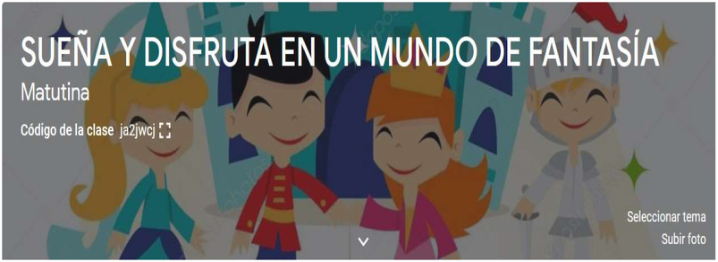
VIRTUAL ENVIRONMENT PROPOSAL The proposal was developed using the free Google Classroom tool. The virtual classroom was designed, in which different types of reading and audi- ovisual materials, question forms, podcasts, forums, among other elements (see Figure 1) will be shared, in the same way it contains links that allow one to explore other types of materials.
The virtual classroom is composed of four blocks as presented in Table 1. The access to classroom is unrestricted, the student can access from any device, in this way a ubiquitous learning is generated where it is possible to integrate the educational contents with technology.
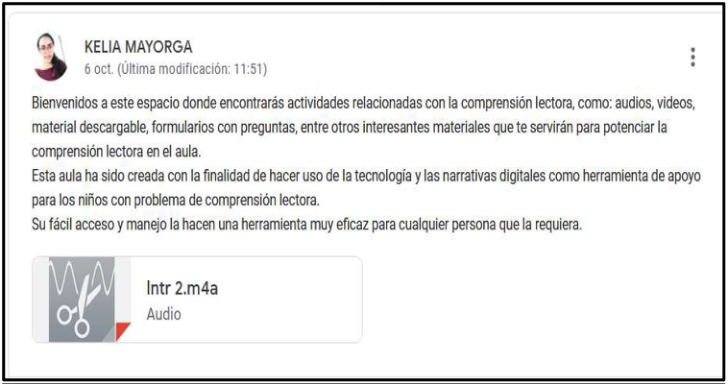
The main screen features the teacher’s greeting to the students, and a brief presentation of the classroom (see Figure 2). This will help users become
Digital Storytelling to Help Improve Reading Comprehension 421
Figure 1: Virtual classroom interface design.Table 1. Components of the virtual classroom.
Table available in the original PDF paper.
Block Title Content 1 Comprehensive reading of stories.
- Story in pdf format: The two friends and the bear. - Narrative video of the story with illustrations. - Form of questions of evaluation of the story. - Crossword. 2 I read and enjoy. Story in pdf format: A colored toad? - Narrative video of the story with illustrations. - Word document to make the structure of the story. - Element of Educaplay (complete sentences) 3 I learn to describe.
- Descriptive content of animals in Pdf. - Word document to make the description. - Element of Educaplay (alphabet soup with the characteristics of animals) - Tale of The Flea and the Louse. 4 Long live the stories!
- Images - Word document for the writing of the story.
familiar with the content and motivate them to continue exploring the edu- cational material. The easy handling of the classroom and a simple interface will allow students to sit in a familiar and friendly space to discover, learn and develop their learning through interaction with technological resources and with their classmates.
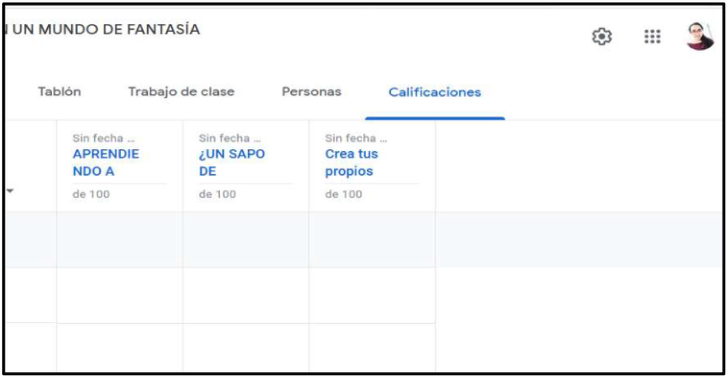
In addition to the planned activities, the teacher can observe the progress of his students (see Figure 3), this will allow to keep track and monitor the progress of the participants and keep track of those who are not fulfilling the tasks or who are experiencing some difficulty in the activities.
CONCLUSION
There are countless platforms, social networks, and information channels where narrative is used as a means of information and entertainment. Short videos, tutorials, and podcasts are a clear example of the interaction between ICT tools and narratives, turning this content into digital narrative that is aimed at a specific group and with a set objective.
Figure 2: Greeting and introduction.Figure 3: Visualization of student progress.
This is how digital narratives become a didactic tool that applied with teaching pedagogy can help improve learning problems, thanks to the visual and auditory format it offers. Provide the student population with an envi- ronment that adapts to their educational needs, to their pace of learning, exposing new ways to generate meaningful lasting knowledge. The proposal presents four blocks aimed at strengthening reading in students. In a next phase, we will seek to analyze the effectiveness of the virtual environment.
ACKNOWLEDGMENT
The authors wish to recognize the support provided by the Universidad Tecnológica Indoamérica to the project INV-0012-030, entitled “Tecnologías educativas para discapacidad”.
Digital Storytelling to Help Improve Reading Comprehension 423
REFERENCES
Encabo Fernández, E., Hernández Delgado, L., Sánchez Sánchez, G. (2019). Children’s literature and hybrid narratives. Canon, modes of thought and education. Educational Contexts. Journal of Education, 0(23), 199–212 Gil, J. (2016). Digital narrative and childhood. The generation of collaborative
creators. Mediterranean, 7(1), 1–12 Hermann, A. (2018). Innovation, technologies and education: digital narrativesas didacticstrategies. Killkana Social, 2(2), 31–38 Ibarra, N., & Ballester, J. (2016). Booktrailer in Early Childhood and Primary Edu-
cation: acquisition and development of communicative, digital and literary skills through digital narratives. Digital Education Review, 30, 76–93. Kim, D., Li, M. (2021.)Digital storytelling: facilitating learning and identity development. J. Comput. Educ. 8, 33–61 Lambert, J., & Hessler, B. (2018). Digital storytelling: Capturing lives, creating
community. Routledge. Mawasi, A., Nagy, P., Finn, E. et al. (2022). Narrative-Based Learning Activities for Science Ethics Education: an Affordance Perspective. J Sci Educ Technol 31, 16–26 O’Byrne, W. I., Houser, K., Stone, R., White, M. (2019). Corrigendum: Digital
Storytelling in Early Childhood: Student Illustrations Shaping Social Interactions. Frontiers in psychology, 9, 2749. Pellas, N., Kazanidis, I., Konstantinou, N. et al. (2017). Exploring the educational potential of three-dimensional multi-user virtual worlds for STEM education: A mixed-method systematic literature review. Educ Inf Technol 22, 2235–2279 Rahiem, M.D.H. (2021). Storytelling in early childhood education: Time to go
digital. ICEP 15, 4
LISTED IN THE AHFE DIGITAL BOOKSTORE CATALOGUE
Explore the complete digital volume
Human Factors and Systems Interaction
Read this individual research paper free through the original publisher, or explore the full digital proceedings book.
ISBN 978-1-958651-28-5
Explore this ISBN in the AHFE Bookstore ↗Listed in the July 2026 bookstore catalogue; search by ISBN to confirm current availability · Digital book purchase optional