Gerrit Hoeborn, Yannick Becerra, Frederic Weingarten, Frederik Winkens (2023). Strategic Positioning in Service-Oriented Business Ecosystems: A Strategic Role Model Approach. In: The Human Side of Service Engineering. AHFE Open Access, vol. 108, pp. 323–332. https://doi.org/10.54941/ahfe1003134
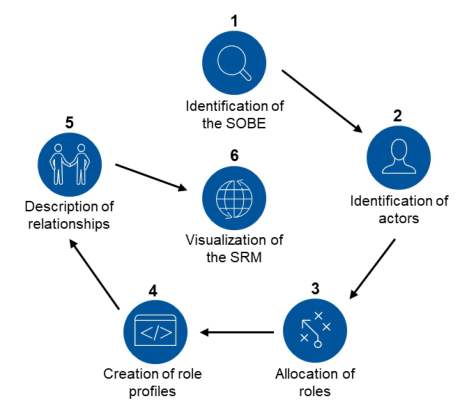
In recent years servitization – a shift from traditional product-based value creation to-wards services – manifests in the transformation of whole industries. The offered ser-vice is more frequently created in service-oriented business ecosystems (SOBE) result-ing in a paradigm shift. Companies are grappling to strategically position themselves in SOBEs using strategic role models (SRMs). The various approaches for SRM in current literature cannot cover all aspects needed, to fully conceptualize strategic roles, that include relevant service-orientation properties.This paper aims to develop a SRM that is tailored to SOBEs which will help researchers and practitioners to identify and under-stand important roles in their SOBE. By integrating the service-dominant-logic (SDL) existing SRMs were merged into a SOBE-tailored SRM, combining a system- and model theory-based approach. The resulting model includes the three phases of a SOBE: preparation, formation, and operation. In each phase the model consists of three system levels: central value creation, complementary services, and enabling network. All system levels have a defined set of up to ten roles and their typical relationships. The designed six step approach – 1. identification of the SOBE, 2. identification of actors, 3. allocation of roles, 4. creation of role profiles, 5. description of relationships, 6. visualization of the SRM – was used to model and analyse a SOBE in the context of construction for plan-ning and construction of a commercial building. This paper shows, that by using the tailored SRM for SOBE enables a structured approach to detect crucial differences (e.g. increments of certain roles or actors) on a general level as well as in a specific SOBE from construction. This facilitates practitioners to analyse their strategic environment and to systematically develop new positioning alternatives by reducing complexity and struc-turing relevant information for positioning.
Optimizing the positioning strategy of companies in service-oriented busi- ness ecosystems (SOBE) is a central component of current research (Adner, 2017, p. 53). It is assumed, that strategic reorientation in SOBE requires the prior identification and depiction of roles, actors as well as their exchange
relationships in a SOBE. Actors can take different roles in SOBE, e.g. for the purpose of strategic realignment, leading to a multitude of potential and dif- ferent strategic role models. There is qualified research from Jacobides et al., Pidun et al. or Autio and Thomas on business ecosystems (BE) and strate- gic role models, but none of the SRMs developed to date are suitable for modelling the roles in a SOBE (Hoeborn and Gonzalez, 2023, p. 8). The development of an adequate SRM for SOBEs should present the attributes, relationships and activities of the roles upon which the actors of a SOBE can be identified and assigned. By adding the characteristics, the SRM should also provide information about the compatibility of the roles in an SOBE, from which findings for strategic measures can be obtained.
In practice, strategic measures such as the selection of the contracting configuration (individual contracting versus general contractor) is of deci- sive importance for the progress of a construction project (Eschenbruch and Racky, 2015). This raises the discussion on the extent to which role configura- tion affects a targeted-oriented and adequate distribution of value creation in the project. Therefore, modelling the individual actors’ prerequisites in their respective roles with SRM might help to realize improved customer-centric project management due to increased transparency in its SOBE.
THEORETICAL BACKGROUND System and Model Theory
The system and model theory are used to develop the model for strategic roles according to its fundamentals. Systems consist of elements that have defined properties and functions. The function is determined by the intended use of the context-specific system. Elements themselves can in turn repre- sent independent systems (e.g. companies as elements of a BE are systems in themselves). Individual elements are connected by relationships. These rela- tionships can take the form of material flows, information flows, or other situational relationships (Haberfellner et al., 2019, p. 4).
Depicting systems assists in visualizing real and complex phenomena and thus simplifies the understanding and design of systems. Thereby, it is impor- tant to always abstract in a problem-oriented way, i.e. to deliberately omit irrelevant parts in order to consider only aspects relevant to the problem (Haberfellner et al., 2019, p. 12). In this process, models are used to create constructions of originals to reduce the complexity of reality so that essential facts and problems can be expediently explained or predicted (Stachowiak, 1973, p. 12; Wöhe and Döring, 2000, p. 36). In modelling, defined main cha- racteristics, principles, knowledge goals and validity criteria should be used (Stachowiak 1973, Zelewski 2008, Becker et al. 2012, Bossel 2004).
The Service-Dominant Logic The service-dominant logic (SDL) is a concept to explain service-oriented value creation. It offers an alternative understanding to the goods-dominant logic (GDL) of how value creation and exchange between actors occurs (Vargo and Lusch, 2004, p. 7). The SDL is composed of four central terms:
Strategic Positioning in Service-Oriented Business Ecosystems 325
actors, service, resources and value (Lusch and Vargo 2014, p. 55). These are the basis for a series of premises of the SDL, of which five are additionally defined as axioms (Vargo and Lusch 2016, p. 8).
To analyse specific strategic role models with respect to their complia- nce with the service-orientation, SDL evaluation criteria were defined. These evaluation criteria are composed of SDL premises and axioms: resource integration (a), the role of the customer/beneficiary (b), service exchange (c), institutions and institutional arrangements (d), and service innovation (e) (Hoeborn and Gonzalez, 2023, p. 4).
Strategic Role Models in Business Ecosystems The strategic role model (SRM) concept entails the analysis of the roles of a BE as defined by Burkhalter and Dedehayir et al. in a holistic way (Hoeborn and Gonzalez, 2023, p. 2): “A SRM is a constellation of roles in a BE that, as a unit, strives to explain how exactly value creation takes place and defines each role’s contribution to the viability and functionality of the system.”
By making specific adaptations to the strategic role model proposed by Dede-hayirs, a foundation for the modelling of SRM in SOBE can be deve- loped (Hoeborn and Gonzalez, 2023, p. 8). This serves as a basis for developing strategic positioning strategies. The goal is to achieve optimal positioning through the efficient use of own resources and capabilities, while simultaneously considering other actors (Müller-Stewens and Lechner, 2016, p. 123).
In addition to the SRM approach, den Oudens Value Flow Model (VFM) is also incorporated into this research. The VFM is applied for the design of ecosystems. It focusses on the compatibility, the influence, the investments and the realisation time of the individual actors in an ecosystem. Further- more, the VFM is organised into four different levels to which actors can be assigned: The area of the core value proposition, the complementary offe- rings, the supplying and enabling network and the area of other stakeholders (den Ouden 2012, p. 154–161).
METHODOLOGY
The methodology of system analysis is conducted with SOBEs representing the object of analysis. The combination of a system- and model theory-based approach is divided into a state analysis and a target concept. The target concept is then used to apply it to a case study of the construction industry.
The state analysis addresses the identification and analysis of current BEs and their characteristics. To realize service orientation the SRM approach of Dedehayir et al. and the SDL theory are combined. The target concept on the other hand, is based on a defined purpose of the model and identifies missing components of the state-analysis. In doing so, the model purpose can be fulfilled in conjunction with the system purpose of SOBE. The system purpose of SOBE in this paper is defined as: A SOBE has the function of creating the value proposition jointly defined by the stakeholders while fully considering the SDL.
For the modelling of the target concept the following model purpose is defined as: The adequate and differentiated visualization and explanation of existing roles and their properties, relationships and activities in SOBE, which actors can adopt in the dynamic course of these in order to serve the purpose of the system.
The target concept begins to integrate service orientation, by full integra- ting the evaluation criteria. In addition, adjustments are made to the roles in respect to their properties, relationships, activities and phase allocation. Furthermore, roles must be removed and added.
Next, den Ouden’s elements adapted for research are added to the proper- ties of the roles. Possible differences from the characteristics of several actors, who together form a role, are specified by “role profiles”(see Table 2). Those profiles are assigned to the roles as internal elements of the use case.
At this point, different transaction types according to den Ouden are considered in the relationships between the roles. The activities and phase assignment of the roles must be adapted to become service-oriented, as well as the prioritized activities of the three different SOBE phases. Finally, the roles are transferred to den Ouden’s system levels.
RESULTS
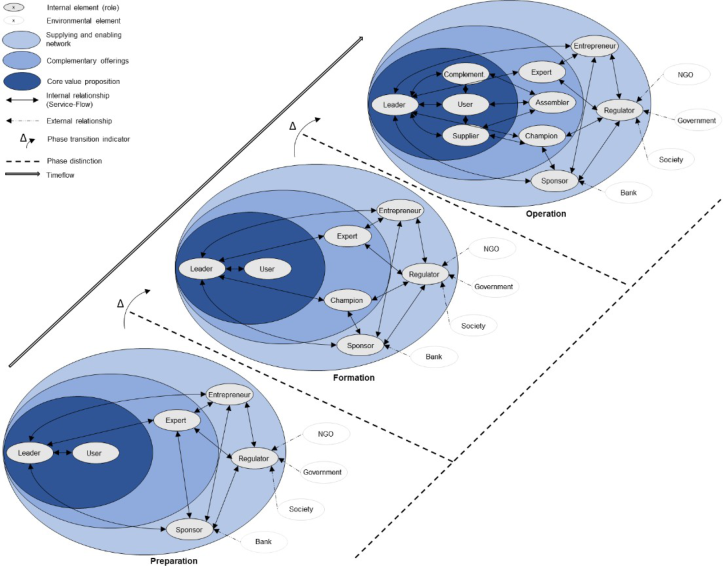
The results present the target concept of the SRM tailored to a SOBE and its four main adaptions (see Figure 1): 1. placement of roles to system levels, 2. distinction of three phases, 3. condensed transaction types, 4 new properties of the roles.
First, the placement of roles in system levels result accordingly to Dedeh- ayir’s group descriptions and den Ouden’s definitions of system levels. The components of the model find their descriptions in the legend. For reasons of illustration, the relationships shown are typical, exemplary relationships as they might look in a specific application. These depend on the specific appli- cation and accordingly take different forms depending on the application. The phase indicator “delta” symbolizes all necessary changes in the current state of the SBE in order for it to evolve to the next phase.
Second, the roles shown have activities on which they focus in the dif- ferent phases. The roles still pursue their activities from the preparation or formation phase in the operation phase, but one activity is always priori- tised depending on the phase. Due to the changes in the activities of these roles according to Dedehayir et al., additional definitional extensions must be made. Regarding the subordinate task of the leader’s value management, it is assumed that the leader already identifies the value proposition in the preparation phase and disseminates it further in the formation phase in the SBE. The role of the entrepreneur remains in the operation phase and ensures promotion and coordination between research and commercialisation. The regulator also remains after the preparation phase and focuses on monito- ring regulatory compliance in the formation phase and promoting growth of all actors by enabling fair competition in the operation phase. The focus on service orientation also implies that there must be no parasitism or exploi- tation of one actor by other actors for their own exclusive benefit. As a
Strategic Positioning in Service-Oriented Business Ecosystems 327
Figure 1: Strategic role model for service-oriented business ecosystems.Table 1. Prioritization of activities according to phases (adjustments marked).
Table available in the original PDF paper.
result, the role of the dominator is not considered in the model. The prio- ritisation and expansion follow Dedehayir et al. (see Table 1). Terms such as “components” or “goods” are changed to “resources”, to be consistent with the SDL and strengthen the focus on service, information, knowledge and competences.
Third, the adjustment of the relationships between the roles takes place in form of a bundling the four differentiated transaction types from den Oudens
into one transaction type, which is given the term “service flow” (SF). These are value streams between the respective roles. This bundling is also part of the completion of the service orientation. Another adjustment relates to the type of arrows that represent the relationships of the elements in the model. A differentiation is made between internal and external relationships. Internal relationships are connections between system-internal elements and external relationships are connections between system-internal elements and environ- mental elements that are added to the model. While internal relationships are exclusively bidirectional, external relationships are unidirectional arrows since the influences originate exclusively from the surrounding elements to the internal elements. These influences are not titled SF, as they can be of different nature.
Last, the properties of the roles influence, investment and realisation time were added to the model. Based on the SDL, the Compatibility always asses- sed as positive. Therefore the intensity of the influence is also constantly positive, thus is indicated by the number of plus signs (“+” low, “++” medium, “+++” high, see Table 2). The higher the influence, the more the value proposition is dependent on the individual actor and his resources.
Table 2. Role profiles from the strategic role model of the construction industry.
Table available in the original PDF paper.
Strategic Positioning in Service-Oriented Business Ecosystems 329
The investments and associated realisation time are adopted definitionally from den Ouden and expressed with the corresponding symbolism. The role profile lists all actors in a role and their respective properties (see Table 2). Within the role profile, individual actors are ranked to the extent to which the actors match the role description through their performed activities in the SOBE.
Case Study: A Strategic Role Model of the Construction Industry Construction projects characteristically have a multitude of stakeholders involved in the development process and form highly competitive value crea- tion systems. In this context, the ever-changing composition of projects, does not always build long-lasting relationships, which results in low trust in the relationships. Modelling the construction industry therefore helps to identify recurring allocations of actors and to derive non-typical positioning options.
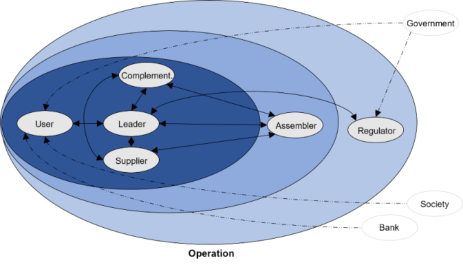
The case-specific application of the model is carried out in collaboration with a project coordinator from the construction industry. The results were derived using a workshop format with a total of five experts. To model and analyse the SOBE for the planning- and construction-phase of a comme- rcial building the following six-step approach was used (see Figure 2). The corresponding result is shown in Figure 3.
Due to the emerging role constellation and the performed activities of the roles resulting from the assigned actors, the present SOBE can be clas- sified into the operation phase (see Table 2). The phase indicator delta is not relevant, as there is no subsequent phase to the operation phase.
The role of supplier has the highest number of actors (five), followed by the roles of leader, assembler, complementor and regulator (three each) and finally, the role of user (two). Ranking the characteristics of individual actors reveals that the roles of leader, assembler and regulator are the most influen- tial. Large investments are made by the roles of leader and supplier, whereas
Figure 2: Applied strategic role model on the case study of the construction industry.Figure 3: Applied strategic role model on the case study of the construction industry.
the roles of complementor, assembler and regulator show only small inve- stments. The realization time for the development and implementation of their services is uniformly longest for the role of the leader. For all other roles, the realization time is predominantly medium.
DISCUSSION
When applying the model to the case study, it is positively noticeable that all actors could be matched to the according roles. This indicates that the model appears to be inherently exhaustive. Combined with the role characteristics influence, investments and realization time the SRM addresses the lack of transparency related to the extent of value creation provided by each role.
Reflecting the SRM in the present case study, it appears, that the constru- ction industry cannot meet all criteria for an SOBE. Still the model allows relevant strategic conclusions for the construction industry.
While performing the analysis with the SRM, it is important to consider, that relationships between actors occupying the same role, will not be visu- alized in the SRM. At the same time, a service flow between two roles does not implicate, that all actors of that role have a service flow to all actors of the interacting role. In the case study actors themselves are required to be a cluster, consolidating entities that do not differ by assumption, instead of representing concrete entities. This generalization is necessary, as there are vast possibilities, how actors can be occupied by different entities such as organizations/individuals of the construction industry.
For project coordinators, the model is an applicable tool that can be used to discuss the preferences of how a project might be organized for their client. As the variation in influence, investment and realization time can be modelled in different SRMs, the advantages and disadvantages of different contracting configurations become instantly visible.
The same effect is applicable on a higher level of abstraction and thus fulfils the objective of the model, as the overall model visualizes the role constella- tion and the exchange relationships in an instant. At the same time, the level of abstraction is eminently well suited for strategic considerations regarding positioning. The fact, that the actors can be clustered representing several
Strategic Positioning in Service-Oriented Business Ecosystems 331
stakeholders and at the same time be associated to different roles that have different characteristics, reversely enables to allocate the specific stakehol- ders to the role that suites best, resulting in an improved division of labour. This facilitates a better positioning in a specific practical use case according to competences and needs of the stakeholders.
CONCLUSION
This paper developed a SRM that is tailored to SOBEs to help researchers and practitioners to identify and understand important roles in their SOBE. The- refore, the service-dominant logic (SDL) was integrated into existing SRMs and were merged into a SOBE-tailored SRM, combining a system- and model theory-based approach. Practitioners can use this model to analyse their stra- tegic environment and to systematically develop new positioning alternatives by reducing complexity and structuring relevant information for positioning.
Research was extended by an empirical-descriptive, semiformal model, which is assigned to the overarching subject of the structure of value netw- orks. Consequently, the model can be used to describe actor and service structures, as well as to qualitatively investigate empirically observable facts and bilateral exchange relationships.
Concluding, the SRM customized for SOBE provides a scientific framew- ork to detect crucial derivations on a strategic level regarding increments of certain roles as well as in a specific SOBE from construction.
LIMITATIONS AND FUTURE RESEARCH Limitations become evident while structuring and embedding relevant theory into the conceptualization of SRM in SOBE. The inclusion of further theory on service orientation in addition to SDL, as well as the implementation of further use cases may sharpen the results even further.
Future research should be conducted for improvement and modification of the developed SRM. One long-term goal for a project controller is to grasp the proportion of value created by each role. Therefore, it would be necessary to understand how much the role characteristics are needed in the different SOBE phases and how characteristics should be specified to bet- ter model service-oriented value creation. The results of this paper should be used as groundwork to develop a first approach of a transparency-based control methodology for by project controllers in the construction industry.
ACKNOWLEDGMENT
The ongoing research is funded under project number 02K20Z002 and 02K20Z005 by the German Federal Ministry of Education and Research (BMBF) in the program “Innovations for tomorrow’s production, services and work” and supervised by the Project Management Agency Karlsruhe (PTKA).
REFERENCES
Adner, Ron (2017): Ecosystem as Structure. in: Journal of Management Volume 43 No. 1, pp. 39–58.
Autio, Erkko; Thomas, Llewellyn D. W. (2020): Value co-creation in ecosystems: insights and research promise from three disciplinary perspectives. in: Satish Nam- bisan, Kalle Lyytinen und Youngjin Yoo (Ed.): Handbook of Digital Innovation. Cheltenham: Edward Elgar Publishing, pp. 107–132. Becker, Jörg; Probandt, Wolfgang; Vering, Oliver (2012): Grundsätze ordnungsmäßi-
ger Modellierung. Konzeption und Praxisbeispiel für ein effizientes Prozessmana- gement. Berlin, Heidelberg: Springer Gabler. Bossel, Hartmut (2004): Systeme, Dynamik, Simulation. Modellbildung, Analyse und Simulation komplexer Systeme. Norderstedt: Books on Demand. Burkhalter, Marc; Betz, Christian; Auge-Dickhut, Stefanie; Jung, Reinhard (2021):
Orchestrating Value Co-Creation in Business Ecosystems. in: Karen Wendt (Ed.): Theories of Change. Cham: Springer International Publishing AG (Sustainable Finance), pp. 257–291. Dedehayir, Ozgur; Mäkinen, Saku J.; Roland Ortt, J. (2018): Roles during innovation ecosystem genesis: A literature review. in: Technological Forecasting and Social Change Volume 136, pp. 18–29. Eschenbruch, Klaus; Racky, Peter (2015): Partnering in der Bau- und Immobili-
enwirtschaft. Projektmanagement- und Vertragsstandards in Deutschland. s.l.: W. Kohlhammer Verlag. Haberfellner, Reinhard; Weck, Olivier; Fricke, Ernst; Vössner, Siegfried (2019): Systems Engineering. Fundamentals and Applications. Cham: Birkhäuser. Hoeborn, Gerrit; Gonzalez, Agustin (2023): Analysis of strategic business ecosystem
role models for service-oriented value creation systems. In publication: Conference on Production Systems and Logistics (CPSL) 2023. Jacobides, Michael G.; Cennamo, Carmelo; Gawer, Annabelle (2018): Towards a theory of ecosystems. In: Strategic Management Journal, Volume 39 No. 8, pp. 2255–2276. Lusch, Robert F.; Vargo, Stephen L. (Ed.) (2014): The Service-Dominant Logic of
Marketing: Routledge. Müller-Stewens, Günter; Lechner, Christoph (2016): Strategisches Management. Wie strategische Initiativen zum Wandel führen. 5th Edition 2016. Stuttgart: Schäffer- Poeschel. Ouden, Elke den (2012): Innovation Design. Creating Value for People, Organizati-
ons and Society. London: Springer. Pidun, Ulrich; Reeves, Martin; Schüssler, Maximilian (2020): HOW DO YOU “DESIGN” A BUSINESS ECOSYSTEM?, The BCG Website: https://www.bcg.co m/publications/2020/how-do-you-design-a-business-ecosystem. Stachowiak, Herbert (1973): Allgemeine Modelltheorie. Wien: Springer. Vargo, Stephen L.; Lusch, Robert F. (2004): Evolving to a New Dominant Logic for
Marketing. In: Journal of Marketing Volume 68 No. 1, pp. 1–17. Vargo, Stephen L.; Lusch, Robert F. (2016): Institutions and axioms: an extension and update of service-dominant logic. in: J. of the Acad. Mark. Sci. Volume 44 No. 1, pp. 5–23. Wöhe, Günter; Döring, Ulrich (2000): Einführung in die allgemeine Betriebswirtsch-
aftslehre. 20th Edition München: Vahlen. Zelewski, Stephan (2008): Grundlagen. In: Hans Corsten (Ed.): Betriebswirtschaftslehre Band 1. Grundlagen; Internes Rechnungswesen; Externes Rechnungswesen; Beschaffung; Produktion und Logistik; Marketing; Investition und Finanzierung. 4th Edition München: Oldenbourg, pp. 1–97.
LISTED IN THE AHFE DIGITAL BOOKSTORE CATALOGUE
Explore the complete digital volume
The Human Side of Service Engineering
Read this individual research paper free through the original publisher, or explore the full digital proceedings book.
ISBN 978-1-958651-84-1
Explore this ISBN in the AHFE Bookstore ↗Listed in the July 2026 bookstore catalogue; search by ISBN to confirm current availability · Digital book purchase optional