Steffen Jansing, Julian Schallow, Paula Danhausen, Nele Schulte-uebbing, Gerrit Hoeborn, Jochen Deuse (2024). Meeting practical requirements for assessing competencies: A framework for a multi-dimensional, layer-based and dynamic model. In: Human Factors in Design, Engineering, and Computing. AHFE Open Access, vol. 159, pp. 2045–2054. https://doi.org/10.54941/ahfe1005772
With digitalization and automation, today's economy is undergoing fundamental changes. Organizations are facing increasing complexity and dynamism, coupled with demographic shifts that require changing workforce skills and organizational flexibility. To ensure a sustainable competitive advantage, it is necessary to efficiently deploy employees based on demand. In addition, a method for early identification and targeted development of future competencies within an appropriate forecasting horizon is required. Building on theoretical foundations, this paper examines the practical challenges of describing and assessing competencies. It also examines the interrelationships between competencies and between competencies and external factors. The paper categorizes competencies based on hierarchical level and task composition, and examines relationships between competencies and external factors. It proposes a novel multi-dimensional, layered, and dynamic competency model as a holistic approach to competency management and forecasting. Finally, this paper outlines steps for validating and implementing the model, and assesses its potential for practical application in organizations navigating the evolving digital landscape.
The world of work is currently undergoing a profound transformation driven by megatrends such as digitalization, automation, and demographic change. Increasing complexity and dynamism in global markets are leading to significant pressure for innovation and rising demands for flexibility of companies. Consequently, this transformation imposes new competency requirements on employees across all sectors and industries, resulting in the emergence of new job profiles and activities (Brockmann and Deuse 2022). Particularly, higher cognitive abilities, social and emotional competencies, and technological expertise are becoming increasingly
important (Bughin et al., 2018). Studies such as Organisation for Economic Cooperation (2016) point out that there is already a gap between job requirements and the existing competencies of employees. This gap affects value creation and exacerbates the skills shortage (Stifterverband, 2018). While some individuals are unable to find employment, positions in other sectors often maintain unfilled (Manyika et al., 2015). This situation underscores the growing importance of predictive competency models to ensure that necessary skills are already developed when needed. Models such as Deary (2014) or Bakhshi et al. (2017) allow predictions at the meta- level of labor market trends, but do not allow detailed sectoral predictions. Therefore, they are only partially suitable for targeted and early promotion of competencies in a corporate context.
Thus, individualized, predictive competency management that aligns with specific business goals is gaining immense importance as a central management tool (International Labour Organization, 2015). This requires a holistic approach that takes into account both existing and future competencies, with the goal of anticipating and reducing competency deficits at an early stage. In order to sustain a competitive advantage, early and systematic competency development is essential (Dworschak et al., 2021). This requires comprehensive competency models that allow for the dynamic mapping of competency development in response to market and environmental factors, while also linking to a company’s organizational structure and goals. In the following sections, we propose a multi- dimensional, layer-based and dynamic competency model and discuss the next steps for its validation and implementation.
ASSESSMENT OF COMPETENCIES In general, competencies can be defined as individual abilities to think and act creatively and self-organized in complex, dynamic, and sometimes chaotic situations (Werner, 2012). Competencies contain knowledge, skills and abilities, but they describe the holistic, value-oriented execution of actions. The interaction of competencies at the individual, team and organizational level is crucial for the competitiveness and business success of a company and is defined as competence capital (Hasebrook et al., 2004; Pawlowsky et al., 2005). In addition to promoting innovation and increasing productivity, competencies, represent a competitive advantage that is difficult to imitate, especially in knowledge-intensive areas (Drucker, 1992; Trojan, 2003).
Competencies are also critical to a variety of business functions, such as talent selection, resource planning, and performance evaluation. This requires a measurable, systematic and traceable documentation of competencies. In practice, companies use various types of competency models. The primary task of these models is to provide a differentiated and clear representation of competencies, which define successful performance in a certain work environment. When properly designed, these models enable a holistic approach to competency management, facilitate the alignment of required and existing competencies, and enable targeted recruitment and development of employees. The design of competency models involves a
Meeting Practical Requirements for Assessing Competencies 2047
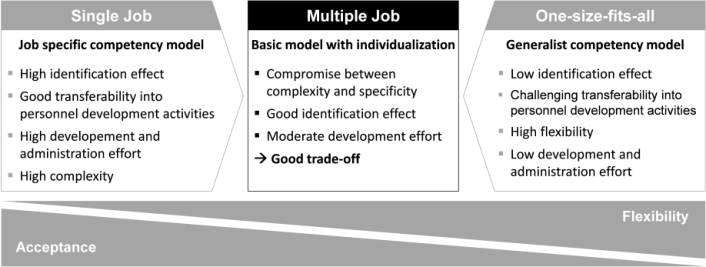
trade-off between acceptance and flexibility (see Figure 1). If the required competencies are defined on a job-specific basis, they represent a single- job model. Due to their high level of precision, these models gain a high level of acceptance and identification among employees, but they require considerable development and maintenance effort. On the other hand, one- size-fits-all models offer high flexibility and low effort but suffer from losses in specificity and identification. Multiple-job models represent a compromise between these extremes. These are based on a common core model and are specified or extended with competencies grouped according to specific tasks (Sauter, 2016).
Figure 1: Structuring competency models in the conflict of acceptance and flexibility. (Adapted from Sauter and Staudt, 2016).
PRACTICAL IMPACT Representative surveys of companies confirm the high and increasing importance of competency management, driven by changing competency requirements. At the same time, qualitative studies rarely suggest the use of job-specific or one-size-fits-all models. Moreover, holistic modular approaches could not be identified in the examined industries. Major barriers include methodological challenges, the inherent effort required for application, and the representation of personal characteristics and soft skills. In particular, the definition, differentiation, and assessment of these factors pose significant hurdles to practical application. In contrast to technical and methodological knowledge, stable traits such as personality and intelligence can only be developed to a limited extent (Deary, 2014; Cobb-Clark and Schurer, 2012). Furthermore, negative behaviors (e.g., narcissism and vanity) affect future collaboration (Wienkamp, 2020; Penney and Spector, 2002). Consequently, an increasing emphasis on considering personal characteristics in recruitment and hiring processes to mitigate future risks can be detected (Jansing et al., 2024).
In the absence of effective models that take into account these competencies and their dynamic changes in the market environment, industrial practice remains focused on technical and methodological competencies. A quantitative analysis in the production, logistics, and
medical technology sectors reveals an emphasis on technical-methodological tasks, while social-interactive activities such as communication, teamwork, and mutual support are underemphasized (Jansing et al., 2024). A lack of industry- and task-specific derivations of particularly relevant personality traits is found in operational practice. In addition, the analysis highlights the importance of level- and task-specific competency management. Differences across industries down to individual tasks may be observed.
In summary, these studies indicate a significant need for support in identifying and formulating non-technical-methodological requirements. Furthermore, there is a need for comprehensive models to represent competency requirements and their predicted development. In the following sections, we will identify the essential interdependencies between competencies as relationships. Based on practical requirements these are transformed into a holistic, level-based model for dynamic competency mapping in organizations.
IDENTIFYING INTERDEPENDENCIES AND EXTERNAL FACTORS To develop a holistic model with a focus on prediction, it is necessary to identify key interdependencies and interactions. Practical workshops were conducted with professionals from various companies in the production, logistics, and medical technology sectors to gain insights into the competency requirements for different tasks and hierarchical positions. These workshops also considered the interactions between different competencies and the influence of external factors. The focus was on the 64 competencies described in the KODE Kompetenzatlas (Competency Atlas) by Heyse and Erpenbeck (2007), categorized into the areas
Meeting Practical Requirements for Assessing Competencies 2049
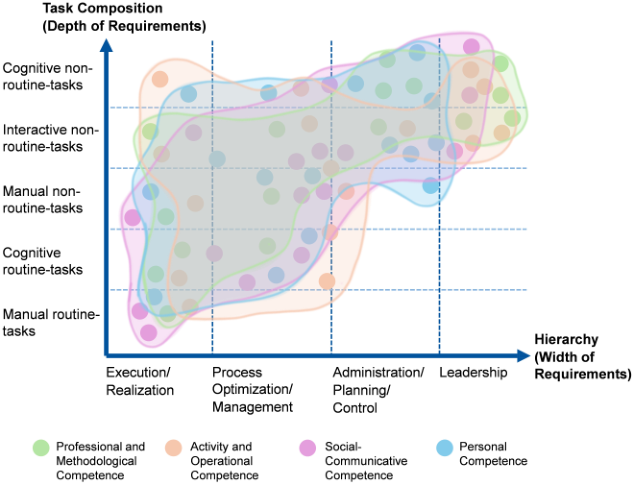
Personal Competencies, Activity and Operational Competencies, Social- Communicative Competencies, as well as Professional and Methodological Competencies. Figure 2 highlights the four areas of competencies in different colors and the correspondent competencies as colored dots.
The analysis framework of the workshop involved two axes (Figure 2). The first axis, hierarchy (width of requirements) addresses the competencies needed for specific positions within an organization’s hierarchy, including execution/ realization, administration/planning/control, process optimization/management, and leadership. The second axis, task composition (depth of requirements) deals with the competencies required to perform different tasks, divided into manual routine tasks, cognitive routine tasks, manual non-routine tasks, interactive non-routine tasks, and cognitive non-routine tasks. The analysis of the competencies was completed by identifying interdependencies between the competencies and the associated external factors.
As Figure 2 illustrates, several patterns emerge regarding the width and depth of requirements. In each of the colored four areas of the KODE, there is a general correlating shape indicating that with a higher hierarchical level, the task composition is less routinized and more cognitive than manual. For example, internal social skills like conscientiousness and integration, and professional skills such as diligence and professional knowledge are crucial at the executive level for everyday tasks. In contrast, leadership skills, such as relationship and project management and organizational skills are essential for non-routine tasks, thereby highlighting their importance in higher-level roles. On a general level, the results imply that loyalty, commitment, resilience, optimism, and social engagement are core competencies essential across all hierarchical levels and task types, emphasizing their universal importance.
In addition, the workshop discussions revealed several significant interdependencies of competencies and external influences. It becomes visible that some competencies overlap in meaning and position on both axes, indicating difficulties to differentiate and define competencies. For instance, project management is deeply interconnected with other competencies, such as good communication, presentation and organization skills. When it comes to external influences, factors such as transparency, home office policy, onboarding practices, and the attractiveness of the organization may have an impact on various competencies. For example, transparency can positively influence adaptability, while a home office policy may have a negative impact on relationship management. As certain industry fields grow (e.g., IT, environmental jobs), others face decline, necessitating a reevaluation of skills on demand. The external factors identified in the workshops can be categorized into three groups based on the entity responsible for influencing or enacting changes within these factors. Firstly, employee-dependent factors include life circumstances, personality and motivation. Secondly, employer- dependent factors can be shaped by organizational decisions, structural changes, and competency management. Lastly, independent factors, such as the economy, are beyond control of both employees and employers. In
general, leadership skills are perceived as more complex and intertwined with external factors than other hierarchical requirement areas.
The results demonstrate that different competencies are required for each task composition and hierarchical level, while underscoring universal competencies. Job requirements vary within these two domains and are individual to every specific job, supporting the rationale for organizing different competencies in hierarchical zones. The complexity and interdependencies of competencies promote a fluid depiction of competencies. The insights in external factors align with broader trends, emphasizing the need for adaptability and continuous skill assessment in the workforce. Compared to previous analyses and industry standards, the findings highlight the dynamic nature of competency relevance. Taken together, results advocate for a holistic and dynamic competency model that integrates both internal skills and external factors for effective and adaptable competency management within organizations.
HOLISTIC MODEL FOR STRUCTURING COMPETENCIES As a basis for the standardized and holistic structuring of competencies along the dimensions mentioned above, a new approach to modelling competencies is required. This approach aims at combining the main dimensions of structuring on the one hand and supporting the processes of defining and developing competencies and their requirements on the other hand. Therefore, the proposed holistic model consists of the three dimensions classification of competencies, leadership level and organizational level, which create a space for mapping and visualizing one competency or sets of competencies. The specific classification and representation of the three dimensions as well as the mapped competencies may vary across organizations.
The main dimensions of structuring are
1. Competency area: Following the common structuring of competencies in practice, the model classifies the allocated competencies into personal, activity and operational, social-communicative as well as professional and methodological competencies as a first axis of the emerging 3D solution space. By following the general structure of the KODE, the holistic model allows immediate orientation for practitioners and easy ad hoc integration of existing company-specific structuring approaches. With regard to the uniform structuring of the axes in the overall solution space, there is a particular need in the area of competency classification to combine all classification criteria in one scale. 2. Leadership: Within the second dimension, the model represents the leadership responsibility and consequently the design scope of the captured competencies. Purely executive functions clearly require different competencies than highly creative and designing functions. A best practice for structuring the scale between these two extremes is lacking. Here, the leadership dimension is considered continuous with overlapping areas and depends on the hierarchical structure of
Meeting Practical Requirements for Assessing Competencies 2051
an organization. The model could, for example, distinguish between execution, optimization, administration and leadership, using the levels of the practical expert workshop. These four levels would be defined with an increasing proportion of cognitive and non-routine tasks within the sections of the model scale. 3. Organizational Level: In contrast to the leadership level (which defines the role of an active user of competencies), the organizational level describes the origin of a given requirement of competencies within an organization. The organization forms the large foundation of this dimension as it includes competencies operating and applying to the whole organization. The job-specific level is the extreme opposite at the top and defines specific competencies required and valid for a single job. By adding the organizational level as a crucial dimension, this model considers the advantages of multiple-job models and combines them with the economies of scale of one-size-fits-all models and the flexibility of single- job models. In practice, the level between organizational and job-specific competencies is bridged by a unit approach. The actual depiction and size of the shares of these organizational levels may vary depending on the size of the company under consideration.
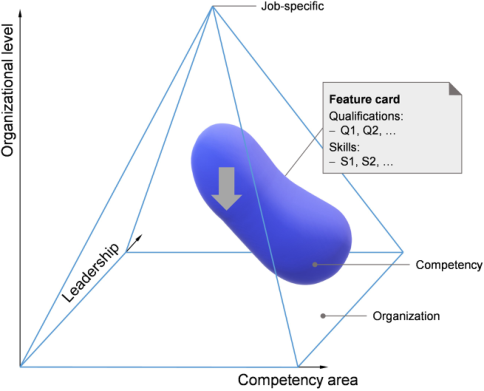
Taken together, the three main dimensions of the model form a 3D geometric solution space that resembles a pyramid, as shown in Figure 3. While the competency classification and the leadership level form the base of this pyramid, the organizational level represents the height of the pyramid. The pyramid tapers with decreasing hierarchical height from company- defined competency requirements at the base to job-specific requirements at the top. This considers that increasing job-specific characteristics relate less to competencies than to requirements that are specified, for example, by qualifications.
Figure 3: Holistic competency model with an exemplary mapping of the competency “communication” in a company-specific context and depiction of a feature card. The arrow shows a specific, predicted development of the competency.
Competencies and their requirements in an organization-specific context can be represented by three-dimensional spaces within the competency model pyramid, called competency profiles. The associated, often job-specific requirements in the form of a series of qualifications, for example, are mapped using feature cards. These can be easily operationalized by the users and concretize the application of the competency profiles for operational practice.
As an example, the competency “communication” is required by the organization for all managers (highly creative and non-routine functions according to the leadership dimension of the model). However, for employees in the “Sales”or “Customer Support”area, specific competency requirements are also set at the purely operational level. Accordingly, the competency profile for “communication” extends from the bottom back to the middle front. This stresses that each specific job is given its own individualized version of the upper competency pyramid, with the organizational level remaining the same.
Furthermore, to simplify the complex 3D model, different sections through the model (e.g. at the unit level of the model to define a group of requirements) are application-oriented and correspond to common practice. This allows the user to significantly reduce the effort of modelling and managing the resulting data in competency management. Finding these sections and providing suitable interfaces for defining and managing the derived data will be a crucial task for the future development of competency management.
Finally, due to its multidimensionality, the holistic model presented offers the possibility of mapping competencies and requirements beyond the current state. It is therefore also suitable for deriving and designing future states of competency requirements. By transforming the 3D profiles and the resulting model sections into their development paths and further indicators for predicting future state profiles, the holistic model becomes fluid and can be used for any kind of prospective derivation within competency management functions.
CONCLUSION AND OUTLOOK Research suggests a need for a holistic and dynamic competency model. The presented model describes competencies in a three-dimensional space consisting of organizational level, leadership, and competency area. Competencies do not coexist in isolation but interact with each other. They are also influenced by factors such as organizational development, societal and technological changes, and industry trends. As a next step these factors should be identified and incorporated into the model. Integrating external factors in the competency model will provide a holistic advancement to previous models. For instance, it could showcase the importance of a positive work environment provided by the organization, which enhances an individual’s ability to fully utilize their competencies. This in turn contributes to increased motivation and overall job satisfaction. We need to examine current and future trends in various competency areas to identify essential, future-proof competencies. To do this, a quantitative survey should be conducted in a sector-specific manner.
Meeting Practical Requirements for Assessing Competencies 2053
Building on this linkage in the model presented, we can transform the competency model into a comprehensive forecasting model. Subsequently, we may test and validate this in user group specific use cases. By extending the model to other task areas and industries, we are able to map competency definitions for individual tasks in their current state and derive future developments. In addition, the model offers the possibility of activity and industry-specific predictions through qualified generalization.
FUNDING This publication is part of the project 22572 N of the Industrial Collective Research (IGF). This project is funded by the Federal Ministry for Economic Affairs and Climate Action (BMWK) on the basis of a decision by the German Bundestag.
REFERENCES
Bakhshi, Hasan, Jonathan M. Downing, Michael A. Osborne, and Philippe Schneider.
2017. The future of skills: Employment in 2030. Pearson. Brockmann, Barbara, and Jochen Deuse. 2022. Konzeptionierung eines Rollenkonstrukts des Industrial Engineering der Zukunft. In Technologie und Bildung in hybriden Arbeitswelten, C.6.3. 68. Kongress der Gesellschaft für Arbeitswissenschaft, Magdeburg. 02. - 04.03.2022. Sankt Augustin: GfA-Press. Cobb-Clark, Deborah A., and Stefanie Schurer. 2012. The stability of big-five personality traits. Economics Letters 115 (1): 11–15. DOI: 10.1016/j.econlet.2011.11.015. Deary, Ian J. 2014. The Stability of Intelligence from Childhood to Old Age. Current Directions in Psychological Science 23 (4): 239–245. Drucker, P. F. 1992. The new society of organizations. Harvard business review 70
(5): 95–104. Dworschak, Bernd, Andrea Altepost, Michael Bau, Christoph Berger, Peter Brandt, Detlef Gerst, Tim Jeske, Wolfgang Kötter, Thomas Mühlbrandt, Roman Senderek, Kai Schweppe, Carsten Ulrich, Steffen Wischmann, and Jens Ziegler. 2021. Die VDI/VDE-Richtlinie 7100 “Lernförderliche Arbeitsgestaltung”: Ein Beitrag zum humanorientierten Management der Digitalen Transformation. In ARBEIT HUMAINE gestalten, B.8.2. 67. Kongress der Gesellschaft für Arbeitswis- senschaft, Bochum. 03. - 05.03.2021. Sankt Augustin: GfA-Press. Hasebrook, Joachim, Olaf Zawacki-Richter, and John Erpenbeck (eds.). 2004. Kompetenzkapital: Verbindungen zwischen Kompetenzbilanzen und Humankapital. Frankfurt am Main: Bankakad.-Verl. Heyse, Volker, and John Erpenbeck (eds.). 2007. Kompetenzmanagement: Methoden,
Vorgehen, KODE® und KODE®X im Praxistest. Münster, New York, München, Berlin: Waxmann. Jansing, Steffen, Julian Schallow, Nele Schulte-Uebbing, Paula Danhausen, Gerhard Gudergan, and Jochen Deuse. 2024. Prognosebasierte Kompetenzbewertung für einen nachhaltigen Aufbau von Schlüsselkompetenzen. Zeitschrift für wirtschaftlichen Fabrikbetrieb 119 (6): 412–417. Organisation for Economic Cooperation. 2016. Getting Skills Right: Assessing and
Anticipating Changing Skill Needs. Paris: OECD. Pawlowsky, Peter, Daniela Menzel, and Uta Wilkens. 2005. Wissens- und Kompetenzerfassung in Organisationen. In Kompetenzmessung im Unternehmen:
Lernkultur- und Kompetenzanalysen im betrieblichen Umfeld, ed. Arbeitsge- meinschaft Betriebliche Weiterbildungsforschung, 341–451. Münster, München, Berlin: Waxmann. Penney, Lisa M., and Paul E. Spector. 2002. Narcissism and Counterproductive Work Behavior: Do Bigger Egos Mean Bigger Problems? International Journal of Selection and Assessment 10 (1-2): 126–134. Sauter, Werner, and Franz-Peter Staudt. 2016. Strategisches Kompetenzmanagement
2.0. Wiesbaden: Springer Fachmedien Wiesbaden. Trojan, Jörg. 2003. Wissensverlustsituationen in Unternehmen. Wissensmanagement (3): 11–13. Werner, G. Faix (ed.). 2012. Kompetenz: Festschrift - Prof. Dr. John Erpenbeck zum
70. Geburstag. Stuttgart: Steinbeis-Ed. Wienkamp, Heribert. 2020. Psychologische Anforderungsanalysen in Theorie und Praxis: Für Führungskräfte und Personalmanager, die Anforderungsprofile erheben wollen. Wiesbaden, Heidelberg: Springer.
LISTED IN THE AHFE DIGITAL BOOKSTORE CATALOGUE
Explore the complete digital volume
Human Factors in Design, Engineering, and Computing
Read this individual research paper free through the original publisher, or explore the full digital proceedings book.
ISBN 978-1-964867-35-9
Explore this ISBN in the AHFE Bookstore ↗Listed in the July 2026 bookstore catalogue; search by ISBN to confirm current availability · Digital book purchase optional