Paolo Tasca, Chiara Giovannini, Fedele Cavaliere, Chiara Noli, Alessandro Celauro, Mario Covarrubias, Paolo Perego (2023). The Role of Physical and Digital Prototyping in Designing Wearable for Rehabilitation - Case Study of a Digital Exergame. In: Artificial Intelligence, Social Computing and Wearable Technologies. AHFE Open Access, vol. 113, pp. 352–362. https://doi.org/10.54941/ahfe1004208
Prototypes are an excellent tool to actualize an idea or a concept. As reported by different methodologies (Double Diamond, Design Thinking), prototypes enable designers to quickly iterate and learn from their designs. Their advantages are not limited to this aspect: by iteratively increasing the level of complexity from one version of the prototype to the next one, they can help enhance the skill set of a person through a learning-by-doing approach. This iterative process allows for the identification of unknown unknowns and can lead to the development of innovative solutions in various contexts, including biomedical engineering and rehabilitation. The multiple iterations and learning processes, inherent in the rehabilitation phase are a great asset when facing biomedical projects, which require multidisciplinary knowledge. The purpose of this paper is to provide supporting evidence for the importance of prototypes in biomedical design as tools to fill the skill gap, by presenting a real-world case study performed in an academic context. A team of university students developed a novel solution for post-stroke rehabilitation, DEUHR (Digital Exergame for Upper Limb and Hand Rehabilitation), based on innovative trends in biomedical technologies, such as motion tracking sensors and exergames. The paper reports the entire process for the design of the rehabilitation system, starting from the initial concept, prototypes, tests with the users, and final outcomes.The concept for DEUHR was first developed through a series of brainstorming sessions and analysis of existing rehabilitation solutions. The team then moved on to creating low-fidelity prototypes to test and refine the interaction design and gameplay mechanics of the exergame. These low-fidelity prototypes allowed the team to quickly iterate and gather feedback from potential users, including stroke patients and rehabilitation therapists. Based on the feedback received, the team made several iterations and improvements to the prototype, gradually increasing the level of complexity and fidelity. This iterative process of prototype development allowed the authors to improve the functionality and usability of DEUHR. To evaluate the usability and effectiveness of DEUHR, a high-fidelity prototype was created in the form of a tablet-based exergame for training. New tests with both the high-fidelity prototype connected with the wearable device were made with users in order to test the functionality and usability altogether.This paper outcome consisted of a demonstrator merging the three main components of the project (the exergame, the sensing unit, and the app) which were later tested on patients. Even if the case study concerned the design of health monitoring devices, it provided valuable insights with respect to the UX design process and allowed the team to grow and expand their initial skill set to meet the requirements needed. This experience led to a rethinking of the prototyping process as an enhancing and engaging opportunity to be featured in a learning environment – possibly extending its validity also outside of the biomedical field.
The Role of Physical and Digital Prototyping in Designing Wearable for Rehabilitation 353
INTRODUCTION
In the dynamic landscape of modern project development, the convergence of digital and physical realms has given rise to a plethora of complex challenges and unprecedented opportunities. This intricate interplay demands innova- tive approaches that can seamlessly bridge the gap between these domains, facilitating efficient and effective project realization, and minimizing costs and the possibility of mistakes. At the heart of this pursuit lies the concept of prototypes, which serve as tangible manifestations of ideas, bridging the gap between abstract concepts and concrete implementations. The strategic inte- gration of prototypes within the developmental processes of both digital and physical projects has emerged as a promising strategy to enhance creativity, streamline collaboration, and accelerate iterative design cycles. In the realm of digital projects, such as software applications and interactive systems, the rapid evolution of technologies demands agile methodologies that can swiftly respond to changing user requirements and technological paradigms. Concur- rently, the proliferation of smart devices, robotics, and the Internet of Things (IoT) has blurred the boundaries between the virtual and the tangible, neces- sitating holistic approaches that account for the interplay between software and hardware. In this context, the use of prototypes has garnered significant attention to address the complex challenges of this integration. Prototypes offer a tangible representation of design concepts, allowing stakeholders to visualize and interact with ideas in ways that transcend mere conceptualiza- tion. By facilitating early-stage validation, refinement, and testing, prototypes offer a mechanism to identify potential pitfalls, optimize functionality, and align project objectives with user expectations. However, the efficacy of pro- totypes extends beyond digital domains, finding relevance in the development of physical products, systems, and structures. Here, prototypes serve as func- tional embodiments of engineering designs, enabling iterative refinement of mechanical, material, and ergonomic aspects. As mentioned before, proto- types are one of the main key features of novel agile methodology, and a crucial stage in the Design Thinking methodology. Design thinking involves creating early, inexpensive, and scaled-down versions of a product or service to test and refine its design. Prototyping allows designers to bring their ideas to life, test the practicability of the current design, and investigate how a sam- ple of users think and feel about a product. The results generated from these tests are then used to redefine one or more of the design elements, and the process is repeated until the final product meets the desired specifications; prototyping is for this reason called an iterative process (Razzouk & Shute, 2012). All these concepts are particularly relevant in a multidisciplinary field as may be that of bioengineering and applications related to health and reha- bilitation. As new technologies and approaches are being explored to improve healthcare outcomes, the use of prototypes in the field of rehabilitation has gained momentum (Bhuyan et al., 2021). Prototypes in rehabilitation have the potential to bridge the gap between theory and practice by providing a platform for testing and refining novel interventions. Two different types of prototypes can be used during the development process: low-fidelity pro- totypes and high-fidelity prototypes. Low-fidelity prototypes are simple and
cost-effective representations of the project concept, often created using basic materials such as paper or cardboard. These prototypes allow for early-stage exploration and validation of ideas, enabling designers and researchers to identify potential design flaws or improvements. High-fidelity prototypes are advanced models that closely resemble the final product in terms of appear- ance, functionality, and user experience. High-fidelity prototypes are used to test and refine the design of a product or service, and to gather feedback from stakeholders and end-users. They allow designers to simulate the look and feel of the final product, and to identify any potential issues or challenges that may arise during the final development process. While high-fidelity pro- totypes take longer to produce than low-fidelity prototypes, they offer a more accurate and reliable representation of the final product and can help design- ers make more informed decisions about the design and development process (Razzouk & Shute, 2012). These types of prototypes can cover most stages of product/service development, but how can they be used in the develop- ment of a more complex product/service in healthcare? Can prototypes be leveraged in such a way as to improve the design process of these systems by fostering better usability and acceptability by all stakeholders? The success of a biomedical project hinges on a diverse range of skills and knowledge span- ning various sub-fields, including electronics, information technology, coding encompassing both firmware and software, mechanics, data analysis, and adherence to national and international regulations. Assuming that any indi- vidual or team already possesses mastery over all these skills is impractical. Developing such an extensive breadth of expertise demands years of dedi- cated study and hands-on experience. However, this learning curve can be expedited through a “learning-by-doing” methodology. This paper critically examines the case study of digital rehabilitation exergame and suggests an innovative outlook on prototypes within the biomedical engineering. These prototypes are positioned as vital tools that bridge the skill gap, particularly benefiting emerging professionals.
THE CASE STUDY With the notable rise in life expectancy over recent decades (Brown, 2014), there has been a corresponding significant increase in chronic illnesses, dis- abilities, and the demand for rehabilitation services (Cieza et al., 2020; Katan & Luft, 2018). One particularly prominent contributor to these disabilities is stroke, impacting approximately 1.1 million individuals across the Euro- pean Union annually (Béjot et al., 2016), and around 185,000 people in Italy (Humanitas - 2019) each year.
Today, stroke rehabilitation is delivered to patients mostly in clinical set- tings. The higher incidence of stroke has caused a greater demand for care, which faces the limited resources in terms of time, space, and finances of the public healthcare system. In addition, patients usually need to travel long distances to reach the clinic/center, in most cases with the help of a care- giver/family member. Furthermore, patients’ access to healthcare facilities has worsened due to the Covid-19 pandemic: some countries have seen a reduction in acute stroke hospital admissions from 50% to 80% (Ostrowska
The Role of Physical and Digital Prototyping in Designing Wearable for Rehabilitation 355
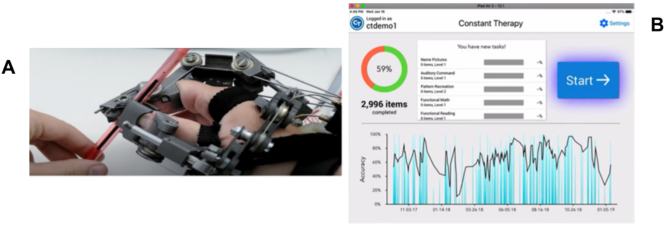
et al., 2021). These factors concur to decrease rehabilitation quality; thera- pists tend to be overloaded by the high demand and in turn patients may lose motivation and abandon follow-up therapy, feeling frustrated and dissatis- fied. The design of these devices tends to be more focused on functionality rather than appearance (as could be the case of Handexos (Chiri et al., 2009) in Figure 1A), which may result in unpleasing looks, uncomfortable fit, and low patient engagement. At the same time, some applications in the reha- bilitation field show a poor design of the User Experience (UX) and User Interface (UI), leading to poor engagement (see Figure 1B).
Figure 1: A. The Handexos system is a device with multiple actuators for each finger that allows for finer motor control. B. Screenshot from the Constant Therapy App.
The purpose of this paper is to provide supporting evidence to the impor- tance of prototypes in design within the biomedical field by presenting a real-world case study. The case study concerned the implementation of a novel solution for the rehabilitation of post-stroke patients based on motion-tracking sensors and exergames. Given the high complexity and interdisciplinarity of the target design, the authors pursued not a linear methodology but a strategy based on iterative prototype development and testing, as the best way to progressively cover the skill gap and advance in the project. The outcome of the project is a Digital Exergame for Upper limb and Hand Rehabilitation (DEUHR), a user-oriented telerehabilitation system for the remote treatment and monitoring of post-stroke patients. The solu- tion aimed at restoring the patients’ independence, improving their quality of life, and eventually inducing a faster social re-integration. DEUHR was the result of a collaboration between Alta Scuola Politecnica (Politecnico di Milano and Politecnico di Torino honor program), Sensibilab Labora- tory from Politecnico di Milano and Hospital Villa Beretta (Costa Masnaga, LC, Italy). Through DEUHR, patients would be monitored outside of the therapist’s office to ensure the continuity of the process, reducing abandon- ment of the treatment and disengagement. Therapists could customize the treatment even months after patients have left the clinic and monitor their progress. Thus, DEUHR would allow the patients to undergo their treatment at home and speed up the whole rehabilitation process even in the earliest stages of therapy. Besides, the DEUHR mobile application would allow a tailored program for each patient, thanks to its modular design.
METHOD: THE PROTOTYPES As described above, the system was developed following the design thinking methodology, so that development progresses through continuous iterations with the prototype. This allows for emphasizing with the user in order to spotlight the needs and requirements and optimize the drafting of system features. After defining all the characteristics the next step was the ideation of the system, and in particular, the design of the procedure by which to arrive at the best possible solution. In this case study, the solution is a “phygital” experience that incorporated a tablet-based exergame and a mobile appli- cation service: the app is paired with a physical device (a motion tracking sensor) so that movements executed by the patient were tracked and used to control the game in real-time.
The DEUHR system is mainly composed of three parts:
Applications: two digital interfaces – one for the patients and one for the therapists to be run on iPad or Android tablets. The two applications have the same purpose, which is to give both categories of users, therapists and patients, the opportunity to monitor the progress of rehabilitation therapy. The therapist also can set the correct rehabilitation course for each individual patient based on the data and feedback from them.
Exergame: An exergame is a gamified exercise aimed at training and/or restoring a motor skill. By this approach, patients can “play their way” to recovery.
Sensing unit: a single inertial measurement unit (IMU) that is cheap, non-invasive and wearable. The sensor is encased in an ergonomic hous- ing designed and 3D-printed by the team, for secure fastening and high portability.
Once defined the general architecture of DEUHR, a prototype version of each component has been defined and implemented i.e. two prototypes of the mobile applications (one for the patients and one for the therapists), a prototype of the exergame (a free-runner videogame for training the motor control of the elbow-flexion extension) and a prototype of a motion tracking sensor in the shape of an Inertial Measurement Unit (IMU).
Apps When designing a multi-devices system, the main goal is to create a seamless digital experience that provides fluid access to the therapy to both categories of users (patients and therapists). A good and seamless Apps experience means an intuitive and time-saving planning of rehabilitation therapy (tar- gets, exercises…) and session scheduling. Owing to a plethora of requisites and limitations, the formulation of the user experience (UX) design exhibited a marked level of intricacy. Furthermore, the substantial abundance of per- missible design variations, coupled with the presence of diverse potential user cohorts, introduced additional hazards into the design progression, a circum- stance further compounded by the limited count of design personnel profiles within the project team (singularly one). In light of these considerations, con- ventional paradigms of UX/UI design were conjoined with intermediary user evaluation protocols. Sustaining direct and uninterrupted engagement with
The Role of Physical and Digital Prototyping in Designing Wearable for Rehabilitation 357
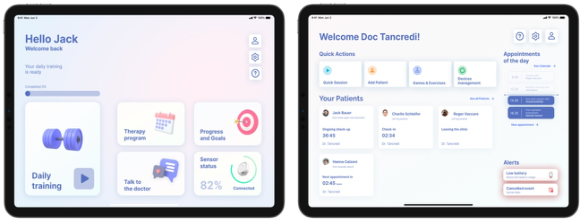
end-users across diverse stages of UX and UI design emerged as indispensable for the realization of successful design outcomes. Initially, the foundational information pathways and architectures underpinning the digital UX for both user categories were established. Subsequently, rudimentary virtual proto- types were conceived, signifying the primary project milestone. Given the pivotal significance of the mobile application within the overarching design framework, numerous cycles of iteration and refinement of the rudimentary prototypes became imperative. These prototypes underwent iterative assess- ment employing techniques such as Card Sorting and Tree Testing among both lay users and clinical practitioners, thereby bestowing robustness upon the envisaged solutions and enriching the design trajectory of the remaining system components with insights drawn from the outcomes of user evalu- ations. After the low-fidelity prototypes allow for reaching a satisfactory level of both information flow and architecture, the next step was a higher- level prototype. The backbone of the remote therapy experience needed to be enhanced with clear, user-friendly, and context-specific features. The mid-fidelity prototype development focused on the design of a smooth and effortless interface both in terms of graphic features and micro-interactions for the main tasks in both applications. The final prototypes of the patient and therapist apps (Figure 2) were delivered through the Figma platform.
Figure 2: UI prototypes of patients and therapists apps.
Exergame Exergames, as mentioned before, are rehabilitative exercises delivered in the form of games/video-games.; the rehabilitative gesture is included in the game as the user controls motion: the user must perform one or more motor tasks to win the game. There are some basic features that enhance the effectiveness of an exergame:
Goal: The exergame should have a well-defined goal, whose achievement represents the exit condition from the exergame. The lack of a precise goal could reduce motivation and lead to scarcer results.
Target: The environment where the game is played should display a target object, i.e. an object that the user should reach by performing the target motor task.
Feedback: Some studies (Schmidt & Wrisberg, 2019; O’Sullivan & Schmitz, 2006) have proved that providing multi-sensory feedback
improves motor learning and the therapy outcome. The feedback may come in a variety of manners (auditory, visual, and haptic feedback, such as changes of color, clinking sounds, and vibrations).
Tracking technology: An exergame should exploit some technology capa- ble of tracking the motion of the user.
Finally, the exergame should address a specific target population so that the characteristics of the game meet the needs of the patients. In the DEUHR project, the exergame named Desert Ride is represented by a side-scrolling desert landscape where a balloon is free to glide to collect coins and avoid flocks of birds, pyramids, and palm trees (see Figure 3). The balloon’s hori- zontal position is fixed a priori, while vertical displacement is controlled by the movement of the player. Desert Ride was implemented with Flutter SDK and Flame Game Engine.
Figure 3: A screenshot of the game scenario of desert ride.
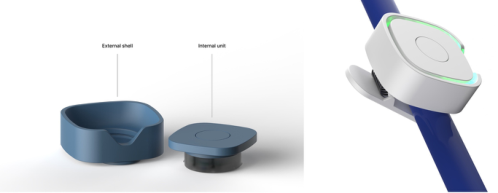
Movement Sensing Devices In order to maintain the entire system easy to use, the movement sensing device consisted in a single sensor whose core is represented by an intertial motion unit (IMU) developed in a previous project ad Politecnico di Milano. The 9DOF (degree of freedom) IMU allows for reconstructing the move- ment in the space of a body district to which it is attached (although in some cases the use of multiple devices could improve the ability to detect particular movements). In order to optimize the usability of the system and allow the same sensor to be used in different modes (attached to the garment, attached to an object, gripped…) a custom case was designed and 3D-printed. This allows the device to be interchangeable with different body areas and exercises thanks to fastening accessories. The device case featured an inter- nal unit, with an easy-to-reach power button, and an external shell with a built-in attach mechanism (Figure 4).
PROTOTYPE TESTS Initially, a prototype version of the game was developed on a PC running on an Android emulator; this allowed to immediately test code. Besides the playable character, the game only featured the target (golden coins)
The Role of Physical and Digital Prototyping in Designing Wearable for Rehabilitation 359
Figure 4: On the left, final look of the device case. On the right, an example of possi- ble interconnection of the sensing unit to a strip. Both renderings were modelled in Autodesk Fusion360.
and a counter for the collected ones. The player, for the sake of simplic- ity, was controlled only with the PC mouse (updating the position of the player according to the point clicked on the screen). By means of subsequent prototype generations, new features were added iteratively:
1) Obstacles: Obstacles (pyramids, bird flocks, and palm trees) were introduced in the game to increase the patient’s engagement so that he/she had objects to avoid apart from the target objects to collect. Auditory (coin clinking and bird squawking) and visual feedback (score updated in real- time) were introduced as well. This enabled the patient to avoid remaining stationary during transitions, as such immobility could potentially induce discomfort.
2) Game repetitions: The possibility to have repetitions in training was added, with a resting time interval in between. To avoid the repetitions being identical, at the beginning of each one, the order of the elements (both coins and obstacles) appearing on the screen was randomized.
3) IMU-based control: The game control was shifted from the mouse to the sensing unit. The angle values of the elbow flexion-extension were tracked in real-time by the unit, sent to the Android emulator via Bluetooth Low Energy (BLE), and used to control the vertical position of the balloon on the screen.
4) Storage of clinically relevant data: Once the controls of the game had been implemented, a new feature to download data recorded by the sensing unit was added.
5) Game settings personalization: The possibility to set many game parameters (number of repetitions, single repetition duration, the target number of coins, maximum flexion and extension angle, etc…) before the beginning of each gaming session was added.
6) Language settings: Besides the English version of the demo, an Italian version was produced to ease the interaction with Italian users in the testing stage.
Subsequently, a comprehensive assessment of the system was conducted, initially encompassing the validation of the accuracy and accurate archival of data obtained from the sensor. This was succeeded by the empirical evaluation of the complete system involving actual patients in a clinical environment. The exergame, as it is structured, can be used for various reha- bilitative acts. In order to test it, the elbow flexion-extension movement was
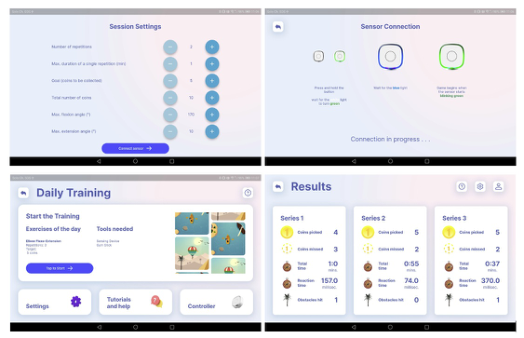
chosen. The 3D-printed case allowed the sensing unit to be attached to stick- like objects, so that the user could control the game’s playable character through the flexion-extension of the elbow while holding the sensorised stick with both hands. The sensing unit was connected to the app via a Bluetooth connection to allow both real-time control of the game’s character and col- lection of useful data about the user’s movements (values of the joint angle of the elbows). The app was designed to work at its best when used on tablets and included both the exergame and all those sections of the app necessary for a smooth and customizable gaming experience and data collection. When using the app, the user is asked to set some parameters for the gaming ses- sion, then the connection between the app and the sensor occurs so that the game can finally start. Once the game session is over, the user can review its performance in terms of collected or missed coins, avoided or hit obstacles, and time elapsed, while those same data, along with the real-time values of the joint angle, are collected and saved in.csv files (one for each repetition) (see Figure 5).
Figure 5: Screens of the app that show the process of settings, connection, and results.
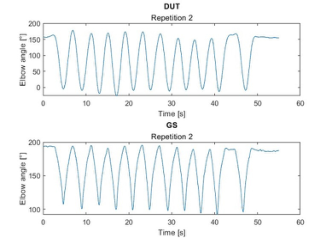
Before testing with real users, the reliability of the measurements needs to be validated. In order to measure the accuracy of the developed sensor, the data collected by the sensing unit during three sample sessions on healthy young participants were compared to those of another wearable system taken as a gold standard (Wearnotch 3D motion capture system). The participant was equipped with both DEUHR’s sensing unit and the Wearnotch (Notch Interfaces Inc.) and was asked to play the exergame. The data collected by the two systems were then compared showing a strong agreement in the wave- forms of the recorded signals (Figure 6). The difference in the absolute values recorded is mainly related to the calibration process at the beginning of the exercise, which is different between the two systems.
Once the sensor was validated in terms of accuracy, the entire system has been tested with three post-stroke patients under the supervision of ther- apists at Villa Beretta Valude Hospital (Costa Masnaga - Italy). All three
The Role of Physical and Digital Prototyping in Designing Wearable for Rehabilitation 361
patients and therapists can play with the prototypes, execute a session and give feedback concerning the usability and intuitiveness of the system, as well as suggestions of any kind about the exergame and the overall expe- rience. The three patients were asked to autonomously navigate the various screens of the app and start a training session, complete it and review their performance with a satisfaction questionnaire derived from the Quebec User Evaluation of Satisfaction with assistive Technology (QUEST)(Demers et al., 1996). The main insights resulting from such tests concerned the need for a smoother and more fluid gaming experience and other features to implement in the app concerning therapy and patient management.
Figure 6: Comparison between the waveform of the elbow angle during repeated flexion-extensions recorded by the device under test (DUT) - the DEHUR system, and the Wearnotch system.
CONCLUSION
The use of prototypes played a crucial role throughout the development of the DEUHR project. Prototypes not only allowed for the evaluation of usabil- ity and measurement accuracy but also served as a means to bridge the gap between theoretical design and practical implementation. By creating a pro- totype of the UI for the mobile application and a demonstrator of a potential real implementation of DEUHR, the project team was able to gather feed- back from real users and assess the feasibility of the design. The present study showed the suitability of prototyping as a means to fill the skill gap in the con- text of a biomedical project. The project (named DEUHR) was developed by students of Alta Scuola Politecnica with the cooperation of academic partners and Villa Beretta, and consisted of a user-oriented approach to post-stroke telerehabilitation. The outcome of the work included: a prototype of the UI for a mobile application; a demonstrator of a potential real implementation of DEUHR in the shape of a tablet-based exergame for training the elbow flexion-extension. The app prototypes were evaluated in terms of usability on some real users (therapists and patients) and measurement accuracy, obtain- ing encouraging results. The iterative prototyping process was essential in refining the design and functionality of DEUHR, especially considering the complexity involved in manufacturing components, programming sensors, implementing real-time communication protocols, and mobile development
strategies. Therefore, the importance of prototypes was undoubtedly relevant during the course of the project, as parallel prototype testing was necessary to advance to the next steps of the design process. DEUHR showed that it is pos- sible to reduce and fill the skill gap by means of iterative levels of prototypes and allowed a learning-by-doing approach, also thanks to the fundamental insights from the academic and external partners. The increasing level of dif- ficulty and the need to combine different aspects under the same functional tool required a careful approach, given the complexity of the task: iterative prototyping led the initial expertise of the team members to a higher level, in both hard and soft skills. From a go-to-market perspective, the design of the remaining components of DEUHR should be tackled, such as connectiv- ity to network infrastructures, multi-platform compatibility, cybersecurity, and access to databases. Moreover, validation on healthy and pathological cohorts may be required to prove the efficacy and safety of DEUHR as a marketable telerehabilitation solution.
REFERENCES
A. Chiri, F. Giovacchini, N. Vitiello, E. Cattin, S. Roccella, F. Vecchi, M. C. Carrozza.
“HANDEXOS: Towards an exoskeleton device for the rehabilitation of the hand” (2009). In 2009 IEEE/RSJ International Conference on Intelligent Robots and Systems. IEEE. Alarcos Cieza, Kate Causey, Kaloyan Kamenov, Sarah Wulf Hanson, Somnath Chatterji, Theo Vos. “Global estimates of the need for rehabilitation based on the Global Burden of Disease study 2019: a systematic analysis for the Global Burden of Disease Study 2019”. (2020). The Lancet 396, 2006–2017 Elsevier BV. Guy C Brown. Living too long. (2014). EMBO reports 16, 137–141 EMBO. Humanitas, Ictus: è terza causa di morte in Italia e non colpisce solo gli anziani
(2019). Website: https://www.humanitas.it/news/ictus-terza-causa-morte-italia-n on-colpisce-solo-gli-anziani/ Louise Demers, Rhoda Weiss-Lambrou, Bernadette Ska. “Development of the Quebec User Evaluation of Satisfaction with assistive Technology (QUEST)” (1996). Assistive Technology 8, 3–13 Informa UK Limited. Mira Katan, Andreas Luft. “Global Burden of Stroke” (2018). Seminars in Neurol-
ogy 38, 208–211 Georg Thieme Verlag KG. Paulina Magdalena Ostrowska, Maciej ´Sliwi´nski, Rafał Studnicki, Rita Hansdorfer- Korzon. “Telerehabilitation of Post-Stroke Patients as a Therapeutic Solution in the Era of the Covid-19 Pandemic” (2021). Healthcare 9, 654 MDPI AG. R. A. Schmidt, C. A. Wrisberg. Motor Learning and Performance 6th Edition with
Web Study Guide-Loose-Leaf Edition (2019). Human Kinetics. Rim Razzouk, Valerie Shute. “What Is Design Thinking and Why Is It Important?”
(2012). Review of Educational Research 82, 330–348. American Educational Research Association (AERA). S. B. O’Sullivan, T. J. Schmitz. Physical Rehabilitation (2006). F. A. Davis Company. Tamanna Bhuyan, Surjendu Maity, Devi Rupa Saha, Nayan Mani Das, Dipankar Bandyopadhyay. “Pathways to Translate the Biomedical Prototypes” (2021) 29–56. In Advanced Micro- and Nano-manufacturing Technologies. Springer Singapore. Yannick Béjot, Henri Bailly, Jérôme Durier, Maurice Giroud. “Epidemiology of
stroke in Europe and trends for the 21st century” (2016). La Presse Médicale 45, e391–e398 Elsevier BV.
LISTED IN THE AHFE DIGITAL BOOKSTORE CATALOGUE
Explore the complete digital volume
Artificial Intelligence, Social Computing and Wearable Technologies
Read this individual research paper free through the original publisher, or explore the full digital proceedings book.
ISBN 978-1-958651-89-6
Explore this ISBN in the AHFE Bookstore ↗Listed in the July 2026 bookstore catalogue; search by ISBN to confirm current availability · Digital book purchase optional