Tomoki Kamegawa, Masaomi Kimura, Imam Mukhlash, Mohammad Iqbal (2023). A method to generate adversarial examples based on color variety of adjacent pixels. In: Artificial Intelligence, Social Computing and Wearable Technologies. AHFE Open Access, vol. 113, pp. 107–114. https://doi.org/10.54941/ahfe1004184
Deep neural networks have improved the performance of large-scale learning tasks such as image recognition and speech recognition. However, neural networks also have vulnerabilities. Adversarial examples are generated by adding perturbations to images to cause incorrect predictions of image classifiers. The well-known perturbation attack is JSMA, which is relatively fast to generate perturbation and requires only simple procedures and is widely used in cybersecurity, anomaly detection and intrusion detection. However, there are problems with the way to perturb pixels. JSMA’s perturbations are easily perceivable by the human eyes because JSAM adds large perturbations to pixels. Some previous methods to generate adversarial examples did not assume that adversarial examples are checked by human eyes and allow larger perturbation to be adding to a single pixel. However, in situations where a deep learning model causes significant damage if it misrecognizes an input, a visual check by a human is necessary. In such cases, adversarial examples should not only cause misclassification in the image classifier system but also require less perturbation to avoid human perception of the perturbation. We propose methods to improve the JSMA problems. Specifically, it adjusts the amount of perturbation by calculating the variance between the value of the pixel to be perturbed and its surrounding pixels. If a large perturbation is added to the area of an image with a large pixel value variation, the perturbation will be imperceptible. In such case, perceivability does not increase significantly with a slightly larger perturbation. In contrast, if the large perturbation is added to the area of an image with small pixel value variation, the perturbation will be more perceptible. In such case, perturbations must be small. In our previous study, we assumed thresholds to classify the perturbations into two classes, large perturbation and small perturbation. If the variance was larger than the threshold, a larger perturbation was added; if the variance was smaller than the threshold, a smaller perturbation was added, which achieved a reduction in the amount of perturbation. However, there were still rooms of improvements of the perturbation to reduce the perceptibility. In this study, we focused on that there were differences in the perception of perturbations depending on the color of the pixel. The amount of perturbation should vary from pixel to pixel, not a fixed amount. Not only the variance of the surrounding pixels but also the variance of a larger area is calculated. By using these ratios, the amount of perturbation is varied from pixel to pixel. Experimental results using cifar-10 showed that the proposed method reduced the amount of perturbation to pixels with a misclassification success rate comparable to that of JSMA and our past method. We also confirmed that the reduced perturbation made the perturbation less perceptible.
Deep neural networks have contributed significantly to the improvement of performance in image and speech recognition. However, deep neural networks can easily be compromised by adding small noise to the input. Adversarial examples for images are generated by perturbing the input image, and make the image classifiers incorrectly predict a label.
Sparse perturbation is one of the ways to add perturbation. It causes mis- classification by perturbing some pixels in the image, rather than the whole of the pixels. Sparse perturbation can be found in real world. Raindrops on the surface can fool the image recognition system of an autonomous vehicle (Yang, 2021) (Zhai, 2020). The study of such sparse perturbations can help improve the performance of image classifiers and the robustness of models for noisy images. A well-known sparse perturbation attack is Jacobian-based Saliency Map Attack (JSMA) (Papernot, 2016) (Sethi et al., 2020), which is fast in generating adversarial examples and relatively simple in its algorithm. It is also possible to output targeted labels. However, there is a problem with the way to add perturbation to pixels. The perturbation can be perceived by the human eyes because the large perturbation was added to the pixels.
Some previous methods for generating adversarial examples do not assume that adversarial examples are checked by human eyes and allow many pertur- bations to be adding to a single pixel. Adversarial examples should not only cause misclassification in the image classifier system but also require less per- turbation to avoid human perception of the perturbation, because adversarial example may be checked by human eyes. The large perturbations to the pix- els are perceived if the input images are checked by the human eyes, or if the output of the model is judged to be inappropriate and is verified by humans. As a result, the adversarial examples are eliminated from the input, which makes the attack on the image classifier fail.
We propose methods to solve the problems in JSMA. Specifically, it adjusts the amount of perturbation by calculating the variance between the value of the pixel to be perturbed and its surrounding pixels. If a large perturbation is added to the area of an image with a large pixel value variation, the per- turbation will be imperceptible. In such case, perceivability does not increase significantly with large perturbation. In contrast, if the large perturbation is added to the area of an image with small pixel value variation, the perturba- tion will be more perceptible. In such case, the perturbation must be small. In our previous studies, we assumed thresholds to classify perturbations into two classes, large perturbation and small perturbation. If the variance is larger than the threshold, a larger perturbation is added; if the variance is smaller than the threshold, a smaller perturbation is added, which achieved a reduction in the amount of perturbation. However, there are still rooms of improvements of the perturbation to reduce the perceptibility.
In this study, we focus on differences in the perception of perturbations depending on the variance of pixel colors. The amount of perturbation should vary from pixel to pixel, not a fixed amount. Not only the variance of the surrounding pixels but also the variance in a larger area is calculated. Even if the variance with the surrounding pixels is not very large and the variance over a wider area is large, it is not a problem to add larger perturbation. In these situations, fixed perturbation is more likely to be perceived if the vari- ance is extremely small, even for the small perturbation. Moreover, the fixed perturbations, even if it is large, may make efficient misclassification diffi- cult if the variance is extremely large. The smaller variance is, the smaller perturbation should be added; the larger the variance is, the larger perturba- tion should be added. For more flexible perturbations, we propose to use the ratio of the variance of the surrounding pixels to the variance over a large area.
RELATED WORKS Szegedy et al. found that perturbations using gradient of prediction errors can cause image classifiers to misclassify (Szegedy et al., 2013). Based on this, methods such as Fast Gradient Sign Method (FGSM) (Goodfellow et al., 2014) and Projected Gradient Descent (PGD) (Madry et al., 2017) have been proposed. These methods add a fixed small perturbation to every pixel to increase the prediction error (Moosavi-Dezfooli et al., 2016). This allows the model to output incorrect predictions.
A Method to Generate Adversarial Examples Based on Color Variety of Adjacent Pixels 109
Adversarial examples with sparse perturbations have also been studied (Modas et al., 2019) (Wiyatno and Xu, 2018) (Combey et al., 2020) (Carlini and Wagner, 2017) (Hein and Andriushchenko, 2017). JSMA is a method that uses the gradient of the output. Perturbations are added to the pixels to obtain the desired output. One-Pixel Attack uses a differential evolution algorithm to perturb just one pixel (Su et al., 2019).
There are adversarial examples that are applicable to the real world (Kurakin et al., 2018) (Eykholt et al., 2018). A raindrop can be a perturba- tion (Yang, 2021) (Zhai, 2020). Adversarial examples for unmanned aerial vehicle (UAV) have been studied (Hickling et al., 2022) (Fu et al., 2022). It is also possible to cause misclassification by using glasses (Sharif et al., 2016) that cause the image recognizer to misrecognize or by attaching patches to the recognition target (Brown et al., 2017).
The authors (Kamegawa and Kimura, 2022) proposed the method to gen- erate adversarial examples with perturbations that are difficult for the human eyes to perceive. It was necessary to reduce the perturbation per pixel. Pixels to be perturbed are selected from the output gradient information, and then fixed perturbations are added to the pixels to generate adversarial examples. Depending on the value of the variance between the perturbed pixel and the surrounding pixels, the amount of perturbation added to the pixels was cho- sen among two options, ϵ1 and ϵ2, where ϵ1 > ϵ2. Compared to JSMA, the previous method achieved reduced perturbation per pixel without changing attack success rates. However, there is a room for improvement in the way to adjust the amount of perturbation.
PROPOSED METHOD The authors (Kamegawa and Kimura, 2022) proposed method to select perturbed pixels by using Equation (1) and Equation (2).
Equations and mathematical formulas are available in the original paper PDF.
xi
< min
xi
∂xi Fs (x) is the output of the original label and Ft (x) is the output of the target label. i is calculated by Equation (3).
i = W × m + n (0 ≤n < W, 0 ≤m < H) (3) W is the width of the input image. H is the height of the input image. (n, m) is a coordinate of the pixels with the origin at the upper left pixel of the image.
Since the image classifier takes the label with the largest value of F(x) as the classification label, the output of Ft (x) should be the largest in order to mis- classify the image to the target label. In addition, making Fs (x) smaller more effectively causes misclassification because Fs (x) is the largest for the image before the perturbation is added. Q1 is the selection of pixels to add positive perturbations, and Q2 is the selection of pixels to add negative perturbations.
The variances of 3 × 3 pixels around pixel xi obtained by Q1 and Q2 and a large area N × N (N > 3)centered on xi is calculated. Let s2
i1 be the variance obtained from the variance of 3 × 3 pixels around pixel xi and s2
i2 be the variance obtained from the large area N × N (N > 3)centered on xi. The perturbation added to pixel xi is denoted by δi. δi is calculated by Equation (4):
i1 s2 i2
where δ is a hypothetical perturbation that is set a priori. However, if s2
i1 and s2
i2 both become smaller, δi becomes larger. If s2
i1 and s2
i2 are small, the color variation with respect to the surrounding pixels is small. In this case, a small perturbation must be added.
To solve this problem, a threshold of variance is introduced. For every pixel, N × N variances are calculated and the median of these is taken as the threshold, T. The variance of all pixels is also calculated as the s2
all. The amount of the perturbation is determined by Equation (5).
Equations and mathematical formulas are available in the original paper PDF.
The perturbation is added to a pixel according to Equation (6).
The positive perturbations are added to pixels in Q1 and the negative perturbations are added to pixels in Q2.
For Q1, we perturb are perturbed the pixel with the highest value of ∂Ft(x)
∂xi − ∂Fs(x) ∂xi −∂Fs(x) ∂xi , and for Q2, we perturb the pixel with the lowest value of ∂Ft(x) ∂xi . Then Q1 and Q2 are calculated again using ex. This is repeated until Ft(ex) takes the greater than any Fj̸=t (ex).
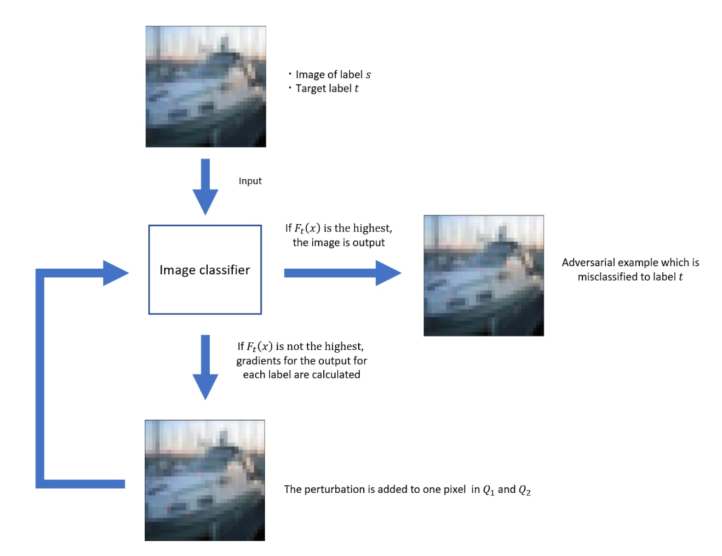
The flow of the adversarial example generation is shown in Figure (1).
EXPERIMENTS Experiments were conducted to measure the performance of the proposed method compared to JSMA and our previous method. To generate perturba- tions difficult for the human eyes to perceive, the perturbations per pixel must be small. In order to confirm this, we used CIFAR-10 for the image dataset and measured the misclassification success rate, the number of perturbed pixels, the sum of perturbations, and perturbations per pixel. Adversarial examples were generated using 100 images with the label “ship” and the tar- get label “airplane”. Pixel values are assumed to be normalized between 0 and 1. The hypothetical perturbation is set to δ = 80/255.
A Method to Generate Adversarial Examples Based on Color Variety of Adjacent Pixels 111
Figure 1: The flow of the adversarial example generation.
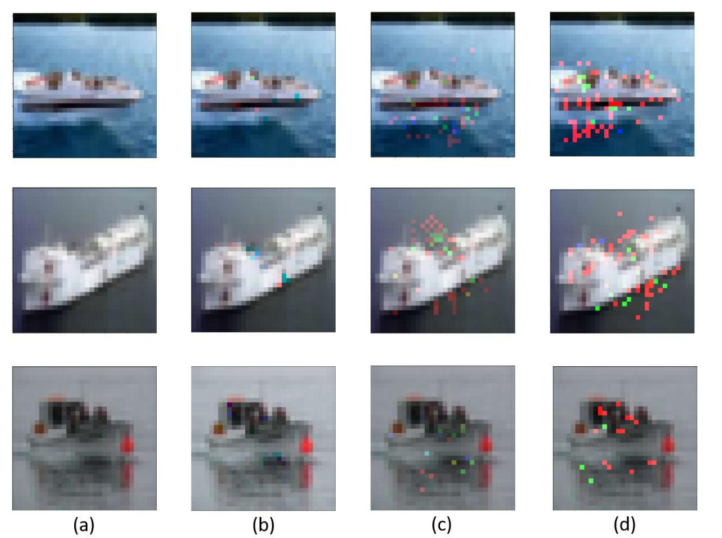
Figure 2 shows adversarial examples for the three methods and Table 1 shows the results of the experiment. “The misclassification success rate” represents the percentage of the generated adversarial samples that were suc- cessfully misclassified to the target label, “The number of pixel value changes per image” represents the average of pixels that changed value per success- fully misclassified adversarial sample, “The sum of perturbations per image” represents the total number of perturbations per successfully misclassified and “The perturbation per pixel” represents the average of the sum of the perturbations per successfully misclassified adversarial example.
The proposed method had the misclassification success rate comparable to that of JSMA and our previous method. The sum of perturbation per image and the perturbation per pixel were the smallest for the proposed method.
Table 1. Result of comparison experiments.
Table available in the original PDF paper.
JSMA
Proposed method
Our previous method The misclassification success rate 82% 82% 83% The number of perturbed pixels 47.05 38.27 32.49 The sum of perturbation per image 4.75 5.27 18.55 The perturbation per pixel 0.13 0.14 0.62
Figure 2: Original image (a) and adversarial examples generated by proposed method (b), our previous method (c) and JSMA (d).
DISCUSSION
The sum of perturbation per image and perturbation per pixel for the pro- posed method is the lowest among the three methods. It is evident that variable perturbation avoids an excess of perturbation when compared to the other two methods. If the perturbation per pixel is small, then more pix- els need to be modified. Table 1 shows that our proposed method has the highest number of perturbed pixels and the smallest perturbation per pixel. This indicates that the alteration to a pixel should be adaptable enough to vary its value depending on the pixel, rather than adding a set value.
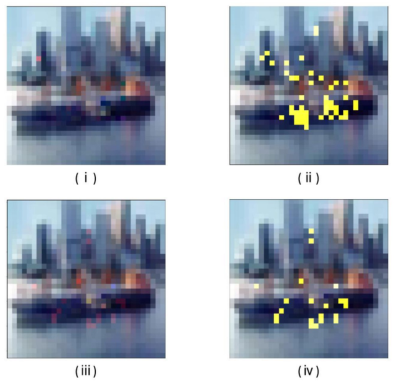
Figure 3 shows the adversarial examples and the visualization of their per- turbations. The adversarial example with proposed method is Image (i) and the perturbations of it are visualized in image (ii). The adversarial example with our previous method is Image (iii) and the perturbations of it are visu- alized in Image (iv). We can see perturbations to flat color areas of the image by the proposed method are less perceptible. In both methods, perturbations are added to the black part of the ship’s hull. In our previous method, fixed perturbations are added, which makes perturbations in black areas more per- ceptible. In contrast, the proposed method introduces a small perturbation to the pixels in the black areas where the variance is smaller. This makes pertur- bations in these areas less perceptible. It shows that adjusting perturbations using the ratio of variances can be effective in reducing the perceivability of perturbations.
A Method to Generate Adversarial Examples Based on Color Variety of Adjacent Pixels 113
Figure 3: Adversarial examples from the proposed and previous method and visual- ization of their perturbations.
CONCLUSIONS
In this study, we generated adversarial examples focused on differences in the perception of perturbations depending on the variance of pixel colors. The reduction in the perturbation per pixel by the proposed method made perturbation less perceptible than our previous methods and JSMA.
In future study, it is essential to explore potential enhancements to per- turbations that consider the cognitive characteristics of human in relation to color, as well as the required security measures to safeguard against such attacks.
REFERENCES
Brown, T. B., Mane, D., Roy, A., Abadi, M., and Gilmer, J. (2017). Adversarial patch.
arXiv preprint arXiv:1712.09665. Carlini, N., and Wagner, D. (may 2017). Towards evaluating the robustness of neural networks. in 2017 IEEE Symposium on Security and Privacy (SP). Los Alamitos, CA, USA: IEEE Computer Society, pp. 39–57. Combey, T., Loison, A., Faucher, M., and Hajri, H. (2020). Probabilistic jacobian-
based saliency maps attacks. Machine learning and knowledge extraction, 2(4), pp. 558–578. Eykholt, K., Evtimov, I., Fernandes, E., Li, B., Rahmati, A., Xiao, C. et al. (2018).
Robust physical-world attacks on deep learning visual classification. in Pro- ceedings of the IEEE Conference on Computer Vision and Pattern Recognition (CVPR). Fu, C., Li, S., Yuan, X., Ye, J., Cao, Z., and Ding, F. (2022, May). Ad 2 attack: Adaptive adversarial attack on real-time uav tracking. In 2022 International Conference on Robotics and Automation (ICRA), pp. 5893–5899. Goodfellow, I. J., Shlens, J., and Szegedy, C. (2014). Explaining and harnessing
Hein, M., and Andriushchenko, M. (2017). Formal guarantees on the robustness of a classifier against adversarial manipulation. Advances in neural information processing systems, 30. Hickling, T., Aouf, N., and Spencer, P. (2022). Robust adversarial attacks detec-
tion based on explainable deep reinforcement learning for uav guidance and planning.arXiv preprint arXiv:2206.02670. Kamegawa, T., and Kimura, M. (2022, November). A Method for Adversarial Example Generation by Perturbing Selected Pixels. In 2022 Asia-Pacific Signal and Information Processing Association Annual Summit and Conference (APSIPA ASC), pp. 1109–1114. Kurakin, A., Goodfellow, I. J., and Bengio, S. (2018). Adversarial examples in
the physical world. In Artificial intelligence safety and security. Chapman and Hall/CRC, pp. 99–112. Madry, A., Makelov, A., Schmidt, L., Tsipras, D., and Vladu, A. (2017).
Towards deep learning models resistant to adversarial attacks.arXiv preprint arXiv:1706.06083. Modas, A. Moosavi-Dezfooli, S. and Frossard, P. (jun 2019). Sparsefool: A few pixels make a big difference. in 2019 IEEE/CVF Conference on Computer Vision and Pattern Recognition (CVPR). Los Alamitos, CA, USA: IEEE Computer Society, pp. 9079–9088. Moosavi-Dezfooli, S. M., Fawzi, A., and Frossard, P. (2016). Deepfool: a simple
and accurate method to fool deep neural networks. In Proceedings of the IEEE conference on computer vision and pattern recognition, pp. 2574–2582. Papernot, N. McDaniel, P and Jha, S. Fredrikson, M. Celik, Z. B. and Swami, A.
(2016). The limitations of deep learning in adversarial settings. in 2016 IEEE European Symposium on Security and Privacy (EuroS&P), pp. 372–387. Sethi, K., Sai Rupesh, E., Kumar, R., Bera, P., and Venu Madhav, Y. (2020). A context-aware robust intrusion detection system: a reinforcement learning-based approach. International Journal of Information Security, 19, pp. 657–678. Sharif, M., Bhagavatula, S., Bauer, L., and Reiter, M. K. (2016, October). Accessorize
to a crime: Real and stealthy attacks on state-of-the-art face recognition. In Pro- ceedings of the 2016 acm sigsac conference on computer and communications security, pp. 1528–1540. Su, J., Vargas, D. V., and Sakurai, K. (2019). One pixel attack for fooling deep neural networks. IEEE Transactions on Evolutionary Computation, vol. 23, no. 5, pp. 828–841. Szegedy, C., Zaremba, W., Sutskever, I., Bruna, J., Erhan, D., Goodfellow, I.,
and Fergus, R. (2013). Intriguing properties of neural networks.arXiv preprint arXiv:1312.6199. Wiyatno, R., and Xu, A. (2018). Maximal jacobian-based saliency map attack.arXiv preprint arXiv:1808.07945. Yang, H.-D. (2021). Restoring raindrops using attentive generative adversarial
networks. Applied Sciences, vol. 11, p. 7034. Zhai, L., Juefei-Xu, F., Guo, Q., Xie, X., Ma, L., Feng, W. et al. (2020). Adversarial rain attack and defensive deraining for DNN perception. arXiv preprint arXiv:2009.09205.
LISTED IN THE AHFE DIGITAL BOOKSTORE CATALOGUE
Explore the complete digital volume
Artificial Intelligence, Social Computing and Wearable Technologies
Read this individual research paper free through the original publisher, or explore the full digital proceedings book.
ISBN 978-1-958651-89-6
Explore this ISBN in the AHFE Bookstore ↗Listed in the July 2026 bookstore catalogue; search by ISBN to confirm current availability · Digital book purchase optional