Yukun Xia, Yingrui Ji, Zijie Ding, Yan Gan (2023). Applying Ming furniture features to modern furniture design using deep learning. In: Artificial Intelligence, Social Computing and Wearable Technologies. AHFE Open Access, vol. 113, pp. 249–257. https://doi.org/10.54941/ahfe1004197
Ming-style furniture is a type of classical Chinese furniture that originated during the Ming Dynasty and has developed and evolved through the Ming and Qing Dynasties to become one of the major schools of classical Chinese furniture. Traditional Ming furniture design is labour-intensive and time-consuming, and designers need to have a wealth of experience and knowledge to create high-quality pieces. However, with the rapid development of computer technology and advances in deep learning algorithms, it is now possible to use computer-aided design techniques and deep learning algorithms to extract and apply features of Ming furniture quickly and accurately.This paper proposes a new method based on deep learning and computer-aided design techniques for applying features of Ming furniture to modern furniture design. By collecting and filtering existing physical images of Ming-style furniture, we use a generative adversarial network algorithm (DCGAN) for image recognition and feature extraction, and generate modern furniture designs. The experimental results show that the algorithm can significantly improve the efficiency of designers and has good feature recognition to extract target contours and accurately obtain design features. As the number of extracted feature samples increases, the clarity of the generated images becomes higher and their generation accuracy also tends to increase. The furniture products generated by the deep learning approach have both modern aesthetics and Ming furniture characteristics, which is conducive to the inheritance and development of traditional Chinese furniture culture. The evaluation shows that the newly generated furniture products meet modern aesthetic standards. The method provides a new way of thinking and approach to the field of furniture design, with high academic and practical application value.
Ming-style furniture, revered as the zenith of Chinese furniture history, encap- sulates a timeless and sophisticated aesthetic that exudes elegance and artistic
flair (Cao Xue, 2020). In this context, the term “antique” characterizes the furniture’s intrinsic simplicity, articulated through its raw materiality, tex- tures, and hues, thus underscoring its natural beauty. The term “elegant” captures the proportional harmony of the furniture’s lines, their understated decorum, and the rationality embedded in the design, adhering to the princi- ples of symmetry and balance that constitute beauty. The term “Li”explicates the elegance of Ming furniture’s form through the unification of points, lines, and planes. “Fine” signifies the mastery of craftsmanship and the innovative mortise and tenon construction techniques used in the fabrication process.
Deep learning, a groundbreaking tool instrumental in advancing artificial intelligence, has the capacity to analyze and extract vast volumes of data dur- ing the pre-design stage, thereby enabling the extraction and categorization of product feature data. During the design solution phase, it can automate aspects of the design process, enhancing efficiency, minimizing human error, and liberating designers to focus more intensively on creative pursuits.
This data-driven design methodology provides designers with more pre- cise insights, empowering them to make more informed product decisions. A proficiently trained AI can supply a myriad of design ideas and inspira- tion, catalyzing innovation in product design. Deep learning thus paves the way for data-driven, automated, and inventive design in the domain of Ming furniture. This methodology refines the product design process, rendering it smarter, more efficient, and more user-focused, consequently augmenting the product’s competitiveness and market value.
LITERATURE REVIEW
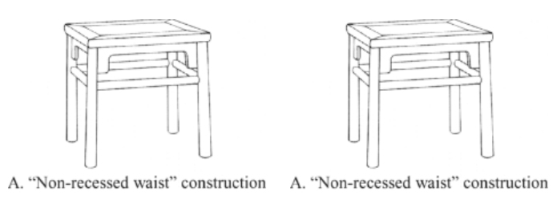
Current State of Ming Furniture Research The seminal study on Ming furniture was initiated by Mr. Wang Shixiang in the mid-1980s, laying the groundwork for subsequent research in the field. Wang distinguished the stylistic characteristics of Ming furniture into two main structures: the “non-concave waist”and the “concave waist”structures, as depicted in Figure 1.
Figure 1: The two main structures of Ming furniture (Liu Xianbo, 2008).
Liu Xianbo and his colleagues argue that the stylistic elements of Ming furniture reflect the aspirations of the Ming Dynasty to establish an idealistic vision of life.
Applying Ming Furniture Features to Modern Furniture Design Using Deep Learning 251
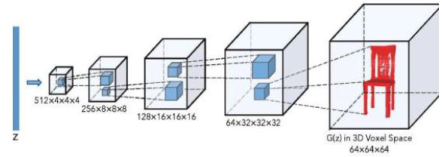
DEEP LEARNING IN FURNITURE DESIGN Generative Adversarial Networks (GANs) represent a subset of deep learning models that evolved from the broader Machine Learning (ML) framework. GANs necessitate image fusion for the computation of thresholds and fitness scores. Post GAN training, image data preprocessing occurs, which encom- passes image segmentation and cleaning. The ensuing results are anticipated for pattern analysis and the accuracy assessment of the image generation of the GAN[4]. Figure 2 depicts an instance of a 3D generative adversarial net- work comprising five 2-level volumetric convolutional neural layers with a 4 × 4 × 4 kernel size.
Figure 2: Image generation/learning with the help of 3D GAN modelling (Wu J et al., 2016).
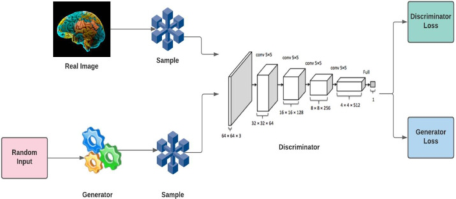
GANs were conceived around 2013 for modeling animal behavior (Bryant G A, 2013). Comprising a generator and a discriminator, the generator aims to create authentic samples, whereas the discriminator strives to differenti- ate between real and generated samples. In a zero-sum game scenario, these two models are collaboratively trained in an adversarial fashion, leading to mutual enhancement and the generation of highly realistic samples. As part of the deep learning model family, particularly the Convolutional Neural Net- work (CNN) framework, GANs are deemed to have converged when the discriminator can no longer discern or provide feedback on discrepancies between real and generated images. Continued learning from the training set results in new information that mirrors the training set, often leading observers to perceive GAN-generated images as realistic due to the potential integration of real features(Marra F et al., 2018). Figure 3 displays the block diagram representation of GAN.
Figure 3: Block diagram of a generative adversarial network (Alankrita Aggarwal et al., 2020).
Fournier-Viger and colleagues employed ML techniques across various stages of industrial product development to guide or comprehend the pro- cess[8]. Within the domain of furniture design, Nelson Vermeer and his team harnessed two deep neural networks to learn these network graphs, reproduce, and generate their variants (Vermeer and Brown, 2022).
An Innovative Design Method for Ming-Style Furniture Based on Deep Learning and Computer-Aided Design.
The innovative design method for Ming-style furniture, rooted in deep learning and computer-aided design, marries modern technology with tra- ditional art. This approach commences with the compilation of a vast array of images of Ming-style furniture. Deep learning techniques are subsequently used for image recognition and feature extraction, detailing the lines, shapes, decor, materials, and hues intrinsic to Ming-style furniture. This stage is piv- otal in understanding and learning the artistic style and characteristics of Ming furniture. The Deep Convolutional Generative Adversarial Network (DCGAN) is utilized for image recognition and feature extraction, with these extracted features subsequently applied to modern furniture design. This method not only bolsters design efficiency and reduces human error but also maintains the aesthetic allure and traditional form of Ming furniture.
Taking into account user feedback and market demand, designers can fine- tune and refine the design. This stage ensures that the resulting furniture sus- tains the traditional elegance of Ming furniture while satisfying contemporary needs for functionality and aesthetics. This spectrum of design methodologies enhances designer productivity, retains the subjectivity inherent in traditional design, and guarantees product diversity, thereby encouraging the emergence of new design innovations.
DATA SETS AND PRE-PROCESSING Data Collection
Utilizing a web crawler, we extracted images from the Google search engine using the keywords “Ming-style furniture” and “modern furniture”. We accrued a total of 2,620 images, comprising 1,874 Ming-style furniture images and 746 modern furniture images. These images were square-shaped, with resolutions ranging between 200px and 400px.
Data Pre-Processing Initial steps involved loading the original dataset and allocating the procured images into the data loader, which enabled efficient image data reading and processing. Subsequently, data cleaning operations were performed on the image data using proprietary software, which involved tasks such as noise removal and rectification of missing or damaged image parts. Given that GAN networks usually stipulate specific input data range requirements, we scaled the data range to [-1, 1].
To enhance data diversity and robustness, we deployed various data aug- mentation techniques such as random rotation, translation, scaling, and
Applying Ming Furniture Features to Modern Furniture Design Using Deep Learning 253
flipping, assisting the GAN network in better learning the features and distri- bution of the data. In the image generation task, a pre-trained Convolutional Neural Network (CNN) was utilized to extract the image’s feature vectors, which served as inputs to the GAN network. Subsequently, the data was partitioned into appropriate batches for training to expedite the process and enhance model stability.
Deep Learning Models GANs are classic unsupervised learning approaches originating from deep learning methodologies. The model comprises a generator and a discrimi- nator. The image generator initially creates images based on random noise, assuming values within the 0–1 range. The generator’s objective is to maxi- mize the discriminator’s probability of error, while the image discriminator aims to enhance the image’s realism without losing other information. Its goal is to refine its judgment accuracy, resulting in data that are more realistic and satisfactory from their mutual competition.
To represent the training and prediction process of the network and cap- ture the complex influence of Ming furniture on modern furniture, we used a specialized GAN model, specifically the Deep Convolutional Generative Adversarial Network (DCGAN). Compared to the base GAN, the DCGAN enhances the stability and improves the quality of the generated results. DCGAN is an unsupervised deep learning-based generative model (Radford A, Metz L, 2015), which does not necessitate any labeling. Both the genera- tor and discriminator in this model employ Convolutional Neural Network (CNN) and integrate Batch Normalisation to enhance training stability and address some training challenges. It substitutes the traditional generative and discriminative multilayer perceptrons with two convolutional architectures.
To ensure the accuracy and professionalism of the model’s results, we used displayed Ming Dynasty furniture images for training, supplemented by a selection of modernized furniture to depict the model’s synthesis. Upon model completion, a simulation study was conducted to evaluate how various Ming Dynasty-era furniture factors influenced the furniture’s morphological evolution and to guide the Automated Image Generation and Classification (AIGC) in determining the design. These influential factors encompass the significance of line construction, mortise and tenon construction for mod- ern furniture, and the affirmation that the form transformation stems from a positive amalgamation of traditional Chinese culture and modernization, which is more user-appealing.
Generators and Discriminators The generator model was configured with an input shape size of 512 * 512 for the input image and an output shape of 64 * 64. Consisting of five layers, the generator accepts input vectors of random noise adhering to a uniform distri- bution. These vectors yield feature information such as the furniture’s lines, shapes, styles, among others, which optimizes the model as per the network’s depth. The model employs Batch Normalization (BN) processing, outputting a 64 * 64 * 3 furniture image. Notably, there is no fully connected layer in
the generator model. The last layer utilizes the tanh activation function, an enhanced version of the sigmoid function, known for its rapid convergence speed.
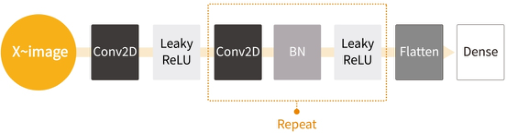
The discriminator model shares the five-layer architecture and employs a downsampling method. The entire network structure lacks a pooling layer and uses LeakyReLU as the activation function. The final output discerns whether the input image corresponds to a real sample (output 1) or an image generated by the generator (output 0). The discriminator incorporates a BN layer. The generator and discriminator structures are depicted in Fig. 4.
Figure 4: Discriminator model structure.
Training We established pertinent network layers and constructed generators and dis- criminators for training. During training, the network model generates data, applying activation and optimization functions. The discriminator randomly selects 16 real images from a normally distributed vector of length 100, producing a 16-dimensional vector. This vector is passed to the generator, resulting in 16 synthetic furniture images. These synthetic images, with a label value of 0, alongside real images, with a label value of 1, form a training set that is passed to the discriminator for training.
The generator’s training involves randomly generating 16-dimensional vec- tors, and after creating 16 fake furniture images, the discriminant prediction result of the fake pictures is compared with the label of the real furniture pictures. The training is based on the discriminator’s judgement: whether the picture is real or not, and the result value is utilized as the loss to train the generator. The loss values from both the generator and the discriminator are in a fluctuating state.
In processing, we employ inverse convolution; normal convolution con- stantly compresses the height and width of our feature layer, while inverse convolution enlarges the feature layer. The generative network converts it into 4 * 4 * 1024 feature layers. After four rounds of deconvolution, the fea- ture layer becomes 16 times the original (i.e., 2ˆ4). Following the activation function, a generated furniture image is obtained. Adam was used as the opti- mizer due to its easy implementation, computational efficiency, and ability to dynamically adjust the learning rate.
A reduction in the generator’s loss is favorable, indicating that it can produce outputs that the discriminator deems real. The generator will thus generate outputs that resemble real samples. Conversely, the loss reduction of the discriminator enables it to more accurately discern between real and
Applying Ming Furniture Features to Modern Furniture Design Using Deep Learning 255
generated data. The discriminator’s task is to output the probabilities of their counterparts for the real and generated samples.
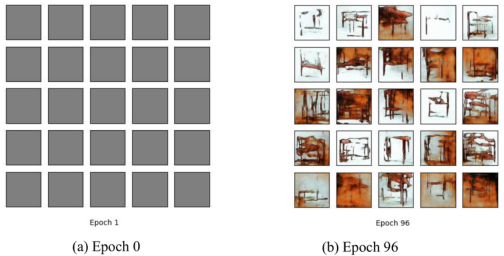
Experimentation For the experimental segment, we used the Intel Xeon Gold 6148 CPU and the NVIDIA 3080ti graphics card. After 4 hours of running, we achieved 96 Epochs, each consisting of 2088 training images, with a sample genera- tor every 50 steps. The number of channels was 64, and the length of the normally distributed random number was defined as 100. After training the DCGAN, we reviewed the training loss values and neural network structure to assess the model’s performance. The generator and discriminator were updated using the same network structure and iterative parameters, resulting in a final test graph containing 25 virtual bright furniture images.
At Epoch 0 and step number 0 (Fig. 5a), the generator had yet to generate furniture images. However, at Epoch 96 (Fig. 5b), the generator produced images that clearly defined the outlines of the furniture.
IMAGE GENERATION AND DESIGN INNOVATION Design Ideas
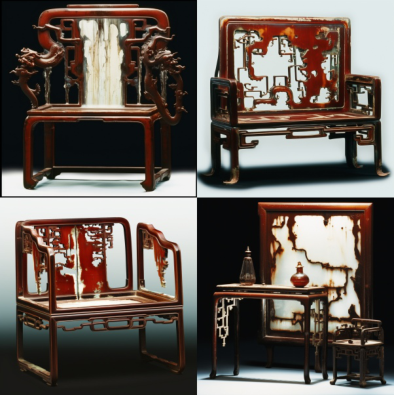
The fuzzy images generated are creatively associated and filtered to select images that align with the designer’s thought process and creativity. The main attributes of the selected images are retained and serve as guidance for design- ing complete, clear, and aesthetically pleasing modern Ming furniture. Design software such as Procreate, Rhino 7, and KeyShot 9 were utilized to visualize the design work. The final output consisted of four product images with dis- tinct shapes(Fig. 6). In the whole design process, AI-generated fuzzy feature images were used, and the designer infused their own subjective creativity and thought, guided by modern aesthetics and traditional style. The process can be seen as a human-computer interaction design process. The design method consists of six parts: data collection, feature extraction, feature reorganiza- tion, image generation, design refinement, and product output. In the first four parts, the machine integrates traditional and realistic styles, generating a
creative prototype of the furniture based on the aesthetics of existing images; in the last two parts, the designer perfects the product’s form, material, and details to meet the user’s aesthetic preferences. This approach saves the designer’s time and allows more focus on creative work, effectively enhancing design efficiency.
Figure 6: Design output image.
Design Assessment Upon completion of the design refinement, the author’s team compared the output images with those of similar shape and composition from the origi- nal sample. Multiple groups were incorporated into a questionnaire to assess user preferences. The assessment questions were divided into four sections: appearance and shape score, purchase expectation score, cultural attribute score, and innovation degree score. A total of 300 questionnaires were dis- seminated online within China, yielding 290 responses, of which 288 were valid. A majority of users favored the modern aesthetic of the product and acknowledged its traditional cultural attributes. However, the innovation level feedback was relatively poor, indicating that while AI tools can ana- lyze and extract features to generate product images, they may struggle to produce something genuinely innovative.
CONCLUSION
Firstly, the model derived from DCGAN training can generate virtual fur- niture that closely resembles real Ming furniture. In the future, this can be directly applied for designers to model modern furniture, generate sample data through the model, which aligns with the distribution of real furniture data, and build a furniture model database to solve the problem of inad- equate labeling data. Secondly, owing to the training mechanism of GAN,
Applying Ming Furniture Features to Modern Furniture Design Using Deep Learning 257
DCGAN can generate virtual furniture images, which can assist designers who may lack inspiration or do not comprehend the characteristics of tra- ditional furniture well enough to apply them to modern furniture. In the future, the adaptation of Ming-style furniture for the design of modern fur- niture may be used in the design industry, thus enabling designers to create superior products.
ACKNOWLEDGMENT
This research was funded by “the Major Philosophy and Social Science Research Project for Hubei Province Colleges and Universities, Grant num- ber No. 20ZD002” and “the Fundamental Research Funds for the Central Universities of China, Grant number HUST: 2020kfyXJJS014”.
REFERENCES
Alankrita Aggarwal, Mamta Mittal, Gopi Battineni, Generative adversarial network: an overview of theory and applications, International Journal of Information Management Data Insights, Volume 1, Issue 1, 2021, 100004, ISSN 2667-0968, https://doi.org/10.1016/j.jjimei.2020.100004. Bryant G A. Animal signals and emotion in music: coordinating emotion across
groups [J]. Frontiers in Psychology, 2013, 4:990. Cao Xue. Research on decorative culture of Ming-style furniture design[J]. Shanxi Youth, 2020, No. 584(12): 242–243. Fournier-Viger, P., Nawaz, M. S., Song, W., Gan, W. (2021). Machine Learning for
Intelligent Industrial Design. in: Principles and Practices of Machine Learning and Knowledge Discovery in Databases. ECML PKDD 2021. Communications in Computer and Information Science, Vol. 1525. https://doi.org/10.1007/978-3- 030-93733-1_11 Liu Xianbo, “Cultural Symbols in Furniture Design: A Study on the Evolutionary Path of Ming Furniture Styling Design”, 2008 Ninth International Conference on Computer Aided Industrial Design and Conceptual Design, Beijing, China, 2008, pp. 738–742, doi: 10.1109/CAIDCD.2008.4730670. Marra F, Gragnaniello D, Cozzolino D, et al., Detection of gan-generated fake images
over social networks[C]//2018 IEEE conference on multimedia information pro- cessing and retrieval (MIPR). IEEE, 2018: 384–389. Radford A, Metz L, Chintala S. Unsupervised representation learning with deep convolutional generative adversarial networks[J]. arXiv preprint arXiv:1511.06434, 2015. Vermeer, N., Brown, A. R. (2022). Generating New Furniture with Machine Learn-
ing. in: Martins, T., Rodríguez-Fernández, N., Rebelo, S. M. (eds) Artificial Intel- ligence in Music, Sound, Art and Design. evoMUSART 2022. Lecture Notes in Computer Science, Vol. 13221. https://doi.org/10.1007/978-3-031-03789-4_26 Wang Shixiang. Classical Chinese Furniture: Classical Chinese Furniture: the Ming and Qing Dynasties. Hanshantang, 1986. Wu J, Zhang C, Xue T, et al., Learning a probabilistic latent space of object
shapes via 3d generative-adversarial modeling [J].Advances in Neural Information Processing Systems, 2016, 29.
LISTED IN THE AHFE DIGITAL BOOKSTORE CATALOGUE
Explore the complete digital volume
Artificial Intelligence, Social Computing and Wearable Technologies
Read this individual research paper free through the original publisher, or explore the full digital proceedings book.
ISBN 978-1-958651-89-6
Explore this ISBN in the AHFE Bookstore ↗Listed in the July 2026 bookstore catalogue; search by ISBN to confirm current availability · Digital book purchase optional