YALI WANG, Yan Gan, Xinxiong Liu (2023). Construction and application of multi-dimensional feature model of Ming-style furniture based on grounded theory. In: Application of Emerging Technologies. AHFE Open Access, vol. 115, pp. 17–27. https://doi.org/10.54941/ahfe1004298
The cultural connotation, modelling characteristics and production technology carried by Ming-style furniture are the precious cultural heritage of the Chinese nation and one of the crucial components of Chinese traditional culture. Under the background of the new era, this paper conducts an in-depth study on Ming-style furniture to inherit and carry forward the traditional Chinese furniture culture and then promote the development of the modern furniture design industry. It combines literature review, case analysis and grounded theory research methods. Firstly, collect many paintings, books and periodicals related to Ming-style furniture, and classify them. Secondly, use the three-level coding process of grounded theory to construct a multidimensional feature model of Ming-style furniture. Lastly, statistical analysis methods further refine the modelling elements of Ming-style furniture. The research results show that a complete multidimensional theoretical model of Ming-style furniture is constructed, composed of six modules: production process, decorative characteristics, material selection, modelling characteristics, category subdivision and size ratio. Otherwise, a MySQL database has been implemented to facilitate storing and managing the multidimensional feature data, encompassing a backend management system, a conceptual model design, and a frontend display system. Finally, the application effectiveness of the constructed multidimensional feature database is demonstrated through visualizations.
Since the 1970s, after decades of development, protecting intangible cultural heritage has increasingly become a global focus. Governments worldwide have begun formulating and promulgating related policies for protecting intangible cultural heritage according to national conditions.In the context of the digital age, countries around the world are constantly looking for intangible cultural heritage protection mechanisms and more scientific and reasonable protection measures that are more suitable for the development requirements of the times. At present, modern digital information technology has become one of the crucial tools for protecting intangible cultural heritage
at home and abroad, and countries worldwide have started the road of diver- sified digital protection of intangible cultural heritage. As far as China is concerned, although the digital protection of intangible cultural heritage in China started relatively late, with the government’s strong support in recent years, the digital protection of intangible cultural heritage has gradually entered the right track and is showing a trend of comprehensive development (Tan Biyong, 2011). Ming-style furniture is a bright star in the long history of Chinese traditional furniture culture, and the manufacturing techniques of Ming-style furniture have been included in the first batch of intangible cul- tural heritage protection lists (Qi Qingfu, 2006). Therefore, always paying attention to the development process of the digital protection of intangible cultural heritage and applying it to the protection of Ming-style furniture will not only help to promote the construction, improvement and develop- ment of the Chinese Ming-style furniture research system but also contribute to the world’s intangible cultural heritage. The smooth development of digital protection of cultural heritage is indispensable in promoting it.
This paper combines grounded theory with statistical analysis methods to construct a theoretical model of Ming-style table cases to enrich the research content of Ming-style furniture. New methods, all-round, and multi- angle research can promote the research system of Ming-style furniture. On the other hand, based on the theoretical model, constructing the multi- dimensional feature database of Ming-style table furniture supplements and improves the digital protection system of China’s intangible cultural her- itage, making it more comprehensive. It aims to promote further the digital protection and inheritance of the world’s intangible cultural heritage.
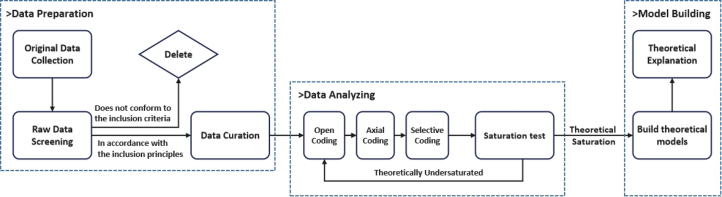
MING-STYLE FURNITURE RESEARCH AND DESIGN BASED ON GROUNDED THEORY The grounded theory research method depends on the research data, and the collection, analysis and induction of data are regarded as the core content of the grounded theory. Among them, the data collection method is similar to other qualitative research, so the data collection of this study uses the litera- ture research method. In addition, the critical technology of grounded theory lies in its three-level coding process, which is the process of first decomposing the collected text data, extracting essential information, then conceptualiz- ing the critical information, and then re-abstracting and integrating them into core categories (Li Zhigang, 2007). According to the general process of grounded theory, the research objects of Ming-style furniture are collated and summarized. In order to show the process of this research more clearly, the following flow chart design of Ming-style furniture research based on grounded theory is obtained (see Figure 1).
CONSTRUCTION OF THEORETICAL MODEL This research is from the collection of original data, to the three-level cod- ing of grounded theory, to the construction of six branch models, and finally combined into a general theoretical model of the multi-dimensional characteristics of Ming-style table and case furniture.
Construction and Application of Multi-Dimensional Feature Model 19
Figure 1: Flow chart of Ming-style furniture research based on grounded theory.
1. Data collection and collation: Using the literature research method, combined with the principle of screening original materials, eight orig- inal literature materials conforming to the study of Ming-style table and case furniture have been included. The screening of original data is divided into three steps: First, Nineteen books related to Ming-style fur- niture were collected through online and offline libraries, online e-book stores, and offline physical bookstores. Second, Formulate the inclusion criteria (see Table 1), delete monographs that do not meet the inclusion criteria, and finally screen out eight famous monographs that meet the inclusion criteria. Third, Randomly select five books published in differ- ent years as the initial coding materials; the other three books are used for the later saturation test.
Table 1. Ming-style furniture research data collection table.
Table available in the original PDF paper.
S/N Inclusion criteria Number of non-compliance
Total number of non-compliance
Total Collection
0 11 19
Criterion 1: Closely related to Ming-style furniture and able to find physical books or full-version e-books;
6
Criterion 2: The book covers the content of Ming-style furniture and table sections, not a simple description;
1
Criterion 3: The introduction of table furniture in the book includes case picture display;
3
Criterion 4: The introduction of table furniture in the book contains the text description of the case;
0
Criterion 5: The introduction of table furniture in the book includes the introduction of the whole body size of most cases;
1
Criterion 6: Monographs by different authors (to avoid too many duplicate cases).
Match Total 8
2. Building the Core Architecture of Theoretical Models: Using Grounded Theory Coding Approaches. This study will use the grounded theory research method to code the data content of the five monographs related
to Ming-style furniture and tables. The coding process will be divided into three steps: Open Coding, Axial Coding and Selective Coding (Barney, 1968).
First, open coding refers to decomposing, reviewing, comparing, summa- rizing and classifying the collected original data. At this stage, this research first unifies all the information collected in monographs, including Ming- style furniture and table cases. Then it refines the concepts and codes of the original sentences line by line—new concepts and coding. After coding 332 cases of Ming-style furniture and table cases in 5 monographs, a total of 3050 original concepts were identified, and then through overall statistics, after merging or eliminating the same and similar concepts, a total of 365 initial concepts closely related to Ming style furniture tables and cases.
Secondly, unlike the dispersion and disorder of open coding, the axial coding process is a clustering process. In the process of axial coding, it is nec- essary to find the relationship between the 365 codes that have been refined and to explore concepts. The internal logic among them is summarized and integrated, and finally, 48 sub-categories and five main categories are obtained. First, the production process refers to the various techniques used in the production process of Ming-style table furniture. It is roughly com- posed of 8 sub-categories, including panel production process, leg production process, zizi production process, teeth Manufacturing technology, foot manu- facturing technology, girdle manufacturing technology, baffle manufacturing technology and other structural manufacturing technology; second, the dec- orative features are the different decorative techniques used in the designated table and case furniture. This main category is composed of 13. It comprises three sub-categories: carving decoration, moulding decoration, metal dec- oration, consecration decoration, paint decoration and texture decoration and so on; third, material selection is characteristic of the material selection of designated table and table furniture. Including hardwood material, non- hardwood material and surface material, a total of 3 sub-categories; fourth, modelling features are the standard modelling combination methods of the specified table and table furniture and the modelling and structural charac- teristics involved in the design process. This part A total of 20 sub-categories have been extracted, including pan shape, waist shape, tooth shape, leg shape, toilet shape, foot shape, drawer shape, and clay shape; finally, the cate- gory subdivision is the designated table Case furniture can be subdivided into which types and four sub-categories are extracted here: table, case, sev- eral types, and kang table Kang several types. The successful refinement of sub-categories and main categories advances the research to the next stage: selective coding.
Furthermore, selective coding aims to refine the core concepts, which is the core category of this study. The data collation, analysis and coding of the first two steps show that all the refined concepts and categories match the classic features of Ming-style table furniture. Therefore, the multi-dimensional fea- tures of Ming-style table furniture are Defined as the core category of this study. The five main categories obtained from the axis coding and the “size
Construction and Application of Multi-Dimensional Feature Model 21
ratio” list for quantitative statistics are combined to form a 6-dimensional characteristic table of Ming-style table and case furniture (see Table 2).
T001 Table Category/ T002 An Category / T003 Side Category / T004 3K Category Size Ratio Length/width/height (separate data sheet) 6
Finally, to improve this study’s integrity, rigour and scientific nature, this study coded the data of the remaining three monographs and extracted a total of 1610 initial concepts. After no new concepts and categories appeared, it was determined that the theory of this study had reached a high degree of saturation.
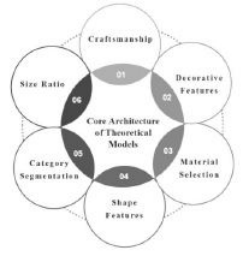
After completing the open coding, axis coding and selective coding of the original data, one core category, six main categories, 48 sub-categories, and 332 Ming-style table cases were extracted. It can be seen from this that the multi-dimensional characteristics of Ming-style table furniture are divided into six dimensions: manufacturing process, decoration character- istics, material selection, modelling features, category subdivision, and size ratio, thus constructing a multi-dimensional feature model of Ming-style table furniture—core architecture (see Figure 2).
3. General theoretical model building: In order to gain a deeper understand- ing of the internal relationship between different main categories, the correlation between the main category and its sub-categories, and the cor- relation between the sub-categories and the original concept, this research will use the grounded theory method based on this core framework.
Combined with statistical methods such as linear correlation, partial cor- relation, and chi-square test, the branch models of different dimensions are analyzed individually, and the branch models are constructed.
Figure 2: The core architecture of the multi-dimensional feature model of Ming-style table furniture.
Branch Model I: Category Segmentation The category subdivision model mainly comprises four categories, includ- ing 38 internal elements. that Ming-style furniture has at least 38 different types of table furniture in categories, including square tables, wine tables, desks, pianos—tables, incense tables, incense tables, kang table, kang table and so on.
According to the content division and correlation analysis results of the Ming-style table and table furniture category subdivision, a category segmen- tation model I was constructed. These four types of modules are composed, and different types of furniture correspond to different size choices. There- fore, from the perspective of design, the internal logic is first to determine the type of furniture and then choose the appropriate size from the direction of different types of furniture; on the contrary, from the perspective of tasting and appreciation From the perspective, the category can also be judged by the size range.
Branch Model II: Material Selection From the material selection model, except for the slight difference in the selec- tion of surface materials, Ming-style furniture is mainly made of hardwood. Among the hardwood materials, Huanghuali is the most representative. It can be seen from the summary of statistical analysis that the selection of mate- rials has no correlation with the category, shape, decoration, process or size modules of Ming-style table furniture, which means that the construction of branch model II (material selection model) only needs to consider the model The content itself is not related to other branch models and can be set as an independent module.
Branch Model III: Modelling Features The content of the shape feature model is relatively complicated. This study conducts in-depth research on six types of shapes, including leg, foot, tooth,
Construction and Application of Multi-Dimensional Feature Model 23
girdle, waist, and other types of shapes. After completing the statistical analy- sis, 29 groups of Ming-style table furniture are commonly used in styling and matching. From the point of view of the shape of the waist, only the shape of the girdle can affect the choice of the shape of the girdle; while the shape of the girdle is related to the shape of the legs, feet and other types of shapes; from the point of view of the shape of the teeth, there is an apparent correla- tion between the legs and teeth of Ming-style table and table furniture, and it will have a particular impact on other types of shapes; in addition, there is also a close relationship between the shapes of legs and feet.
Branch Model IV: Decoration Characteristics The content of the decorative feature model is divided into five categories: modelling structure decoration, carving decoration, moulding decoration, lacquer decoration, and other decorations. Seventy-six original concepts related to decoration characteristics have been extracted, and the analy- sis shows that modelling structure decoration and moulding decoration are positively correlated. The decorative features of Ming-style table and table furniture can be selected from modelling structure decoration, moulding decoration, carving decoration, lacquer decoration and other decorations. There is a negative correlation between them, which means that if choosing to increase a specific type of decorative element, you should reduce other decorative elements accordingly.
Branch Model V: Manufacturing Process The production process model comprises six directions: panel production process, girdle production process, teeth production process, girdle produc- tion process, leg and foot production process, and other structural production processes, and the data is limited, so it has yet to be analyzed. Outline the internal relationship among the six directions of manufacturing processes. The construction of the manufacturing process characteristic model is mainly based on the six sub-categories extracted from grounded theory and sta- tistical analysis, and the influence relationship between sub-categories and sub-categories has temporarily defaulted as a parallel relationship.
Branch Model VI: Size Ratio The size scale model is based on the length, width, and height dimensions of Ming-style tables and furniture. After statistical analysis of quantitative data and chi-square test, four types of desks, cases, several types, and kang tables and kangas are obtained. The direction gives the recommended range of values for the whole body’s length, width and height. The construc- tion of the production process characteristic model is mainly based on the six sub-categories extracted from grounded theory and statistical analysis, and the influence relationship between sub-categories and sub-categories has temporarily defaulted as a parallel relationship.
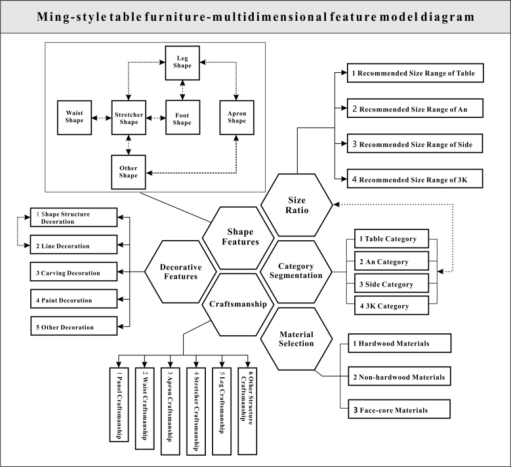
Finally, after merging the six-dimensional branch models, a complete the- oretical model of multi-dimensional features of Ming-style table cases is constructed, which serves as the basis for subsequent database construction.
Figure 3: Ming-style table furniture - multi-dimensional feature theory model diagram.
As shown in the figure above, the Ming-style table furniture- multidimensional feature theory model comprises six-dimensional branch modules: category subdivision, material selection, modelling features, deco- ration features, manufacturing process, and size ratio, among them category details. The division and size ratio modules are closely related. That is to say, different categories of furniture correspond to different overall size ranges; moreover, apart from the complex interrelationships among the internal ele- ments of the modelling feature plate, the other five dimensions Most of the internal elements of the plates are juxtaposed, which means that in the process of appreciating or designing Ming-style table furniture, focusing on and think about the different combinations of its modelling features; in addition, from the model diagram It can be seen that in the decorative feature section, “mod- elling structure decoration” is often used in conjunction with “moulding decoration”. In short, from the multi-dimensional feature model of Ming- style table and table furniture, it can be mapped that the six-dimensional features of Ming-style furniture design, such as category subdivision, material selection, modelling features, decorative features, manufacturing technology, and size ratio, are indispensable.
PRACTICAL APPLICATION: MULTI-DIMENSIONAL FEATURE DATABASE OF MING-STYLE TABLE FURNITURE
1. Realization of background management system: The database system used in this research is based on the commonly used B/S architecture. Python language was utilized to write the system, while Bootstrap and Django were combined to build the system’s web framework. Finally, the MySQL database management software was used to store and manage
Construction and Application of Multi-Dimensional Feature Model 25
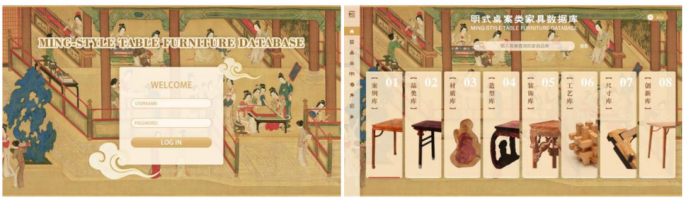
information data in a unified manner.The research generated a system data attribute table based on the architectural diagram of the database system model. It populated the data using the multi-dimensional feature attribute table of Ming-style furniture. The result is a background man- agement system for the Ming-style table furniture multi-dimensional feature database. This system is operated by an administrator and is used for management work such as inputting, editing, and updating the information data of the database. The background management system has multiple levels, including the user login page, case library page, cat- egory library page, material library page, and user management page. 2. Front-end technology implementation: Front-end technology imple- mentation involves utilizing Photoshop for designing and slicing web- page renderings, Dreamweaver CC for creating HTML webpages, and After Effects for presenting animation effects of database webpage operations.The front-end interface design serves as the cornerstone of presenting a database system. A visually appealing and user-friendly interface design enhances users’ intuitive interaction experience. A well- executed interface design encompasses considerations such as design style, layout, text arrangement, color coordination, content selection, browsing interaction, and various other design aspects.In the case of the multi-dimensional feature database for Ming-style tables and fur- niture, the interface design style was chosen based on its traditional Chinese cultural background. The renowned calligrapher and painter Qiu Ying from the Ming Dynasty was selected as the theme background for the interface design. Furthermore, in terms of overall color selec- tion and coordination, the color saturation of the background screen was adjusted to reduce it, while employing warm log colors as the primary color scheme with a touch of natural white. This color com- bination harmoniously aligns with the simple and elegant nature of Ming-style furniture.Regarding page layout, the content display area is clearly divided, unnecessary elements or structural designs unrelated to the main display content of the page are minimized, interactions are kept to a minimum, and key display content is emphasized to enhance user efficiency.Additionally, in terms of text arrangement, attention is given to the hierarchy of text content, highlighting important text, ensur- ing consistent font size, font style, and word spacing throughout the page. Depending on the volume of text content, appropriate typesetting adjustments are made.
Figure 4 shows the login page design of the multi-dimensional feature database of Ming-style table furniture. In conclusion, following an analysis of the stakeholders and usage requirements of the database, a comprehensive development process is undertaken to construct a Ming-style table furniture database. This process involves carefully selecting the background manage- ment system, designing the conceptual model of the database, determining the implementation path for the database backend, and establishing the front-end display system for the multidimensional feature database.
CONCLUSION
This study investigates the applicability of the grounded theory research method for mining and collecting multi-dimensional feature information per- taining to Ming-style furniture. Additionally, it combines statistical methods such as correlation analysis and difference analysis to establish a multi- dimensional feature theory model for Ming-style table furniture. This inter- disciplinary research approach represents a novel endeavor within the field of Ming-style furniture research.
Preservation and safeguarding of cultural heritage: Ming-style furniture holds significant historical and cultural value as a prominent representative of traditional Chinese furniture. Constructing a multi-dimensional feature database enables systematic documentation and preservation of the features, designs, and evolutionary processes associated with Ming-style furniture. Consequently, this database offers robust support for digitally protecting traditional furniture, thus safeguarding and perpetuating the nation’s rich cultural heritage.
Research and academic significance: The multi-dimensional feature database of Ming-style furniture presents abundant research resources and reference materials for scholars, researchers, and designers. A profound com- prehension of the design principles, process characteristics, and artistic styles of Ming-style furniture can be attained by comprehensively analyzing and studying the database’s data. This facilitates in-depth research on Ming-style furniture and offers valuable references and inspiration for furniture design, cultural studies, and other related disciplines.
Fostering innovative design: The Ming-style furniture multi-dimensional feature database provides valuable resources and inspiration for innovation within furniture design. Designers can derive inspiration and learn from traditional design elements and craftsmanship by analyzing and compar- ing the characteristic data stored in the database. By amalgamating modern aesthetics and contemporary demands, they can create new Ming-style fur- niture imbued with a distinctive style and contemporary characteristics. This progression aids in promoting the transformation and advancement of the traditional furniture industry while fostering the development of cultural and creative industries.
Education and inheritance: The multi-dimensional feature database of Ming-style furniture is crucial for education and inheritance. Through its establishment and utilization, knowledge and skills related to Ming-style fur- niture can be imparted to future generations. Furthermore, this database
Construction and Application of Multi-Dimensional Feature Model 27
cultivates and nurtures talent in relevant fields, thereby promoting the inher- itance and innovation of traditional furniture craftsmanship. This, in turn, ensures the continuity of furniture culture and provides an optimal learning platform for nurturing a new generation of furniture designers and skilled artisans.
FUNDING This research was funded by “the Major Philosophy and Social Science Research Project for Hubei Province Colleges and Universities, Grant num- ber No. 20ZD002 “and “the Fundamental Research Funds for the Central Universities of China, Grant number HUST: 2020kfyXJJS014”.
ACKNOWLEDGMENT
We would like to express our gratitude to the School of Mechanical Science and Engineering, HUST for providing research resources on this study.
REFERENCES
Barney G. Glaser, Anselm L. Strauss, Elizabeth Strutzel. The Discovery of Grounded Theory; Strategies for Qualitative Research[J]. Nursing Research, 1968, 17(4). Li Zhigang. Application Analysis of Grounded Theory Method in Scientific Research
[J]. Oriental Forum, 2007(04): 90–94. Qi Qingfu. On Inheritance and Inheritors in the Protection of Intangible Cultural Heritage[J]. Northwest Ethnic Studies, 2006(03):114-123+199. Tan Biyong, Zhang Ying. Research on Digital Protection of Chinese and Foreign
Intangible Cultural Heritage [J]. Books and Information, 2011(04): 7–11.
LISTED IN THE AHFE DIGITAL BOOKSTORE CATALOGUE
Explore the complete digital volume
Application of Emerging Technologies
Read this individual research paper free through the original publisher, or explore the full digital proceedings book.
ISBN 978-1-958651-91-9
Explore this ISBN in the AHFE Bookstore ↗Listed in the July 2026 bookstore catalogue; search by ISBN to confirm current availability · Digital book purchase optional