Yukun Xia, Zijie Ding, Shanyu Ge, Yongkang Wu, Yan Gan (2023). Home Healthcare System Application Design for COVID-19 Preventive Management. In: Health Informatics and Biomedical Engineering Applications. AHFE Open Access, vol. 78, pp. 41–48. https://doi.org/10.54941/ahfe1003453
COVID-19 is an infectious disease now known as a "global pandemic" and is reported to be transmitted directly, aerosolized and by contact, and is highly contagious when in contact with patients. Fever, dry cough, and malaise are the most common symptoms of COVID-19. And at this stage, there is still no comprehensive solution for the containment of COVID-19 from a microbiological and curative point of view. Therefore, we need a more independent environment and a smarter medical system for detection and transient isolation before and after social events. And IoT is a popular and proven management technology that can support a variety of human behavior management programs.In this paper, we used interview method, follow-up method, questionnaire method, and literature search method for research verification, process profiling of multiple usage scenarios, and proposed an APP(Application) program design of home medical system for different users' behavioral habits, with functions including risk assessment of planned activity locations and self detection after social activities (via close objects such as masks), etc. The application consists of four main modules: detection, planning, recording, and communication, tracking and warning of epidemic risk sites via wearable devices to reduce the risk of infection for users, and integration of software functions with smart home systems via IoT technology to improve the effectiveness of preventive management for users.
Director-General of the World Health Organization (WHO) Tan Desai said in February 2020 in Geneva, Switzerland, that the new coronavirus-infected pneumonia would be dubbed “COVID-19.” The World Health Organization (WHO) recognized coronavirus (SARS-CoV-2) as the cause of the 2019 pan- demic coronavirus disease in the same month (COVID-19). In the aftermath of the “pandemic of disease,” the daily increase in diseases and fatalities is a major source of concern for governments and populations. From the Decem- ber 31, 2019 COVID-19 outbreak through April 10, 2022, the WHO has received reports of over 496 million confirmed cases of COVID-19 and 6 million verified deaths. And the lack of homogeneity of symptoms among patients has pushed the pandemic to worldwide proportions (Elrashdy et al., 2020).
While Aggarwal et al. in 2020 concluded that age and pre-existing disease conditions such as diabetes, hypertension, respiratory disease and cardiova- scular disease are believed to increase the risk of death in patients with viral infections.Although vaccines have been developed against COVID-19 and its variants, their effectiveness is still difficult to resist the spread of the virus. From the point of view of microbial therapy, it is a method that can solve the problem at the root, but the results of his research are difficult to appear in a short time. That is why home systems and a smart application are needed to alleviate the problem through a preventive approach.
LITERATURE REVIEW
Following is an outline of the theory behind the design of home healthcare systems. Essentially, a smart house is outfitted with an advanced network that connects sensors and home equipment with capabilities that can be remotely monitored, used, or supervised in order to satisfy the demands of the residents. Diegal et al. view it as an integrated living environment with upgraded systems comprising four intelligent phases: devices, sensors, con- trol, and management. In the field of healthcare, smart homes can provide multifaceted, multisensory detection and management capabilities to meet the daily medical needs of the majority of families, improve their quality of life and health confidence, and provide a “fast track” for the elderly, children, and some individuals with limited mobility. IoT technology ena- bles smart homes to manage a broad spectrum of human behaviors in the field of disease prevention, assessing and alerting the user’s physical con- dition through data transfer from multiple devices and recommending the user’s future plans based on the assessment results for disease prevention and management purposes.
In order for the COVID-19 virus to reduce transmission and even disappear in the near future, humans are paying to be “regulated”in almost every aspect of their daily lives, and there are now rules governing how people around the world live, work, learn, play, and function, which has revolutionized how nearly everyone used to live.
From a prevention and management standpoint, the difficulty is the psych- ology of the masses. The psychological resistance hypothesis, presented by Rabia Bokhari and other scholars explains why individuals in a crowd are attracted to “risk” and outlines how any regulation or prohibition that seeks to prevent individuals from acting in a certain way might lead to psycholo- gical resistance. People are said to create a “motivational condition” when freedom is lost or threatened with elimination. When a person thinks that a rule or regulation threatens their autonomy or freedom of choice, they enter the motivational state described above, which assures that they exercise their power by rejecting the rule in question.
The COVID-19 prevention study has shifted its focus to machine lear- ning to solve the problem. The application of machine learning is a superior method for controlling prevention. Using machine learning, researchers such as Liberios Vokorokos detected Covid-19 illness. The accuracy of machine learning in predicting mortality in Covid-19 patients was 92%, and they
Home Healthcare System Application Design for COVID-19 Preventive Management 43
hoped that using machine learning in medicine would aid in the develo- pment of more accurate treatment plans. When training a prediction model for Covid-19 disease, the scholars achieved a success rate of 74% to 76%. After numerous experiments to improve the success rate, the accuracy of the VGG16 architectural predictions was increased to 86%. In many insta- nces, machine learning delivers more informative feedback, and we anticipate that this will result in faster turnaround times and fewer errors, allow- ing people to make better judgments. In addition, Omer Ali and other researchers have used machine learning to identify early COVID-19 signs. Physiological signature detection through smart wearables, while modern smart wearables and trackers are equipped with various sensors to track individual activities and used to differentiate the results, which aids in the analysis of potential biomarkers useful for early disease diagnosis and prevention.
The IoT plus preventive management system has applications in most key domains.In the field of medicine, Eshrag A. Refaee et al. proposed a compu- ting system integrating deep learning and IoT for effective disease diagnosis in a smart healthcare system, where data is collected via various IoT weara- ble devices, where sensors collect data and relay it to DL systems for accurate medical diagnosis. This instrument has significantly increased the effective- ness of medical diagnosis and paved the path for home employment and detection. Luke Power and other researchers have utilized IoT technology in the field of home healthcare and management by collecting data on the activities of users in the home and analyzing their condition and mood using sensors and remote indoor positioning systems.
App Strategy Design Based on Preventive Management Before beginning the design, we must determine the user’s requirements. This application’s target audience requires the author’s research and analysis of home user groups, families with elderly members and children to consider additional difficulties. In order to build a more comprehensive application product, it is essential to precisely assess the features of each level of the target audience. Our team gathered information about user requirements through follow-up visits, interviews, and questionnaires.
The author’s team interviewed ten family groups, distributed 203 questi- onnaires, and obtained 200 valid responses from 202 total responses. We did in-depth study on the function of “caregivers” in the family, and through the interviews and questionnaires, we were able to gain a comprehensive understanding of the user population.
Psychological characteristics: Unable to confirm the infection status of themselves or those with whom they come into contact, accompanied by anxiety, easily aggravating their fear of the outside world; worried about the infection of the elderly and children with weak resistance at home, alw- ays worried, easily distracted; under the epidemic, the management mode is more constrained and single, easy to make people resist psychology, difficult to manage.
Behavioral characteristics: need to go out the majority of the time, most people are forced to take public transportation; need to go home for disin- fection activities, activities in the living room, kitchen, and bedroom, when they cannot judge their own condition, to avoid contact with the elderly and children as much as possible. The majority of responders wear a mask most of the time to reduce their risk of infection.
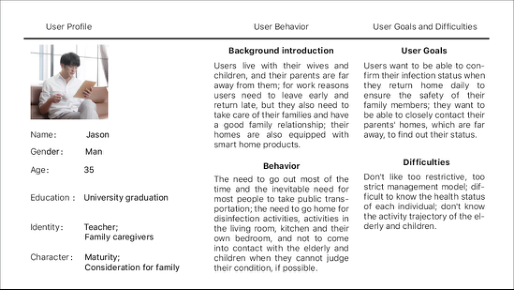
Through the analysis of user clustering, the Alan Cooper persona was used to construct “a 35-year-old family man with children”who wanted to be able to identify his health status each day and to know more about the outside world and viruses (see Figure 1).
Figure 1: User portrait analysis (Constructed using Alan Cooper persona method).
User needs: Need to confirm the infection status to reduce the panic about external things; can always pay attention to the elderly and children at home; personalized management mode to reduce the resistance psychology; need to go out most of the time and need a separate space for isolation at home; distance from parents and other relatives, need a more emotional contact.
Design function transformation:Health status display; family member association; smart home system for management; isolation check for con- firmation; emotional family interaction.
Interpretation of the Design Model in the “Prevention Management - Rehabilitation Management” Link The method will alter the user’s travel and home habits, but the persona- lized design will prevent the user from feeling constricted or wasting time. Furthermore, the family association approach will increase the user’s accepta- nce, hence reducing the aforementioned resistance. The process will enable users to add a brief waiting period when traveling or returning home so that the system can assess and record the health risks associated with the trip. During the waiting period, users will be able to access information about the outdoors and their family members’ health records.
To limit the unintentional spread of disease or to strengthen family trust. After spending a significant amount of time away from home or in a cro- wded environment, a short risk detection and assessment session will be
Home Healthcare System Application Design for COVID-19 Preventive Management 45
conducted using a combination of home smart devices and wearable devices. If the result is “not infected,” the user can continue as normal; if the result is “infected,” the system will record and provide the optimal remedy for the user. The system will offer recommendations for future journeys based on the user’s condition until he or she recovers.
Design development Combine previous information to determine design use and direction:Reduce the speed and route of disease transmission through preventive manage- ment;save medical resources by means of home diagnosis;reduce the fear and resistance of users to diseases;to enhance the intimate relationship between families.
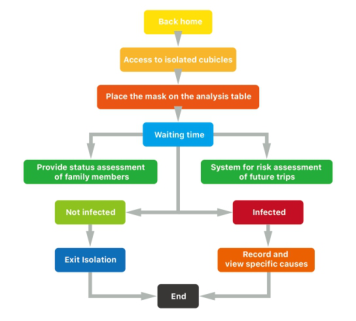
We had to develop the application framework in keeping with the “Functi- onal flowchart of preventative management” outlined in the preceding section (see Figure 2). The program will serve four primary purposes: device connectivity, disease detection, medical planning, and family engagement. Detection Home, My Family, Medical Information, and Personal Tasks and Profile make up the interface’s four parts.
In the Detection Home area, you will first be prompted to check in and select your family identification. If this is the user’s first time logging in, they will also be prompted to create a virtual image that matches their appearance. Then, in the test panel, users must pair their phones with the analyzer via Bluetooth or another method, place their masks or other objects that can be contaminated with COVID-19 markers on the analyzer, and wear smart wearable products such as bracelets. Additionally, there will be a brief waiting period before users can view the health information of other family members. A pop-up window that vibrates to remind the user to view the results appears once the results are available. If the result is “not infected,” the user is alerted and blessed; if the result is “infected,” the program moves to the medical planning and advising screen for further diagnostic and recovery counsel, and displays information regarding body temperature and disease level. The location of the infectious disease will be highlighted and described in writing adjacent to it, and the user will be able to click on it to access self-management
Figure 2: Functional flow chart of prevention management.
resources. This part can assist users more efficiently in completing preventive self-management, which can effectively limit disease transmission channels.
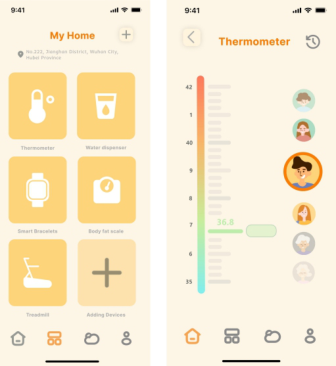
The My Family area displays a list of family devices and family members. When a family device is connected and used, the icon of that device becomes colorful and emphasized, and vice versa becomes gray. When a family mem- ber is active in the people list, the theme color associated with their mood is displayed, and a mood icon displays next to their name.
For secondary diagnosis and disease management, the most prominent position in the medical information area is given to the nearest and best hospital information. There are also three buttons for emergency, care, and equipment, allowing users to assist themselves or family members with public diagnosis in the event of an emergency. This board is utilized when away from home to address preventive management.
In the Personal Task and Profile board, it is primarily responsible for recor- ding the user’s past sickness information and integrating it with data analysis to make future testing and diagnostic results more precise. In this part, users can add rehabilitation chores for self-promotion, and they can asso- ciate rehabilitation tasks with family members for the goal of strengthening family ties.
The following step in the design process is element selection. This appli- cation’s primary target audience is home users, and its objective is to detect highly infectious viruses such as COVID-19 to assure home security. The desi- gners chose to make the elements and the family image more cartoonish and friendly; the process of preventive management is proposed to be the process of fighting against a virus invasion, while the user’s identity image can be modified to reduce the user’s sense of panic and increase their acceptance.
High-fidelity renderings of the application’s interface include the four pan- els mentioned above and a deeper interface for the detection process, the effects and interactions of which are shown below (see Figure 3).
Figure 3: Interface effect.
Home Healthcare System Application Design for COVID-19 Preventive Management 47
When the application is ready, the designer conducts usability testing of the product through interviews, and we collect the findings through simulated tests. The test material basically consisted of three sections: the applica- tion interaction difficulty test, the interface element acceptance test, and the application feature expectation test.
After collecting the test results and user reviews, we conducted further analysis. We learned that some older users had problems accurately com- pleting the application interaction process, that the majority of users had a higher acceptance of the interface elements, and that the vast majority were more anticipatory of the application’s capabilities. We choose to alter the tested interaction flow to make it more consistent with human usage patterns in order to enhance the user experience and efficiency.
CONCLUSION
The application adopts the concept of preventive management for reducing the spread of diseases, and can effectively reduce the user’s resistance from the family’s point of view for the purpose of controlling and managing disea- ses such as COVID-19. However, due to the development time limitation, the specific effect of the application needs further trials and tests, and more data from families need to be collected to improve the judgment and efficiency of the program.The author hopes that the design and research in this paper can be more than just for COVID-19 type of virus, and hopes to provide dire- ction for developing a general prevention and management approach. With the further improvement of science and technology, the forms of detection and information display can be more diversified, and there is more room for improvement in the use of the process and the form of interaction.
ACKNOWLEDGMENT
This research is funded by National Key Research and Development Program of China (2019YFC1805204).
REFERENCES
Bokhari, R.; Shahzad, K. Explaining Resistance to the COVID-19 Preventive Measures: A Psychological Reactance Perspective. Sustainability 2022, 14, 4476. https://doi.org/10.3390/su14084476 Elrashdy F, Aljaddawi AA, Redwan EM, Uversky VN (2020) On the potential role of
exosomes in the COVID-19 reinfection/reactivation opportunity. J Biomol Struct Dyn 39:1–12. Hosseini, N. F., Dalirfardouei, R., Aliramaei, M. R. et al. Stem cells or their exosomes: which is preferred in COVID-19 treatment?. Biotechnol Lett 44, 159–177 (2022). J. Jie Kai Yan and A. Siew Hoong Lee, “A Conceptual Model on Integration
of Technology Acceptance Model on Smart Home Healthcare System among Elderly,” 2022 4th International Conference on Advances in Computer Tech- nology, Information Science and Communications (CTISC), 2022, pp.1–5, doi: 10.1109/CTISC54888.2022.9849744.
L. Vokorokos, J. Palša, B. Madoš, M. Havrilla and M. Hasin, “Use of Machine Learning for COVID-19 Disease Detection,” 2022 IEEE 26th International Confe- rence on Intelligent Engineering Systems (INES), 2022, pp.000231–000236, doi: 10.1109/INES56734.2022.9922642. L. Power, S. Dunnett and L. Jackson, “Internet of Things Home Healthcare: The Fea-
sibility of Elderly Activity Monitoring,” 2018 International Conference on Com- putational Science and Computational Intelligence (CSCI), 2018, pp. 907–912, doi: 10.1109/CSCI46756.2018.00179. McIntosh K, Hirsch MS, Bloom A (2020) Coronavirus disease 2019 (COVID-19).
UpToDate Hirsch MS Bloom 5(1):873. O. Diegel et al. “A BLUETOOTH HOME DESIGN @ NZ BT - Home-Oriented Informatics and Telematics” pp. 87–99 2005. Refaee, E. A., Shamsudheen, S. A computing system that integrates deep learning
and the internet of things for effective disease diagnosis in smart health care systems. J Supercomput 78, 9285–9306 (2022). https://doi.org/10.1007/s11227- 021-04263-9
LISTED IN THE AHFE DIGITAL BOOKSTORE CATALOGUE
Explore the complete digital volume
Health Informatics and Biomedical Engineering Applications
Read this individual research paper free through the original publisher, or explore the full digital proceedings book.
ISBN 978-1-958651-54-4
Explore this ISBN in the AHFE Bookstore ↗Listed in the July 2026 bookstore catalogue; search by ISBN to confirm current availability · Digital book purchase optional