Jonas Lick, Benedict Wohlers, Philipp Sahrhage, Felix Schreckenberg, Susanne Klöckner, Sebastian Von Enzberg, Arno Kühn, Roman Dumitrescu (2023). Integrating Domain Expertise and Artificial Intelligence for Effective Supply Chain Management Planning Tasks: A Collaborative Approach. In: Artificial Intelligence, Social Computing and Wearable Technologies. AHFE Open Access, vol. 113, pp. 115–125. https://doi.org/10.54941/ahfe1004185
The integration of Artificial Intelligence (AI) techniques into various domains has revolutionized numerous industries, and Supply Chain Management (SCM) is no exception. This paper addresses the challenges encountered in SCM and the development of AI solutions within this context. Specifically, we focus on the application of AI in optimizing supply chain planning tasks. This includes forecasting demand, availability and feasibility checks for customer orders, supply chain network design and information flow inside the supply chain planning processes. However, the successful implementation of AI in SCM requires a deep understanding of both the domain-specific challenges and the capabilities and limitations of AI technologies. Thus, this paper proposes an overarching approach that facilitates collaboration between domain experts in SCM and AI experts, enabling them to jointly develop effective solutions.The paper begins by outlining the key challenges faced by SCM professionals, including demand volatility, complexities in inventory management, and dynamic market conditions. Subsequently, it delves into the challenges associated with developing AI solutions for SCM, including data quality, interpretability, and model transparency. To address these challenges, the proposed approach promotes close collaboration and knowledge exchange between SCM and AI experts. By leveraging the domain knowledge and experience of SCM experts, AI experts can better understand the special issues of SCM processes and tailor AI techniques to suit specific needs. In turn, SCM experts can gain insights into the capabilities and limitations of AI, allowing them to make informed decisions regarding the adoption and integration of AI in their supply chain planning operations. Furthermore, the paper discusses the importance of establishing a multidisciplinary team comprising experts from the fields of SCM, AI, and IT. This team-based approach fosters a holistic understanding of SCM challenges and ensures the development of AI solutions that align with business goals and practical constraints.In conclusion, this paper highlights the challenges in combining SCM and AI and proposes a collaborative approach to address these challenges effectively. By leveraging the expertise of both domain and AI experts, organizations can develop tailored AI solutions that enhance supply chain planning, improve decision-making processes, and drive competitive advantage. The proposed approach contributes to the successful integration of AI in SCM, ultimately leading to more efficient and resilient supply chains in the era of artificial intelligence.
AI is one of the most significant technologies currently in widespread use. Its impact on how companies operate is profound. The domain of supply chain management (SCM) is particularly suited for the application of AI due to its characteristics. The requirements for sustainability, resilience and effi- ciency of value chains are constantly increasing. In order to be able to meet these requirements, the potential of AI must be leveraged and used efficiently (Pournader et al., 2021). In this paper, we focus on the planning tasks at the tactical and strategic level of SCM, as these offer particularly great leverage for the medium- to long-term design of value chains. Moreover, they have one feature in common: the planning tasks according to Kuhn (demand planning, network planning, procurement planning, production planning, distribution planning and availability and feasibility checks) are carried out on the basis of forecast values and/or simulation studies. This is where AI can provide good support (Pournader et al., 2021, Cioffi et al., 2020).
However, the efficient development and subsequent successful use of AI solutions entails several challenges. For example, one must consider the inher- ent technical limitations of AI while simultaneously aiming to maximize the business value through the AI solution. To achieve this goal, it is imperative to bring together domain experts (Dora et al., 2022).
In the field of SCM, professionals deal with issues such as demand volatil- ity, inventory management complexities, and dynamic market conditions. These issues require AI solutions that are not only effective but also adaptable to the constantly evolving SCM landscape. Examples for potential AI solu- tions in SCM are intelligent sales forecasts, intelligent delivery time forecasts and AI solutions for analyzing and fixing problems such as parts tourism within the own SC and the bullwhip effect. The problem lies in bridging the gap between SCM and AI experts to enable the development of tailored AI solutions for SCM (Fosso Wamba et al., 2022).
This paper aims to address the mentioned challenges by proposing a collaborative procedure model that fosters knowledge exchange and close collaboration between SCM and AI experts. The paper’s contributions are twofold:
1. It provides a comprehensive overview of process models for the two domains of data science resp. AI and SCM and known process mod- els that combine these domains. The need for action is derived on this basis. 2. It proposes a collaborative process model that facilitates the joint devel- opment of AI solutions for SCM. This approach promotes the establish- ment of a multidisciplinary team comprising SCM, AI and IT experts. This team-based approach ensures a holistic understanding of SCM chal- lenges and the development of AI solutions that align with business goals and practical constraints like data availability across supply chain business partners.
Integrating Domain Expertise and Artificial Intelligence 117
This paper is focused on the process model itself, the supporting tools described will be published on the “it’s OWL innovation platform”1 for public use.
STATE OF THE ART: SCM AND AI PROCESS MODELS SCM plans and controls all material, information, and cash flows along the entire value chain – from the point of origin to the point of demand. The aim is to optimize the entire system and improve processes along the supply chain across all participants, for example to shorten order lead times or increase customer satisfaction (Werner 2017).
The best-known models in supply chain management are task models rather than process models. Examples include the supply chain operation reference model (SCOR model) or Kuhn’s task model. Although the SCOR model describes business activities along the functional areas of a supply chain (plan, source, make, deliver, return), these are not put into a defined sequence in the sense of a process model (SCOR 2017). Kuhn’s task model also does not offer a perspective in the sense of a process model on supply chain management. Rather, all IT-supportable tasks within SCM are struc- tured and collected according to their long-term nature from strategic to operational (Kuhn & Hellingrath 2013).
One of the best-known process models for the development of data-driven solutions is CRISP-DM (Cross Industry Standard Process for Data Min- ing), which was originally developed for data mining (Kessler et al., 2020). The model consists of 6 specific phases filled with activities, which have to be carried out iteratively: Business Understanding, Data Understanding, Data Preparation, Modelling, Evaluation and Deployment & Presentation (Schnattinger et al., 2020). The generic fields of action found in the phases with their subordinate actions and process steps are strongly dependent on the domain-specific field of application (Chapman et al., 2000). The CRISP- DM is very well suited as a process model for AI projects, including ML applications due to the overlap of the machine learning and data mining tech- niques. This is particularly evident in the modelling phase as both disciplines seek solutions within the data (Schnattinger et al., 2020). By AI projects in this context, we mean more elaborate development processes and explicitly not the use of pre-parameterised AI solutions such as ChatGPT. In its basic form, the described actions are described in a high-level manner. For this rea- son, approaches have emerged in the literature that can be seen as extension work. For example, Kessler & Gómez use the CRISP-DM approach to add three additional phases and responsibilities of their activities (Kessler et al., 2020). Another approach describes the adaption of the CRISP-DM approach performed by business professionals which are supported by a data science coach (Merkelbach et al., 2022).
Fischer et al. refer to the development steps of data-driven modelling in their AI system engineering lifecycle, which focuses on data preparation as 1The it’s OWL innovation platform contains databases with information and results on diverse innovation and transfer projects of the Technology Network it’s OWL. Around 200 companies, research institutes and organisations are part of it’s OWL.
the basis for modelling and finding a solution configuration (Fischer et al., 2020). Based on a systematic literature review, Schreckenberg et al., present a workflow that depicts differences and challenges in each phase depend- ing on an AI maturity level, while describing the roles and their activities to be performed. The thesis was put forward that the respective AI matu- rity of a company is fundamentally responsible for the different activities (Schreckenberg et al., 2021).
As shown, although process models present the phases of AI development and the activities contained therein and consider the roles involved, method- ologies for the incorporation and seamless communication of domain specific SCM expert knowledge are excluded in many parts or not described in a required detail level. For this reason, this paper aims to improve the collab- oration between SCM and AI experts by detailing the CRISP-DM process model.
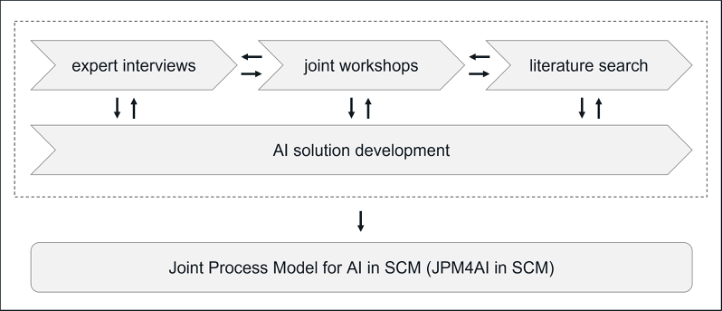
JOINT PROCESS MODEL FOR AI IN SCM The methodology for developing the Joint Process Model for AI in SCM (JPM4AI in SCM), that is introduced in the following paragraph, involved an approach that combined expert interviews, literature search, joint work- shops, and the development of concrete AI solutions within the German research project MOVE as shown in Figure 1. This comprehensive approach ensures a thorough understanding of the challenges and opportunities asso- ciated with integrating AI into SCM.
Figure 1: Methodology for developing the JPM4AI in SCM.
The developed process model is referring to the CRISP-DM model and details the phases of CRISP-DM in two ways: (1) a more detailed description of the respective steps in the phases of CRISP-DM and (2) the provision of concrete tools for carrying out the described steps.
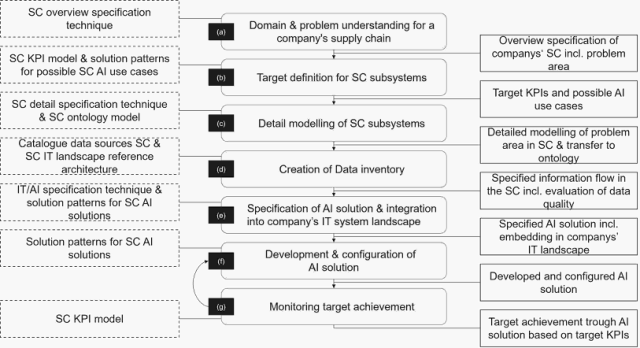
Based on the mapping of the CRISP-DM model phases to the JPM4AI in SCM, shown in Table 1, Figure 2 provides an overview of the phases, tools, and outcomes for each phase of our process model. The individual phases and supporting tools are described below. As with the underlying CRISP-DM, the
Integrating Domain Expertise and Artificial Intelligence 119
Table 1. Phases of CRISP-DM and derived phases of JPM4AI in SCM.
Table available in the original PDF paper.
Phase CRISP-DM Corresponding phase in JPM4AI in SCM Business understanding (a) domain & problem understanding in supply chain (b) target definition for supply chain subsystem (c) detail modelling supply chain subsystem Data understanding (d) data inventory Data preparation Data preparation Modelling (e) specification of AI solution & specification of integration into IT system landscape Evaluation Deployment Data preparation (f) development & configuration of AI solution Modelling Evaluation Deployment Business understanding (g) monitoring of target achievement
progression through the phases of our process model is to be understood as iterative and by no means sequential. For reasons of improved readability, we have chosen to refrain from indicating the iterative references between the individual phases in Figure 2.
Figure 2: Overview of JPM4AI in SCM and supporting tools.
(a) Domain & Problem Understanding for a Company’s Supply Chain Description: In the first phase of the process model, the rough structure of a company’s supply chain is specified. The first step is to identify the most important value creation partners. Based on this, the flow of goods between the value creation partners are modelled. The supply chain specified in this way is already sufficient to define areas where the company faces challenges in a joint discussion with SC domain experts. These challenges are referred to as symptoms within our process model. Based on the identified symp- toms, an initial assignment to problems in the affected SCM planning tasks
is made. The result of this phase is an overview of the company’s supply chain structure, highlighting areas where challenges or symptoms occur. These areas are then initially linked with problems in the execution of the SCM planning tasks (demand planning, network planning, procurement planning, production planning, distribution planning and availability and feasibility checks).
Developed tools: In this phase the helping tool is the so-called overview specification technique. Through an iterative procedure and a literature research, eight supply chain objects were identified. These objects repre- sent the nodes and edges within a supply chain so that the physical material flow can be specified. The specification technique distinguishes between “supplier”, “production unit”, “transport”, “storage unit”, “distribution centre”, “crossdock”, “dealer/customer” and “sales market”. These sup- ply chain objects have specific relations and dependencies, which limits the potential combinations of the elements. Furthermore, predefined properties qualitatively describe the respective objects. The degree of abstraction can be adapted depending on the application.
(b) Target Definition for Supply Chain Subsystems Description: Once the structure of the company’s supply chain has been recorded and roughly described, the target definition is part of the next phase. Analogous to the CRISP-DM model, this phase demands the definition of project goals for AI solution development including success criteria of the AI deployment. The first step describes the intended project outcomes, the second step the success criterias for the project. To define goals that are as comprehensible and measurable as possible, we incorporate a KPI model in our process model. This model defines key figures that make the challenges and consequences in the execution of SCM planning tasks measurable. Input for the appropriate selection of key figures is the symptom-problem matching performed in phase (a).
Based on the defined target KPIs and their target values, an initial alloca- tion of potential AI use cases is made. This mapping is done together with SC domain and AI experts. To assist, we provide AI use case solution patterns. Based on the SCM planning tasks, these solution patterns describe possible AI use cases and methodologies, as well as their requirements for technical prerequisites such as data quality.
This phase results in selected target KPIs, their corresponding target values and a first selection of possible AI use cases.
Developed tools: The developed KPI model is based on the SCOR Model (Chapman et al., 2000) and focuses on the fundamental supply chain areas of a company. The KPI model aggregates various top-level indicators into the Supply Chain Health indicator. We present the KPI model in detail in the publication (Wohlers et al., 2022).
The solution patterns were developed based on literature research. They collect the AI use cases implemented in the MOVE research project and expand them to include AI use cases in SCM that are widespread in the lit- erature. The AI solution patterns are categorised into AI approaches in the areas of ML, time series analysis and operations research. For each use case,
Integrating Domain Expertise and Artificial Intelligence 121
they specify possible maturity levels based on the data science maturity model according to (Lo et al., 2023). In addition, initial information on the techni- cal implementation is collected (possible AI algorithms and necessary data points including their required quality).
(c) Detail Modelling of Supply Chain Subsystems Description: By defining target KPIs and their target values as well as the area of challenges resp. symptoms, the according subsystems of a company’s sup- ply chain can be described in more detail. Additional elements of the detail specification technique enable the description of the existing company pro- cesses and structures according to the supply chain structure modelled in phase (a).
The detail specification technique builds on top of the specification tech- nique used in phase (a). It uses functional areas and parameters of a supply chain to detail the supply chain specification. This enables to gather und model knowledge about booking locations, material and goods movements as well as data collection points. To improve interoperability between the actors along the value chain and to facilitate communication with AI experts, the semiformal detail specification technique is extended by a so-called formal logistic model. This model offers a machine-readable documentation of the specified supply chain subsystems based on ontology principles. This helps documenting the relevant domain information in a formal way for the AI and IT experts, who can eventually use the formal logistic model as input for their implementation tasks.
The result of this phase is a detailed model of relevant SC subsystems, provided in a semiformal model and as a machine-readable formal logistic model.
Developed tools: The functional areas of the detail specification technique contain parameters, which are derived from literature research, expert inter- views and the KPI model (see phase b). Twelve different functional areas are described, which can be combined in a predefined way. The following functional areas are part of the specification technique: “Goods receipt”, “Goods issue”, “Handling area”, “Picking area”, “Packaging and consol- idation area”, “Production area”, “Storage area”, “Ramp”, “Transport”, “Storage location”, “Storage and retrieval area” and “Customer”. The func- tional areas are a way of supplementing the supply chain objects already recorded in phase (a). It is possible to omit functional areas if the information is not relevant for the previously defined purpose.
The developed ontology of the formal logistic model translates the semi- formal model of the detail specification technique into a machine-readable documentation. We provide an example of the ontology as an assistance tool in this phase.
(d) Creation of Data Inventory Description: The data inventory phase builds on the detailed modelling for the relevant SC subsystem from phase (c). This model already contains the physical material flow between the nodes of the supply chain. On this basis, the information flow along the material flow is added in the data inventory.
A catalogue of reference data sources in supply chains is used to support the creation of the data inventory. In addition, the necessary data sources for calculating the target KPIs selected in phase (b) are already assigned to the KPIs within the KPI model. These can be used as additional support. An IT landscape reference architecture for SCM that represents typical IT systems and their functions is given as a supporting tool as well.
The data inventory thus collects data points and their sources to analyze the information flow within the SC subsystem. All data are also assessed for their quality as part of the data inventory.
As a result, the data inventory contains documentation on all relevant data in the IT system landscape of the applying company. Based on this informa- tion, the feasibility of the selected AI use cases can be assessed, and the first use cases for implementation will be prioritised. This prioritisation is done through a cost-benefit analysis. Costs arise primarily from necessary data pre- processing steps and making new data sources available. AI use cases with a high potential for improvement of the selected target KPIs from the KPI model (see phase b) and that are already available including relatively simple data preprocessing are prioritised the highest.
Developed tools: The reference catalogue of SCM data points distinguishes between master data, inventory data and movement/transaction data. For each SCM planning task, the data identified as relevant in the literature and from interviews with business experts is listed.
The IT reference architecture specifies the most important functional mod- ules of common IT systems in SCM. For example, function modules in material requirements planning, purchasing, sales and other areas are defined for the ERP IT system. The data sources from the reference catalogue of SCM data points can be located in all of these areas. In combination, both tools ensure that no important data sources for the implementation of the AI use cases are overlooked.
(e) Specification of AI Solution & Integration Into Company’s IT System Landscape Description: Based on the documented data sources and prioritised AI use cases from phase (d), the technical implementation of the use cases is concep- tualised in this phase. To do this, we again use a specification technique that targets experts from the IT of the applying company and AI experts.
The result of phase (e) is a specified AI solution integrated in a company’s IT landscape.
Developed tools: Based on “Paise, a Process Model for AI Systems Engi- neering” (Hasterok 2021) our AI specification technique consists of the elements “Subsystem IT”, “Data Source”, “AI Algorithm/Method”and “Part of Data Pipeline”.
The first element of the specification technique is the “Subsystem IT”. This refers to the specific IT infrastructure or component within the organization where the AI solution will be integrated. It could be an existing ERP system, a CRM platform, a database management system, or any other IT compo- nent. The “Data Source” element focuses on identifying and specifying the
Integrating Domain Expertise and Artificial Intelligence 123
sources from which data will be drawn for the AI solution. The “AI Algorith- m/Method” element delves into the specifics of the AI solution. It involves selecting the appropriate AI algorithm or method based on the AI solution patterns (see phase b) and specifying the training, validation, and testing pro- cesses for the chosen algorithm. The “Part of Data Pipeline” element focuses on the end-to-end data flow for the AI solution. This involves specifying the data ingestion process, including data extraction, transformation, and load- ing (ETL) procedures. Also, the detailing of the data preprocessing steps, such as normalization, encoding, and feature engineering and outlining the data analysis and model training phases are part of this specification element. It can also be used for specifying the post-analysis steps, including model validation, deployment, and feedback loops.
(f) Development & Configuration of AI Solution Description: Based on the previous specification in phase (e), the actual AI solution is now implemented, e.g., in the form of a python script. In addition, the other components of the AI solution are developed or configured. The developed AI solution patterns, which were already explained in phase (b), support this process.
The result of this phase is a developed and configured AI solution. Developed tools: Relevant components of AI solution patterns for this phase show the conceptual functionality of different AI algorithms and methods, as well as the most relevant software tools and libraries for their implementation.
(g) Monitoring Target Achievement Description: In the final phase, the KPIs selected for target definition (see phase b) are measured again after the AI solution has gone live. We advocate that the target KPIs are monitored regularly subsequent to the AI solution being implemented. Based on our experience, it shows that the impact of the AI solution on the KPIs can be seen after a few months. The degree of target achievement can be determined based on the KPIs and the need for action to adapt and further develop the AI solutions can be derived on this basis.
Developed tools: The same KPI model is used that was already presented in phase (b).
CONCLUSION
AI is playing an increasingly important role in SCM and is already in use in many companies. In order to generate added business value, it is essential that AI solutions are developed together with domain experts from SCM and corporate IT. The process model presented shows concrete phases and tools to facilitate and support this collaboration.
The JPM4AI in SCM process model was developed based on litera- ture research and expert interviews with company representatives from the domains SCM, IT and AI and takes into account the jointly discussed chal- lenges in the collaboration. In the next step, we will validate the process model and the tools provided with the company’s SCM and AI experts.
To do this, we will apply the process model and the tools and compare them with AI projects that have already been run by the companies.
Future research activities should, for example, combine the process model with other methods to ensure the scalability of AI solutions, i.e., focus more on the overall enterprise architecture.
ACKNOWLEDGMENT
This work is part of the research project “MOVE - Machine intelligence for the optimisation of value networks”. The project is funded by the Ministry of Economic Affairs, Industry, Climate Action and Energy (MWIDE) of the State of North Rhine-Westphalia and managed by the Project Management Jülich (PtJ). The authors are responsible for the content of this publication.
REFERENCES
Chapman, P.; Clinton, J.; Kerber, R., et al., (2000): CRISP-DM 1.0. Step-by-Step Data Mining Guide, o. O.: SPSS. Cioffi, R.; Travaglioni, M.; Piscitelli, G.; Petrillo, A.; De Felice, F. Artificial Intelli-
gence and Machine Learning Applications in Smart Production: Progress, Trends, and Directions. Sustainability 2020, 12, 492. Dora, Manoj, et al., “Critical success factors influencing artificial intelligence adoption in food supply chains.” International Journal of Production Research 60.14 (2022): 4621–4640. Fischer, L.; Ehrlinger, L.; Geist, V.; Ramler, R.; Sobiezky, F.; Zellinger, W.; Brunner, D.;
Kumar, M.; Moser, B. AI System Engineering—Key Challenges and Lessons Learned. Mach. Learn. Knowl. Extr. 2021, 3, 56–83. Fosso Wamba, Samuel, et al., “Industry experiences of artificial intelligence (AI): Benefits and challenges in operations and supply chain management.” Production planning & control 33.16 (2022): 1493-1497. Hasterok, Constanze, et al., “Paise®. das Vorgehensmodell für KI-Engineering.”
(2021). Hellingrath, Bernd, and Axel Kuhn. Supply chain management: Optimierte Zusammenarbeit in der Wertschöpfungskette. Springer-Verlag, 2013. Hesenius, M.; Schwenzfeier, N.; Meyer, O., et al., (2019): Towards a Software
Engineering Process for Developing Data-Driven Applications. In: T. Menzies B. Turhan (Hrsg.): RAISE ‘19: Proceedings of the 7th International Workshop on Realizing Artificial Intelligence Synergies in Software Engineering. Piscataway: IEEE PRess, S. 35–41 Kessler, R.; Gómez, J. M. (2020): Implikationen von Machine Learning auf das Datenmanagement in Unternehmen. In: HMD Praxis der Wirtschaftsinformatik, 57 (2020) 1, S. 89–105. Lo, VSY and Pachamanova, DA. 2023. From Meaningful Data Science to Impactful
Decisions: The Importance of Being Causally Prescriptive. Data Science Journal, 22: 8, pp. 1–18. S. Merkelbach, S. Von Enzberg, A. Kühn and R. Dumitrescu, “Towards a Process Model to Enable Domain Experts to Become Citizen Data Scientists for Industrial Applications,” 2022 IEEE 5th ICPS, Coventry, United Kingdom, 2022, pp. 1–6 Pournader, Mehrdokht & Ghaderi, Hadi & Hassanzadegan, Amir & Fahimnia,
Behnam, 2021. “Artificial intelligence applications in supply chain management,” International Journal of Production Economics, Elsevier, vol. 241(C).
Integrating Domain Expertise and Artificial Intelligence 125
Schnattinger, K. (2020): Künstliche Intelligenz. In: M. Lang M. Müller (Hrsg.): Von Augmented Reality bis KI - Die wichtigsten IT-Themen, die Sie für Ihr Unternehmen kennen müssen. München: Carl Hanser Verlag, S. 93–118. Schreckenberg, Felix, and Nikolas Ulrich Moroff. “Developing a maturity-based
workflow for the implementation of ML-applications using the example of a demand forecast.” Procedia Manufacturing 54 (2021): 31–38. Werner, H. (2017): Supply Chain Management. Grundlagen, Strategien, Instrumente und Controlling. 6, Wiesbaden: Springer Gabler. Supply-Chain Council: Supply-Chain Operations Reference-model: SCOR Overview
Version 12.0 Wohlers, Benedict, et al., “A Domain-independent Model for KPI-based Process Management.” Production Management and Process Control 36 (2022): 70.
LISTED IN THE AHFE DIGITAL BOOKSTORE CATALOGUE
Explore the complete digital volume
Artificial Intelligence, Social Computing and Wearable Technologies
Read this individual research paper free through the original publisher, or explore the full digital proceedings book.
ISBN 978-1-958651-89-6
Explore this ISBN in the AHFE Bookstore ↗Listed in the July 2026 bookstore catalogue; search by ISBN to confirm current availability · Digital book purchase optional