Steffen Jansing, Roman Moehle, Barbara Brockmann, Jochen Deuse (2023). The hybrid analysis as a disseminator in the field of motion economics studies through machine learning methods and rule-based knowledge. In: Human Factors and Simulation. AHFE Open Access, vol. 83, pp. 158–167. https://doi.org/10.54941/ahfe1003573
1 Institute of Production Systems, TU Dortmund University, 44227 Dortmund, Germany ↗
2 Institute of Production Systems, TU Dortmund University, 44227 Dortmund, Germany; Centre for Advanced Manufacturing, University of Technology Sydney, Ultimo NSW 2007, Australia ↗↗
Manufacturing companies are increasingly confronted with the challenges of market globalisation, a shortening of product life cycles and a growing diversity of variants. New and flexible approaches to optimizing production processes and their planning ability are therefore needed to secure competitiveness in a sustainable way. Manual assembly in particular is a cost factor in the manufacturing industry and takes up a high proportion of the total production time. In addition to the efficient design of assembly processes, the ergonomic assessment and optimisation of work systems to avoid health hazards is also becoming increasingly important, also in consideration of demographic change. Currently, high personnel costs for the analysis of the workplace as well as special technical requirements for the employees in industrial engineering are identified as problematic. Especially for small and medium-sized companies with limited capacities in planning and existing competence levels of the employees, this aspect represents a hurdle that should not be underestimated. The following paper discusses the hypothesis that a combined approach of machine learning and rule-based knowledge as a hybrid analysis is suitable for transferring motion data captured by motion capturing into rule-conforming analyses in a semi-automated way. For this purpose, the new process building block system MTM-Human Work Design is used, which documents the required influencing factors chronologically and makes them variably evaluable in order to create time measurements and ergonomic execution analyses.
Manufacturing companies are facing increasing challenges by rising compe- titive pressure, which is forcing them to make more efficient use of their resources (Abele and Reinhart, 2011). In order to maintain a long-term com- petitive position in high-wage locations such as Germany (Eurostat, 2022), this means constantly reviewing the deployment of employees. Despite the
The Hybrid Analysis as a Disseminator in the Field of Motion Economics Studies 159
increasing use of automation solutions, the majority of activities in the areas of production and logistics continue to be performed manually, with manual activities represent a significant cost factor and therefore requiring detai- led planning (Scholer, 2018). Reinforced by demographic change as well as an increased awareness of work-related health hazards, the ergonomic assessment and optimization of work systems is also gaining in importance (Schlund et al., 2018). Furthermore, the ergonomic design of work systems is essential for error-free, efficient, and waste-reduced execution of work and has been shown to increase employee motivation along the value chain (Dombrowski and Kuhlang, 2017).
Therefore, Industrial Engineering has a set of different analysis tools at its disposal. One example is formed by the systems of predetermined times as a tool for time measurements analysis of manual processes (Shell, 1986). With their help, work processes can be described by standardized move- ment increments to which execution times are assigned on the basis of an assumed standard performance. This also enables a prospective planning of processes as well as a direct evaluation of optimizations (Deuse and Busch, 2012). One of the most common building block systems in operational appli- cation in Germany and other industrial states is Methods-Time-Measurement (MTM) (Genaidy et al., 1990). In contrast, ergonomic design of work systems focuses on reducing the probabilities of potential health hazards for emplo- yees through stress reduction (Schlick et al., 2018). To this end, numerous methods with varying focus and granularity available to practitioners. An example of a holistic assessment of biomechanical risk for the whole body and upper extremities is the Ergonomic Assessment Worksheet (EAWS) (Sch- aub et al., 2013). The process building block system MTM-Human Work Design (MTM-HWD) is a new method of industrial engineering that makes it possible to derive time measurements and ergonomic analyses on the basis of a process description.
Both methods in the area of time measurements and ergonomic analyses require a high degree of experience in addition to profound technical quali- fications in their application for small and medium-sized companies (Benter and Kuhlang, 2020; Deuse and Busch, 2012).
Therefore, new and complementary methods are needed to simplify and reduce the effort required to create work system analyses. The use of digi- tal technologies for virtual mapping of human movements is becoming more important in industrial planning processes. These technologies are useful for deriving planning analyses on time measurements and ergonomics in the context of digital work system design, such as with ema Work Designer (Fritzsche, 2021; Bullinger-Hoffmann and Mühlstedt, 2016). The automa- ted generation of analyses, for example, offers high potential in this context (Borsdorf et al., 2022). Motion capturing (MoCap) methods can be used to reduce the effort involved in recording the actual state of manual processes. Studies have already shown that the use of data recorded via MoCap is sui- table for the derivation of MTM components. However, the direct derivation using mathematical models and the exclusive use of neural networks as mach- ine learning (ML) methods have revealed the need for optimizing the quality of results (Deuse et al., 2020; Benter and Kuhlang, 2020). Furthermore, if
the existing need to capture ergonomic influencing variables is taken into account, a clear extension with additional influencing variables results. One approach to meet both the higher requirements and the fundamental challen- ges of automated analysis of human movements in the context of work study is the combined use of machine learning and rule-based reasoning. Such a formalized model for hybrid analysis is discussed in the following paper with its challenges and special potentials.
CAPTURING OF MOTION DATA IN MANUAL PROCESSES Acquiring digital motion data is a fundamental requirement for generating automated execution analyses and is already being used in various ways, such as ergonomic risk assessment (Yunus et al., 2021). The goal is to capture and mathematically describe movements as accurately and completely as possible (Simon et al., 2017). When directly comparing the different MoCap methods, it is important to identify and classify differences that are essential for use in work economic studies.
This can be done using optical and non-optical systems. If an optical recor- ding is carried out, it can be marker-based with markers attached to the human body or markerless (Gudehus, 2009; Schlick et al., 2018). Marker- based MoCap methods use markers on the human body and can be further divided into camera-based systems and systems using sensors. While camera- based systems capture markers fixed to the body and use computation to generate a three-dimensional image of the human body (Gudehus, 2009; King and Dailey Paulson, 2007), some methods also exist in which sensors are atta- ched directly to the body. Sensors include protractors, pressure sensors for the feet, accelerometers, and gyroscopes (Aminian and Najafi, 2004). However, when using marker-based MoCap systems, regardless of the specific technical implementation, there is a risk of influencing the human’s movement pattern and thus manipulating the analysis results (Gudehus, 2009).
In contrast, markerless systems are based on magnetic, mechanical, or acoustic technologies and measure changes in physical quantities. These quantities can subsequently be used to infer the position and orientation of objects (King and Dailey Paulson, 2007). Additionally, it is possible to gene- rate 3D models visually by using special cameras to capture additional depth data in addition to the simple 2D image (Kadambi et al., 2014). An example of the use of 3D cameras in the context of work study is the work of Benter and Kuhlang (2020), which describes the use of 3D motion data to identify motions in the MTM-1 process building block system. This work also points to the particular suitability of video-based, markerless systems due to their minimal effect on motion execution.
In addition to using cameras with depth detection, deep learning techni- ques can generate a 3D skeletal model from a single two-dimensional RGB image or 2D image sequence (Motta et al., 2017; Guo et al., 2019; McLau- ghlin et al., 2022). An example is represented by the model of Simon et al. (2017), which uses this technique for hand recognition and was trained using multiview bootstrapping. For this, images of hands in different poses were captured from two perspectives, and points on the hand were detected using
The Hybrid Analysis as a Disseminator in the Field of Motion Economics Studies 161
Convolutional Pose Machines (Wei et al., 2016; Simon et al., 2017). Since this approach does not impose any special requirements on cameras or use of additional sensor technology and also allows approximation of hidden points, it is particularly suitable for detecting motion sequences.
PERFORMANCE OF MACHINE LEARNING IN WORK STUDIES The described recording of human movements via MoCap provides the basis for processing as machine-readable data. For example, Benter and Kuhlang (2020) identify movements using mathematical models for the characteri- stic expression of joint angles over time. Furthermore their provision as machine-readable data enables the use of machine learning methods for the classification of movements. Machine Learning (ML) is the term used to describe a subfield of Artificial Intelligence that focuses on the problem of constructing a system that improves itself based on experience (Mitchell, 2017). The goal of ML is described as learning patterns, from existing data, which can be used to predict future data (Murphy, 2012).
An example of the use of ML is described by Deuse et al. (2020) in the use of convolutional neural networks to identify MTM-1 basic movements from motion data. Here, however, the focus is exclusively on the basic movements and the upper body of the subject. Another example involving ergonomic variables and the whole body in the context of MTM-HWD is described in Jansing et al. (2023). In this, the suitability of ML for the classification of expressions of the influence factors Type of Grasp and Grasp Motion for the right hand was tested. Thereby, both the models for the prediction of Type of Grasp and Grasp Motion were able to achieve high accuracy. Thus, the use of MoCap systems and the subsequent analysis of the motion data using ML could be identified as a proven means to reduce the analysis effort by detecting actions and the expression of influencing factors (Jansing et al., 2023; Deuse et al., 2020). Other approaches, such as the use of ML models for the text-based eva- luation of work processes, also demonstrate the particular suitability of ML for use in work economics studies. In addition to the reduction of analysis- specific effort, a particular suitability for the reduction of complexity can be observed when using MTM process languages (Borsdorf et al., 2022).
Both the presented studies and other studies (e.g., (Koch et al., 2022)) point to existing challenges in the use of ML in the context of analyses. For exam- ple, there are high demands on the quality and size of the data set used to train the models employed (Koch et al., 2022; Borsdorf et al., 2022). The datasets need to present a diverse range of activities in differing frameworks to guaran- tee reliable training of the models. The use of skeletal models can reduce the effort required to differentiate the subject group by excluding anthropome- tric factors that may influence the results. Otherwise, additional influencing factors such as gender, body size, physical constitution, etc. are required as part of the data acquisition process to represent a broad subject collective (Deuse et al., 2020). The quantity of influencing factors to describe in the analysis context represents a further hurdle. A first step is the use of the com- bined process module system MTM-HWD. This enables a comprehensive
description by means of 26 influencing factors compared to an individual evaluation by means of MTM-1 (32 factors) and EAWS (43 factors) (Kuh- lang, 2015). In addition, influence factors can also be directly derived using rule-based knowledge in conjunction with body poses estimated via skeletal models (Jansing et al., 2023). Existing uncertainties in common ML algo- rithms also require an approach beyond the mere use of ML models. Such deterministic algorithms only differentiate distinctly different human body motions (Le and Nguyen, 2020). In conclusion, the integration of rule-based knowledge in addition to an exclusive evaluation using ML represents an elementary component for the automated and correct generation of analyses.
INTEGRATION OF RULE BASED KNOWLEDGE To translate digital motion data from software applications, the MTM ASSO- CIATION e.V. has created MTMmotion, a concept that is intended to enable different software tools to describe motion data in a uniform manner and translate it into MTM analyses. The software transforms data that are avai- lable in a defined input format into MTM analyses via an interface, whereby the consideration of the MTM set of rules ensures the correctness of the MTM analysis in terms of rules (Huebser et al., 2021; Borsdorf et al., 2022). This concept was developed in which the translation of VR motion data into MTM-UAS analyses was conceptually implemented. Objects, body and arm movements, and postures were identified as key data (Spitzhirn et al., 2022).
In addition to the incorporation of rule-based knowledge into the gene- ration of analyses with accompanying entanglements between MTM-HWD actions and influencing factors, another example is the consideration of experiential knowledge to increase prediction accuracy. This refers to the consideration of probabilities with which individual actions and influencing factors occur simultaneously or follow each other. By the interaction of ML for the evaluation of movement data with the further described decision parameters a higher result quality of the analysis is expected compared with deterministic algorithms. Finally, ambiguities as well as errors in the data require user feedback for elimination and does not require expert knowledge due to the implicit consideration of rule-based knowledge.
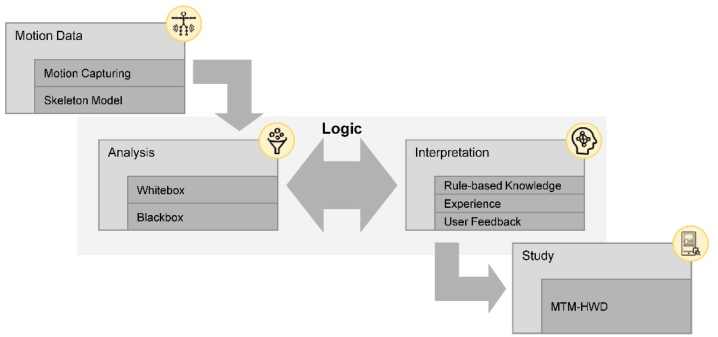
PROSPECTION FOR HYBRID ANALYSIS METHOD To integrate the described decision parameters into a holistic pro- cess of creating analyses, a partially automated procedure is required. In a combining logic, the new process applies both rule-based and experience-based knowledge to the motion data collected via MoCap. The missing parts and ambiguities in the database can be corrected by user feedback. This requires a multistep approach, which is described in Figure 1.
The basis of the analysis is motion data recorded via MoCap. As descri- bed above, these can be acquired via a multitude of systems. To enable a system-independent use of the method, skeleton models should be used. They
The Hybrid Analysis as a Disseminator in the Field of Motion Economics Studies 163
Figure 1: Concept of hybrid analysis for the transfer of movement data into motion studies.
are suitable for an analysis via ML models and the application of direct rule-based knowledge, e.g., via joint angles.
The derivation of the various influencing variables is carried out as part of the analysis of the movement data. A distinction is made betw- een blackbox and whitebox models. Dependencies that are deterministi- cally known are represented with whitebox models (e.g., joint angle for trunk inclination or leg posture). Unknown dependencies are represented by data-driven blackbox models, which are very difficult to explain in their result from a mathematical point of view (e.g., for grip type or grip move- ment) (Loyola-Gonzalez, 2019). Classification and regression methods based on deep neural networks are considered particularly useful for black-box models.
In interaction with the analysis, the interpretation of the analysis results takes place. Both processes can be summarized as a logic, which represents a hybrid model and links several data models: constraints by conside- ring rule conformance, probability predictions for individual actions and influencing factors as well as user feedback for ambiguities and misses. The result of the interpretation represents the input for the final analysis step.
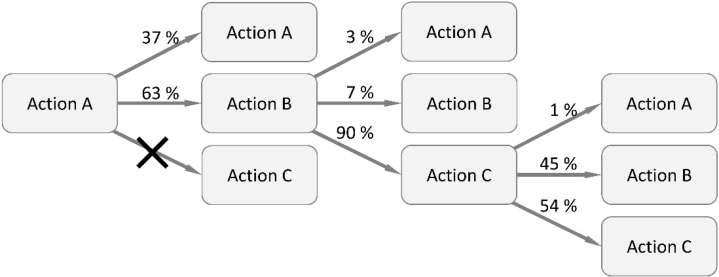
The prediction and output of probabilities for subsequent motion incre- ments enables the implementation of a branch prediction interface. By combi- ning this with the prediction of model probabilities and constraints involving the maximum likelihood method, the most statistically likely outcome for a parameter can be determined. This is exemplified in Figure 2 below. In this, the individual actions shown in rectangles follow each other with a differen- tiated probability or are excluded. Thus, probable paths in the interpretation can support the decision making.
The result of the logic represents information which, as unambiguous information, enables the time measurements as well as ergonomic study of movement execution in the form of an MTM-HWD analysis.
Figure 2: Exemplary representation of a sequence of actions with typical probabilities of occurrence and rule-based constraints for decision support.
CONCLUSION AND OUTLOOK Through the interaction of black- and whitebox models for the analysis of motion data as well as their interpretation as an overall structured logic, a higher result quality can be expected compared to deterministic algori- thms. By considering constraints and empirical knowledge, uncertainties in common ML algorithms can be reduced.
To elaborate the described target state, a development of a methodology for the implementation of the rule-based knowledge for the process building block system MTM-HWD is required first. Furthermore, an elaboration of the design for the analysis for the interaction of the black- as well as whi- tebox models has to be developed. In addition, it requires the inclusion of appropriate data acquisition for training the created ML models to complete the blackbox models. It also requires the development of a concept for taking user feedback into account via a suitable user interface.
FUNDING This publication is part of the projects 21605 N and 22813 N of the Industrial Collective Research (IGF). These projects are funded by the Federal Ministry for Economic Affairs and Climate Action (BMWK) on the basis of a decision by the German Bundestag.
REFERENCES
Abele, Eberhard; Reinhart, Gunther (2011): Future of Production. Challenges, research fields, opportunities. (translated title) Munich: Carl Hanser. DOI: 10.3139/9783446428058. Aminian, Kamiar; Najafi, Bijan (2004): Capturing human motion using body-fixed
sensors: outdoor measurement and clinical applications. In: Comp. Anim. Virtual Worlds 15 (2), S. 79–94. DOI: 10.1002/cav.2. Benter, Martin; Kuhlang, Peter (2020): Analysing Body Motions Using Motion Capture Data. In: Isabel L. Nunes (ed.): Advances in Human Factors and Systems Interaction, vol.959. Cham: Springer International Publishing (Advances in Intelligent Systems and Computing), p. 128–140.
The Hybrid Analysis as a Disseminator in the Field of Motion Economics Studies 165
Borsdorf, Albrecht; Nöhring, Fabian; Kuhlang, Peter (2022): Automated generation of MTM analyses. (translated title) In: Zeitschrift für wirtschaftlichen Fabrikbetrieb 117 (10), S. 651–654. DOI: 10.1515/zwf-2022-1124. Bullinger-Hoffmann, Angelika C.; Mühlstedt, Jens (2016): Homo Sapiens Digita-
lis - Virtual ergonomics and digital human models. (translated title) Wiesbaden, Heidelberg: Springer Vieweg. DOI: 10.1007/978-3-662-50459-8. Deuse, Jochen; Busch, Felix (2012): Time management in assembly. (translated title) In: Assembly in industrial production: Springer, Berlin, Heidelberg, S. 79–107. DOI: 10.1007/978-3-642-29061-9_4. Deuse, Jochen; Stankiewicz, Lukas; Zwinkau, Ronny; Weichert, Frank (2020): Auto-
matic Generation of Methods-Time Measurement Analyses for Assembly Tasks from Motion Capture Data Using Convolutional Neuronal Networks - A Proof of Concept. In: Isabel L. Nunes (ed.): Advances in Human Factors and Systems Inte- raction, vol. 959. Cham: Springer International Publishing (Advances in Intelligent Systems and Computing), p. 141–150. Dombrowski, Uwe; Kuhlang, Peter (ed.) (2017): Human - Organization - Technology in Lean Enterprise 4.0. (translated title) Proceedings of the 10th Braunschweig Symposium on Holistic Production Systems. Aachen: Shaker. ISBN: 978-3-8440- 5411-8. Eurostat (2022): Average gross monthly earnings of full-time employees in European
Union (EU) countries in 2018. (translated title) Statista. Access: https://de.statista. com/statistik/daten/studie/183571/umfrage/bruttomonatsverdienst-in-der-eu/, last checked 16.01.2023. Finsterbusch, Thomas (2016): Development of a methodology for the formation of building block systems for human work design. (translated title) Disser- tation. Dresden University of Technology; German MTM Association. ISBN: 978-3-945635-12-4. Finsterbusch, Thomas; Petz, Andreas; Faber, Marco; Härtel, Jörg; Kuhlang, Peter;
Schlick, Christopher M. (2016): A Comparative Empirical Evaluation of the Accu- racy of the Novel Process Language MTM-Human Work Design. In: Christopher Schlick und Stefan Trzcieli´nski (ed.): Advances in Ergonomics of Manufacturing: Managing the Enterprise of the Future, vol. 490. Cham: Springer International Publishing (Advances in Intelligent Systems and Computing), S. 147–155. DOI: 10.1007/978-3-319-41697-7_14. Fritzsche, Lars (2021): Ergonomics 4.0 - Challenges and opportunities of Industry 4.0 for the design of humane workplaces. (translated title) Hochschule Mittweida, University of Applied Sciences. DOI: 10.48446/opus-12302. Genaidy, A. M.; Agrawal, A.; Mital, A. (1990): Computerized predetermined
motion-time systems in manufacturing industries. In: Computers & Industrial Engineering 18 (4), S. 571–584. DOI: 10.1016/0360-8352(90)90016-F. Gudehus, Thomas C. (2009): Development of a method for the ergonomic evaluation of assembly activities by motion capturing. (translated title) Dissertation. Kassel University, 2008. Kassel: Kassel University Press. ISBN: 978-3-89958-650-3. Guo, Yu; Zhao, Lin; Zhang, Shanshan; Yang, Jian (2019): Coarse-to-Fine 3D Human
Pose Estimation. In:. International Conference on Image and Graphics: Springer, Cham, S. 579–592. DOI: 10.1007/978-3-030-34113-8_48. Huebser, Louis; Thamm, Sascha; Hellebrandt, Thomas; Heine, Ina; Schmitt, Robert H. (2021 Detection of assembly line sequences using 6 DoF time series data for process diagram generation. (translated title) In: Leyendecker, B. (eds) Quality Management in the 20s - Trends and Perspectives. Berlin, Heidelberg: Springer Berlin Heidelberg, S. 120–145. DOI: 10.1007/978-3-662-63243-7_7.
Jansing, Steffen; Brockmann, Barbara; Möhle, Roman; Patzelt, Dominik; Deuse, Jochen (2023): Potentials of motion capturing in the creation of execution analy- ses. Future-proof time measurements and ergonomic analyses. (translated title) In: Zeitschrift für wirtschaftlichen Fabrikbetrieb 118 (1-2). DOI: 10.1515/zwf- 2023-1008. Kadambi, Achuta; Bhandari, Ayush; Raskar, Ramesh (2014): 3D Depth Came-
ras in Vision: Benefits and Limitations of the Hardware. In: Computer Vision and Machine Learning with RGB-D Sensors: Springer, Cham, S. 3–26. DOI: 10.1007/978-3-319-08651-4_1. King, Brett Allan; Dailey Paulson, Linda (2007): Motion Capture Moves into New Realms. In: Computer 40 (9), S. 13–16. DOI: 10.1109/MC.2007.326. Koch, Julian; Büsch, Lukas; Gomse, Martin; Schüppstuhl, Thorsten (2022): A
Methods-Time-Measurement based Approach to enable Action Recognition for Multi-Variant Assembly in Human-Robot Collaboration. In: Procedia CIRP 106, S. 233–238. DOI: 10.1016/j.procir.2022.02.184. Kuhlang, Peter (ed.) (2015): Modeling Human Work in Industrial Engineering: Fundamentals, Practical Experiences, and Perspectives. (translated title) Stuttgart: ergonomia (MTM-Schriften Industrial Engineering, 3). ISBN 978-3-935089-29-6. Le, Van-Hung; Nguyen, Hung-Cuong (2020): A Survey on 3D Hand Skeleton and
Pose Estimation by Convolutional Neural Network. In: Adv. sci. technol. eng. syst. j. 5 (4), S. 144–159. DOI: 10.25046/aj050418. Lotter, Bruno (2012): Assembly in Industrial Production. A Handbook for Practice.
(translated title) 2nd ed. Berlin, Heidelberg: Springer Berlin / Heidelberg. DOI: 10.1007/3-540-36669-5. Loyola-Gonzalez, Octavio (2019): Black-Box vs. White-Box: Understanding Their Advantages and Weaknesses From a Practical Point of View. In: IEEE Access 7, p. 154096–154113. DOI: 10.1109/ACCESS.2019.2949286. McLaughlin, Niall; Martinez-del-Rincon, Jesus; Miller, Paul (2022): 3-D Human
Pose Estimation Using Iterative Conditional Squeeze and Excitation Networks. In: IEEE Trans. Cybern. 52 (1), S. 687–699. DOI: 10.1109/tcyb.2020.2964992. Mitchell, Tom (2017): Key Ideas in Machine Learning. In: Tom Mitchell (ed.): Machine Learning: McGraw Hill. India. ISBN: 9781259096952. Motta, Everton Simoes da; Sementille, Antonio Carlos; Aguilar, Ivan Abdo (2017):
Development of a Method for Capturing Human Motion Using a RGB-D Camera. In: 2017 19th Symposium on Virtual and Augmented Reality (SVR): IEEE. DOI: 10.1109/SVR.2017.21. Murphy, Kevin (201): Machine Learning - A Probabilistic Perspective. Cambridge: MIT Press (Adaptive Computation and Machine Learning). ISBN: 978-0-262- 01802-9. Schaub, Karlheinz; Mühlstedt, Jens; B. Illmann; Sebastian Bauer; L. Fritzsche;
Torsten Wagner et al. (2013): Ergonomic assessment of automotive assembly tasks with digital human modelling and the ‘ergonomics assessment worksheet’ (EAWS). In: International Journal of Human Factors Modelling and Simulation, S. 398–426. DOI: 10.1504/IJHFMS.2012.051581. Schlick, Christopher; Bruder, Ralph; Luczak, Holger (2018): work science. (translated title) 4. ed. 2018. Berlin, Heidelberg: Springer Berlin Heidelberg. DOI: 10.1007/978-3-662-56037-2. Schlund, Sebastian; Mayrhofer, Walter; Rupprecht, Patrick (2018): Options for
the design of individualized assembly workstations with respect to recent tech- nological developments. (translated title) In: Z. Arb. Wiss. 72 (4), S. 276–286. DOI: 10.1007/s41449-018-0128-5.
The Hybrid Analysis as a Disseminator in the Field of Motion Economics Studies 167
Scholer, Matthias (2018): Adaptive and adaptive automation in automotive assembly using continuous modular engineering - The example of human-robot cooperation in underbody assembly. (translated title) Dissertation. Saarländische Universitäts- und Landesbibliothek. DOI: 10.22028/D291-27801. Shell, Richard L. (ed.) (1986): Work measurement: Principles and practice. Inst of
Industrial Engineers. ISBN: 978-0898060850. Simon, Tomas; Joo, Hanbyul; Matthews, Iain; Sheikh, Yaser (2017): Hand Keypoint Detection in Single Images using Multiview Bootstrapping. DOI: 10.48550/ar- Xiv.1704.07809. Spitzhirn, Michael; Benter, Martin; Heindl, Christoph; Scheder, Noël; Reisinger,
Gerhard; Strohmeier, Felix; Behrendt, Wernher (2022): Hybrid work systems— platform-based work planning—designing productive and human-centered work processes. In: Z. Arb. Wiss. 76 (4), S. 489–509. DOI: 10.1007/S41449-022- 00342-6. Wei, Shih-En; Ramakrishna, Varun; Kanade, Takeo; Sheikh, Yaser (2016): Convolutional Pose Machines. In: 2016 IEEE Conference on Computer Vision and Pattern Recognition (CVPR): IEEE. DOI: 10.48550/arXiv.1602.00134. Yunus, Muhamad Nurul Hisyam; Jaafar, Mohd Hafiidz; Mohamed, Ahmad Sufril
Azlan; Azraai, Nur Zaidi; Hossain, Md Sohrab (2021): Implementation of Kinetic and Kinematic Variables in Ergonomic Risk Assessment Using Motion Capture Simulation: A Review. In: International journal of environmental research and public health 18 (16). DOI: 10.3390/ijerph18168342.
LISTED IN THE AHFE DIGITAL BOOKSTORE CATALOGUE
Explore the complete digital volume
Human Factors and Simulation
Read this individual research paper free through the original publisher, or explore the full digital proceedings book.
ISBN 978-1-958651-59-9
Explore this ISBN in the AHFE Bookstore ↗Listed in the July 2026 bookstore catalogue; search by ISBN to confirm current availability · Digital book purchase optional