Dimitrios Ziakkas, Konstantinos Pechlivanis, Brian Dillman (2023). Assessment of pilots' training efficacy as a safety barrier in the context of Enhanced Flight Vision Systems (EFVS). In: Human Factors and Simulation. AHFE Open Access, vol. 83, pp. 113–119. https://doi.org/10.54941/ahfe1003568
Aviation and air travel have always been among the businesses at the forefront of technological advancement throughout history. Both the International Air Transportation Authority's (IATA) Technology Roadmap (IATA, 2019) and the European Aviation Safety Agency's (EASA) Artificial Intelligence (AI) roadmap (EASA, 2020) propose an outline and assessment of ongoing technological prospects that change the aviation environment with the implementation of AI from the initial phases. New technology increased the operational capabilities of airplanes in adverse weather. An enhanced flight vision system (EFVS) is a piece of aircraft equipment that captures and displays a scene image for the pilot, allowing for improved scene and object detection. Moreover, an EFVS is a device that enhances the pilot's vision to the point where it is superior to natural sight. An EFVS has a display for the pilot, which can be a head-mounted display or a head-up display, and image sensors such as a color camera, infrared camera, or radar. A combined vision system can be made by combining an EFVS with a synthetic vision system. A forward-looking infrared camera, also known as an enhanced vision system (EVS), and a Head-Up Display (HUD) are used to form the EFVS. Two aircraft types can house an EFVS: fixed-wing (airplane) and rotary-wing (helicopter).Several operators argue that the use of Enhanced Flight Vision Systems (EFVS) may be operated without the prior approval of the competent authority, assuming that the flight procedures, equipment, and pilot safety barriers are sufficiently robust. This research aims to test pilots' readiness levels with no or little exposure to EFVS to use such equipment (EASA, 2020). Moreover, the Purdue simulation center aims to validate this hypothesis. The Purdue human systems integration team is developing a test plan that could be easily incorporated into the systems engineering test plan to implement Artificial Intelligence (AI) in aviation training globally and evaluate the results. Based on guidelines from the International Air Transport Association (IATA), the Purdue University School of Aviation and Transportation Technology (SATT) professional flying program recognizes technical and nontechnical competencies. Furthermore, the Purdue Virtual Reality research roadmap is focused on the certification process (FAA, EASA), implementation of an AI training syllabus following a change management approach, and introduction of AI standardization principles in the global AI aviation ecosystem.
FAA advisory circular (AC) 90-106B discusses instrument approach operati- ons with an improved flight vision system (EFVS). It covers dispatching and releasing aircraft for EFVS operations and the requirements for EFVS ope- rations to 100 feet above the touchdown zone elevation (TDZE), including touchdown and rollout. Imaging-sensor technologies have the potential to give significant advantages in terms of both safety and capability for flight operations that take place in low-visibility conditions. An EFVS is defined as “...an installed aircraft system which uses an electronic means to provide a display of the forward external scene topography (the natural or manmade features of a place or region especially in a way to show their relative positions and elevation) through the use of imaging sensors, including but not limited to forward-looking infrared, millimeter wave radiometry, millimeter wave radar, or low-light-level image intensification,” (AC) 90-106B. This definition states that an EFVS is a forward-looking electronic view. A display element, sensors, computers and power supply, indicators, and control mechanisms are all components that make up an EFVS.
An EFVS provides the pilot with a real-time visual of the external scene and flight information, flight symbology, and navigation assistance, all on a single display. This is accomplished by using a transparent HUD or a similar display. Imaging sensors produce an image of the outside environment in real-time. These imaging sensors could be based on FLIR, millimeter wave radiometry, millimeter wave radar, low-level light intensification, or any other real-time imaging technologies. An EFVS can allow a pilot to see approach lights, visual references associated with the runway environment, and other objects or fea- tures that might not be visible using natural vision alone, depending on the atmospheric conditions and the strength of energy emitted and/or reflected from the outside scene. An EFVS enhances the pilot’s ability to see energy emitted and/or reflected from the outside scene.
The pilot must perceive the artificially presented elements at their correct places concerning the natural environment, or the image will not be consi- dered “conformal” to the scene. A horizon bar and the coordinates of the nearest runway are only two additional visual clues that the system typi- cally shows with the augmented image. Providing the pilot with a real-time visual vision of the outside world in all-weather situations is made possible by integrating diverse sensor types like long wave IR, short wave IR, and millimeter wave radar. The performance of long-wave infrared (IR) sensors, for instance, can diminish under significant water droplet precipitation, but millimeter-wave radar would be less affected. EFVS is useful since it impro- ves flight safety across the board, especially during the approach and landing phases when visibility is low. To better prepare for landing, a pilot on a sta- bilized approach can see the runway environment (lights, runway markings, etc.) sooner. Infrared imagery reveals hidden hazards on the runway, inclu- ding topography, buildings, cars, and even other aircraft. Aircraft having certified improved vision systems are given the ability to perform Category I approaches at Category II minimums by the FAA. In bad visibility, an ope- rator may be allowed to fly closer to the runway surface (usually as low as
Assessment of Pilots’ Training Efficacy as a Safety Barrier 115
100 ft) to increase the likelihood of detecting the runway environment before landing. Aircraft without such devices would be restricted from flying as low and would often be forced to perform a missed approach and land at another, more suitable airport.
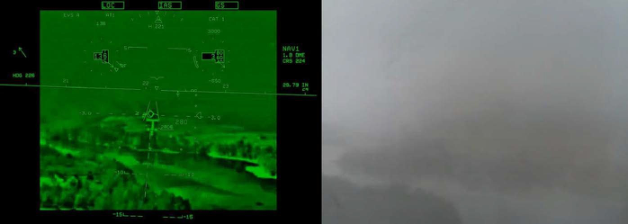
The head-up display (HUD) or a comparable display allows the pilot to continue facing forward along the flight path throughout the entire approach, landing, and rollout processes. This is possible by combining flight informa- tion with navigation direction and sensor data. To descend below DA/DH or MDA, the primary objective of an EFVS is to make it possible for a pilot to use enhanced visual images rather than their native line of sight. Using an EFVS can increase safety by raising the user’s awareness of their current situation and position, supplying visual cues to help them keep a stable appro- ach, and reducing the number of missed approaches. Even in circumstances where the flight visibility is sufficient for a pilot to use natural vision to drop below DA/DH or MDA, an EFVS may still give helpful visual signals for bet- ter situation awareness. This is because an EFVS displays information in three dimensions (Figure 1).
Figure 1: View during an approach with (on the left) and without the use of an EFVS (right) (AC-906B, 2022).
REVIEWING OPERATION CHALLENGES FOR ENHANCED FLIGHT VISION SYSTEMS There are two distinct varieties of EFVS approach operations: EFVS Opera- tions to Touchdown and Rollout; and EFVS Operations to 100 Feet Above the TDZE. The employment of enhanced vision imagery produced by an enhanced flight vision system (EFVS) in place of natural vision by the pilot in order to descent below Decision Altitude (DA) or Decision Height (DH) in order to touchdown and rollout is referred to as an EFVS operation to touchdown and rollout. In the operator’s practices to conduct EFVS opera- tions to touchdown, a minimum visibility is specified for the operation. This minimum visibility is based on the demonstrated performance of the opera- tor’s system. This advisory circular (AC) 90-106B outlines a procedure for demonstrating the capability to undertake EFVS operations to touchdown in visibilities as low as 1,000 feet of Runway Visual Range (RVR). Opera- tors can demonstrate improved performance and acquire a license to conduct EFVS operations in even lower visibilities, providing that their airworthiness approval is appropriate for the EFVS operation that will be undertaken.
A descent below DA/DH or MDA to 100 feet above the TDZE is an EFVS operation to 100 feet above the TDZE. During this operation, the pilot relies on the enhanced vision imagery provided by an EFVS rather than their natu- ral vision to complete the descent. A pilot must have sufficient flight visibility to identify the required visual references specified using natural vision to con- tinue the approach below 100 feet above the TDZE. Additionally, the pilot must continue using the EFVS to ensure that the enhanced flight visibility meets the visibility requirements of the instrument approach procedure that is being flown.
The single case study methodology was utilized throughout the investiga- tion of the assessment of pilots’ training efficacy as a safety barrier in the context of Enhanced Flight Vision Systems (Saunders, 2019). Following an extensive literature review, the Purdue SATT ream assessed SMEs’ percepti- ons, including Human Factors analysts, AI analysts, regulators, test pilots, manufacturers, airline managers, examiners, instructors, qualified pilots, and pilots in training. The literature review focused on the following research questions:
How do SMEs understand training efficacy in aviation?
How do SMEs understand AI learning assurance in aviation?
How do SMEs understand traditional V-Cycle in aviation?
How do SMEs understand the W-shaped process in aviation?
How could the training efficacy act as a safety barrier in EFVS?
IMPLEMENTATION OF CBTA - TRAINING EFFICACY IN EFVS Although it is feasible to observe and evaluate an operator’s ability of EFVS operation in a simulator or aircraft, a Competency Based Training Asses- sment approach should be implemented in training. CBTA implementation may be carried out via tabletop exercises or operational monitoring. Ope- rator knowledge of the following is essential. Following and recording the CBTA approach, operators may provide the FAA inspector with brief com- ments that may help to gain a better understanding of EVFS operation (Singhal, 2019).
The research team examined a Threat Error Management (TEM) model, implementing Artificial Intelligence (AI) technology in the aviation learning assurance process through learning process verification, traditional V - cycle, and W-shaped model. The proposed training efficacy focuses on two aspects of Threat Management:
1. It recognizes that a threat exists. A Threat is defined as an event (concer- ning the environment or the aircraft) or an error (from another aircraft, air traffic control, or ground staff) occurring outside the influence of the flight crew (not caused by the flight crew). Threats increase the operati- onal complexity of a flight and requires crew attention and management if safety margins are to be maintained (Endsley, 1995). 2. A Flight Crew Error is an action or inaction that deviates from crew or organizational intentions or expectations. Error in the operatio- nal context is considered a factor reducing the margin of safety and increasing the probability of adverse events.
Assessment of Pilots’ Training Efficacy as a Safety Barrier 117
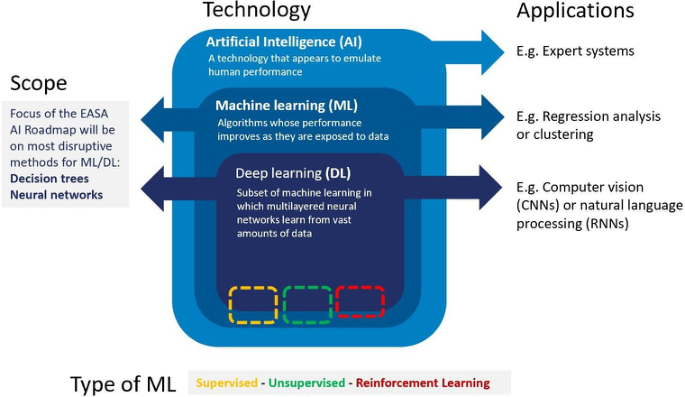
The research team then examined the application of Artificial Intellige- nce (AI) technology to the aviation learning assurance process via learning process verification, the traditional V-cycle, and the W-shaped model. This was accomplished after completing a thorough literature review and thema- tic analysis. The frequency and significance of references in the literature review indicated the significance of a global perspective of the W-shaped learning assurance model concerning AI certification methods (EASA, 2020). The certification, operational environment, feedback, reporting culture- transparency, flexibility, and learning assurance relationship were also related to the followed taxonomy for AI -training (Figure 2).
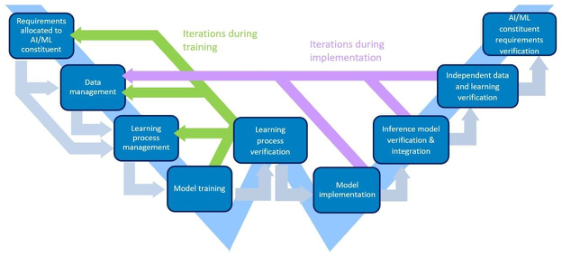
Lastly, the W-shaped model and AI dependability are interconnected (Ruth et al., 1982). Figure 3 illustrates the significance of the three specified categories and nine subcategories of the iterative nature of the learning assurance process in certification.
The systematic literature review results show that user resistance decrea- sed when AI adoption in certification was presented as a W-shaped learning assurance model. In the existing regulatory framework, requirements-based
Figure 2: AI taxonomy in EASA AI roadmap (EASA, 2020).Figure 3: W-shaped learning assurance iteration (EASA, 2020).
“development assurance” drives the risk-based approach for systems, equi- pment, and parts during development. Development assurance approaches cannot accommodate learning-based design-level layers. System-level assu- rance may require a requirements-CBTA approach introducing the training efficacy as a safety barrier under a TEM concept in the context of EFVS.
CONCLUSION
The EFVS is a challenging approach in conjunction with implementing the operating procedures at low altitudes with reduced visibility, minimum decision time, and increased threats. Improved certification and training that addresses safety, technical, and regulatory concerns are needed to deploy EFVS devices (DARPA, 2014). The suggested EFVS aviation learning assu- rance research in training efficacy – AI certification and users’ experience was organized based on an examination of the current literature on FAA EFVS regulation – advisory circulars. Results show that the certification shift of EFVS has increased training needs and user resistance related to AI (Liu, 2018). Research how to overcome this reluctance to change the AI - cockpit design and user interactions are essential. A simple to complex stra- tegy should be used for the suggested commercially available AI technology application in-flight operations (Stanton & Harris, 2015).
The following findings from this case study, which considered the incor- poration of training efficacy - learning assurance related to EFVS, are summarized:
Adapting CBTA assurance frameworks to enhance training-learning pro- cesses as safety barriers in EFVS;
Creating a framework for data management to address the correctness (bias mitigation) and completeness/representativeness of data sets used for the ML items training under EFVS and their verification;
Adapting a Systems Theoretic Early Concept Analysis (STECA) is recom- mended as a follow-up, focusing on a TEM identification approach.
ACKNOWLEDGMENT
The authors thank faculty members of Purdue and Coventry Universities for their invaluable feedback contributing to this work.
REFERENCES
AC 90-106A - Enhanced Flight Vision Systems. https://www.faa.gov/documentLibr ary/media/Advisory_Circular/AC_90-106A.pdf DARPA, “ALIAS Industry Day Release, “ed: Defense Advanced Research Projects
Agency (DARPA), 2014. EASA. (2020). Artificial Intelligence Roadmap: A human-centric approach to AI in aviation. Endsley, M. R. (1995). Toward a theory of situation awareness in dynamic systems. Human Factors, 37(1), 32–64. https://doi.org/10.1518/001872095779049543 FAA, “AC 25.1302–1: Installed Systems and Equipment for Use by the Flightcrew,”
ANM-111, Ed., ed. USA: Federal Aviation Administration (FAA), 2013.
Assessment of Pilots’ Training Efficacy as a Safety Barrier 119
IATA. (2019). Aircraft Technology Roadmap to 2050. Liu, Q. & Li, Pan & Zhao, Wentao & Cai, Wei & Yu, Shui. (2018). A Survey on Security Threats and Defensive Techniques of Machine Learning: A Data-Driven View. s.l. : IEEE Access. 6. 12103–12117. 10.1109/ACCESS.2018.2805680, 2018. Lukosch, Heide, et al. “Exploring the Relation Between Awareness, Trust and Inno-
vation: A Simulation Gaming Study.” European Conference on Games Based Learning, Academic Conferences International Limited, Oct. 2018, p. 904. Ruth, J. C., Godwin, A. M., & Werkowitz, E. B. (1982). Voice Interactive System Development Program. Advanced Avionics and the Military Aircraft Man/Mach- ine Interface. Saunders, M., Lewis, P., & Thornhill, A. (2019). Research Methods for Business
Students Eighth Edition. In Research Methods for Business Students. Pearson Education Limited. Singhal, Megha, et al. “TM4SF18 Is Aberrantly Expressed in Pancreatic Cancer and Regulates Cell Growth.” PLoS One, vol. 14, no. 3, Public Library of Science, Mar. 2019, p. e0211711. Stanton, N. A., & Harris, D. (2015). The future flight deck: Modelling dual, single,
and distributed crewing options. Applied Ergonomics, 53(B), 331–342. https://doi .org/10.1016/j.apergo.2015.06.019 U. S DoD, AC-90-106B, (2022). Enhanced Flight Vision System Operations.
Read this individual research paper free through the original publisher, or explore the full digital proceedings book.
ISBN 978-1-958651-59-9
Explore this ISBN in the AHFE Bookstore ↗Listed in the July 2026 bookstore catalogue; search by ISBN to confirm current availability · Digital book purchase optional