Dimitrios Ziakkas, Konstantinos Pechlivanis, Brian Dillman (2023). The role of Digital Twins in future transportation challenges. In: Application of Emerging Technologies. AHFE Open Access, vol. 115, pp. 388–396. https://doi.org/10.54941/ahfe1004336
Students enrolled in technical education programs, such as Aeronautical Engineering Technology, pursue careers in aviation, aerospace, and commercial space industries, encompassing physical and digital work environments. Gaining knowledge in a broader range of subjects, including digital twin settings, is crucial for contextual learning and generating graduates with the level of proficiency the industry demands. Crow and Dabars (2020) highlight the significance of instructional innovation in their analysis of the fifth-wave history of American colleges. There is a demand for the modification of conventional academic processes in order to better cater to the external needs of retraining and upskilling both current workers and recent graduates. The aviation and aerospace sectors have consistently incorporated the Industrial Internet of Things (IIoT), Digital Twins, Big Data frameworks, automation, and robotics in diverse capacities into their routine operations over an extended period. The rapid progress in computer and sensor capabilities has facilitated the widespread adoption of many data science methods, such as the digital thread, digital twin, edge computing, machine-to-machine learning (M2M), and Artificial Intelligence (AI). Educational institutions, including prominent colleges like Purdue, must integrate digital thread and digital twin technologies into the learning framework beyond the introductory levels. For graduates to possess the necessary skills to join the workforce with a high level of preparedness, it is imperative to integrate Digital Twins into the learning cycle. The Purdue University CREATE approach for Augmented, Virtual, and Mixed Reality Simulation and Digital Twins is centered around enhancing the efficacy and efficiency of aviation training programs on a global scale, specifically the Competency-Based Training and Assessment (CBTA) framework. This approach aims to achieve this by offering a more authentic and immersive learning experience proposal, streamlining the training and certification processes, and facilitating the transition to an Artificial Intelligence (AI) – Digital Twins environment. The present study also focuses on reducing residual risk within the 'AI black box.' The analysis and evaluation of the difficulties of implementation of Artificial Intelligence (AI) were conducted within the framework of Digital Twins.
The Role of Digital Twins in Future Transportation Challenges 389
INTRODUCTION
The rapid expansion of digital technologies has revolutionized several businesses in recent years, including the aviation transportation industry (Molchanova, 2020). One of the most interesting new ideas to emerge in this environment is the concept of “Digital Twins.” A Digital Twin is a real-time virtual version of a physical asset, process, or system that pro- vides data-driven insights, analysis, and simulations (Altair, 2022). Digital Twin technologies have received a lot of attention in the aviation industry because of their potential to improve operating efficiency, safety, and mainte- nance practices (Xiong & Wang, 2022). This research investigates the use of Digital Twin technologies in aviation transportation, as well as some of the accompanying issues that must be overcome for its adoption.
The aviation sector is distinguished by its sophisticated network of com- plex systems spanning aircraft design and manufacturing to maintenance and air traffic control (Guo et al., 2019). Digital Twin technologies have devel- oped as a breakthrough solution that links the physical and digital realms, providing previously unattainable real-time insights and predictive capabili- ties (Elgan, 2023). Stakeholders can monitor and analyze real-world data by establishing a virtual counterpart of an aircraft or a whole airport ecosystem, supporting improved decision-making processes, streamlining operations, and decreasing downtime (Miskinis, 2019).
Digital Twin technology has a wide range of uses in aviation transporta- tion. Digital Twins enable engineers in aircraft design and manufacture to simulate and examine the performance of various components, resulting in more efficient designs and shorter development cycles (Botin-Sanabria et al., 2022). These technologies provide real-time monitoring of aircraft systems during operations, allowing for early detection of anomalies and potential issues. Airlines can also use Digital Twins to properly estimate maintenance requirements, streamline maintenance schedules, and avoid operational disruptions (Bonnar, 2020).
Despite the enormous potential, incorporating Digital Twin technology into the aviation industry is difficult. Among these include data standardiza- tion, data management, and data security, as well as implementation hurdles and legacy system transformation (Xiaochen et al., 2022). Furthermore, as the aviation business deals with sensitive information about flight opera- tions and passenger safety (Xiaochen et al., 2022), data security, privacy, and intellectual property (IP) are critical.
Creating accurate and dependable virtual representations of complicated aviation systems is another difficulty. Models used to construct Digital Twins must be highly comprehensive and tested against real-world data to assure accuracy (Rodriguez et al., 2023). Furthermore, interoperability of various technologies and data sources within the aviation industry remains chal- lenging Standardization of data formats, communication protocols, and interfaces is required to allow for the seamless integration of Digital Twin technologies across several stakeholders (Xiaochen et al., 2022).
This research study seeks to provide a full review of Digital Twin tech- nologies in aviation transportation, with an emphasis on their applications,
benefits, and implementation issues. Understanding these issues and suggest- ing potential solutions allows stakeholders in the aviation sector to acquire insights into how to fully utilize Digital Twin technologies while overcoming constraints that may impede their successful adoption.
METHODOLOGY
The proposed research philosophy in aviation aligns with the ADDIE (Analyse -Design-Develop-Implement-Evaluate) methodology, which incor- porates the utilization of immersive technology – digital twins in the aviation ecosystem. The present analysis aims to examine the implementation chal- lenges of CREATE Artificial Intelligence (AI) research roadmap in the avia- tion ecosystem by utilizing data obtained from the Evidence-Based Training (EBT) – Competency Based Training Assessment (CBTA) IATA analysis and Digital twins features, (IATA, 2021).
Purdue’s CREATE approach in the assessment of risk follow the utilization of a combination of multi-layered digital twin and Monte Carlo approaches (Pilko et al., 2023) Monte Carlo methods are highly appropriate for analyzing data that represents system failure rate, event occurrence, and mobility pat- terns, owing to their statistical nature. The Training Needs Analysis (TNA) is selected as a systematic process used to identify and assess the training requirements of individuals or groups within an organization in the avia- tion ecosystem. It involves gathering and analyzing data to determine the knowledge, skills, and attitude of future aviation experts.
Following Honour’s (2006) Task Network Analysis (TNA), the CREATE research team categorized complex tasks into a series of sub-tasks, each of which has a clearly defined digital twins identity and objective. In order to effectively comprehend and execute each subtask, the Purdue team identifies the requisite skills associated with each subtask, such as reproductive skills, decision-making skills, behavioral skills, and so on, following CBTA taxon- omy. Additionally, it is important to determine the minimum levels of fidelity necessary to achieve the desired learning objectives, as outlined by Chapanis (1996).
The aim of this study is to explore digital twins implementation in avia- tion operations and training by employing a competency-based training and assessment (CBTA) approach that incorporates artificial intelligence (AI) and follows a thematic academic framework.
The implementation challenge lies in enhancing the connection between training tasks and the corresponding tools in the following areas:
Accommodate the utilization of digital twins under the CBTA concept
Facilitate enhanced standardization of utilized training / operational tools.
The proposed Purdue CREATE research and training syllabi (AI CRE- ATE platform) include cutting-edge technologies in aviation training. These technologies include Virtual Reality (VR), Mixed Reality (MR), Augmented Reality (AR), Simulated Air Traffic Control Environment, Digital Twins, arti- ficial intelligence (AI) instructor, eye tracking, and their use in various stages of aviation training. The objective is to enhance or expand upon a certain
The Role of Digital Twins in Future Transportation Challenges 391
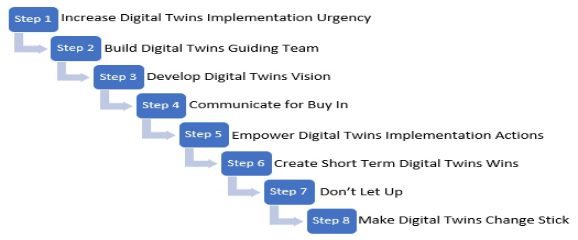
concept or idea respecting the technology culture of each organization and following Kotter’s 8-step change model.
Figure 1: Adaptation of Kotter’s eight-step process in leading change for digital twins implementation (Kotter, 1996).
The Purdue research protocol presents digital twins’ applications for both civil and military purposes as the initial stage of digital twins’ implementation.
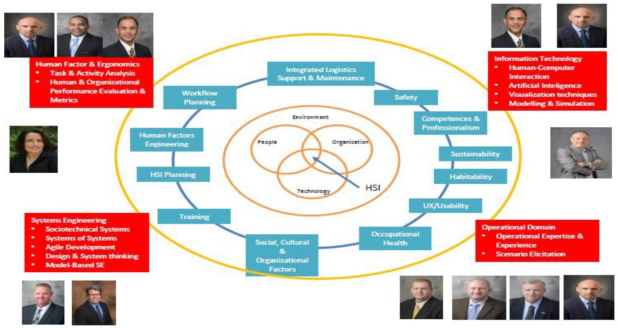
The proposed Purdue CREATE research and training syllabi (AI CREATE platform) for integrating digital twins into aviation training on a global scale was established by the Purdue CREATE HSI team. This protocol may be seamlessly integrated into any systems engineering test plan, allowing for the implementation of AI and subsequent evaluation of its effectiveness. Purdue CREATE Human Factor SMEs published the first handbook on the imple- mentation of AI in aviation in September 2023. This handbook collaboration is based on the utilization of systems engineering processes and methodolo- gies, which are being employed to effectively integrate human systems within the overall digital twins framework. The primary objective of this handbook collaboration is to ensure the achievement of successful AI human systems integration in a global CBTA context.
Figure 2: Purdue research sectors (Ziakkas, 2023).
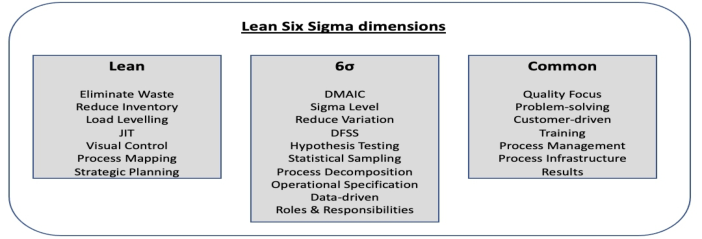
Furthermore, Purdue’s study reveals a strong correlation between lower- ing operating and training costs and employing the CBTA-lean approach (Ziakkas, 2022).
Figure 3: Purdue lean six sigma dimensions (Ziakkas, 2022).
FINDINGS In aviation training, digital twins can create realistic simulations of air traffic environment, airports, aircraft, engines, and other aviation systems. These simulations can provide immersive training experiences for pilots, mechanics, air traffic controllers, and other aviation professionals.
One “traditional” use case for digital twins in aviation training is for pilot training using flight simulators. With a digital twin, pilots can practice flight operations in various weather conditions without risking the safety of a real aircraft. Additionally, digital twins simulate emergency scenarios, such as engine failures or systems malfunctions (abnormal–emergencies), allow- ing pilots to practice responding to these situations in a safe and controlled environment.
An existing use case for digital twins in air traffic control is predicting and managing airspace congestion. Air traffic control digital twins can use real-time data and predictive analytics to simulate the impact of weather con- ditions, flight delays, security threats, and other factors on air traffic flow. This information can be used to optimize air traffic routes and schedules to minimize congestion and improve efficiency. Another potential use case for digital twins in air traffic control is training air traffic controllers. Further- more, digital twins can simulate air traffic scenarios, allowing controllers to practice managing different situations and develop their skills in a safe and controlled environment. This can help to improve safety and efficiency in air traffic control by enabling controllers to make better decisions and respond more effectively to unexpected events.
Digital twins can also be used in aviation maintenance training. By creating a virtual–mixed reality of aircraft engines and other components, mainte- nance personnel can practice diagnosing and repairing problems without working on real aircraft. This can reduce the risk of damage to aircraft and equipment while providing a more efficient and cost-effective training experience.
The Role of Digital Twins in Future Transportation Challenges 393
Furthermore, another potential use case for digital twins in airport oper- ations is aircraft handling. Digital twins can be used to simulate aircraft movement on runways and taxiways and optimize the allocation of gates and parking positions. This can help to reduce delays and improve the over- all efficiency of aircraft handling. Another potential use case for digital twins in airport operations is baggage handling. Digital twins can simulate baggage movement through the airport, including check-in, security, and sorting pro- cesses. This can help identify bottlenecks and inefficiencies in the baggage handling system and enable airport operators to optimize the baggage flow, reducing waiting times for passengers and improving overall efficiency. Dig- ital twins can also be used in passenger flow management, allowing airport operators to simulate the movement of passengers through different areas of the airport, such as check-in, security, and boarding gates. This can help to identify potential bottlenecks and optimize the flow of passengers, improving the overall passenger experience and reducing waiting times.
Overall, digital twins have the potential to revolutionize aviation opera- tions - training by providing a more immersive and realistic learning expe- rience for aviation professionals. By enabling aviation personnel to practice their skills in a safe and controlled environment, digital twins can help to improve safety, efficiency, and overall performance in the aviation industry, implementing Competency Based Training and Assessment (CBTA).
ANALYSIS Digital twins have the potential to revolutionize aviation operations - training by providing a more immersive and realistic learning experience for avia- tion professionals. By enabling aviation personnel to practice their skills in a safe and controlled environment, digital twins can help to improve safety, efficiency, and overall performance in the aviation industry, implementing Competency Based Training and Assessment (CBTA).
The European Union Aviation Safety Agency (EASA) has recognized the potential benefits of artificial intelligence (AI) in aviation and has been actively exploring ways to implement AI in the industry.
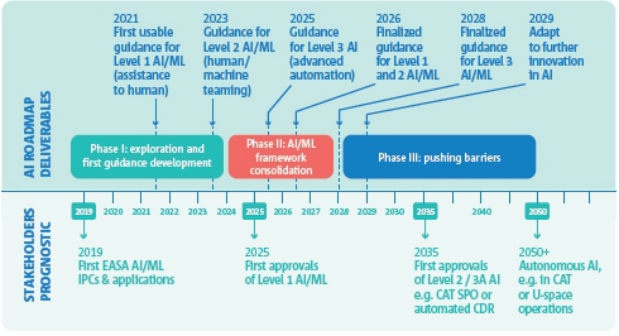
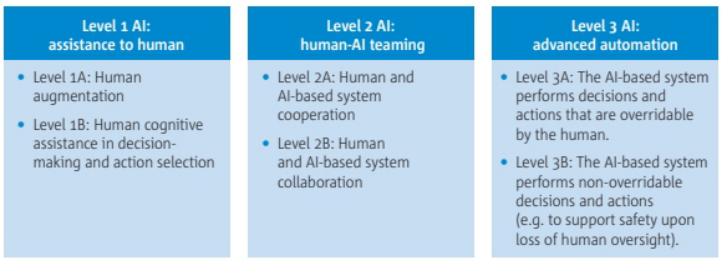
Purdue SATT follows the EASA AI research-industrial roadmap. The proposed levels are: In the domain of commercial air transport, the timeline associated with the three steps described above could be:
First step: crew assistance/augmentation (2022-2025) -VR lab of SATT – Hangar of the Future – AMT-I
Second step: human/machine collaboration (2025-2030)
Third step: autonomous commercial air transport (2035+).
Purdue implements the following AI steps through the following teams for civil and military projects:
1. Human Factors and Ergonomics 2. Information Technology 3. Operational Domain 4. Systems Engineering
Figure 4: EASA AI roadmap (EASA, 2023).Figure 5: EASA AI levels (EASA, 2023).
CONCLUSION
In general, digital twins possess the capacity to significantly transform avia- tion operations, particularly in the realm of training, by offering a heightened level of immersion and realism in the learning process for aviation profession- als. Digital twins have the potential to enhance safety, efficiency, and overall performance in the aviation sector by providing a secure and regulated set- ting for aviation professionals to hone their abilities. This can be achieved through the implementation of Competency Based Training and Assessment (CBTA).
The potential advantages of artificial intelligence (AI) in the aviation sec- tor have been acknowledged by the European Union Aviation Safety Agency (EASA), which has been actively investigating strategies for the integration of AI within the industry.
Purdue University’s School of Aeronautics and Astronautics (SATT) aligns its research agenda with the European Union Aviation Safety Agency (EASA) Artificial Intelligence (AI) research-industrial roadmap.
The Role of Digital Twins in Future Transportation Challenges 395
ACKNOWLEDGMENT
The authors thank faculty members of Purdue and Coventry Universities for their invaluable feedback contributing to this work.
REFERENCES
Altair (2022). Overview: What is Digital Twin Technology. https://altair.com/newsroom/articles/overview-what-is-digital-twin-technology? Bonnar, L. (2020, May 17). Twinning Digital Twins show their power by Louise Bonnar. Aviation Maintenance Magazine. https://www.avm-mag.com/twinning-d igital-twins-show-their-power-by-louise-bonnar/ Botín-Sanabria, D. M., Mihaita, A. S., Peimbert-García, R. E., Ramírez-Moreno,
M. A., Ramírez-Mendoza, R. A., & Lozoya-Santos, J. D. J. (2022). Digital twin technology challenges and applications: A comprehensive review. Remote Sensing, 14(6), 1335. Chapanis, A. (1996). Human factors in systems engineering. Wiley Series in Systems Engineering and Management. Andrew Sage, series editor. Hoboken, NJ: Wiley. Crow, M. M., & Dabars, W. B. (2020). The fifth wave: The evolution of American
higher education. Johns Hopkins University Press. EASA. (2023). Artificial Intelligence Roadmap: A human-centric approach to AI in aviation. Elgan, M. (2023, February 28). “Digital Twin”Tech is twice as great as the metaverse.
Computerworld. https://www.computerworld.com/article/3688917/digital-twin- tech-is-twice-as-great-as-the-metaverse.html Guo, W., Toader, B., Feier, R. et al. (2019). Global air transport complex network: multi-scale analysis. SN Appl. Sci. 1, 680. https://doi.org/10.1007/s42452-019- 0702-2 Honour, E. C. (2006) “A Practical Program of Research to Measure Systems Engi-
neering Return on Investment (SE-ROI),” proceedings of the Sixteenth Annual Symposium of the International Council on Systems Engineering, Orlando, FL. IATA. (2021). CBTA expansion within the Aviation System. 2021.06.02_CBTA expansion within the aviation system_final version. https://www.iata.org/conte ntassets/c0f61fc821dc4f62bb6441d7abedb076/cbta-expansion-within-the-avia tion-system.pdf Kotter, J. P. (1996). Leading change an action plan from the world’s foremost expert
on business leadership. Harvard Business Review Press. Molchanova, K. (2020). A Review of Digital Technologies in Aviation Industry. Logistics and Transport, 47(3-4), 69–77. Miskinis, C. (2019). How digital twin will change the aerospace industry forever. Challenge Advisory. https://www.challenge.org/insights/digital-twin-in-a erospace/ Pilko, A., Ferraro, M., & Scanlan, J. (2023). Quantifying specific operation airborne
collision risk through Monte Carlo Simulation. Aerospace, 10(7), 593. https://do i.org/10.3390/aerospace10070593 Rodríguez, F., Chicaiza, W. D., Sánchez, A., & Escaño, J. M. (2023). Updating digital twins: Methodology for Data Accuracy Quality Control using machine learning techniques. Computers in Industry, 151, 103958. https://doi.org/10.1016/j.comp ind.2023.103958 Rotolo, D., Hicks, D., & Martin, B. R. (2015). What is an emerging technology?
Research Policy, 44(10), 1827–1843. https://doi.org/10.1016/j.respol.2015.06. 006
Xiaochen Zheng, Jinzhi Lu & Dimitris Kiritsis (2022) The emergence of cognitive digital twin: vision, challenges and opportunities, International Journal of Pro- duction Research, 60:24, 7610–7632, DOI: 10.1080/00207543.2021.2014591. Xiong, M., & Wang, H. (2022). Digital twin applications in aviation industry: A
review. The International Journal of Advanced Manufacturing Technology, 121 (9-10), 5677–5692. Ziakkas, D., Sarikaya, I., Natakusuma, H. C. (2023). EBT-CBTA in Aviation Training: The Turkish Airlines Case Study. In: Harris, D., Li, WC. (eds) Engi- neering Psychology and Cognitive Ergonomics. HCII 2023. Lecture Notes in Computer Science (), vol. 14018. Springer, Cham. https://doi.org/10.1007/978- 3-031-35389-5_14 Ziakkas, D., Michael, W. S., & Pechlivanis, K. (2022). The implementation of
competency-based training and assessment (CBTA) framework in Aviation Man- power Planning. Transportation Research Procedia, 66, 226–239. https://doi.org/ 10.1016/j.trpro.2022.12.023
LISTED IN THE AHFE DIGITAL BOOKSTORE CATALOGUE
Explore the complete digital volume
Application of Emerging Technologies
Read this individual research paper free through the original publisher, or explore the full digital proceedings book.
ISBN 978-1-958651-91-9
Explore this ISBN in the AHFE Bookstore ↗Listed in the July 2026 bookstore catalogue; search by ISBN to confirm current availability · Digital book purchase optional