Dimitrios Ziakkas, Konstantinos Pechlivanis, Abner Flores (2024). The Role of Artificial Intelligence in Weather Prediction, Flight Planning, Route Optimization and Scheduling. In: Intelligent Human Systems Integration (IHSI 2024): Integrating People and Intelligent Systems. AHFE Open Access, vol. 119, pp. 421–428. https://doi.org/10.54941/ahfe1004506
Artificial intelligence (AI) is being used to improve weather prediction and turbulence detection, which can help to enhance flight safety. AI-powered weather prediction systems can be used to generate more accurate and up-to-date weather forecasts. This information can help pilots make better decisions about flight planning and execution. The turbulence detection systems can identify areas of turbulence in real time. This information can be used to help pilots avoid turbulence, which can help to improve safety and comfort for passengers. Reduced risk AI-powered systems can help to reduce the risk of accidents caused by weather or turbulence by improving accuracy and providing earlier warnings. The National Weather Service (NWS) uses AI to improve weather prediction models. The NWS reports recognize that AI has improved its forecasts' accuracy by up to 10%. Moreover, the Federal Aviation Administration (FAA) uses AI to detect real-time turbulence. The FAA reports that the use of AI applications makes identifying turbulence areas easier and more effective in avoiding overflying into them. Airlines are using AI to improve their flight planning and execution. Airlines following weather AI recommendations reduce delays and improve the safety of their flights. In detail, Weather Prediction AI analyses large volumes of weather data, such as radar, satellite, and numerical weather prediction models, to provide accurate and timely weather forecasts. This helps pilots plan and adjust flight routes and schedules to avoid severe weather conditions and improve flight safety. Turbulence Detection AI applications detect and predict turbulence in real time using sensor data and weather models. This helps pilots avoid turbulence and provides passengers with a smoother and more comfortable flight experience while reducing the risk of injuries. In the long run, Machine Learning develops machine learning algorithms to learn from past weather and turbulence data and predict future conditions more accurately. This allows airlines to make more informed flight routing and scheduling decisions based on the most up-to-date weather information. Additionally, Automated Decision Support AI develops automated decision support tools that provide pilots with real-time weather and turbulence information, allowing them to make informed decisions about flight routing and scheduling and improve flight safety. Overall, using AI in weather prediction and turbulence detection transforms how airlines monitor and manage weather-related risks, making air transport safer, more efficient, and more comfortable for passengers. By providing accurate and timely weather information, airlines can improve flight safety, reduce flight delays, and provide passengers with a more reliable travel experience. Purdue CREATE approach offers a structured analysis and recommendations for implementing AI in weather prediction, flight planning, route optimization, and scheduling.
Artificial Intelligence (AI) plays a significant role in various aspects of avia- tion, including weather prediction, flight planning, route optimization, and scheduling. AI technologies, such as machine learning, data analytics, and predictive modelling, are being used to enhance the accuracy and efficiency of these processes. Integrating AI in weather forecasting and turbulence detection has significantly revolutionized how airlines monitor and mitigate weather-related hazards. This advancement has enhanced safety, increased operational efficiency, and improved passenger comfort within air trans- portation. The provision of precise and punctual meteorological data by airlines can strengthen the safety of flights, mitigate flight disruptions, and offer passengers a more dependable travel encounter.
The utilization of AI has been employed to boost the accuracy of weather forecasting and the detection of turbulence. This information could improve pilots’ decision-making processes about flight planning and execu- tion, thereby contributing to the improvement of flight safety. Over time, Machine Learning endeavors to enhance machine learning algorithms that leverage historical weather and turbulence data to make more precise pre- dictions about future circumstances. Utilizing current weather data enables airlines to make more educated aircraft routing and scheduling decisions. Fur- thermore, the Automated Decision Support AI is responsible for developing automated decision support tools that furnish pilots with up-to-date weather and turbulence data. These tools enable pilots to make well-informed flight routing and scheduling choices, enhancing flight safety.
The utilization of AI-powered systems has the potential to mitigate the occurrence of mishaps resulting from adverse weather conditions or turbu- lence through enhanced precision and timely provision of warnings. AI by the National Weather Service (NWS) enhances the accuracy and efficacy of weather prediction models. The reports from the National Weather Ser- vice acknowledge that artificial Intelligence has enhanced the precision of its forecasts, with improvements of up to 10%. In addition, the Federal Aviation Administration (FAA) employs AI to identify and monitor real- time turbulence. According to the Federal Aviation Administration (FAA), using artificial intelligence (AI) technologies enhances the efficiency and effi- cacy of recognizing turbulence zones, hence facilitating the avoidance of flying into such areas. Airlines utilize AI techniques to improve flight plan- ning and execution. Airlines that adhere to weather AI advice can mitigate delays and enhance the safety of their flights. The meteorological Predic- tion AI system thoroughly examines extensive quantities of meteorological data, encompassing radar, satellite imagery, and numerical weather predic- tion models, to deliver precise and prompt weather forecasts. This technology assists pilots in strategizing and modifying flight routes and schedules to circumvent hazardous weather situations and enhance the overall safety of the trip—the identification and characterization of turbulence in fluid flow systems. Artificial intelligence (AI) programs can identify and forecast tur- bulence in real-time by analyzing sensor data and utilizing meteorological models.
The Role of Artificial Intelligence 423
The Purdue SATT approach provides a systematic examination and sug- gestions for integrating AI in several domains, such as weather prediction, flight planning, route optimization, and scheduling.
METHODOLOGY
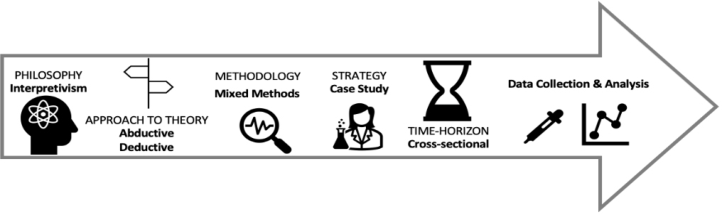
According to the concept of the Research Onion proposed by Saunders et al. (2019), Purdue University recommends employing a combination of qualitative and quantitative research methodologies to assess the impact of AI in many aspects of the aviation ecosystem, such as weather prediction, flight planning, route optimization, and scheduling. The research pathway is illustrated in Figure 1.
The initial phase of this study involved doing a comprehensive systematic literature analysis, which identified five key areas of focus: AI applications, weather prediction, flight planning, route optimization, and scheduling. The chosen literature provided a thorough examination of the integration of AI in the aviation industry (Ziakkas et al., 2023), serving as the basis for the sub- sequent stage of semi-structured interviews. The research conducted by the Purdue SATT primarily involved the collection and analysis of primary data from subject matter experts (SMEs) who were purposefully selected. This data was gathered through semi-structured interviews, which were chosen as a compromise between the data collection process and the ability of the research participants to express their thoughts and opinions (Bryman & Bell, 2015).
Figure 1: Research methodology presentation based on Saunders et al., (2019).
FINDINGS Use of AI in Weather Prediction and Turbulence Detection for Enhanced Flight Safety
The utilization of artificial intelligence (AI) has been employed to boost the accuracy of weather forecasting and the detection of turbulence, thereby con- tributing to the improvement of flight safety. The utilization of AI-powered weather prediction systems has the potential to enhance the precision and timeliness of weather forecasts. The meteorological Prediction AI system con- ducts a comprehensive analysis of extensive meteorological data, including radar, satellite imagery, and numerical weather prediction models, to deliver
precise and punctual weather forecasts. This information possesses the poten- tial to enhance pilots’ decision-making processes pertaining to flight planning and execution. The utilization of AI-powered systems has the potential to mit- igate the occurrence of mishaps resulting from adverse weather conditions or turbulence through enhanced precision and timely provision of warnings.
The integration of artificial intelligence (AI) inside the operations of the National Weather Service (NWS) has been implemented with the aim of augmenting the precision and effectiveness of weather forecasting models. According to data from the National Weather Service, artificial intelligence has shown to improve forecast accuracy by up to 10%. Furthermore, the Federal Aviation Administration (FAA) utilizes artificial intelligence (AI) to effectively detect and monitor real-time turbulence. As per the Federal Aviation Administration (FAA), the utilization of artificial intelligence (AI) technologies enables the detection of locations characterized by turbulence and improves the efficacy of avoiding flight paths over such areas. Airlines are employing artificial intelligence (AI) techniques to enhance their flight planning and execution processes. Airlines that adhere to weather artifi- cial intelligence (AI) advice experience a decrease in flight delays and an enhancement in flight safety. In due course, Machine Learning will facilitate the development of machine learning algorithms that can effectively assim- ilate historical weather and turbulence data, hence enhancing the accuracy of future condition predictions. This enables airlines to enhance their air- craft routing and scheduling decisions by leveraging the latest meteorological data.
In general, the integration of artificial intelligence (AI) in the field of weather prediction and turbulence detection has significantly revolution- ized the approach of airlines towards monitoring and mitigating weather- related hazards. The provision of precise and punctual meteorological data by airlines has the potential to enhance the safety of flights, mitigate flight disruptions, and offer passengers a more dependable travel encounter. This transformation has resulted in enhanced safety, improved operational efficiency, and heightened passenger experience within the realm of air transportation.
Role of AI in Flight Planning, Route Optimization, and Scheduling The application of artificial intelligence (AI) in the domain of flight plan- ning has gained significant attention and interest in recent years. The current development stage of AI-powered flight planning systems is in its nascent phase, although it holds the potential to fundamentally transform the process of flight planning. The discipline of flight planning is undergoing significant transformation due to the emergence and advancement of artificial intelli- gence (AI). AI-powered systems are currently being employed to automate various operations, generate predictions, and offer recommendations to aid pilots and dispatchers in planning flights that are both more efficient and safer. This enables airlines to promptly adapt to dynamic circumstances and enhance flight plans in real-time during flights.
The Role of Artificial Intelligence 425
Artificial intelligence (AI) applications contribute to the establishment of an air transport system that is both effective and efficient, while also promot- ing sustainability. AI technologies have the potential to revolutionize the way flight planning is conducted, offering enhanced efficiency and effectiveness. This can be exemplified by the following instances.
AI in Flight Route Planning Artificial intelligence (AI) is rapidly transforming the field of flight route optimization. Artificial intelligence (AI)-enabled systems are currently being employed to automate various tasks, generate predictions, and offer recom- mendations within the aviation industry. These applications aim to enhance the efficiency and safety of flight planning processes. Globally, there is a growing trend among airlines to implement artificial intelligence (AI) systems for the purpose of optimizing aircraft routes. Notable examples of airlines using this approach are United Airlines, Delta Airlines, and American Air- lines. The ongoing advancement of AI technology is anticipated to yield a proliferation of groundbreaking and paradigm-shifting applications within this domain. Flight-route planning subject matter experts (SMEs) employ artificial intelligence (AI)-enabled software for the subsequent tasks:
Analysing weather data
Analysing traffic data
Optimizing fuel consumption
Weather Forecasting
Aircraft Performance
Airspace Optimisation
Flight Plan Analysis Machine Learning researchers endeavor to build machine learning algo- rithms that are capable of extracting knowledge from historical flight data and subsequently optimize fly routes in real time. This enables airlines to make more precise and well-informed determinations regarding flight routes, relying on the most current and comprehensive data accessible. The cur- rent development of AI-powered aircraft route optimization systems is in its nascent phase, although it holds the potential to fundamentally transform the process of flight planning. Through the analysis of meteorological data, traffic data, and various other elements. Artificial intelligence (AI) has the potential to assist airlines in identifying the most optimal and economically viable flight routes for their aircraft, as outlined below:
1. Reduced fuel consumption: AI-powered systems can help reduce fuel consumption by finding the most efficient routes – minimising CO2 emissions. 2. Reduced delays: AI-powered systems can help to reduce delays by finding routes that avoid congestion. This can improve customer satisfaction and reduce costs. 3. Increased safety: AI-powered systems can help to increase safety by find- ing routes that avoid adverse weather. This can help to prevent weather related accidents and improve the flight safety of air travel.
AI in Flight Crew Scheduling The aviation industry is currently seeing substantial changes because of the increasing use of artificial intelligence (AI), and flight crew scheduling is not an exception to this phenomenon. Artificial intelligence (AI) is employed in the development of machine learning algorithms, which are designed to acquire knowledge from historical staff scheduling data and subsequently enhance crew assignments in real-time. This enables airlines to enhance the precision and knowledge-driven nature of their crew assignment decisions by leveraging the latest information available. Artificial intelligence (AI) has been shown to improve operational efficiency, cost-effectiveness, and safety in various fields. The utilisation of artificial intelligence (AI) in flight crew scheduling encompasses several notable approaches:
Optimizing crew schedules The optimised management of crew schedules can be achieved by the utilization of AI-powered systems, which take into account a multitude of aspects like personnel availability, flight schedules, and regulatory needs.
Crew Pairing Optimisation The crew pairings are optimized by the AI system, considering several factors such as crew availability, qualifications, bidding, and seniority. This practice aids in mitigating fatigue and enhancing crew productiv- ity by ensuring that crew members are allocated to flights that align with their aptitudes and expertise.
Predicting crew fatigue The prediction of crew fatigue can be achieved by the utilization of AI- powered systems, which employ an analysis of many aspects like flight crew duty hours, sleep patterns, and stress levels. This data can be uti- lized to guarantee that staff do not experience weariness, hence enhancing safety measures.
Reducing crew costs AI-driven systems have the potential to save personnel expenses by discovering possibilities to consolidate crew positions or minimize the nec- essary number of crew members for flights, including standby tasks and positioning.
Automated Crew Scheduling The development of automated crew scheduling software by artificial intelligence (AI) aims to expedite and streamline the process of gen- erating schedules. This approach aids in minimizing the duration and intensity involved in crew scheduling, while simultaneously guarantee- ing that personnel assignments are optimized regarding efficiency and safety.
CONCLUSION
Globally, there is a growing trend among airlines to implement artificial intelligence (AI) applications for the purpose of optimising aircraft routes. Notable examples of airlines that have adopted this approach are United Airlines, Delta Airlines, and American Airlines. The ongoing advancement of
The Role of Artificial Intelligence 427
AI technology is anticipated to yield a proliferation of novel and paradigm- shifting applications within this domain. The incorporation of artificial intel- ligence (AI) into aviation operations not only improves safety and efficiency, but also facilitates cost reduction and minimises environmental consequences for airlines. Through the utilisation of data-driven insights and predictive modelling, artificial intelligence (AI) enables airline professionals to make well-informed decisions and enhance operational efficiency within a dynamic and ever-changing industry.
The topic of aircraft route optimisation is undergoing a rapid trans- formation due to the advancements in artificial intelligence (AI). Artificial intelligence (AI) technologies are currently being employed to automate var- ious operations, generate predictions, and offer recommendations within the aviation industry. These applications aim to enhance the efficiency and safety of flight planning processes. The integration of artificial intelligence (AI) into flight crew scheduling has significantly transformed the organisational and operational aspects of crew management in the aviation sector. This inte- gration has resulted in notable improvements in productivity, cost efficiency, and safety for airlines. The optimisation of staff assignments in airlines has the potential to mitigate crew tiredness, enhance crew productivity, and bol- ster overall safety, so ensuring passengers a travel experience that is both comfortable and reliable.
ACKNOWLEDGMENT
The authors thank faculty members of Purdue University and the Coventry research team for their invaluable feedback contributing to this work.
REFERENCES
Bryman, A., and Bell, E., (2015). Business research methods. (4th ed.) Oxford: Oxford University Press. EASA. (2023a). Artificial Intelligence Roadmap 2.0: Human-centric approach to AI
in aviation. Jones, J., Bonin, T., Mitchell, E. (2023). Evaluating Wind Hazards for Advanced Air Mobility Operations, AIAA 2023–4104. AIAA AVIATION 2023 Forum, https://doi.org/10.2514/6.2023-4104 Goger, B., & Dipankar, A. (2023). Evaluating the Turbulence Representa- tion in a Numerical Weather Prediction Model Over Mountainous Terrain. https://doi.org/10.5194/egusphere-egu23-7270 Guo, J., & Sun, Y. (2023). Research on freight scheduling route redistribution
based on data prediction and optimization algorithm. 2023 IEEE 5th Inter- national Conference on Power, Intelligent Computing and Systems (ICPICS). https://doi.org/10.1109/icpics58376.2023.10235491 Muñoz-Esparza, D., Sharman, R. D., & Deierling, W. (2020). Aviation turbulence forecasting at upper levels with machine learning techniques based on regression trees. AMETSOC. Planning and scheduling in AI. (1989). Machine Intelligence and Autonomy for
Saunders, M., Lewis, P., & Thornhill, A. (2019). Research Methods for Business Students Eighth Edition. In Research Methods for Business Students. Pearson Education Limited. Shackelford, S. J. (2020). Governing the internet of things. The Internet of Things.
https://doi.org/10.1093/wentk/9780190943813.003.0005 Ziakkas, D., Plioutsias, A., Pechlivanis, K. (2022). Artificial Intelligence in the aviation decision-making process. The transition from extended Minimum Crew Operations to Single Pilot Operations (SiPO). Artificial Intelligence and Social Computing. AHFE (2022) International Conference. AHFE Open Access, vol 28. AHFE International, USA. http://doi.org/10.54941/ahfe1001452.
LISTED IN THE AHFE DIGITAL BOOKSTORE CATALOGUE
Explore the complete digital volume
Intelligent Human Systems Integration (IHSI 2024): Integrating People and Intelligent Systems
Read this individual research paper free through the original publisher, or explore the full digital proceedings book.
ISBN 978-1-958651-95-7
Explore this ISBN in the AHFE Bookstore ↗Listed in the July 2026 bookstore catalogue; search by ISBN to confirm current availability · Digital book purchase optional