Dimitrios Ziakkas, Neil Waterman, Abner Flores (2024). Emerging Technologies in Aviation: The Simulated Air Traffic Control Environment (SATCE) application in Competency Based Training and Assessment. In: Intelligent Human Systems Integration (IHSI 2024): Integrating People and Intelligent Systems. AHFE Open Access, vol. 119, pp. 627–635. https://doi.org/10.54941/ahfe1004528
1 Purdue University, School of Aviation and Transportation Technology, West Lafayette, IN 47907, USA, 2 500A Huntmar Park Drive | Herndon, VA 20170, USA ↗
2 Purdue University, School of Aviation and Transportation Technology, West Lafayette, IN 47907, USA ↗
SATCE (Simulated Air Traffic Control Environment) is a system that enhances effective and efficient communication while simulating Air Traffic Control (ATC) scenarios for training purposes. SATCE implementation in aviation training provides a more realistic and immersive training environment (use of AI in communication requirements of training with controlled traffic volume and events), offering Competency Based Training and assessment (CBTA) features in phraseology and procedures. The Purdue - ASTi research case study of SATCE allows aviation SMEs to improve their knowledge and abilities in a realistic and immersive environment. Another possible application of digital siblings in SATCE is the simulation of various aircraft types and scenarios. The objective of team initiatives at Purdue University School of Aviation and Transportation Technology (SATT) is to investigate the behavior and performance of various training scenarios under SATCE and design, test, and certify the implementation – use of various flight devices in the existing airspace classification environment. By providing a more realistic and immersive learning experience (lean process for training/certification, transition to AI - AAM environment), the Purdue – SATT approach for SATCE can potentially increase the efficacy and efficiency of aviation training programs (CBTA globally). In addition, this research concentrates on mitigating residual risk in the 'AI black box' by concentrating on aviation ecosystem operations under SATCE – facilitating various aircraft types, airspace, and the implementation of AAM. The results are intended to analyze and evaluate the certification and learning assurance challenges associated with Artificial Intelligence (AI) under the SATCE perspective.
Flight simulators that aim to provide the most authentic experience have con- tinuously tried to replicate the real-world aircraft environment to effectively train crew members, encompassing all aspects of human sensory percep- tion. The tactile and mechanical feedback of the cockpit controls closely
resemble the sensations and forces experienced during aircraft operation. The visual displays and readouts exhibit responsiveness akin to an airplane’s, governed by intricate simulation models. The aircraft’s controls and envi- ronment engage in a reciprocal relationship, facilitating the simulation of its movement. This simulation is further enhanced with the implementation of high-fidelity out-of-the-window image production, platform motion, and vibration signals, as well as a sound system that faithfully reproduces the auditory experience of the cockpit. Therefore, a contemporary Full Flight Simulator (FFS) replicates the physical layout of an authentic aircraft cockpit, excluding two specific variations.
The absent components encompass ‘additional vehicular movement’ and Air Traffic Control (ATC). These shortcomings exhibit a notable magnitude and demonstrate a transparent interconnection. These factors have signifi- cance as they both entail a substantial strain for the crew, a component that is logically integral to all simulated flight training. The presence of other traffic in close proximity to the aircraft poses a substantial and potentially fatal risk to safety. This is due to the fact that any form of interaction between aircraft, whether occurring during flight or while on the ground, has the potential to result in the destruction of one or both aircraft, as well as a significant loss of life.
During the early stages of aviation, the number of aircraft in operation was limited. However, with the rise in air traffic, the potential for aircraft collisions became a tangible concern. Consequently, establishing air traffic control systems, which relied on regulations governing aircraft behavior and facilitated communication between aircraft and ground-based controllers via radio, became imperative. Over time, it became evident that the adoption of a singular language, namely English, along with the establishment of a standardized lexicon for aircraft and air traffic control (ATC) communica- tions, was imperative. This need for standardization grew in significance as the aviation industry expanded globally. Aviation English has emerged as the universally adopted language for the aviation industry worldwide, as stip- ulated by the International Civil Aviation Organization’s English Language Proficiency Level 4 (ICAO ELP Level 4) requirement.
Hence, acquiring proficiency in radio communications and mastering the appropriate phraseology for all aspects of a flight presents a formidable undertaking in terms of communication skills.
During the early phase of flight training, aspiring pilots are instructed on the A-N-C triple, which symbolizes the three fundamental priorities when assuming control of an aircraft: Aviate, Navigate, and Communicate. The primary objective is to engage in aviating, which entails operating the aircraft through the utilization of its controls and flight instruments. Additionally, it is crucial to determine one’s current location and desired destination to navi- gate. Furthermore, effective communication facilitates the comprehension of an aircraft’s intentions and requirements by other aircraft and air traffic con- trol (ATC). It also enhances situational awareness by providing insight into the actions of nearby aircraft. The functioning of air traffic control (ATC) is a multifaceted system characterized by numerous variables. However, at its essence, the primary objective of ATC is to guarantee that every aircraft
Emerging Technologies in Aviation: The Simulated Air Traffic Control Environment 629
is provided with enough airspace to navigate safely. When contemplating an airspace encompassing multiple aircraft, each with unique performance characteristics and operating at different stages of flight, it becomes evident that accurately replicating this scenario in a flight simulator training device has significant challenges. Air Traffic Control (ATC) must furnish control instructions and promptly address the requirements of every aircraft falling under the purview of the controller’s jurisdiction.
Additionally, ATC must facilitate a seamless transfer of responsibilities to the subsequent controller through effective coordination. The air traffic control (ATC) environment might be likened to a complex game of three- dimensional chess, where a series of activities are not simply carried out linearly. Instead, it involves numerous variables that must be considered within a constantly evolving timeline while adhering to established rules and regulations. Aircraft cannot halt operations while the controller deliberates on the subsequent action. Their capabilities are constrained by operational performance and fuel levels, and they are susceptible to the influence of weather conditions. Every air traffic controller is a highly skilled professional who can make time-sensitive judgments crucial for ensuring the safety of airplanes operating inside a certain airspace. The process of acquiring cer- tification as an Air Traffic Control (ATC) controller often spans a duration of 2 to 4 years. During this period, trainee ATC controllers undergo rigorous training and assessment. Notably, the failure rate for individuals pursuing this career path ranges from 25% to 50%.
At the most advanced level of certification, contemporary flight simula- tion devices need a programmatic depiction of the air traffic control (ATC) environment or other aircraft comprehensively. However, they may incorpo- rate a limited and predetermined portrayal of these elements to fulfill specific training needs. The complete range of representations of other traffic aircraft may encompass an intruder threat aircraft that manifests suddenly, initiat- ing a Traffic Collision Avoidance System (TCAS) event and a ground aircraft that can inadvertently enter the runway, leading to a runway incursion. In both occurrences, radio communication is absent, which typically informs the crew about the evolving circumstances.
The IATA Guidance Material on “Competency Assessment and Evaluation for Pilots, Instructors, and Evaluators” provides a comprehensive overview of several definitions. About fundamental principles: The concept of competency is a fundamental aspect of various academic disciplines and professional fields. It refers to “One aspect of human per- formance” that is a dependable indicator for forecasting job success. Com- petency is demonstrated and perceived by behaviors that effectively utilize the essential knowledge, abilities, and attitudes to execute activities or tasks within predetermined circumstances. The Competencies of Pilots are:
1. Application of knowledge: The individual exhibits a comprehensive grasp of pertinent expertise, including important information, opera- tional procedures, aircraft systems, and the surrounding operational conditions.
2. Application of procedures and compliance with regulations: The indi- vidual demonstrates the ability to recognize and utilize suitable protocols as outlined in official operational guidelines and relevant regulatory frameworks. 3. Communication: In the operational environment, effective communica- tion is achieved through the utilization of suitable methods, regardless of whether the situation is routine or atypical. 4. Aeroplane, Flight Path Management, automation: The automation system is responsible for regulating the trajectory of the flight. 5. Aeroplane, Flight Path Management, manual control: The flying path is controlled through manual control. 6. Leadership and Teamwork: This individual possesses the ability to moti- vate and inspire others to actively participate in the pursuit of a common objective. Engages in cooperative efforts to achieve the objectives of the collective group. 7. Problem Solving and Decision Making: The individual recognizes antecedents, addresses challenges, and engages in decision-making. 8. Situation awareness and Management of Information: The individ- ual demonstrates the ability to perceive, comprehend, and effectively manage information, while also displaying the capacity to predict the potential impact of that information on the overall functioning of the system or organization. 9. Workload Management: To maintain available workload capacity, it is essential to prioritize and distribute jobs by utilizing appropriate resources.
Table 1. Pilot - CBTA competencies.
Table available in the original PDF paper.
CBTA competencies Pilot competencies PC 0 Application of Knowledge PC 1 Application of Procedures and Compliance with Regulations PC 2 Communication PC 3 Aeroplane Flight Path Management, automation PC 4 Aeroplane Flight Path Management, manual control PC 5 Leadership & Teamwork PC 6 Problem Solving & Decision Making PC 7 Situation Awareness and Management of Information PC 8 Workload Management
METHODOLOGY
The Purdue SATT research team follows ICAO’s (2015) recommended Analyze- Design – Develop – Implement – Evaluate (ADDIE) instructional system design model. The recommended model provides a structured frame- work for designing and developing the research through a step-by-step process of identifying the aviation industry’s needs with multi-level factors.
The analysis section analyzes the aviation communication competency strengths, weaknesses, opportunities, and threats. This is followed by the
Emerging Technologies in Aviation: The Simulated Air Traffic Control Environment 631
design phase, which contains the wireframing of the digital prototype to demonstrate the potential of the evaluation tool before the development. The development stage includes the tool’s physical development and the artificial intelligence image processing software. Next, we will assess the implementa- tion of the Simulated Air Traffic Control Environment (SATCE) tool through several methods for the aviation ecosystem: a safety-risk assessment, benefit- cost analysis, and sustainability assessment. The last step, Evaluation, will evaluate the projected impacts of the SATCE tool on the commercial market.
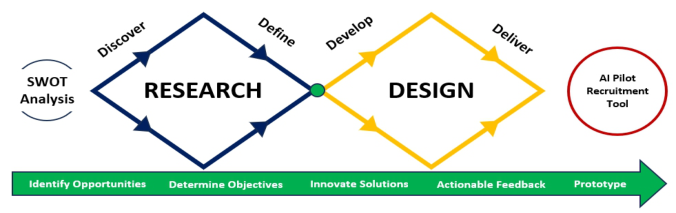
This project utilizes the British Design Council’s Framework of Innovation (2015) Double-Diamond approach, illustrated in Figure 1. The Double- Diamond approach utilizes a four-step framework to guide designers to approach the problem from a wide and in-depth perspective (divergent think- ing) initially and then converge to provide a specific solution to meet design needs.
Figure 1: Presentation double-diamond approach in SATCE.
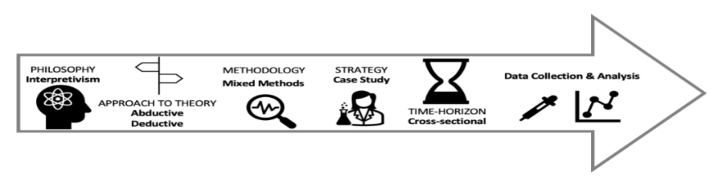
Additionally, the purpose of this project is to explore the effects of educat- ing and implementing a human-centered design approach on the operational costs of the aviation ecosystem. Because it comprises the elimination of extra- neous procedures in the design procedure, the lean mentality is relevant to research because it can facilitate cost- and time-efficient testing and qualifi- cation techniques, which in turn can reduce training expenses for potential SATCE operators. Figure 2 illustrates the application of Competency-Based Training and Assessment (CBTA) in the process of personnel planning for the aviation industry. The Research Onion concept, which has been produced from the work of Saunders, Lewis, and Thornhill (2019), serves as the basis for this diagram.
Figure 2: CBTA implementation in SATCE following the research onion, Saunders, Lewis, and Thornhill (2019).
The central emphasis of this research centers on utilizing a case study framework, a commonly employed approach in the field of social sciences. This methodology is highly regarded for its ability to provide a complete
and in-depth examination of a certain research subject or entity. Using a case study offers a significant framework for the interpretivist paradigm, enabling researchers to acquire qualitative insights from participants (Quinlan, 2019). This study aims to employ a case study methodology to examine the aviation training and operation framework within the Purdue/SATT-MPS A320 simu- lator device, utilizing the SATCE/ASTi SERA environment. The primary data for this study will be obtained and analyzed by the Purdue CREATE research team using ASTi SERA SATCE. The research areas to be explored will be determined by subject matter experts (SMEs) who were intentionally chosen to participate. The literature review yielded four primary themes following a thorough analysis, encompassing the assessment of competency-based train- ing, the concept of SATCE, the aspects of an AI technological roadmap, and training and certification standards. The data collecting method of choice for this project will be semi-structured interviews, which balance facilitating the data collection process and allowing study participants to express their thoughts and opinions (Bryman & Bell, 2015).
FINDINGS During the early stages of flight simulation training, the primary focus was ensuring skill in aircraft operation, understanding aircraft systems, and effec- tively controlling malfunctions that may harm the aircraft. The mechanical reliability of the aircraft posed a significant risk to flight safety, yet the level of automation was limited, resulting in a more physically demanding flying experience. Due to the minimal number of operational aircraft, the potential risk posed by other aircraft inside the same area was negligible. There has been a noticeable drop in concerns about aircraft reliability and an increase in the degree of automation confusion. However, it is critical to recognize that new threats to aircraft safety have emerged, mainly due to significant increases in air traffic (Pinto et al., 2023).
Implementing Evidence-Based Training (EBT) represents a substantial improvement in training approaches, emphasizing the evaluation and enhancement of crew competency. Crew members are exposed to various scenarios that may arise during line operations. Their proficiency in the fol- lowing areas is assessed: The following are significant areas of aviation focus: Communication, Automation in aircraft flight path management, Man- ual control of aircraft flight path management, Leadership and teamwork, Problem-solving and decision-making, Situation awareness, and Workload management are some of the skills required.
The burden encountered in the simulator accurately represents and can be compared to that of a real aircraft, which is a critical assumption underly- ing EBT. This consideration emphasizes the significance of air traffic control (ATC) and external aircraft in determining the realism of the training expe- rience. Another aspect of this problem is the increased effort placed on the instructor during ATC role-playing exercises, which inhibits the instructor’s ability to monitor and analyze the competency aspects required to observe adequately.
Emerging Technologies in Aviation: The Simulated Air Traffic Control Environment 633
ASTi and the Purdue team used Line-Oriented Flight Training (LOFT) sce- narios prioritizing crew resource management (CRM). A LOFT session will emphasize unusual occurrences that necessitate excellent communication, situational awareness, and leadership but will otherwise match an airline’s normal line operations. Training and assessment of aviation ecosystem com- petencies (CBTA), particularly PC 2,5,6,7 and 8, will be the primary focus of the SATCE research project (Table 1). Purdue SATT researchers adopt an EBT approach focusing on CBTA.
ANALYSIS The Simulated Air Traffic Control Environment (SATCE) is a significant departure from the traditional Air Traffic Control (ATC) - Tower framework since it involves a shift in perspective from the tower to the cockpit. The pro- ficient performance of several controllers, as observed during a flight, needs to be reproduced, along with arranging and managing other aircraft in the airspace. The enhanced level of complexity observed in this phenomenon greatly surpasses the basic logic trees and flying behaviors often encountered in tower simulators. Presently, advanced SATCE solutions incorporate artifi- cial intelligence techniques to replicate the decision-making processes of air traffic control (ATC) controllers.
Additional examination is required when considering the speech recogni- tion needs. This is because, unlike air traffic control (ATC) tower simulators that imitate a stationary tower at a particular airport, a SATCE system may be implemented at a flight training center that caters to flight crews from many countries. Therefore, the voice recognition system must exhibit a strong capacity for accommodating diverse accents while upholding a com- mendable level of accuracy in its recognition capabilities. The distinctive terminology and rhythm of speech employed in aviation communications pose challenges for even the most advanced general-purpose speech recog- nition systems offered by prominent information technology companies like Google and Apple. Consequently, achieving the required level of recognition accuracy becomes difficult. As a result, contemporary SATCE (Simulated Air Traffic Control Environments) solutions include tailored speech recognition systems suited explicitly for aviation English.
The generated speech should accurately replicate the cadence of radio traf- fic as heard on aviation frequencies, encompassing both the ATC controllers and other traffic aircraft radio transmissions. Furthermore, it is imperative to incorporate a diverse range of voices and accents inside the speech-generating sub-system. This is due to the fact that during a typical flight, an aircraft may engage with many air traffic control (ATC) controllers, potentially number- ing five or six. Additionally, the aircraft will be exposed to various voices emanating from other traffic planes via radio communication.
CONCLUSION
An AI designed SATCE system may provide a complete air traffic control environment throughout flight, enabling seamless flights between any global airport. Regionally precise ATC actions and traffic planes must be offered,
together with IFR and VFR flight operations for fixed-wing and rotary- wing aircraft. This system will support training from the beginning to airline line-oriented flight training and military counterparts. Flight simulation func- tions like freezes, repositions, and resets should be added to the system. Additionally, design objectives should reduce instructor air traffic control (ATC) workload, provide easy integration within training settings, and avoid operational disturbances to training flow. The suggested system should be autonomous, requiring no instructor interaction during a scenario. Config- uring the system before a flight should be easy, like choosing the departure and destination airports.
Decision-makers without AI experience face various challenges when implementing SATCE in aviation training. This study uses immersive tech- nologies to improve flying teaching. Dynamic real-time visualization, auto- mated human profile assessment, and training system modification may improve flight training efficiency. Digitization includes immersive virtual technology and synthetic learning environments. These technologies will help flight trainers understand participants’ performance, improving training efficiency.
Reduced instructor hours, competency-based training with simulator preparation, scheduling flexibility, improved system knowledge, faster learn- ing, better retention, and less negative training are the benefits.
To conclude, the ASTi SERA framework overcomes problems and lim- itations inherent in human-provided communications instruction. whereas the Implementation Guide of AI in aviation will facilitate certification and training syllabus – CBTA requirements (Ziakkas et al., 2023).
ACKNOWLEDGMENT
The authors thank faculty members of Purdue University and the ASTi SERA research team for their invaluable feedback contributing to this work.
REFERENCES
Bryman, A., and Bell, E., 2015. Business research methods. (4th Ed) Oxford: Oxford University Press. Halldale Group (2022). “SATCE Closes the Fidelity Gap”. https://www.halldale.c
om/articles/19656-satce-closes-the-fidelity-gap Halldale Group (2023). “Industry calls for mandatory adoption of SATCE in Pilot Training” https://www.halldale.com/articles/21451-cat-industry-calls-for-mandato ry-adoption-of-satce-in-pilot-training. ICAO. (2015). Manual of Criteria for the Qualification of Flight Simulation Training
Devices - Volume I - Aeroplanes (9625-1) (4th ed., Vol. 1). International Civil Aviation Organization. Pinto Neto, E. C., Baum, D. M., Almeida, J. R., Camargo, J. B., & Cugnasca, P. S. (2023). Deep learning in air traffic management (ATM): A sur- vey on applications, opportunities, and open challenges. Aerospace, 10(4), 358. https://doi.org/10.3390/aerospace10040358 Quinlan, K. M. (2019). Emotion and moral purposes in higher education teaching: Poetic case examples of teacher experiences. Studies in Higher Education, 44(9), 1662–1675. https://doi.org/10.1080/03075079.2018.1458829
Emerging Technologies in Aviation: The Simulated Air Traffic Control Environment 635
Saunders, M. N. K., Lewis, P., and Thornhill, A. (2019) Research Methods for Business \ Students. Eighth Edition. New York: Pearson. Simthetiq. (2021, August 31). Simthetiq X2 Visual System Integrated With ASTI SERA Product for Satce-Compliant Flight Training. https://www.simthetiq.com/news/x2-visual-system-integrated-with-asti-sera- satce-compliant-training/ Ziakkas, D., Pechlivanis, K., & Keller, J. (2023). The implementation of Artificial
Intelligence (AI) in Aviation Collegiate education: A simple to complex approach. Proceedings of the 6th International Conference on Intelligent Human Systems Integration (IHSI 2023) Integrating People and Intelligent Systems, February 22–24, 2023, Venice, Italy. https://doi.org/10.54941/ahfe1002863 Ziakkas, D., Sarikaya, I., Natakusuma, H. C. (2023). EBT-CBTA in Aviation Training: The Turkish Airlines Case Study. In: Harris, D., Li, WC. (eds) Engineering Psychology and Cognitive Ergonomics. HCII 2023. Lecture Notes in Computer Science (), vol. 14018. Springer, Cham. https://doi.org/10.1007/978-3-031-35389- 5_14 Ziakkas, D., Vink, L.-S., Pechlivanis, K., & Flores, A. (2023). Implementation Guide
for Artificial Intelligence in Aviation: A Human-Centric Guide for Practitioners and Organizations.
LISTED IN THE AHFE DIGITAL BOOKSTORE CATALOGUE
Explore the complete digital volume
Intelligent Human Systems Integration (IHSI 2024): Integrating People and Intelligent Systems
Read this individual research paper free through the original publisher, or explore the full digital proceedings book.
ISBN 978-1-958651-95-7
Explore this ISBN in the AHFE Bookstore ↗Listed in the July 2026 bookstore catalogue; search by ISBN to confirm current availability · Digital book purchase optional