Abner Flores, Dimitrios Ziakkas, Jean - Francois Delisle (2023). The role of Human-Centered Design in Advanced Air Mobility implementation process. In: Application of Emerging Technologies. AHFE Open Access, vol. 115, pp. 350–356. https://doi.org/10.54941/ahfe1004332
AAM (Advanced Air Mobility) is an emerging field in aviation that focuses on developing AAM / electric vertical takeoff and landing (eVTOL) aircraft for urban air mobility. Human-centered design can be used in AAM to provide an advanced emerging environment of the eVTOL aircraft and its operating environment, allowing for a more efficient and cost-effective development process – focusing on the human factors/ergonomics, training, certification, and qualification. Purdue School of Aviation and Transportation Technology proposed a research case study for digital twins in AAM that aims at designing and remote testing prototypes - eVTOL aircraft simulator devices. By creating a digital twin of the AAM flying/simulator device, designers (Purdue Human Factors team – CAE network) and Subject Matter Experts (SMEs) aim to test different configurations and scenarios, allowing the research team to identify human factor – certification – training issues and optimize performance (Training – Certification requirements) before the physical prototype is built. Results were analyzed and evaluated the Artificial Intelligence (AI) certification and learning assurance challenges.
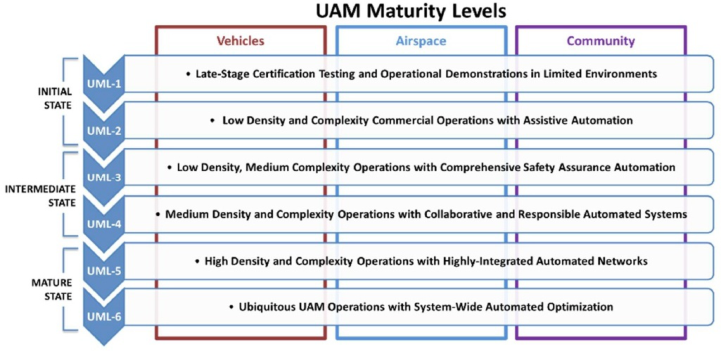
The scale of six levels of Urban Air Mobility depicts the ultimate vision (maturity levels) of fully automated and optimized operations. Operation- ready technologies are currently enabling missions in the vicinity of UML-2.5, where AI-based systems are already supporting the capability to safely oper- ate in a well-scoped environment, beyond the line of sight, and in the vicinity of commercial operations, following NASA Maturity levels (Figure 1).
AAM/UAM infrastructure planning is central to the enablement of the industry. To ensure viable business operations, factors related to social acceptance (noise, operation sustainability, affordability), integration with logistic and mobility infrastructure (vicinity to airport, docks, bus), aircraft performance, TLOF procedures, and electrical power consumption need to be assessed. Moreover, the multi-layered digital twin is well suited to generate synthetic data and evaluate the performance of a suggested network.
Many AAM/UAM missions are experimental by nature. In this context, one of the critical challenges for operators is to get mission approval. Part of the approval process requires the operator to complete a risk analysis. The JARUS SORA process provides a detailed, step-based approach to risk analy- sis for special operations. It is divided into clear steps associated with Specific Assurance Integrity Levels that are designed to quantify risk ultimately and, if too high, leave it to the operator and regulator to mitigate them to an acceptable level. Pilko et al., 2023 shows that simulation plays a key role in quantifying risk using a mix of multi-layered digital twin and Monte Carlo methods. Monte Carlo methods are well suited due to the statistical nature of data representing system failure rate, event occurrence, and mobility pat- terns. SAE G35 is currently working on providing a path toward certification via simulations, paving the way to add more credibility to automated risk assessments.
Traditional Air Traffic Control (ATC) Concept of Operations (ConOps) and systems are not designed to handle the low altitude, dense, and highly dynamic traffic represented by UAM operations. Developing robust and interoperable UAM air traffic management systems is crucial. The exist- ing literature review (Lascara et al., 2019) explores the challenges and presents specific operational concepts of integrating highly automated UAM operations into the National Airspace System (NAS). The proposed frame- work can serve as a starting point for concept evaluations of an Airspace Integration Framework and is articulated around Augmented Visual Flight Rules, Dynamic Delegated Corridors, Automated Decision Support Ser- vices, and Performance-Based Operations. The research questions aim to identify impacts to air traffic managers controlling that airspace, impacts to other VFR traffic in that airspace and other IFR traffic in the vicinity, decision support capabilities for ATC, UTM, and operators, and procedural
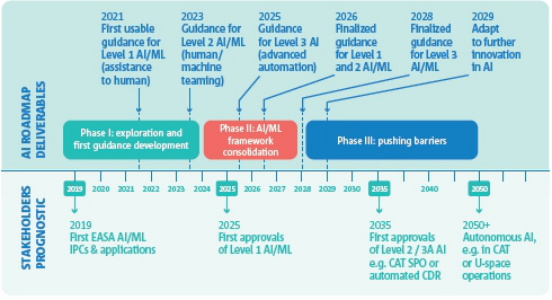
changes/additions that are needed to enable the operation. Moreover, the Pur- due team proposes the implementation of the EASA AI technology roadmap elements in the human–centered design approach in AAM (Figure 2).
Figure 2: Artificial intelligence in aviation roadmap (EASA, 2023).
METHODOLOGY
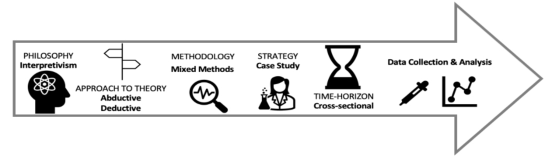
The proposed research recommends both qualitative and quantitative methodologies to verify the efficacy of implementing Competency-Based Training Assessment in enhancing organizational performance within the framework of a well-defined change management strategy. The selected approach for this study is an inductive research method, which aims to exam- ine the human–centered design approach in AAM. This will be achieved by identifying AAM personnel competencies that effectively decrease perfor- mance gaps (CAE, 2021). Furthermore, this study investigates the effects of implementing the human–centered design process and training on the operational expenses of AAM operators. The lean mindset is pertinent to research as it entails the elimination of unnecessary processes in the design procedure, hence facilitating cost- and time-efficient testing - and qualifica- tion practices, reducing training expenses within potential AAM operators. The use of Computer-Based Training and Assessment (CBTA) in aviation AAM personnel planning is illustrated in Figure 3. This diagram is based on the Research Onion proposal, which has been developed from the work of Saunders, Lewis, and Thornhill (2019).
Figure 3: CBTA Implementation in the human–centered design approach in AAM based on the Research Onion proposal as adapted from Saunders, Lewis, and Thornhill (2019).
The Role of Human-Centered Design in Advanced 353
The primary focus of this study revolves around the application of a case study framework, which is widely used in the social sciences. This technique is favored for its capacity to offer a comprehensive analysis of a certain research topic or organization. Yin (2014) argues that directing attention toward a singular corporate entity allows for the efficient resolution of challenges and the acquisition of unique insights that are specific to that particular oper- ating framework (i.e., AAM). The incorporation of a case study provides a valuable structure for the interpretivist paradigm, allowing researchers to gather qualitative insights from participants (Quinlan, 2019). This research would follow a case study approach to investigate through digital twins’ environment the AAM operation framework, design, and remote testing of prototypes - eVTOL aircraft simulator devices. The Purdue research team will collect and analyze this study’s primary data through remote access to the AAM prototype simulator following identified research areas flown by subject matter experts (SMEs) who were purposefully selected for partici- pation. The literature research revealed four main topics after the thematic analysis, connecting competency-based training assessment, AAM, AI tech- nology roadmap elements, and training/certification policies. Semi-structured interviews will be used as a data-gathering method, offering a compromise between the data collection process and allowing study participants to voice their thoughts and opinions (Bryman & Bell, 2015).
FINDINGS According to CAE research (CAE, 2021), UAM will create additional demand for pilots, and they will need additional skill sets to operate in the new chal- lenging UAM traffic environment. Modern learning techniques like adaptive learning with self-paced student-centric training programs using immersive training technologies. Virtual Reality (VR) / Mixed Reality (MR) and Aug- mented Reality (AR) are incorporated into the early training program that will get the initial pilots qualified on the road to ramp up pilot training to meet demand while keeping the lower footprint and improving training cost efficiency. Moreover, the Purdue team proposes the implementation of the EASA AI technology roadmap elements in the human–centered design approach in AAM. The”Implementation Guide for Artificial Intelligence in Aviation: A Human–Centric Guide for Practitioners and Organizations offers a step-by-step approach and facilitates certification and training syllabus – CBTA requirements (Ziakkas et al., 2023).
Additional physiological sensors can be utilized in Unmanned Aerial Vehi- cle (UAV) applications to enhance the efficiency of the Human-Machine Interface (HMI). This can be achieved through the incorporation of advanced technologies like voice recognition and biometric sensors. The aforemen- tioned sensors are employed for the purpose of analyzing cockpit commu- nications, visual scan patterns, and detecting the cognitive load of the pilot. The use of machine-based monitoring and augmentation of the human cog- nitive state serves to mitigate cognitive overload and reduce the need for human monitoring in decision-support systems, thereby addressing issues such as trust and loss of situational awareness in human-machine interfaces
(HMIs). The implementation of such artificial intelligence (AI) functionality has the potential to facilitate pilots’ engagement with an urban setting that is inhabited by other electric vertical takeoff and landing (eVTOL) aircraft, which exhibit authentic behaviors and engage in realistic interactions with one another. An intelligent air traffic control system can be developed to facil- itate interactions between human pilots and autonomous aircraft, enabling them to seek clearances and routing. Lastly, this scenario can effectively demonstrate the functionality of these systems in an emergency landing train- ing exercise, when there is an unforeseen need for coordination between the human pilot, air traffic control (ATC), and the autonomous aircraft.
Finally, this research aims to identify challenges and propose certification– training solutions to the following areas:
Human Automation/Autonomy Teaming
Crew Resource Management (CRM) Principles for Remote and Dis- tributed Teams.
ANALYSIS In order to facilitate urban air mobility (UAM) operations effectively, decision support systems must effectively utilize and share information with estab- lished and traditional air traffic control (ATC) services. The utilization of advanced automation support has experienced a growing trend in the adop- tion of tactical deconfliction activities within the Air Traffic Management (ATM) domain. This is due to the imperative requirement for ATM systems to possess a high degree of automation and intelligence. The primary objec- tive of the proposed project is to develop a sophisticated automated system for managing air traffic of unmanned aircraft systems (UAS) and traditional aircraft using digital twins and AAM prototype simulator. This system will be built upon artificial intelligence (AI) technology. Additionally, the research aims to identify and address concerns pertaining to the explainability of intel- ligent algorithms in scenarios where human operators play a crucial role in making decisions that impact safety.
The existing literature review (Xie et al., 2021) highlights the adoption of ATM AI for incidents and accident risk prediction through the XGBoost algorithm. The study focuses on explaining the trained AI model and the predicted results. Moreover, considerations are made on the most promising strategies to strengthen the trust between the ATC and the system through the redesign of the interface of Human Machine Interaction (HMI). With the increasing role of Artificial Intelligence (AI), the complexity of machine learn- ing “black boxes” has been increasing, which then raises the need for greater transparency through an Explainable AI (XAI). CAE research introduces the aviation incident and accident prediction model adopting the XGBoost algorithm, which is part of the ATM/UTM Decision Support System (DSS). Moreover, the proposed research aims to improve the development of an ATM/UTM application by using AI algorithms and exploring the explana- tion methods of the results given by the model with Explainable AI (XAI), explaining the post-explanation method with SHAP, to achieve the trustwor- thiness and reliability of the AI system. Ensemble learning including boosting
The Role of Human-Centered Design in Advanced 355
(XGBoost), bagging and stacking is used to build predictive and explana- tion models using the XAI method for model transparency and post-hoc explainability.
CONCLUSION
According to the EASA Artificial Intelligence Roadmap (EASA, 2023a), industrial actors are expecting the first crew assistance/augmentation devel- opments in the 2022–2025 time frame. Automation will gradually ramp up to human/machine collaboration between 2025 and 2030, culminating with human supervision or fully autonomous systems arriving after 2035.
To achieve those milestones, the EASA guidance for Machine Learning pro- posal (EASA, 2023b) for Level 1 Artificial Intelligence (assisting humans) and Level 2 Artificial Intelligence (human-machine collaboration) aims to proac- tively address forthcoming EASA guidelines and safety standards pertaining to machine learning (ML) applications with safety implications. It provides guidance to applicants who are incorporating AI/ML technologies into sys- tems designed for safety or environmental purposes. It provides a particular set of guidelines covering the following building blocks that lead to Trust- worthy AI: AI Trustworthiness Analysis, AI Assurance, Human Factors for AI and AI Safety Risk Mitigation.
CAE - Purdue proposed research case study for digital twins in AAM aims at designing and remote testing prototypes - eVTOL aircraft simula- tor devices. By creating a digital twin of the AAM flying/simulator device, designers (Purdue Human Factors team – CAE network) and Subject Matter Experts (SMEs) aim to test different configurations and scenarios, allowing the research team to identify human factor – certification – training issues and optimize performance (Training – Certification requirements) before the physical prototype is built.
ACKNOWLEDGMENT
The authors thank faculty members of Purdue University and the CAE research team for their invaluable feedback contributing to this work.
REFERENCES
Bryman, A., and Bell, E., (2015). Business research methods. (4th Ed) Oxford: Oxford University Press. CAE. (2021). Pilot Training for Advanced Air Mobility. https://www.cae.com/medi
a/documents/Civil_Aviation/cae_evtol_advanced_air_mobility_report_2021.pdf EASA. (2023). Artificial Intelligence Roadmap: A human-centric approach to AI in aviation. Goodrich, K. H., & Theodore, C. R. (2021). Description of the NASA urban air
mobility maturity level (UML) scale. AIAA Scitech 2021 Forum. https://doi.org/ 10.2514/6.2021-1627 Jeong, J., So, M., & Hwang, H.-Y. (2021). Selection of vertiports using K-means algorithm and noise analyses for Urban Air Mobility (UAM) in the Seoul Metropolitan Area. Applied Sciences, 11(12), 5729. https://doi.org/10.3390/app11125729
Lascara, B., Lacher, A., DeGarmo, M., Maroney, D., Niles, R., & Vempati, L. (2019).
Urban Air Mobility Airspace Integration Concepts. Pilko, A., Ferraro, M., & Scanlan, J. (2023). Quantifying specific operation airborne collision risk through Monte Carlo Simulation. Aerospace, 10(7), 593. https://do i.org/10.3390/aerospace10070593 Quinlan, K. M. (2019). Emotion and moral purposes in higher education teaching:
Poetic case examples of teacher experiences. Studies in Higher Education, 44(9), 1662–1675. https://doi.org/10.1080/03075079.2018.1458829 Saunders, M. N. K., Lewis, P., & Thornhill, A. (2019). Research Methods for Business Students. Eighth Edition. New York: Pearson. Vázquez, M. H. (2021). Vertiport Sizing and Layout Planning through Integer
Programming in the Context of Urban Air Mobility. Xie, Y., Pongsakornsathien, N., Gardi, A., & Sabatini, R. (2021). Explanation of machine-learning solutions in air-traffic management. Aerospace, 8(8), 224. https: //doi.org/10.3390/aerospace8080224 Yin, R. K. (2014). Case Study Research: Design and Methods. (5th Edition) Los
Angeles, CA: Sage Publications Ziakkas, D., Plioutsias, A., Pechlivanis, K., 2022. Artificial Intelligence in the aviation decision-making process. The transition from extended Minimum Crew Operations to Single Pilot Operations (SiPO). Artificial Intelligence and Social Computing. AHFE (2022) International Conference. AHFE Open Access, vol 28. AHFE International, USA. http://doi.org/10.54941/ahfe1001452. Ziakkas, D., Vink, L.-S., Pechlivanis, K., & Flores, A. (2023). Implementa-
tion Guide for Artificial Intelligence in Aviation: A Human-Centric Guide for Practitioners and Organizations. In Amazon. Retrieved October 22, 2023, from https://www.amazon.com/IMPLEMENTATION-GUIDE-ARTIFI CIAL-INTELLIGENCE-AVIATION-ebook/dp/B0CL8H14TV/ref=sr_1_1?qid= 1697646031&refinements=p_27%3ADimitrios\protect$\relax+$Ziakkas&s=d igital-text&sr=1-1&text=Dimitrios\protect$\relax+$Ziakkas
LISTED IN THE AHFE DIGITAL BOOKSTORE CATALOGUE
Explore the complete digital volume
Application of Emerging Technologies
Read this individual research paper free through the original publisher, or explore the full digital proceedings book.
ISBN 978-1-958651-91-9
Explore this ISBN in the AHFE Bookstore ↗Listed in the July 2026 bookstore catalogue; search by ISBN to confirm current availability · Digital book purchase optional