Adriana Rodriguez Casamayor, Sibylle Hermann, Hans Nopper, Thomas Lück (2023). Redefining SME Cooperation to Foster a Value-creation-oriented Approach and Propel Forward Cutting-edge AM Services in the Medical Market. In: The Human Side of Service Engineering. AHFE Open Access, vol. 108, pp. 312–322. https://doi.org/10.54941/ahfe1003133
Multi-actor collaboration in business ecosystems has gained importance over the years, not just in research and literature, but also in practice with enterprises veering towards service-oriented value creation to benefit from the competitive advantage it offers for each of the partners in the system. However, in order to harness the potential gains that are implicit in these new ecosystems, SMEs are challenged to develop new strategies to become part of a larger, more complex and dynamic community of co-operating and competing entities that encompasses specialists of different fields with multiple competences and skills, and to influence the building of new governance rules to guarantee their success. This paper depicts the value-creation-oriented approach of a German SME in the field of additive manufacturing (AM) to find its role and establish itself as reliable and valuable player within new multi-actor alliances with the aim of positioning innovative customized products in the medical market. The company’s motivation to reposition itself is driven by an underlying interest of changing the dependence on the existing traditional supply chain structures and promoting its contribution to innovation in the AM branch regarding “production as a service”. Therefore, the firm is willing to contribute to, explore and exploit new methods and procedures to model and simulate various value creation systems in order to support the strategic and operative decision-making in the context of the SME’s reality. For this purpose, three different use cases are considered for analysis: 3D-printed phantoms as visual models, realistic organ phantoms for the surgical training of surgeons, and orthoses and prostheses. The modelling of these three cases, along with further elements and scientific procedures currently under development, set the grounds for a research project in which the SME participates. The first stage of the analysis examines the competitive strengths of the company, such as the potential of the cutting-edge products and services, the processes and technical requirements; and outlines their (dis)advantages compared to similar offers currently available on the market, which with they compete. The second stage offers an insight on the multi-actor constellation in each of the three use cases while deciphering the synergies between actors, resources and processes and how they are intertwined. This phase lays the foundation for understanding not just the roles of the SME and of the other participants, but also the transfer mechanisms (flows of information, material or money) within the complex structures of the business ecosystems. The third stage deals with the SME’s strategies to reposition itself and the risks that it entails. The modelling allows the comparison of boundaries, necessary transitions and their related risks across all use cases. It also identifies the key challenges the SME has to overcome to build up its multi-actor skills on the path to establish new innovative service-oriented forms of value creation. This article offers some insights into the ongoing process of modelling and simulation of innovative ideas, as well as of the perceived value-in-use of the effort to contribute to the methodological development. It also includes a briefly description of the state of the art in the AM branch and of the SME’s core competencies in the medical field that allows for contextualization.
It has been observed for some time that manufacturing companies are increa- singly evolving from product manufacturers to service and solution providers (Baines et al, 2009). This transformation process is driven by the desire of companies to better meet customer needs and at the same time gain a com- petitive advantage by creating bundles of products and services that are not easily copied (Böhmann et al. 2013, Bruhn & Hadwich, 2019). The gro- wing importance of services corresponds to a general paradigm shift in the service marketing literature, the service-dominant logic, according to which value creation is no longer seen primarily as the result of the production or refinement of material goods, but rather as the co-creation of value that occurs when suppliers and customers integrate their respective resources and which is realized at the moment a good or service is used (Vargo & Lusch, 2004). The move towards service-oriented value creation is accompanied by
Redefining SME Cooperation to Foster a Value-Creation-Oriented Approach 313
the fact that service provision is increasingly taking place across industry boundaries. Traditional value chains are being complemented by multi-actor constellations in which loosely connected actors collaborate to fulfill a com- mon value proposition (Vargo, 2012, Lusch & Nambisian, 2015, Vargo & Lusch, 2016). A key driver is the increasing digital interconnectedness of products and processes, which enables new forms of collaboration.
Value creation in networks or ecosystems is complex. It always takes place in an area of tension between cooperation and competition. Cooperation is necessary in order to achieve common goals, while competition arises with regard to performance contributions and the sharing of profits (Bruhn & Hadwich, 2019). Ideally, the actors involved share the same rules and norms and are characterized by a high willingness to contribute their resources in the expected way. Otherwise, the result can be value diminution or value co-destruction (Vafeas et al. 2016, Mustak & Plé, 2020). Aligning and orch- estrating the performance contributions of all partners thus becomes a critical success factor (Tombeil & Nägele, 2022).
Against this backdrop, companies looking to reposition themselves in the market face the challenge of understanding existing or emerging ecosystems and finding a role where they can bring their resources and capabilities to bear in the most efficient and profitable way (Müller-Stewens & Lechner 2016, Heuskel, 1999). They face questions such as:
Who are the players in the ecosystem in question and what is the relationship between them?
What resources do they bring to the table and what benefits can they derive from the collaboration?
What do the processes look like and which actors are involved in which process steps?
Are there customer needs not being adequately addressed by existing players?
Which products or services can be used to create added value for custo- mers?
How is the network orchestrated and who needs to be approached to gain access to the network?
What are the costs and risks associated to the collaboration and market entry?
Answering these questions requires extensive analysis and many discussi- ons with stakeholders. Insights and business ideas must be documented in a comprehensible manner. A common method for the compact representation of value propositions and business models based on them are business model frameworks such as the Business Model Canvas (Osterwalder & Pigneur, 2010), the Lean Canvas (Maurya, 2012) or the Business Model Navigator (Gassmann et al. 2016), to name just a few. These frameworks enable a com- pact description of business models from the perspective of the main supplier. At their core, they comprise three elements: value proposition, value creation, and value capturing. A few frameworks aim at mapping business models of collaborating partners, such as the Business Model Co-Creator (Schletz &
Tombeil, 2018) or the Service-dominant Business Model Radar (Gilsing et al. 2018). However, what all these frameworks have in common is that they only support a qualitative description of business model elements. An opti- mization or simulation of different business model alternatives in multi-actor constellations is thus not possible. For this, a formal mathematical modelling of the value creation system is required. Such a method is being developed in the research project from which the following case study originates. Howe- ver, this work is only in the early stages, so that the modelling method could not yet be applied to the full extent in the use cases described below.
ENTERING THE MEDICAL MARKET WITH CUTTING-EDGE ADDITIVE MANUFACTURING SERVICES The above-mentioned factors set the foundation for a wider research project in which the SME participates. It aims to explore and exploit new methods and procedures to model and simulate various value creation systems in order to support the strategic and operative decision-making in the context of the SME’s reality. This paper shares the early stages of the ongoing research and provides an insight into the approaches and challenges faced by an additive manufacturing SME seeking to enter new service ecosystems in which it has not previously operated.
Additive manufacturing technologies and thus the AM-market keeps conti- nuously developing and is quite dynamic. The spectrum of available printers, printing technologies and materials, as well as its different combinations, is steadily developing enabling a vast range of applications. On the other hand, the AM-production prices have been falling constantly making AM more and more competitive with classic manufacturing technologies. In this context, a growing market resulted in an increasing number of competitors in the AM- service provider field, putting pressure on the margins.
Cirp GmbH is a German SME whose expertise relies on the processing of polymers with diverse additive manufacturing techniques. In order to cre- ate a connection between the market demands in the industry and the latest breakthrough technologies, the company has participated in multiple funded research activities addressing diverse areas of application. This enables the SME to push the boundaries of additive manufacturing and improve not just the materials and processes, but also the knowledge on polymer processing and, therefore, its own products.
Motivation of the Company to Explore New Markets As stated by the Organisation for Economic Co-operation and Development (OECD) in 2008, “in order to stay competitive, SMEs must constantly improve their skills not only in regard to science and technology but also in the management of technology and knowledge of the market and its evolution”.
In recent years, cirp has been investigating different market segments within the medical realm. Personalized medicine has gained relevance and that is where AM offers a significant potential: because every human is diffe- rent, bespoke production seems to be made for this field. The latest industry
Redefining SME Cooperation to Foster a Value-Creation-Oriented Approach 315
report has estimated the global healthcare 3D-printing market to grow at a CAGR of 18% in the next five years (Market Data Forecast, 2022:13).
Cirp has increased its expertise in various areas of additive manufactu- ring through research over the years and does not want to be considered just as an extended workbench for its clients and customers. In this regard, the SME addresses the need to reposition itself driven by an underlying interest of changing the dependence on the existing traditional supply chain structu- res; and has acknowledged the necessity of collaborating across boundaries with specialist of diverse fields to foster a value-creation-oriented approach. However, expanding the business opportunities in a multi-actor collaboration framework entails certain challenges and risks regarding on the one hand the legal and technical requirements of the industry and the products; and on the other hand, the regulation of the economic claims and roles of the actors involved.
The aim is to create a new value-creation-oriented approach to find its new role and establish itself as valuable player within new multi-actor alliances to position innovative customized products in the medical market: 3D printed organ phantoms, and orthoses and prostheses.
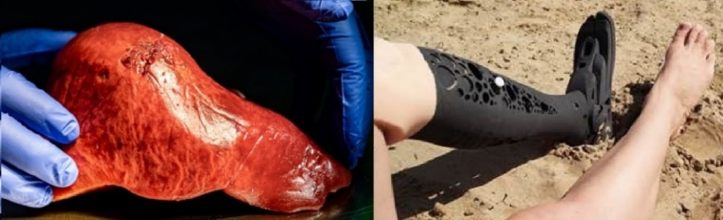
Market Options Analysis and Evaluation One sector that the SME has been investigating within the medical realm is the use of the cutting-edge organ phantoms as visual models and for the training of surgeons and medical specialists. Of these two options, the latter is a new field of application of additive manufacturing for which there is not yet an established market. Another potential new business area being explored by cirp is the 3D printing of orthoses and prosthetic devices. Figure 1 shows two products of the used cases below described.
3D-Printed Organ Phantoms Nowadays, the rapid development of medical visualization technologies ena- bles the depiction of bespoke pathologies. The data generated from different medical imaging methods such as Computed Tomography (CT) and Magne- tic Resonance Imaging (MRI), if properly processed, can be used to recreate
patient-specific 3D-printed models of organs to be used as visual aid for the planning of surgical procedures as well as for training purposes.
AM-technology offers a wide range of design possibilities to print organ models in different sizes, colours, and hardness levels. Combined with augmented reality (AR) and virtual reality (VR) tools, for example, 3D- printed organ models provide the haptic feedback these technologies are lacking (Reinschluessel et al., 2019). As Nopper et al. (2022:2) points out, mutual understanding between designers and doctors and comprehending the objective for which the visual phantom will be used is crucial for choosing the proper AM-process and design, as well as to ensure that the 3D-printed model fulfils its purpose.
In discussions with experts from the field regarding possible applications of 3D-printed organ models for surgical training, cirp was able to iden- tify the following advantages of organ phantoms over classic cadaver-based biological models:
The use of 3D-printed models does not arise ethical concerns and the replacement of cadavers is ethically desirable (3Rs)
Representation of bespoke pathologies becomes possible
Standardisation of training leads to comparability and accessibility
Sensor integration is possible.
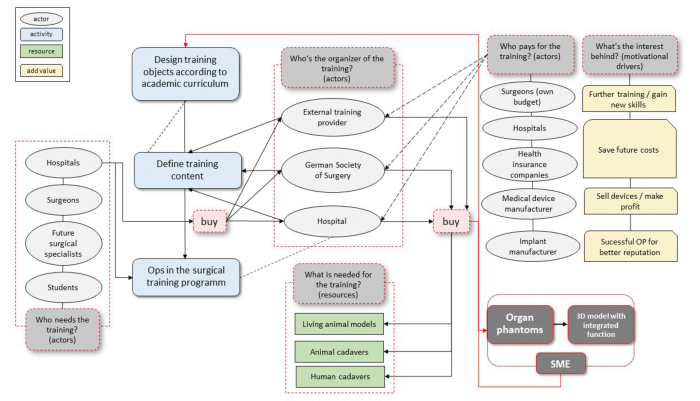
The latter renders an integration of the phantoms into an interactive trai- ning scenario possible, opening a new paradigm of surgical training. After this initial potential assessment, a new service-oriented form of value creation for surgical trainings was further investigated, since realistic organ phantoms for training find multiple fields of application. Key-customers for realistic training phantoms are university clinics and external surgical training pro- viders. Whereas training within clinics is funded internally, manufacturers of medical devices fund a vast majority of specific surgical training courses. cirp attended diverse surgery training workshops and interviewed surgeons of different specialties and physicians. The key findings are summarized in Figure 2. The graphic deciphers the synergies and co-dependences between actors, and identifies key resources, activities and financial flows involved in the current training scenario. It provides as well insights into the actors’ motivational drivers to participate in this specific value-creation system.
Neurosurgery was one of the first options evaluated in detail: about 20% of the 2500 neurosurgeons practicing in Germany are doctors in training (Bundesärtzekammer Ärztestatistik, 2020), meaning that ca. 500 specialists have to participate in surgical training programs in the clinics. The initial research showed that the surgical trainings are divided in 3 different diffi- culty levels leading up to about 1500 trainings requiring phantoms every year. This number does not consider other training courses conducted by external providers in Germany.
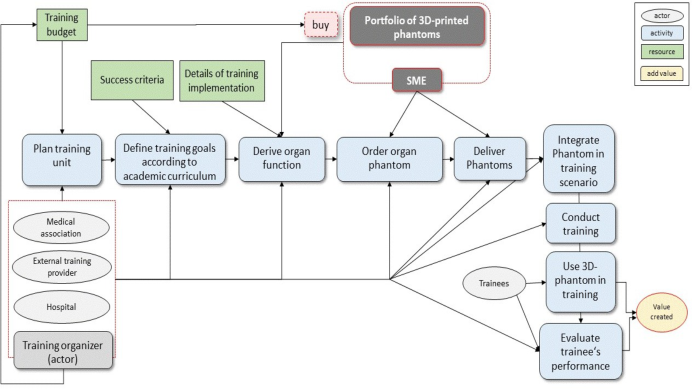
Producing an innovative 3D-printed phantom is one of the strengths of cirp. However, the development towards service-oriented value creation can prosper if the company succeeds in integrating itself into the value chains where relevant key partners incorporate their services and resources
Redefining SME Cooperation to Foster a Value-Creation-Oriented Approach 317
Figure 2: Analysis of the existing training scenario in Germany by cirp GmbH.Figure 3: Model of a possible value chain where 3D-printed phantoms are used for value-creation.
in support of the core product (Figure 3). On the other hand, informing and advising the training provider about emerging opportunities in additive manufacturing regarding organ phantoms could become an important new part of the company’s services.
The market segment for 3D-printed visual models for surgical planning proved to be challenging in terms of viability at a very early stage. As soon as a medical product deals with personal medical data and has a direct impact on the patient’s treatment and, therefore, has a clinical outcome, the legal framework and existing regulations for medical devices set high deman- ding standards to the processes and certifications. Complying with these
regulations result in extensive costs that set high barriers to the market entry. For this reason, the SME focused the research on the 3D-printed models for training purposes. The large dependence on the clinical know-how and the high-cost for a market entry, due to certification issues, are relative to a com- parably easy-to-access manufacturing and design know-how for the visual phantom.
3D-Printed Orthoses and Prosthetic Devices In orthopaedic technology, manufacturing has always been the core of the service and is to a large extent associated with manual labour and skilled craftsmanship. Additive manufacturing technology matches bespoke manu- facturing process perfectly, thus experienced herein a huge growth. This is supported by the fact that digital scanning methods are faster and more convenient than classic methods like plaster moulds or similar. The AM- inherent possibilities of function integration further intensify this trend, as complex prostheses integrate more and more complex electronic and mech- anical features. This technical tornado rearranged the market, forcing many players like the orthopaedics and health care supply stores to adapt new technologies and to engage into multi-actor alliances.
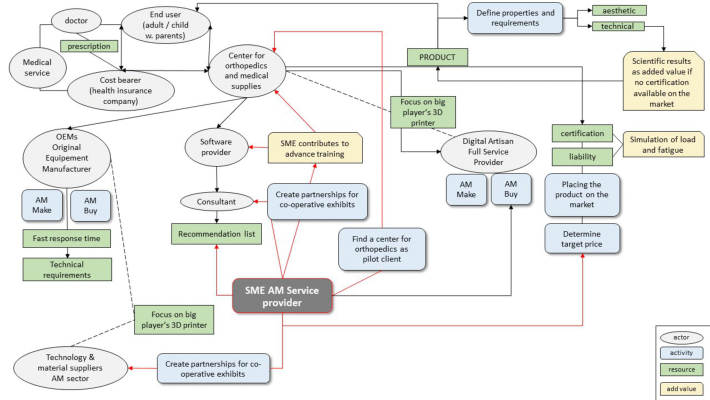
Within the framework of a market development program of the Fede- ral Ministry for Economic Affairs and Climate Action (BMWi), the Swiss German Chamber of Commerce (2021:02) concluded that “the market for medical technology is a global growth market with a high rate of innovation”. It confirms that the area of orthopaedics is the strongest in the world market for medical technology (12%) followed by the minimally invasive medicine (10.4%). It also estimates that orthopaedics belongs to one of the most inno- vative research sectors in Germany (2021:5). cirp conducted a first market sounding and talked to experts at various trade fairs to understand not just the roles of the other participants involved, but also the transfer mechanisms within the complex structures of an already established business ecosystem. Figure 4 depicts the key players within in the area of orthoses and prosthetic devices (OT-market) and the processes and technical requirements involved. It also represents potential new partnerships for the SME and the resulting added value.
Mastery of the whole value-creation chain renders practically impossi- ble for smaller players, whereas bigger players try to be in control of the most deciding fractions. Starting from the 3D-printing and scanning hardw- are and manufacturing know-how to the appropriate software solutions, the value chain is quite fragmented. On the other hand, the design of prostheses itself remains a central part. Nevertheless, the direct contact to the custo- mer remains key, putting orthopaedics in a strategic position and serving those stores with AM-services is the key-objective of cirp. Further goals of the SME to reach a unique selling proposal include positioning itself with a distinctive service in this market landscape and going beyond the status of a pure manufacturing provider. Otherwise, the SME risks to get under margin pressure from the various competitors. In the next steps of the research pro- ject, a questionnaire to carry out expert interviews with key market players
Redefining SME Cooperation to Foster a Value-Creation-Oriented Approach 319
Figure 4: Analysis of the market segment for orthoses and prosthetic devices in Germany by cirp GmbH.
within the sector will be developed in order to find clusters of interest and gather relevant information to build up the multi-actor skills of the SME on the path to reposition itself and establish new forms of value creation. Apart from building up reputation through reliability, quality and service speed, extended consulting services for the stores are being considered. Building up specific unique software-based expertise within the value chain could be here beneficial. Simulation expertise of load and fatigue of AM-lattices gained on another research project conducted by the SME could come into play and add value to its products.
Liability considerations play an important role within the market segment. This is even more, as the main funding body of the products are the assu- rances, where safety considerations are a major issue within the approval process. Regarding the structure of this market segment, incorporating work- shops focusing on the 3D-printing technology for orthopaedic centres as a new service of the SME would represent an added-value to the process.
CONCLUSION
Due to the technological progress and the digital transformation in the last decades, the increased competition in an interconnected, global economy has led to new business ecosystems where service-oriented forms of value creation are gaining ground.
The use of organ phantoms opens a new paradigm of surgical trai- ning. Integrated in a broader training scenario, interactive 3D-printed organ models offer unprecedented training possibilities featuring bespoke patho- logies and the possibility of creating equitable training units in which all participants have equal opportunities to train their skills. The value of the training is equally quantifiable and would not need to be adapted to the
availability of resources, being all trainees equally assessed by identical per- formance measures. The benefits of this multi-actor collaboration would cover a need that is challenging to address with the given actual resou- rces: training becomes repeatable, comparable and quantifiable. Despite their numerous advantages, elaborate 3D-printed phantoms must justify their higher price against animal cadavers, which are often available at convenient costs. The use of organ phantoms requires a higher investment. Furthermore, the complex the 3D-phantom is, the higher are the time to market and the risk involved.
The SME’s examinations lead to think that AM will have an important role within the OT-market in the next years. Whether the added value provided by special software know-how can be a decisive factor for cirp within the multi- actor landscape needs to be modulated in the next steps. New approaches to other key players in this market to discuss possible partnerships and further services to expand the role of the SME need to be examined and discussed.
Understanding how the actors are interconnected in both emerging busi- ness ecosystems and their constraints is still challenging. Within the frame- work of the research project that is being conducted, gaining access to the existing network has proved to be difficult, particularly in the organ phan- tom market. Further research is needed to find key pillars that could foster and help establishing a solid multi-actor collaboration framework for this emerging market segment. The development of formal models and the simu- lation of different value creation constellations and processes foreseen in the next stages of the research project will be a valuable contribution to sup- port the strategic and operative decision-making in the context of the SME’s reality.
ACKNOWLEDGMENT
The ongoing research is funded under project number 02K20Z006 (cirp GmbH) and 02K20Z000 (Fraunhofer IAO) by the German Federal Mini- stry of Education and Research (BMBF) in the program “Innovations for tomorrow’s production, services and work” and supervised by the Project Management Agency Karlsruhe (PTKA).
REFERENCES
Baines, T. S., Lightfoot, H. W., Benedettini, O., & Kay, J. M. (2009). The servitization of manufacturing: A review of literature and reflection on future challenges. Journal of Manufacturing Technology Management, 20(5), 547–567. https://doi. org/10.1108/17410380910960984. BÄK, Bundesärtzekammer, Ärztestatistik (2020). Ärztestatistik 2021 - Bundesärzte-
kammer (bundesaerztekammer.de). Böhmann, T., Warg, M., & Weiß, P. (2013). Service-orientierte Geschäftsmodelle: Erfolgreich umsetzen (2013. Aufl.). Springer Gabler. Bruhn, M., & Hadwich, K. (2019). Service Coopetition – Dienstleistungen im Span-
nungsfeld von Wettbewerb und Kooperation. In M. Bruhn & K. Hadwich (Eds.), Kooperative Dienstleistungen: Spannungsfelder zwischen Service Cooperation
Redefining SME Cooperation to Foster a Value-Creation-Oriented Approach 321
und Service Coopetition (pp. 3–34). Springer Fachmedien. https://doi.org/10. 1007/978-3-658-26389-8_1. Gassmann, O., Frankenberger, K., & Csik, M. (2016). Geschäftsmodelle entwickeln: 55 innovative Konzepte mit dem St. Galler Business Model Navigator. Carl Hanser Verlag GmbH & Co. KG. Gilsing, R., Adali, O. E., Turetken, O., & Grefen, P. (2018). A reference model for the
design of service-dominant business models in the smart mobility domain. https: //www.researchgate.net/publication/328334842_A_reference_model_for_the_de sign_of_Service-Dominant_Business_Models_in_the_smart_mobility_domain. Handelskammer Deutschland-Schweiz (2021). Rehabilitation und Orthopädie. Produkte und Lösungen für die Zukunft. Projektmagazin Leistungsschau Orth- opeaedie Rehabilitation Medizintechnik. https://www.handelskammer-d-ch.ch/ media/4142/download/Projektmagazin%20Leistungsschau%20Orthopaedie% 20Rehabilitation%20Medizintechnik.pdf?v=1. Heuskel, D. (1999). Wettbewerb jenseits von Industriegrenzen: Aufbruch zu neuen Wachstumsstrategien (1. edition). Campus Verlag. Lusch, R. F., & Nambisan, S. (2015). Service innovation: A service-dominant
logic perspective. MIS Quarterly, 39(1), 155–175. https://doi.org/10.25300/MI SQ/2015/39.1.07. Market Data Forecast (2022). Global Healthcare 3D Printing Market (2022-2027).
Research Report January 2023. Maurya, A. (2012, February 27). Why Lean Canvas vs Business Model Canvas?
Continuous Innovation Blog. https://blog.leanstack.com/why-lean-canvas-vs-bu siness-model-canvas/ Müller-Stewens, G., & Lechner, C. (2016). Strategisches Management: Wie strategische Initiativen zum Wandel führen (5. edition). Schäffer-Poeschel Verlag. Muender, T., Reinschluessel, A. V., Salzmann, D., Lück, T., Schenk, A., Weyhe, D.,
Döring, T., & Malaka, R. (2022). Evaluating Soft Organ-Shaped Tangibles for Medical Virtual Reality. Extended Abstracts of the 2022 CHI Conference on Human Factors in Computing Systems, 1–8. https://doi.org/10.1145/3491101. 3519715. Mustak, M., & Plé, L. (2020). A critical analysis of service ecosystems research: Rethinking its premises to move forward. Journal of Services Marketing, 34(3), 399–413. https://doi.org/10.1108/jsm-02-2019-0084. Nopper, H., Uslar, V., Salzmann, D., Santos, U. F., Lueck, T., Schumann, C., Karaya-
giz, F., & Malaka, R. (2022). Evaluating benefits of patient-specific 3D-printed phantom designs in visceral surgery. Transactions on Additive Manufacturing Meets Medicine, 4(1), 671. https://doi.org/10.18416/AMMM.2022.2209671. OECD (2008), Enhancing the Role of SMEs in Global Value Chains, OECD Publishing, Paris, https://doi.org/10.1787/9789264051034-en. Osterwalder, A., & Pigneur, Y. (2010). Business model generation: A handbook for
visionaries, game changers, and challengers. Wiley; Kindle. Reinschluessel, A., Fischer, R., Schumann, C., Uslar, V., Muender, T., Katzky, U., Kißner, H., Kraft, V., Lampe, M., Lück, T., Bock-Müller, K., Nopper. H., Pelzl, S., Wenig, D., Schenk, A., Weyhe, D., Zachmann, G., Malaka, R. (2019). Introducing Virtual & 3D-Printed Models for Improved Collaboration in Surgery. CURAC- 18th Annual Meeting of the German Society for Computer- and Robot-Assisted Surgery, Reutlingen, Germany. Schletz, A., & Tombeil, A.-S. (2018). Geschäftsmodelle für Netzwerker gestalten.
Tombeil, A.-S., & Nägele, R. (2022). Towards a Concept of “Governance as a Smartservice in Service-Oriented Value-Creation-Systems”. In C. Leitner, W. Ganz, C. Bassano, & D. Satterfield (Eds.), The Human Side of Service Engineering. AHFE (2022) International Conference (Bd. 62, S. 328–334). https://doi.org/10. 54941/ahfe1002574. Vargo, S. L., & Lusch, R. F. (2004). Evolving to a new dominant logic for marketing.
Journal of Marketing, 68(1), 1–17. https://doi.org/10.1509/jmkg.68.1.1.24036 Vargo, S. L., & Lusch, R. F. (2012). Toward a Better Understanding of the Role of Value in Markets and Marketing. Emerald Group Publishing. Vargo, S. L., & Lusch, R. F. (2016). Institutions and axioms: An extension and update
of service-dominant logic. Journal of the Academy of Marketing Science, 44(1), 5–23. https://doi.org/10.1007/s11747-015-0456-3 Vafeas, M., Hughes, T., & Hilton, T. (2016). Antecedents to value diminution: A dyadic perspective. Marketing Theory, 16(4), 469–491. https://doi.org/10.1177/ 1470593116652005.
LISTED IN THE AHFE DIGITAL BOOKSTORE CATALOGUE
Explore the complete digital volume
The Human Side of Service Engineering
Read this individual research paper free through the original publisher, or explore the full digital proceedings book.
ISBN 978-1-958651-84-1
Explore this ISBN in the AHFE Bookstore ↗Listed in the July 2026 bookstore catalogue; search by ISBN to confirm current availability · Digital book purchase optional