Anne Sophie Tombeil, Lukas Block (2023). Towards a Metamodel for Service-Oriented Value Creation. In: The Human Side of Service Engineering. AHFE Open Access, vol. 108, pp. 302–311. https://doi.org/10.54941/ahfe1003132
Today, the economy, society and politics are confronted with multiple challenges regarding the future of value creation. These challenges are: The simultaneity of hyper-individualized demand patterns, global challenges such as climate change, food shortage or energy security as well as opportunities and risks through digitalization. Available and sustainable service offerings that create value-in-use are one way to develop solutions towards these challenges. Yet, due to the challenges, their design is characterized by high complexity and requires a new quality of collaboration in multi-responsible actor constellations. Thus, we pose the following research question: How can we succeed in supporting the invention, innovation, and reliable delivery of smart service offerings in complex service-product systems?Modelling is a well-known approach to reduce complexity and enforce understanding as well as innovation in socio-technical systems. As such, our approach aims at developing a formal mathematical model of service-oriented value creation. It allows to model and subsequently simulate new service-oriented and sustainable value creation configurations. It supports strategic management decisions like partner selection but also helps to identify operational design tasks of the system (e. g., interface compatibility).We draw on three concepts as a bases for our model about service oriented value creation:1.A Service has three dimensions: Potential, process and output/outcome2.Complex service-product-system appear, when digital smartness is added. Digital service-product-systems encompass four layers: Infrastructure respectively products and database, digital service, personal service and coordination in the system.3.Business Modelling is oriented in three dimensions: Value proposition (promis making), value creation (promis keeping) and value capture (producing value as well as splitting costs and benefits) Framed by these concepts we locate the space where service-oriented value creation can enfold. The methodological approach to generate the formal model from these concepts combines grounded theory and practice research. Theoretical literature review in the field of service-oriented value creation provides a deductive way to identify model elements and mathematical relationships between them. Practice research follows an inductive argumentation to tune the model towards real-world requirements and challenges (e. g., data availability). Thereby, it relies on discursive transdisciplinary workshop procedures to fuse both parts. The project consortium includes social scientists, industrial engineers and computer scientists. Companies from three industries are involved as practical partners with their service offers or innovation ideas: Services for local public transport in rural areas, services to promote transparency in project management in the construction industry and services to place additive manufacturing products as a service in medical markets.In our contribution to the Session we aim to share first results regarding the model. This encompasses: •The conception of the model on three levels: Meta Model, Domain Meta Model, Case Specific Model. The model elements their relationships and the reasoning behind them is explained.•The explanation of central computational functions as well as how modelling and simulation can aid in the design of service-oriented value networks.•First insights into the technical implementation and our planned open-source strategy.•Experiences with the transdisciplinary approach and outlook on next steps in the project.The ongoing research is funded under project number 02K20Z000 by the German Federal Ministry of Education and Research (BMBF) in the program "Innovations for tomorrow's production, services and work" and supervised by the Project Management Agency Karlsruhe (PTKA).
Today, economy, society and politics are confronted with multiple challenges regarding the future of value creation. One of the top issues in our view is to provide for the creation of a new quality of collaboration between multi-responsible actors to cope with complexity on a system of systems level. In this paper we share the approach and first results of our ongoing project “Service-Oriented Value Creation (SOW)” funded by the German Federal Ministry of Education and Research. Our research aims to support decision making regarding the engineering of purpose, structures, and processes as well as the governance, respectively management, of collaboration in complex multi-responsible actor constellations. We develop a metamodel to describe, analyse and understand service-oriented value creation in complex networks. The project consortium follows a multidisciplinary approach and includes social scientists, industrial engineers, and computer scientists. We rely on such a large scope of involved parties to check and ensure the
Towards a Metamodel for Service-Oriented Value Creation 303
viability of axioms and normative principles, to avoid under-complexity of the solution and at the same time to keep the practical application of the solution in mind.
FRAMING THE SUBJECT AREA OF SERVICE-ORIENTED VALUE CREATION Dimensions of Service-Oriented Value Creation
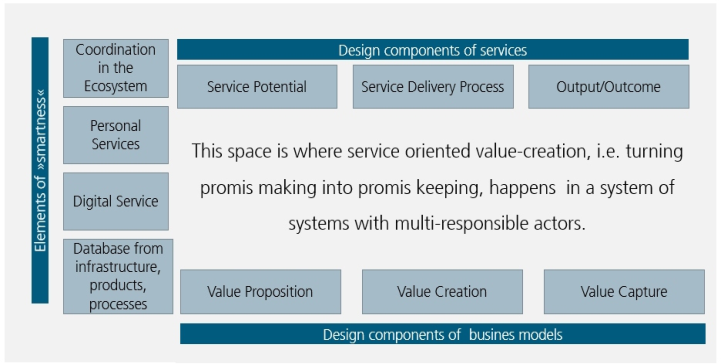
Service-oriented value creation is driven by complexity in multiple dimensions. Within the project, we developed a framing of the subject area in three dimensions (Figure 1).
Within the first dimension, we address the “elements of smartness” that is individual configurable personal services based on intelligent technology and data use (see Bullinger 2017, left hand side of figure 1). Smartness includes four elements from bottom to top (Neuhüttler 2019, 2022): (1) a database which is produced by infrastructure including products and processes, (2) digital services like collecting, storing, providing and allowing for analyzing data, (3) personal services, that is making a value proposition towards a customer and keeping it through delivery of value- in-use, and (4) coordination in the ecosystems since it is very unlikely that one company or corporate actor can provide for the four mentioned elements alone. Additionally, we address the “design components of services” as second dimension which always comprises the following three elements (Bullinger/Scheer 2003, top of Figure 1): providing the service potential, that is everything needed to be able to deliver on the value proposition, realizing the service delivery process to create the promised output and a perceived outcome which is contingent to the subjective perception of the customer or user. In the third dimension, we address the “design components of business models” (Osterwalder/Pigneur 2011) which include the value
Figure 1: Service oriented value creation framed in three dimensions (own representation).
304 Tombeil and Block
proposition to be made, the value creation to be realized and the value capture to be achieved and distributed. We propose that the combination of these three dimensions encloses a space where “Service-oriented Value Creation” happens in a system of systems. Service-oriented value creation turns promise making into promise keeping. Thereby, the performance relies on multi-responsible actors. Multi-responsibility means that every part of the system of systems feels and acts responsibly for the performance on the collective level, and not only for the respective self-interest because, as Bouncken and Kraus put it “the fate of the participant is connected to the system”. (Bouncken/Kraus 2021, Tombeil/Nägele 2022).
This framing shows that multi-responsible actor, service-oriented value creation is characterized by high complexity, which we delineate as follows:
Innovative service offerings combine product and service components and use data and digital transformation as an enabler and driver.
Traditional industry boundaries and logics blur.
Value creation no longer takes place only in closed chains but also in open networks that represent a system of systems.
Collective purpose, reliability of contributions, balancing of interests and governance are key challenges to generate high collaborative quality.
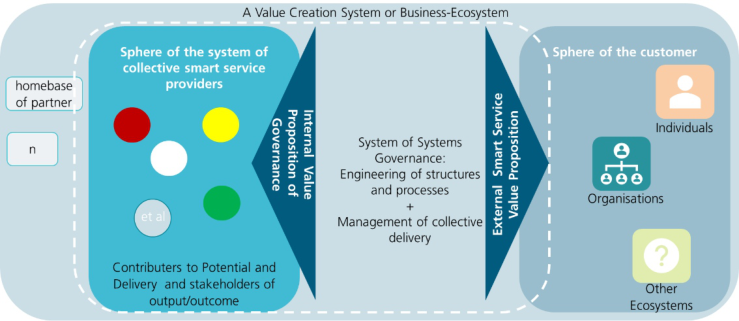
As such, we need to understand service-oriented value creation as a complex system of systems with multiple actors. Thereby, the following aspects represent the main characteristics (see Figure 2). On the left in Figure 2, we see that service-oriented value creation is multi-actor value creation including collective smart service providers with their different organizational home bases (Tombeil, Nägele 2022, Gassmann/Ferrandina 2021). The boundaries of such a value creation system – be it a completely new system or the transformation of an existing one – may not (yet) be clear. However, involved actors are supposed to have a shared “External Value Proposition (ExVP)” towards the sphere of the customer or at least a strong idea of it (see Figure 2, center). This ExVP expresses the reason to be part
Figure 2: Value creation in a system of systems (own representation).
Towards a Metamodel for Service-Oriented Value Creation 305
of the system of systems. Actors in the system of systems are expected to contribute their strengths and competencies in collective functionality and multi-responsibility to consolidate and deliver on that ExVP. Accordingly, the system of systems needs to be engineered regarding structures and processes to enfold collective functionality and foster multi-responsibility of the involved actors. System governance and management should regard aspects like relationships, power, trust, and knowledge integration. Creating an “Internal Value Proposition (IntVP)” by and for the system which is framed by the ExVP is a good starting point to operationalize, engineer, and manage multi-responsble actor collaboration over time (see Figure 2, left). It is likely that emergent effects occur. Continuous reshaping and adaptive governance and management of the system of systems becomes necessary (Tombeil/Nägele, 2022, Hilb 2021).
Research Approach Modeling is a well-known approach to reduce complexity, enforce understanding as well as innovation in socio-technical systems (Walden et al. 2015). Different models have already been suggested to depict, analyze and understand service value networks (see e.g., (Bullinger/Scheer 2003; Becker et al. 2009; Wieringa et al. 2009). Yet, all these approaches either ignore the multi-dimensional relationships constellations or are not able to connect them across different perspectives on the value creation network. Thus, they fall short to describe and manage the complexity and the emergent effects depicted in the above.
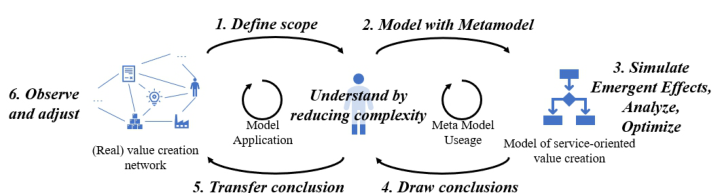
Our approach aims at developing a formal-mathematical metamodel for service-oriented value creation. The metamodel encodes the already existing knowledge in service research in a formal and partially mathematical way. Emergent effects can be simulated by a computer and analysis of complex actor and value creation networks is supported. Formalization allows to depict and analyze the multi-dimensional relationships from different perspectives with the help of a modeling software. Thus, the metamodel focuses on the generic and multi-dimensional relationships between the value creating elements (e.g., activities, resources, and actors). The elements and relationships of the metamodel can then be used to model specific service- oriented and sustainable value creation configurations. Thereby, the goal of the metamodel is not to depict or predict the revenue or agent behavior in the service value network as accurately as possible. It is rather a tool to better understand the emergent behavior of the network, by analyzing, simulating, and adjusting the network and its elements iteratively (see Figure 3). Consequently, it supports strategic management decisions like partner selection but also helps to identify operational design tasks of the system (e.g., interface compatibility).
The methodological approach to generate the formal-mathematical metamodel is two sided: It combines grounded theory and practice research. Theoretical literature review in the field of service-oriented value creation provides a deductive way to identify model elements and mathematical relationships between them. Practice research follows an inductive argumentation to tune the model towards real-world requirements
306 Tombeil and Block
Figure 3: Interaction between the modeler, the model and the metamodel.
and challenges (e.g., data availability). Thereby, it relies on discursive transdisciplinary workshop procedures to fuse both parts.
Organize, Realize and Value Inter- and Transdisciplinary Research and Development Processes The project consortium was organized with researchers form a wide range of disciplines as well as practioners from companies of a wide range of industries and different maturity. With this we attempt to grasp the term or the subject area “Service-oriented Value Creation” in depth and lose as little as possible of a meaning during transformation to a formal-mathematical model
DEKO DERICHS u KONERTZ Projektmanagement GmbH provides services of project management and consulting in building construction. DEKO aims to innovate on value-oriented construction development solutions in a highly fragmented multi-actor ecosystem where monetarizing on intransparency and knowledge-hiding is the norm. The basic hypothesis is that transparency and data integration can raise potentials for more user-oriented value creation.
omobi GmbH is a start-up focusing on on-demand mobility solutions. omobi strives to advance sustainable value creation networks in the digital ecosystem vehicle with its technological, methodological, and organizational aspects. Thus, omobi integrates and optimizes the exchange and contribution of external partners and applications into its vision of future mobility. Thereby, forecasting, recording, and negotiating value creation contributions of each partner is crucial for a fair cooperative value creation among the partners and a smart service delivery.
cirp GmbH develops a new business field for additive manufactured products in the medical and therapeutic sector. It is expected that the metamodel as well as the modeling procedure can support in creating a certifiable value-added partnership among the different actors. Thus, cirp will evaluate how to manage the high quality requirements towards handling, interpretation, and processing of three-dimensional data from imaging methods in medical diagnostics as well as how to possibly implement the legal framework.
Researchers in the project are the FIR e.V. Aachen, part of RWTH University, the Fraunhofer IAO and the IAT University of Stuttgart.
Towards a Metamodel for Service-Oriented Value Creation 307
FIR e.V. aims to enfold potentials of collective value creation systems for businesses. The focus of research and development are the scientifically sound yet practically applicable identification and description of archetypal, strategic roles and possible success positions as well as their application- oriented simulation.
Fraunhofer IAO focusses on research for the successful design of networked value creation with a emphasis on multiresponsible-actor- systems. Contributions are made to the creation of knowledge and new methodological approaches as well as tools to support engineering and management for collaboration quality.
IAT of the University of Stuttgart performs the formal-mathematical modeling of the identified elements of value creation systems as well as their methodical application. The aim is to develop a new methodological approach that describes configuration principles and identifies and classifies success factors for multi-actor collaboration regarding the innovativeness and stability of a value creation system.
We created three types of working groups to explore and exploit the contributions from the different perspectives and to succeed in knowledge integration, while acting sensible to different interests and contexts. The first working group type is defined by partners from one practioner and one research organization each. The second type is built by researchers from the three institutes which represent different disciplines. The third type is built by the consortium with participation of at least one colleague of each participating organization. Meetings of the first type are individually organized online or on-site, meetings of the second type have been at the very beginning on-site and continued online every two weeks and in peak times of progress every week. Meetings of the third type are online monthly and on site twice a year for two days. Until now, knowledge creation, transfer, and integration has been concentrated on understanding and visualizing the respective service-oriented value creation system; be it an existing one or one that is supposed to come into existence. Furthermore, a collection of possible questions and expectations from practioners to the metamodel is produced and taken account of in the development of the metamodel. Practice research is complemented by desktop research to collaborate on necessary definitions, explore axioms and normative propositions. So far, emerging artefacts are a glossary, conceptual visualization in PowerPoint, Conceptboard and classical process modeling tools as well as the emerging metamodel and the corresponding software tool. Translation into formalization and test of each element is an ongoing iterative process in discursive transdisciplinary workshop procedures.
DEVELOPING A METAMODEL FOR SERVICE-ORIENTED VALUE CREATION How We Built the Metamodel
Our way of modeling service-oriented value creation is based upon three levels of models: (1) The (generic) metamodel of service-oriented value creation, (2) domain-specific metamodels and (3) case specific models. The
308 Tombeil and Block
metamodel depicts the necessary model elements and their relationships to describe service-oriented value creation in general. The domain-specific metamodels specialize these elements and relationships. They provide stereotypes of model elements and network topologies typical for a certain domain (e.g., Mobility or Additive Manufacturing). The case specific models build upon the domain-specific metamodels. They describe specific value creation networks in practice. While the last type of models is to be developed by practitioners, the former two models are subject to formal-mathematical definition.
Defining a metamodel follows an iterative process of gaining the necessary knowledge and subsequent conceptualization and formalization of the knowledge gathered into model elements and relationships. As already described above, we followed a simultaneous deductive and inductive approach to accumulate a body of knowledge about service-oriented value creation. We then followed a twostep approach to conceptualize and formalize the knowledge. Firstly, the core elements within the body of knowledge were formally defined. Examples for core elements are resources, activities, and actors. Subsequently, relationships between the elements were identified. Relationships between the elements constitute the metamodel’s topology. They define, how the emergent effects are simulated, which analyses are possible within the metamodel and how the perspectives are linked together. The relationships are crucial to the metamodel’s capabilities. Thus, we assigned each identified relationship to one of the following three classes:
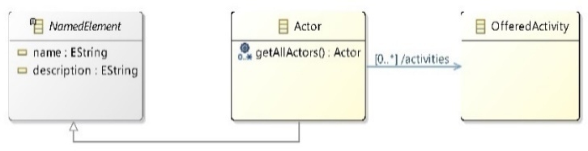
Axioms: Axioms describe fundamental and unchangeable assumptions about value creation (see Figure 4). Consequently, axioms define the core relationships in the metamodel’s topology which must be fulfilled in all models derived from the metamodel.
Normative propositions: Normative propositions describe basic assumptions of service-oriented value creation, which many of the theories relevant to the subject share. They remain valid if there is no paradigm shift. Thus, propositions are also defined as relationships in the metamodel or in one of the domain metamodels. Yet, they do not define core dependencies and might be changed in future releases of the metamodel.
Assumptions: Assumptions are relationships which are assumed to be true in general. However, for certain networks their existence or specification might differ or not hold at all. Thus, they can be adjusted or overwritten in the domain metamodels or in the specific models.
Figure 4: Exemplary depiction of the axiom “Actors offer activities in service-oriented value creation.” as a relationship between the elements “Actor” and “OfferedActivity”.
Towards a Metamodel for Service-Oriented Value Creation 309
The relationships are then introduced in the metamodel as described for each element. Furthermore, expressions – also called “Functions” – are introduced to describe the behavior of the elements. They define how a certain agent might behave or how the perceived value is calculated from the current network’s state.
A core requirement for the metamodel is that modelers should only be required to describe the already existing knowledge about the network. The model’s analysis then points them towards missing knowledge areas or makes assumptions to still be functional. Simulation and optimization help to evaluate the effect of different possibilities in the unknown or uncertain knowledge areas. The metamodel then provides elements, relationships, and expressions to describe these knowledge areas.
The metamodel is defined in XCore, a metamodeling language of the Eclipse Modeling Framework. Based on this framework, a software tool is currently under development. It should help to create the specific models. We plan to evaluate the metamodel together with the practitioners in the project. The elements and relationships will then be adjusted to the practical needs. After that, the domain metamodels will be developed based on these use cases in the Construction, Mobility and Additive Manufacturing domain.
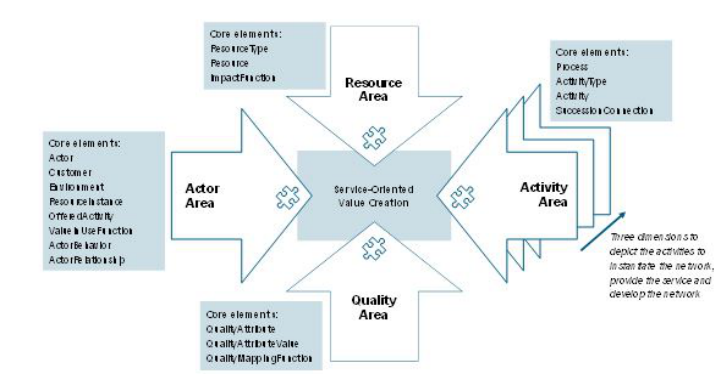
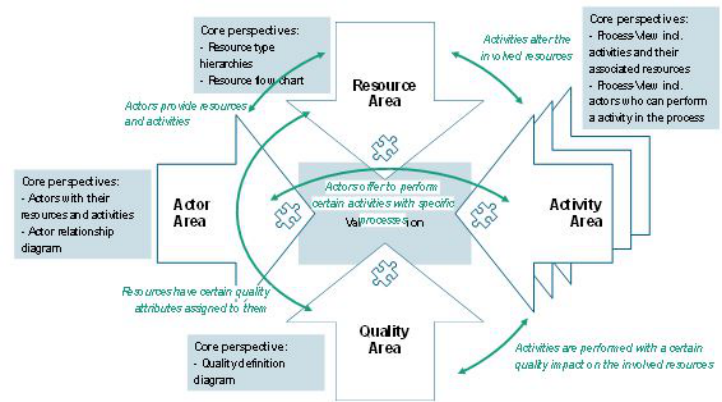
How the Metamodel Currently Looks Like The metamodel for service-oriented value creation is divided into four focus areas (see Figure 5). Each focus area describes value creation from a certain perspective. This structures the model and helps modelers and practioners to understand and apply it faster. The elements of the focus areas are interconnected by their relationships, which cross the boundaries of the areas (see Figure 6). Each focus area comes with at least one perspective on the model (see Figure 6). Perspectives reduce complexity by only showing the subset of elements and relationships which are relevant for a certain concern
Figure 5: Focus areas of the metamodel with their associated core elements.
310 Tombeil and Block
Figure 6: Relationships between the focal areas of the metamodel and their associated perspectives.
of the modeler (Walden et al. 2015). Thus, they manage complexity when carrying out the methodology’s activities.
CONCLUSION AND NEXT STEPS So far, we conclude that the approach proved to be a good way of conceptualizing the topic. We enabled successful intersubjective exchange and translation into formal mathematical terms. The project proceeds on its way to deal with complex value creation systems. We plan to release the metamodel, its domain metamodels and the modeling tool as open source as soon as a first complete version is available. Iterative releases will follow during the empirical evaluation, providing updates and adaptions according to new insights. The practioners in the project will model their specific value creation networks during the empirical evaluation. Thereby, they will follow a modeling methodology, which is currently under development. The methodology will guide future applicants through the iterative process, depicted in Figure 3. The methodology will be released as a modeling handbook alongside the metamodel and the modeling tool. Consequently, next steps will include the extension of the metamodel (i.e., by including actor relationships like transparency), developing the modeling methodology and testing the metamodel.
ACKNOWLEDGMENT
The ongoing research is funded under project number 02K20Z000 by the German Federal Ministry of Education and Research (BMBF) in the program “Innovations for tomorrow’s production, services and work” and supervised by the Project Management Agency Karlsruhe (PTKA).
Towards a Metamodel for Service-Oriented Value Creation 311
REFERENCES
Becker, J., Knackstedt, R., Beverungen, D., Bräuer, S., Bruning, D., Christoph, D., Greving, S., Jorch, D., Joßbächer, F., Jostmeier, H., Wiethoff, S., Yeboah, A., (2009): Modellierung der hybriden Wertschöpfung: Eine Vergleichsstudie zu Modellierungstechniken. Bouncken, R. B., Kraus, S. (2021): Entrepreneurial ecosystems in an interconnected
world: emergence, governance and digitalization, Review of Managerial Science, https://www.researchgate.net/publication/348390352_Entrepreneurial_ecosyste ms_in_an_interconnected_world_Emergence_governance_and_digitalization. Bullinger, H. J., Neuhüttler, J., Nägele, R., Woyke, I. (2017), “Collaborative Development of Business Models in Smart Service Ecosystems.” Portland International Conference on Management of Engineering and Technology (PICMET). Bullinger H. J., Scheer A.-W (2003): Service Engineering. Entwicklung und Gestaltung innovativer Dienstleistungen, Springer. Gassmann, O., Ferrandina, F. (ed. 2021): Connected Business. Create Value in a
Networked Economy. Hilb, M. (ed. 2021): Governance of Ecosystems. The Role of Governance in Collaborative Value Creation. Neuhüttler, J., (2022): Ein Verfahren zum Testen der wahrgenommenen Qualität in
der Entwicklung von Smart Services, Schriftenreihe zu Arbeitswissenschaft und Technologiemanagement, Stuttgart. Neuhüttler, J., Ganz, W., Spath, D. (2019): An Integrative Quality Framewok for Developing Industrial Smart Services. Service Science 11(3): 157–171. https://doi. org/10.1287/serv.2019.0242 Osterwalder, A., Pigneur, Y. (2011): Business Model Generation: Ein Handbuch für
Visionäre, Spielveränderer und Herausforderer, Campus Verlag. Tombeil, A., Nägele, R. (2022). Towards a Concept of “Governance as a Smart- Service” in Service-Oriented Value-Creation-Systems. In: Leitner, C., Ganz, W., Bassano, C. and Satterfield, D. (eds) The Human Side of Service Engineering. AHFE (2022) International Conference. AHFE Open Access, vol 62. AHFE International, USA. https://doi.org/10.54941/ahfe1002574 Walden, D. D., Roedler, G. J., Forsberg, K., Hamelin, R. D., Shortell, T. M. (Hg.)
(2015): Systems engineering handbook. A guide for system life cycle processes and activities. International Council on Systems Engineering (INCOSE). Wiley. Wieringa, R., Engelsman, W., Gordijn, J., Ionita, D. (2019): A Business Ecosystem Architecture Modeling Framework. Proceedings of CBI 2019.
LISTED IN THE AHFE DIGITAL BOOKSTORE CATALOGUE
Explore the complete digital volume
The Human Side of Service Engineering
Read this individual research paper free through the original publisher, or explore the full digital proceedings book.
ISBN 978-1-958651-84-1
Explore this ISBN in the AHFE Bookstore ↗Listed in the July 2026 bookstore catalogue; search by ISBN to confirm current availability · Digital book purchase optional