Ashir Ahmed, Muhammad Asyraf Danial Bin Karim, Rafiqul Islam, Mostafa Taufiq Ahmed, Naoki Nakashima (2022). An Affordable and Standard Digital Healthcare management as a Service (HaaS) for Small Clinics in Developing Countries. In: Human Interaction & Emerging Technologies (IHIET 2022): Artificial Intelligence & Future Applications. AHFE Open Access, vol. 68, pp. 625–631. https://doi.org/10.54941/ahfe1002786
Millions of clinics in developing countries are using paper-based health records in their daily operations. Health information is archived in papers, patients use these paper records which are hard to manage. These clinics do not have the technical expertise to deploy electronic health record systems neither can they maintain these systems on their own. Some health data management systems are freely available, but they are not used by these small clinics. Standards such as Health Level Seven (HL7), openEHR, Systematized Nomenclature of Medicine (SNOMED) Clinical Terms, International Classification of Diseases (ICD-11) etc. are becoming more reliable and usable yet they do not reach these clinics.In this study, we propose, design, and implement a Healthcare management as a Service (HaaS) to support such small clinics. HaaS consists of a standards compliant electronic health record system that follows FHIR (Fast Healthcare Interoperability Resources) and openEHR open standards. It provides lightweight, simple, and low-cost front-end applications for small clinics that make the service usable by authorized users without needing technical expertise to store and manage health data. The applications also allow individual patients to store and view their own health data independently. Aside from clinical usage, the platform also supports secondary use of stored health data for medical research purpose. To maintain privacy protection, patients can give different level of health data sharing consent, and only anonymized and consented data are shared to researchers through the platform. To add another layer of privacy protection, clinical data is stored and managed separately by an openEHR compliant server in the platform. Personal and demographic data are stored in a FHIR compliant server.For the implementation, we used open-source software for all components of the platform and deployed the platform using Docker on a local computer. We prepared three applications that can register new patients, record health data, and store them respectively. An application that transforms and stores non-standard compliant health data is also prepared. We prepared an application that displays consented health data. We tested three functions, whether (a) obtained personal and clinical data are separately stored at FHIR and openEHR servers, (b) non-standard compliant data can be fetched and stored to HaaS, and (c) patients’ data privacy are maintained. We manually checked that all data are stored as designed, confirmed the data transfer was made successfully and the privacy was maintained. We transformed and stored 43,835 patient records from Portable Health Clinic system to the platform using the data transformer application. Three dummy patients with a healthcare service provider and 1 independent patient records are also stored to the platform using the three applications. All patient records include personal, demographic, and clinical data. We made a query using the prepared application and checked the result. The result showed that the platform works as designed and is configurable to fit different local needs while maintaining privacy. Future tasks include testing the platform with different small clinics and collect their views to evaluate the effectiveness of the system.
Millions of clinics and pharmacies in developing countries are still using paper-based health records in their daily operations to provide healthcare services. Because the staff are storing every information in handwritten form, patients only have access to their health data on papers which not only take space and time, but also easy to be misplaced, making paper records unre- liable. There are several barriers and challenges that clinics in developing countries face in order to implement a health information system. Some of the biggest barriers are the lack of technical expertise and the refusal to use new technologies (Scott Kruse et al. 2018). Small clinics in developing coun- tries do not have an IT department. This means these clinics have to rely on the local and national government to adopt and push the usage of EHR systems. But as a study reported, there is a slow progress of national scale health information system implementation due to the lack of coordinated efforts within the governments (Long et al. 2018). Another big barrier is the high cost in implementing and maintaining EHR systems (The Commonw- ealth Fund 2005). Implementing a new EHR system is a costly project even for big hospitals, usually taking years to finish. There are some EHR vendors such Epic and Cerner that offer cloud-based EHR software systems for heal- thcare service providers to use, but the price of services that are provided is not affordable by small clinics. Although there are some health data manage- ment systems that are freely available to be used and implemented, they are not used by these small clinics due to the technically challenged staff barrier.
But there are some opportunities now for the small clinics to start using EHR systems. In recent years, health information system standards such as standards by Health Level 7 (HL7), openEHR, Systematized Nomenclature of Medicine (SNOMED) Clinical Terms, International Classification of Dis- eases (ICD-11) etc. are becoming more reliable and used more in production. While this may look like another barrier as an EHR system must follow these standards, the standards already provide detailed specifications of how to develop and design an EHR system. Another opportunity for healthcare digi- tization is the availability of high-speed connectivity between a cloud-based server and small clinics in developing countries that has started in recent years. GSM Association reported that 4G coverage in developing countries increased to 84% by the end of 2020 (GSM Association 2021). This means the usage of cloud-based EHR systems by the clinics can be realized and implementable.
The objective of this study is to propose, design, and implement a Health- care management as a Service (HaaS) to support small clinics in developing countries.
PROPOSED DESIGN HaaS functions as the IT department for these small clinics. Following the requirements given by a clinic, HaaS develops and provides applications that are lightweight and easy to use by the clinic staff. The clinic then can proceed to use the applications without worrying about the back-end system. The key requirements in designing HaaS are affordability, standards compliance,
An Affordable and Standard Digital Healthcare Management 627
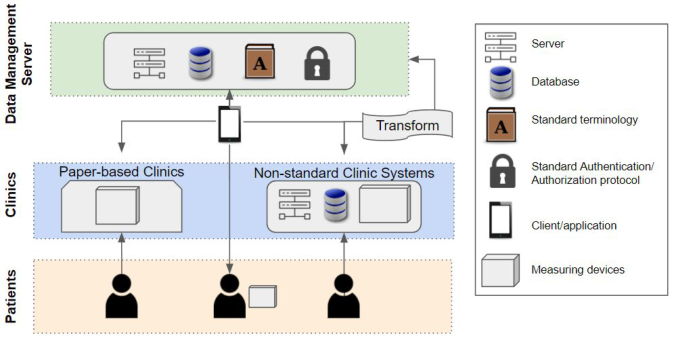
Figure 1: Architecture of HaaS.
and configurability. Configurability means HaaS can be configured to fulfill different local requirements while maintaining the standards. HaaS can be used by clinics that are still using paper records, and also clinics that are digitized but their current systems are not standards compliant.
HaaS mitigates the lack of technical skills and high cost barriers by pro- viding the clinics with functionalities that they only need. This reduces the burden on clinic staff as they can expect the provided applications only pro- vide the functionalities that they need, nothing more, nothing less. This is achieved through the implementation of FHIR and openEHR standards in HaaS. Compared to big hospitals which need complex systems for their daily workflow, small clinics only need relatively simple systems to deliver daily healthcare service to patients.
DATA MANAGEMENT SERVER HaaS serves a cloud-based server to the clinics. The server service is named Data Management Server (DMS). DMS consists of four main components; servers, database, terminology services, and user management services (see Figure 1).
With HaaS, data from clinics and individual patients are stored and mana- ged in DMS, essentially functioning as an EHR system. DMS is run and managed by the HaaS administration team. Clinics only interact with DMS through lightweight applications that are provided. Patients can also be pro- vided with applications that interact with DMS directly so that they can check and update their own health information.
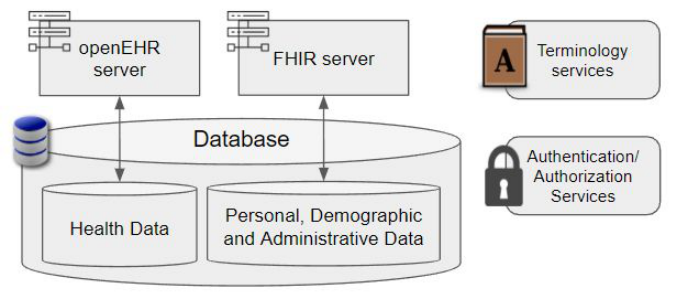
DMS listens and responds to requests from applications, stores personal, demographic, and clinical data in standardized format, provides standard terminologies such as SNOMED-CT and ICD-11, and manages user authen- tication and authorization protocol. Servers in DMS consist of two different servers, a FHIR server and an openEHR server, meaning each server follows the standards respectively (see Figure 2). The openEHR server only has one
Figure 2: Components of data management server.
purpose; to store and manage health data. Health data in this paper refers to clinical data and some chosen demographic data. Storage and management of personal data and demographic data, and other EHR system functiona- lities such as system administration, finance, medication, appointment and such are managed by the FHIR server. This approach follows the idea that openEHR and FHIR standards complement each other as each has strengths in different aspects of the healthcare information system (OpenEHR Board, 2021). The usage of both FHIR and openEHR servers make DMS intero- perable, ensuring easy data exchange between heterogeneous systems and platforms.
FHIR FHIR is an open standard specification maintained by Health Level 7 (HL7). It is a standard that focuses on helping data exchange between healthcare systems easy and developer-friendly. FHIR Resources provide specificati- ons that capture information such as patient, procedure, and billing. These Resources can be represented and exchanged in different formats such as JSON and XML formats. Another important feature that FHIR standard provides is the interfaces for exchanging the Resources between systems.
OPENEHR The openEHR standard provides maximal structured clinical data models called Archetypes. The Archetypes act as basic building blocks to build EHR systems, and are used as the basis for the ISO standard 13606 (ISO 2019). An openEHR Template is a set of archetypes used together by tooling to make clinical forms that can be designed to fit different clinical requirements. One such tool, Archetype Designer, can be used by clinic doctors to easily pro- duce an openEHR Template. Then, HaaS can produce an application easily following the given template. An instance of the clinical form is called an openEHR composition. Another important component of the standard is the
An Affordable and Standard Digital Healthcare Management 629
Table 1. Personal data and demographic data of dummy patients.
Table available in the original PDF paper.
Patients Personal Data Demographic Data Name Phone Number Birthdate Gender Patient A Dummy1 Patient1 012-345-678 1968-10-23 Female Patient B Dummy2 Patient2 011-234-567 1987-04-19 Female Patient C Dummy3 Patient3 013-245-678 1971-08-04 Male Patient D Asyraf Karim 014-235-678 1998-05-23 Male
Archetype Query Language (AQL), a query language that provides a very powerful and flexible method to query data stored in an openEHR server.
Clinics and Patients HaaS provides lightweight applications to clinics so that clinic staff can manage data easily without operating the complex EHR system. Since the clinics only need to pay for the application’s subscription fee and some DMS maintenance cost. HaaS is affordable compared to other EHR vendors. For clinics with non standards compliant systems, HaaS also provides a data tran- sform application to migrate existing data in their legacy system to DMS. Patients provide their data to DMS either through clinics or individually through application subscription using certified health measuring devices.
EXPERIMENT AND RESULT In the experiment, only openEHR and FHIR servers and the database are implemented in the DMS. Open-source software (HAPI JPA FHIR server, EHRbase openEHR server, PostgreSQL database) are used as the compo- nents, and are deployed using Docker on a local computer. Three applications that register new patients, record health data, and store the data are develo- ped respectively. A viewer application that fetches data from openEHR server, uses AQL for data querying, and displays the result is also developed.
Portable Health Clinic (PHC) (Ahmed et al. 2020) is used in the experi- ment, acting as the clinic with a legacy system. A data transformer application is developed to transform and store 43,835 patient records from the PHC system to DMS. 3 dummy patient records (patient A, B, C) are stored by a dummy clinic that acted as the clinic that is not digitized, and 1 dummy pati- ent (patient D) acted as the independent patient (see Table 1 and 2). In the experiment, both dummy patients and the independent patient have the same requirements. All patient records include personal, demographic, and clinical data.
Two openEHR templates are produced by using a free online tooling and stored in DMS. One template corresponds to the requirements of PHC and used in the data transformer application, while the other template corre- sponds to the requirements of the dummy clinic and independent patient, and used in the data storing application.
Three major functions-(a) whether personal and clinical data are separately stored in FHIR and openEHR servers (b) whether non-standard compliant
Table 2. Health data of dummy patients.
Table available in the original PDF paper.
Diastolic
Patients Health Data Age Gender Temperature (C) SpO2 (%) Systolic (mmHg)
(mmHg) Patient A 53 Female 36 99 125 86 Patient B 34 Female 36 97 102 74 Patient C 50 Male 35 98 130 92 Patient D 23 Male 36 99 100 70
Table 3. Query result.
Table available in the original PDF paper.
Age Gender Body_Temp SpO2 Systolic Diastolic Weight Height 23 Male 36.0 Cel 99.0% 100.0 mm[Hg] 70.0 mm[Hg] — — 34 Female 36.0 Cel 97.0% 102.0 mm[Hg] 74.0 mm[Hg] — — — — 100.0 [degF] 100.0% 117.0 mm[Hg] 85.0 mm[Hg] 53.7 kg 148.0 cm — — 100.0 [degF] 98.0% 106.0 mm[Hg] 80.0 mm[Hg] 50.7 kg 151.0 cm — — 100.02 [degF] 99.0% 112.0 mm[Hg] 90.0 mm[Hg] 39.6 kg 142.0 cm — — 100.04 [degF] 98.0% 100.0 mm[Hg] 80.0 mm[Hg] 32.7 kg 160.0 cm — — 100.04 [degF] 98.0% 100.0 mm[Hg] 80.0 mm[Hg] 41.4 kg 167.0 cm — — 100.04 [degF] 98.0% 111.0 mm[Hg] 79.0 mm[Hg] 52.6 kg 162.0 cm — — 100.04 [degF] 99.0% 118.0 mm[Hg] 87.0 mm[Hg] 60.6 kg 148.0 cm — — 100.04 [degF] 99.0% 97.0 mm[Hg] 66.0 mm[Hg] 43.4 kg 149.0 cm
data can be fetched and stored to HaaS (c) whether patients’ data privacy are maintained, are tested. An AQL query that requests for 10 patient records which include age, gender, body temperature, SpO2, systolic and diastolic blood pressure, body weight, and height with the condition that SpO2 value is under 120 mmHg, is sent to the openEHR server in DMS using the viewer application.
Only health data with systolic value below 120 mmHg is returned and displayed (see Table 3). Since the request is only sent to openEHR, personal data is not returned at all, only anonymous health data. The above two rows are the dummy data since age and gender data are part of their health data, while weight and height data are not. The rest of the rows are data from the PHC system.
CONCLUSION
This study identified the barriers for small clinics in developing countries from implementing EHR systems. Health data standards that support buil- ding EHR systems do exist, but currently are not adopted widely in these clinics. These led to the continuous usage of paper records in their daily workflow. To solve this, this study designed an architecture that revolves around open standards such as FHIR and openEHR. Clinic staff then are only provided with lightweight and easy to use applications. The configu- rability of HaaS made it affordable to the small clinics as they only need
An Affordable and Standard Digital Healthcare Management 631
to subscribe to the functionalities that they need for. HaaS also ensures pri- vacy protection of the patients by separating their personal data from health data. One implementation of the proposed design was conducted. HaaS was deployed in the lab and the functionalities were then tested and confirmed. A data transform application to fetch and transform data from non-standard systems, and store them to the new standards compliant system was develo- ped. Finally, by making a query and checking the result, both dummy data and real data are confirmed to have been stored successfully. Future tasks and challenges include testing the system in different small clinics in developing countries and collecting their views to evaluate the effectiveness of the system, and testing the system with user authentication and authorization functions for robust security.
ACKNOWLEDGEMENT
The authors would like to acknowledge Dr Sidharth Ramesh and the Med- blocks team for their help in the development of implementation of HaaS. We also owe gratitude to Grameen Communications Bangladesh members for their support and suggestions throughout this study.
REFERENCES
Ahmed, A., Hasan, M., Sampa, MB., Hossein, KM., Nohara, Y. and Nakashima, N. (2020). Portable health clinic: Concept, design, implementation and challenges. Mobile Technologies for Delivering Healthcare in Remote, Rural or Developing Regions, pp. 105–121. GSM Association. (2021). The State of Mobile Internet Connectivity 2021 [online].
Available from: https://www.gsma.com/r/wp-content/uploads/2021/09/The-State- of-Mobile-Internet-Connectivity-Report-2021.pdf [Accessed: 20 January 2022] ISO International Organization for Standardization (2019). ISO 13606- 2:2019(en) Health informatics — Electronic health record communication — Part 2: Archetype interchange specification [online]. Available from: https://www.iso.org/obp/ui/#iso:std:iso:13606:-2:ed-2:v1:en [Accessed: 21 February 2022]. Long, L.-A., Pariyo, G., Kallander, K., 2018. Digital Technologies for Health Workforce Development in Low- and Middle-Income Countries: A Sco- ping Review. Glob Health Sci Pract 6 [online], S41–S48. Available from: https://doi.org/10.9745/GHSP-D-18-00167 [accessed 20 January 2022] OpenEHR Board (2021). OpenEHR and FHIR [online]. Available from: https://www.dropbox.com/s/ijvt0r0wx0qbl6k/openEHR%20_AND_%20 FHIR.pdf?dl=0 [Accessed: 21 February 2022]. Scott Kruse, C., Karem, P., Shifflett, K., Vegi, L., Ravi, K., & Brooks, M. (2018).
Evaluating barriers to adopting telemedicine worldwide: A systematic review. Journal of telemedicine and telecare [online], 24(1), pp.4–12. Available from: https://doi.org/10.1177/1357633X16674087 [Accessed: 22 January 2018]. The Commonwealth Fund. (2005). Cost is Biggest Barrier to Electronic Medical Records Implementation, Study Finds [online]. Available from: https://www.commonwealthfund.org/publications/newsletter-article/cost-biggest- barrier-electronic-medical-records-implementation [Accessed: 8 February 2022].
Read this individual research paper free through the original publisher, or explore the full digital proceedings book.
ISBN 978-1-958651-44-5
Explore this ISBN in the AHFE Bookstore ↗Listed in the July 2026 bookstore catalogue; search by ISBN to confirm current availability · Digital book purchase optional