Forhad Hossain, Rafiqul Islam, Mostafa Taufiq Ahmed, Ashir Ahmed (2022). Technical Requirements to Design a Personal Medical History Visualization Tool for Doctors. In: Human Interaction & Emerging Technologies (IHIET 2022): Artificial Intelligence & Future Applications. AHFE Open Access, vol. 68, pp. 518–525. https://doi.org/10.54941/ahfe1002772
A doctor needs to know the patients’ medical history to investigate the root cause of symptoms. Traditionally it is done by a questionnaire at the clinic’s reception desk, or the doctor asks a series of questions to obtain a relevant medical history. An incomplete or wrong medical history affects the doctor’s decision. The challenge for a busy doctor is to obtain all the relevant medical history in a short period of time accurately and without missing any important history. Affordable clinics employ an assistant or junior doctor to sort out all the paper-based medical history and mark the important points. It increases doctors’ work performance by saving doctors time and making room for consulting more patients. But not all the small clinics can afford such assistants. This paper lists the technical requirements to develop a personal medical history visualization tool to increase doctors’ productivity.
Knowledge about a patient’s medical history allows a doctor to gain a good understanding of the patient’s problems. It helps to identify the root cause of the current health complexities. Also, it helps to track the health problems and treatments. Usually, a doctor wants to reduce per patient consultation time to accommodate more patients in the queue. Medical ‘history taking’ takes a longer time during the doctor’s consultation. Studies conducted in the United States, India, and Brazil reported that history-taking was respon- sible for 76%, 78.6%, and 77.8% of all diagnoses made, respectively, and that investigations played complementary roles in excluding other diagnostic options and increased physicians’ self-confidence (Benseñor 2003, Roshan & Rao 2000, Peterson et al. 1992). Medical record keeping has evolved into a science of itself. This will be the only way for the doctor to prove that the treatment was carried out properly (Thomas, 2009). Traditionally medical history like prescriptions, diagnosis reports etc. are recorded in paper-based
Technical Requirements to Design a Personal Medical History Visualization Tool 519
documents. It is difficult to properly manage them from the patient side. It becomes more challenging for patients who travel a lot to carry all the paper-based past medical records. Thanks to the recent digital transforma- tion movement, most of the hospital/clinics/health service providers maintain digital health records for their patients and it became easier to search the medical history.
However, there are three major limitations- (i) The clinics maintain the medical history of their own patients recorded by them, therefore they cannot see any medical history from other clinics (ii) these medical history/records are not structured in a standard manner, therefore medical history are not interoperable (iii) these medical histories are not allowed to be accessed by physicians from other clinics.
Alabbasi and his team introduced the concept of Personal Health Book (PHB), where a patient can own, operate, and manage his/her own medi- cal history (Alabbasi et al. 2014). A patient can also share his/her own data with other authorized parties such as family members and doctors. Saripalle and others explore and critically analyze HL7 FHIR to design and prototype an interoperable mobile PHR that conforms to the HL7 PHR Functional Model and allows bi-directional communication with OpenEMR (Saripalle et al. 2019). HL7 FHIR ensures the data standards in EHR, EMR or PHRs. To reduce the data sharing limitations Sun & Fang proposed a secure EHR system, based on cryptographic constructions, to enable secure sharing of sensitive patient data during cooperation and preserve patient data privacy. This EHR system further incorporates advanced mechanisms for fine-grained access control, and on-demand revocation, as enhancements to the basic access control offered by the delegation mechanism, and the basic revocation mechanism, respectively. The EHR system proposed by (Sun & Fang, 2010) was demonstrated to fulfill objectives specific to the cross-domain delegation scenario of interest.
There are big advantages to managing personal medical history. It helps the doctors in decision making, it reduces medical errors, it can reduce medi- cal cost and improve the overall performance of medical treatment. Digital health services like Portable Health Clinic (Ahmed et al. 2020) help to main- tain individual medical health records for the doctor, patient, and researchers. To understand the medical history of an individual there is a need for the appropriate visualization. Standard medical history record and visualization can help the doctor for effective decision making.
There are existing research activities for medical history visualization. “AnamneVis” (Zhang et al. 2011) uses ICD code for universality, “hGraph” (Ledesma et al. 2016) uses a single graph to visualize limited health data, “Health Timeline”(Ledesma et al. (2019) collects data from multiple EMR/E- HRs but selective, “PatientsLikeMe” (Frost & Massagli, 2008) uses a modi- fied Gantt chart to visualize the patient’s symptoms and treatment history but no data standardization and integration. However, each of these tools has some limitations and is not fully designed to collect, integrate and visua- lize the entire health history of a patient and not fully dedicated to the doctor. Our previous work proposed a unique personal health data visualization tool concept named “myHealth View”, where a patient’s entire medical history
will be visualized in a smart health Gantt chart in one window (Hossain, F & Ahmed 2021). Hypothetically, a standard visualization tool for perso- nal medical history visualization should have the following characteristics: a) visualization of individual health data, b) visualization of the entire health history of a person, c) doctor-friendly, d) easy and quickly understandable health history and e) accurate health history for making the correct decision and providing quality treatment by a doctor. Existing visualization tools have some unique features but those are not sufficient to make quick and effective decisions for doctors.
The rest of the paper is organized as follows- in section, “motivation and objective, we explain current practices and limitations of the maintenance of personal medical history, section “Technical Requirements” lists technical requirements deemed necessary to implement the myHealthView visualiza- tion tool. Section “Discussion” discusses the pros and cons of the concept. Finally, we conclude with the current status and future work in the section “Conclusion”.
MOTIVATION AND OBJECTIVE Personal medical history maintenance is not a common practice in developing countries. Usually, people maintain hardcopy prescriptions and diagnostic reports for a few years, not for their entire life. It is quite difficult to maintain an entire life’s medical reports manually. Although in developed countries health service providers and doctors maintain electronic health records for their patients, that is only limited for that specific service provider. Standards for archiving and exchanging medical records exist but are not popular even in developed countries.
The World Health Organization’s (WHO) draft four-year global strategy on digital health aims to “improve health for everyone, everywhere by accele- rating the adoption of appropriate digital health”(WHO, 2019). Maintaining medical records in Electronic Health Records (EHR), Electronic Medical Records (EMR) and Personal Health Records (PHR) are key issues to achieve the digital health goal. These are helpful for the doctors to check the indi- vidual medical history of a particular patient. The existing personal health visualization tools have many features to gain different objectives but there is no such tool dedicated for the doctors.
The objective of this paper is to list the technical requirements to deve- lop such a personal medical history visualization tool for doctors to increase his/her working efficiency.
TECHNICAL REQUIREMENTS This section lists the technical requirements for the visualization tool.
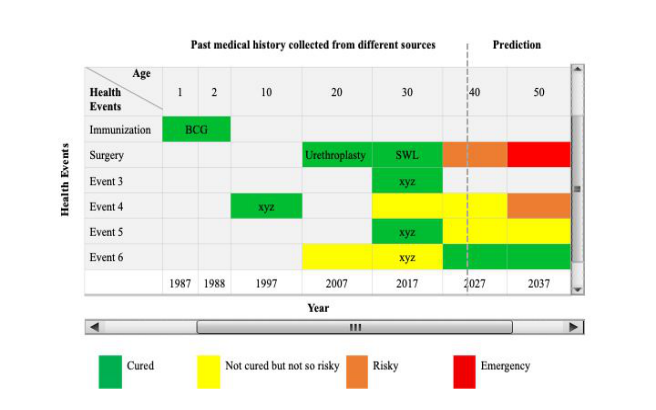
Quick and Accurate View A smart mechanism is required for a doctor to view the most relevant medical history of a patient quickly and accurately. Figure 1. shows a hypothetical view of the tool. The following components will be required.
Technical Requirements to Design a Personal Medical History Visualization Tool 521
Figure 1: Smart health gantt chart.
Two-dimensional window: X-axis represents the timeline from birth year to standard life expectancy age. Y-axis represents the health events. Each health event can be titled as pre-defined classification, in the health summary diseases names will appear on the screen but it will be programmed follo- wing ICD (International Classification of Diseases) 11 (WHO, 2022) or the latest version of this code. This will help to make this Gantt chart a universal standard. Any doctor from anywhere in the world would be able to under- stand the disease name or health complexities. Summary information could be medication, surgery, diagnosis, doctor visit, immunization, or other which represents the action/activity against diseases.
Color Status: The four-color status will help to understand the urgency of these complications. Here, green indicates ‘cure’, yellow indicates ‘not cured but not so risky’, orange indicates ‘risky’, and red indicates ‘emergency’. These will be helpful for a quick understanding of the level of complications of each health problem.
Scrolling and Zooming: This smart health Gantt chart can visualize the medical history of any person, be it a child or an old person. There is no age limit. Scrolling zooming options can help to check the large volume of health data.
In summary, the following features will be required:
Categorization of health events based on year, age, disease, treatment actions.
List of diseases based on ICD-11
Categorization of color status by machine learning programming with preset determinants
Scrolling and zooming options to accommodate all the health events in one window.
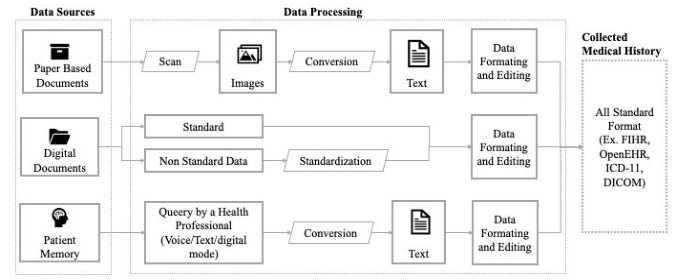
Figure 2: Collection of medical history in a standard manner.
Collection of Medical History in a Standard Manner Medical history of an individual may not be on a single platform and may not be in the same standard. For the data collection and data integration several steps will be required as shown in Figure 2. Data sources and processing steps are as follows:
Paper Based Documents: Individual medical history can be in paper-based documents (prescription, medical reports, etc.). It will be required to scan the documents to convert them into images. Technologies like Optical Character Recognition (OCR) exist to convert images into digital text.
Digital Documents: Medical history can be collected as digital data from EHR, EMR, PHR or IOT (Internet of Things) devices. These are widely practiced nowadays. There are two kinds of digital data; standard (FHI- R/OpenEHR enabled) and non-standard. Standard data can be transferred directly for pre-processing, but non-standard data should pass a gateway to convert into standard format.
Patient Memory: All medical histories of a patient may not be in paper nor in digital documents. A certified health professional can ask questions to obtain the medical history in standard format. It can be done either in text or voice form. Text and voice should be converted in standard medical data format.
To collect standard medical history from three different sources, the following features will be required.:
Adoption OCR, ASR or STT technology to convert image and voice into text
All health data should follow the FHIR (Fast Healthcare Interoperability Resources) (HL7, 2019) and OpenEHR (OpenEHR, 2020) standards.
Data pre-processing/data preparation for checking the errors and to eliminate redundant, incomplete or incorrect data.
Adaptive Behavior of the Tool The visualization tool should be doctor friendly. Intelligent features can be added to make it smart and effective for doctors.
Technical Requirements to Design a Personal Medical History Visualization Tool 523
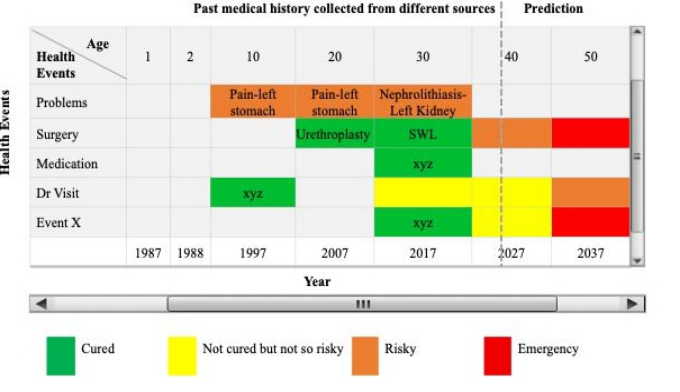
Figure 3: Doctor preference-based health data visualization (Example: for a Urologist).
Doctor preference-based view: An individual may have too many health complexities and may visit different kinds of doctors. For an example, Mr. X has had kidney disease, dental problems, and lower back pain for 10 years and every year he visits the physician. His entire health history is available in the visualization system but when he visits a urologist, the urologist might be interested to see only a urology-related health summary. If all other health data appear in the same window at the same time, it may create confusion for the doctors and it will be time consuming for the doctor to sort out only urology related data. A tool will be required to sort the relevant health events and highlight them as shown in Figure 3.
Prediction of future health status: This smart health Gantt chart could show the prediction of future health status based on available previous medi- cal history. This prediction might be helpful for the doctors in decision making as well as it can be helpful for the patient to maintain a healthy lifestyle. It is not necessary to predict all health events.
In summary, the following two tools will be required to make the system doctor friendly.
A machine learning based recommender system to visualize doctor disci- pline based medical history.
Technology to predict future health status
CONCLUSION
This paper introduces an important issue for the doctors in developing coun- tries. A doctor needs to know a patient’s medical history to make an efficient clinical decision. However, the scarcity of doctors in developing countries means that they can spend only limited consultancy time. This paper highli- ghts this issue from our own experience and lists the technical requirements
to build a smart medical history visualization tool to obtain a patient’s medi- cal history quickly and accurately. We envision that in the near future, our health activities will be archived digitally, and it will be a challenge for the doctor to sort out the relevant history out of huge amounts of data. Our next task is to develop a prototype to get feedback from the doctors to deve- lop a suitable model. The challenge is to collect the medical history which is not digitally archived. This paper suggests methodologies to obtain untapped medical data.
ACKNOWLEDGMENT
The authors would like to acknowledge that, this work was supported by JST SPRING, Grant Number JPMJSP2136.
REFERENCES
Ahmed, A., Hasan, M., Sampa, M. B., Hossein, K. M., Nohara, Y., & Nakashima, N.
(2020), “Portable health clinic: concept, design, implementation and challenges. Mobile Technologies for Delivering Healthcare in Remote, Rural or Developing Regions.” Healthcare Technologies, 105. Alabbasi, S., Ahmed, A., Rebeiro-Hargrave, A., Kaneko, K., & Fukuda, A. (2014), “Design of a personal health book for ensuring healthcare data portability.” Inter- national Conference on Applied and Theoretical Information Systems Research (ATISR 2014), 1–14. Benseñor I. M. (2003), “Do you believe in the power of clinical examination? The
answer must be yes!.” Sao Paulo medical journal = Revista paulista de medicina, 121(6), 223. https://doi.org/10.1590/s1516-31802003000600001 Frost, J. H., & Massagli, M. P. (2008), “Social uses of personal health information within PatientsLikeMe, an online patient community: what can happen when pati- ents have access to one another’s data.”Journal of medical Internet research, 10(3), e15. https://doi.org/10.2196/jmir.1053 Health Level Seven International (HL7). (2019), “Fast Healthcare Interoperability
Resources (FHIR) (Version-4).” https://www.hl7.org/fhir/ Hossain, F., & Ahmed, A. (2021), “Visualization of Healthcare Data for Busy Doctors in Developing Countries to make Efficient Clinical Decisions.” Paper pre- sented at the 10th Social Business Academia Conference 2021, Nairobi, Kenya. https://bit.ly/3L5GP3L Hossain, F., Islam, R., Osugi, T., Nakashima, N., & Ahmed, A. (2022), “A Study on
Personal Medical History Visualization Tools for Doctors.” The 2022 IEEE 4th Global Conference on Life Sciences and Technologies, Osaka, Japan. Ledesma, A., Al-Musawi, M. & Nieminen, H. (2016), “Health figures: an opensource JavaScript library for health data visualization.” BMC Med Inform Decis Mak 16, 38. https://doi.org/10.1186/s12911-016-0275-6 Ledesma, A., Bidargaddi, N., Strobel, J., Schrader, G., Nieminen, H., Korhonen,
I., & Ermes, M. (2019), “Health timeline: an insight-based study of a timeline visualization of clinical data.” BMC medical informatics and decision making, 19(1), 170. https://doi.org/10.1186/s12911-019-0885-x OpenEHR Foundation. (2020), “openEHR (5.2.0).” https://www.openehr.org/ Peterson, M. C., Holbrook, J. H., Von Hales, D., Smith, N. L., & Staker, L. V. (1992), “Contributions of the history, physical examination, and laboratory investigation in making medical diagnoses.” The Western journal of medicine, 156(2), 163–165.
Technical Requirements to Design a Personal Medical History Visualization Tool 525
Roshan, M., & Rao, A. P. (2000), “A study on the relative contributions of history, physical examination and investigations in making medical diagnosis.” The Journal of the Association of Physicians of India, 48(8), 771–775. Saripalle, R., Runyan, C., & Russell, M. (2019), “Using HL7 FHIR to achieve
interoperability in patient health record.” Journal of biomedical informatics, 94, 103188. https://doi.org/10.1016/j.jbi.2019.103188 Sun, J., & Fang, Y. (2010), “Cross-Domain Data Sharing in Distributed Electronic Health Record Systems.” IEEE Transactions on Parallel and Distributed Systems, 21, 754–764. Thomas J. (2009), “Medical records and issues in negligence.” Indian journal
of urology: IJU : journal of the Urological Society of India, 25(3), 384–388. https://doi.org/10.4103/0970-1591.56208 World Health Organization. (2019), “Global Strategy on Digital Health 2020–2024.” https://saluddigital.com/wp-content/uploads/2019/09/Draft- Global-Strategy-on-Digital-Health.pdf World Health Organization. (2022), “International Classification of Diseases 11th Revision.” https://icd.who.int/en Zhang, Z., Ahmed, F., Mittal, A., Zhao, R., Viccellio, A., & Mueller, K. (2011),
“AnamneVis: A Framework for the Visualization of Patient History and Medical Diagnostics Chains.”
Read this individual research paper free through the original publisher, or explore the full digital proceedings book.
ISBN 978-1-958651-44-5
Explore this ISBN in the AHFE Bookstore ↗Listed in the July 2026 bookstore catalogue; search by ISBN to confirm current availability · Digital book purchase optional