Mohamed Adalbi, M Salim Ferwati, Ahmad Mohammad Ahmad, Yong Cheol Lee (2022). Smart Cities Strategies in Developing Countries: The Case of Lusail City, Qatar. In: Intelligent Human Systems Integration (IHSI 2022): Integrating People and Intelligent Systems. AHFE Open Access, vol. 22. https://doi.org/10.54941/ahfe1001015
The last decade has witnessed a rapid technological development that contributed to improving the quality of life in many aspects. As new technologies come to life, more innovations evolve. Many of these innovations have been effectively translated into large-scale applications, creating an initiative called “Smart Cities”, which aims to make cities more sustainable and reliable to adapt to the increasing needs and challenges associated with the growing urbanization. Some developing countries have adopted these “Smart Cities” initiatives to serve their strategic development visions. Qatar, for example, is a developing country in the Middle East with a comprehensive nation-al vision by 2030 that defines the framework in which national strategies and implementation plans can be developed to make Qatar an advanced society capable of sustaining its development and providing a high standard of living for its people. As the Smart Qatar journey evolves and expands, a comprehensive e-government system and digital infrastructure have been launched along with the initiation of two large Real Estates projects as an insight to Smart Cities, Msheireb Downtown Doha, with $5.5 billion investment, and Lusail City, that was introduced on the momentum of 2022 FIFA World Cup. This paper takes Qatar as an example of developing country and studies how Lusail Smart City strategy contributed to tangible real-life applications that were contextual and relevant to Qatar’s current and future challenges, aspirations and needs as part of its national vision in 2030, in addition to summarizing some lessons that can benefit other developing countries that would take similar steps.
Countries and societies are taking advantage of the rapid technological innovations by adapting these innovations into large-scale implementations (e.g. Cities) to cope with the dynamic urbanization growth. These large-scale applications formed an initiative called “Smart Cities”. A Smart City is a city that uses intelligence of an integrated infrastructure that solves the current challenges and provides provisions for future ones like growing populations and increasing carbon emissions. Also, it tries to optimize the usage of services like water, electricity, and cooling resulting in higher quality of life along with maintaining security and sustainability.
1. Background about Qatar Qatar is located in the Middle East as a peninsula in the Arabian Gulf and has witnessed a dynamic growth in its population during the last two decades, reaching about 2.57 million in August 2021 (Planning and Statistics Authority, 2021). As a future vision, the Qatari government has realized this rapid growth and started taking forward steps to control and monitor the country growth through developing a comprehensive e-government platform (e.g. Hukoomi portal) and digital infrastructure, including telecommunication and technology development as a continuation to Emiri decision No. 4 for 2016 that concentrates on enhancing several services to the public (Ministry of Transport and Communicatoins, 2019). The rapid growth in population and urban expansion increased the need for smart infrastructure all across the country; this can be noticed with the implementation of smart airport technologies at Hamad International Airport (HIA), in addition to founding TASMU Smart Qatar Program in 2017 by Qatar government to enhance the application of technology and innovation to drive improved quality of life in multiple public sectors in the country including transport, logistics, environment, healthcare, and sports (TASMU, 2020). Furthermore, Qatar has invested in digital networks development through developing the Internet of Things (IoT) as an essential need for smart transformation with total investments that are expected to reach $573 million by 2022 and projected total investments in ICT systems to reach $4.4 billion in 2021 (Ministry of Transport and Communicatoins, 2019). Qatar’s development has been primarily dependent on oil and gas resources (General
Intelligent Human Systems Integration (IHSI 2022): Integrating People and Intelligent Systems https://openaccess.cms-conferences.org/#/publications/book/978-1-7923-8988-7
Secretariat for Development Planning., 2008); however, the Qatari government is encouraging foreign and diverse investment in an effort to build a solid and sustainable economy by 2030, as it will be explained in the following sections.
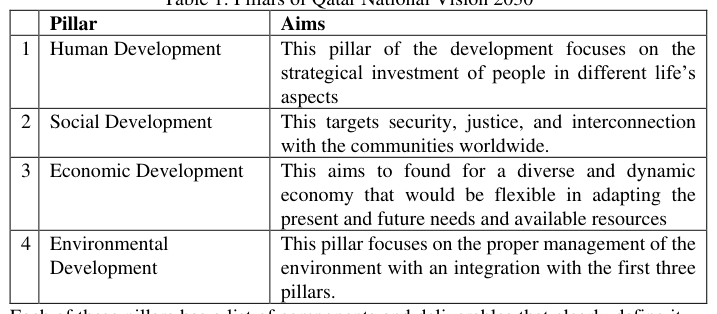
2. Qatar National Vision 2030 In 2008, the Government of Qatar had set a national comprehensive development vision providing a general framework and guidelines to convert Qatar to a state that sustains its development and offers high quality of life for its residents (Amiri Diwan - State of Qatar, 2021). Qatar National Vision 2030 aims to be achieved based on the following four interconnected fundamentals explained in Table 1.
Table 1: Pillars of Qatar National Vision 2030 Pillar Aims 1 Human Development This pillar of the development focuses on the strategical investment of people in different life’s aspects 2 Social Development This targets security, justice, and interconnection with the communities worldwide. 3 Economic Development This aims to found for a diverse and dynamic economy that would be flexible in adapting the present and future needs and available resources 4 Environmental Development
3. Lusail City
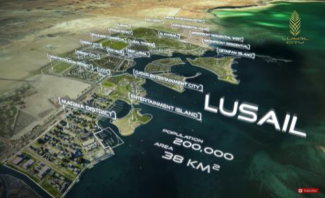
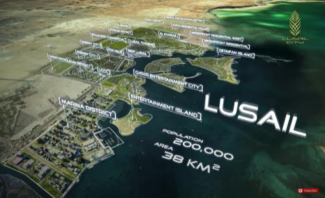
Figure 2. Lusail City Districts (LusailFigure 1. Location of Lusail City (Lusail City, 2021)
City, 2021) Lusail City has grown within the vision laid in 2008 and inspired by the 2022 FIFA World Cup; therefore, the city will host Lusail Stadium, which is the largest stadium for the world cup with a capacity of around 80,000, and it will be the 5th largest stadium in the world. The city has been built from the ground up to be prepared for future needs with smart infrastructure with a total investment that exceeds $45 billion
Intelligent Human Systems Integration (IHSI 2022): Integrating People and Intelligent Systems https://openaccess.cms-conferences.org/#/publications/book/978-1-7923-8988-7
(Shaaban & Adalbi, 2021) that includes hotels, schools, retails, offices, and other residential and recreational districts (Figure 1). The city is located 15 km to the north side of Doha City (Figure 2) and described as the home of vision and innovation with a new urban identity to be added to the State of Qatar with a complex system that is implemented in a precise manner and up to the highest standards to ensure the highest quality of life to its residents.
LUSAIL CITY SMART SYSTEMS
1. Lusail Control and Command Center (LCCC) LCCC is the central command and control center for the operations of the Smart City within Lusail, where everything comes together, and data is collected and analyzed. Through LCCC, all sensors and meters are monitored, and the information is transferred to the concerned personnel very fast through a solid fibre network that is branched all over the city. This data is two-way communication; in other words, the employee will be able to control many features based on the information received (e.g. Road diversion).
2. Building Management System All systems and services in the building can be monitored and controlled by LCCC, including telecommunication, electricity, pneumatic waste collection, and district cooling through smart meters that can provide real-time data transferred by the fibre network that is branched around the city and detect any faults in the systems. An additional feature introduced is smart home automation, where all home features are controlled through a centralized platform; on the other hand, other features are automated through smart systems. For example, District cooling is managed and optimized considering the time of the day to reduce the cost and save resources.
3. Citywide Integrated Communications With cloud-based services, real-time data are accessible to everybody anytime and everywhere. Tens of digital screens are distributed along with the city, providing a platform for digital advertising as well as the information of different facilities, events, retails, restaurants all around the city. Through Interactive Information System, residents can find information about events, locations, and the best direction and means of transport to use to get to their destination.
4. Traffic System The city provides an intelligent and comprehensive transportation system by providing different means of transportation (e.g. Light Rail Transit, Water Taxi, public transportation, and a considerable road network). The traffic volumes are monitored through induction loops on the ground that can get the data regarding cars density and deliver it either to the signals or LCCC to take action and ensure the highest level of traffic efficiency. In addition, the city has the
Intelligent Human Systems Integration (IHSI 2022): Integrating People and Intelligent Systems https://openaccess.cms-conferences.org/#/publications/book/978-1-7923-8988-7 feature of live directional signals, where traffic can be diverted remotely. Furthermore, the city provides a transportation app where all transportation systems are linked together and optimized.
5. Security With a high level of design, a CCTV monitoring network was introduced in Lusail city to ensure full city coverage and high security for the citizens. The CCTV network is connected to LCCC, and it was implemented based on Ministry of Interior standards and guidelines.
6. Energy Efficiency With the smart metering strategy, Lusail city is designed to optimize the use of energy through recording the use of energy. Furthermore, the city infrastructure has been designed with intelligent automated systems that would adapt energy based on the needs. For example, Intelligent Street Lighting is an example of an energy-saving system. It automatically turns off the lights in the absence of traffic and adjusts the light level according to the weather status.
RELEVANCE TO QATAR VISION As mentioned earlier in this paper, Qatar National Vision 2030 has been set based on four main pillars. Each of these pillars consists of multi-components that form the deliverables towards achieving the target for 2030 (Planning and Statistics Authority of Qatar, n.d.). This section elaborates more on these components and gives the smart feature of Lusail city that serves it.
1. Human Development
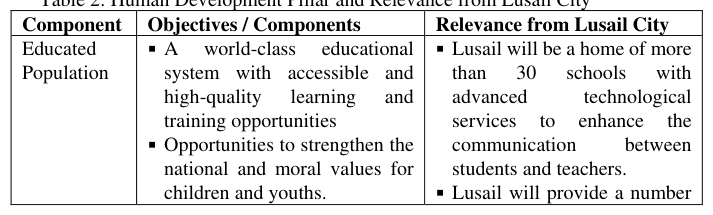
As a developing country, Qatar invested in the health and education of its people providing the highest standards of education and healthcare services. Human development aims to build a community that is well educated with all facilities provided to all Qatari citizens to interact with the local and international markets and communities. Table 2 provides the components of Human Development and how Lusail city was designed to serve this objective.
Table 2: Human Development Pillar and Relevance from Lusail City Component Objectives / Components Relevance from Lusail City Educated Population
Intelligent Human Systems Integration (IHSI 2022): Integrating People and Intelligent Systems https://openaccess.cms-conferences.org/#/publications/book/978-1-7923-8988-7
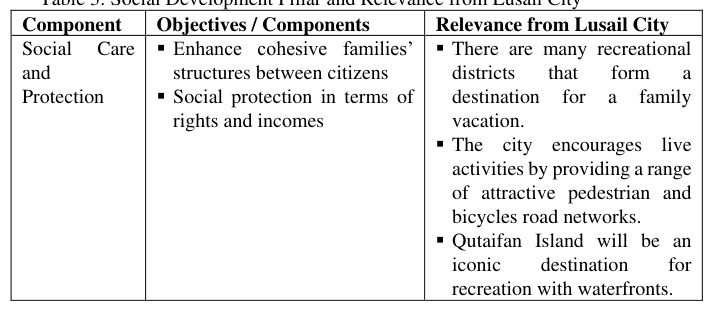
2. Social Development In this pillar, Qatar aims to build a society that would be effectively capable of adapting to the most recent findings and life requirements. Besides that, Qatar will seek to offer high levels of safety and security to its citizens and preserve the Arab and Islamic identity.
Table 3: Social Development Pillar and Relevance from Lusail City Component Objectives / Components Relevance from Lusail City Social Care and Protection
Intelligent Human Systems Integration (IHSI 2022): Integrating People and Intelligent Systems https://openaccess.cms-conferences.org/#/publications/book/978-1-7923-8988-7
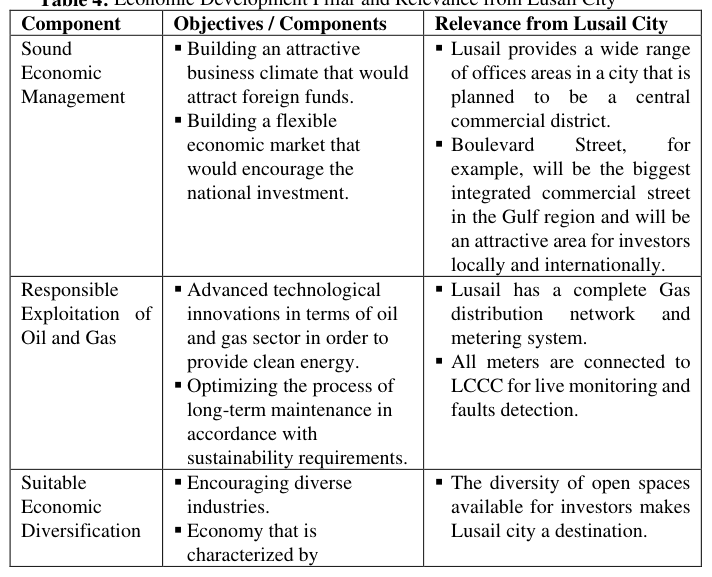
3. Economic Development The Economic Development pillars are considered the backbone of the national vision as it drives the other pillars by offering better and diverse opportunities for people. The basis of these pillars is encouraging more investments and competitions and optimizing Qatar's economic resources by the balance between Oil-based and knowledge-based income.
Table 4: Economic Development Pillar and Relevance from Lusail City Component Objectives / Components Relevance from Lusail City Sound Economic Management
Intelligent Human Systems Integration (IHSI 2022): Integrating People and Intelligent Systems https://openaccess.cms-conferences.org/#/publications/book/978-1-7923-8988-7 innovation, entrepreneurship, and efficient delivery of public services.
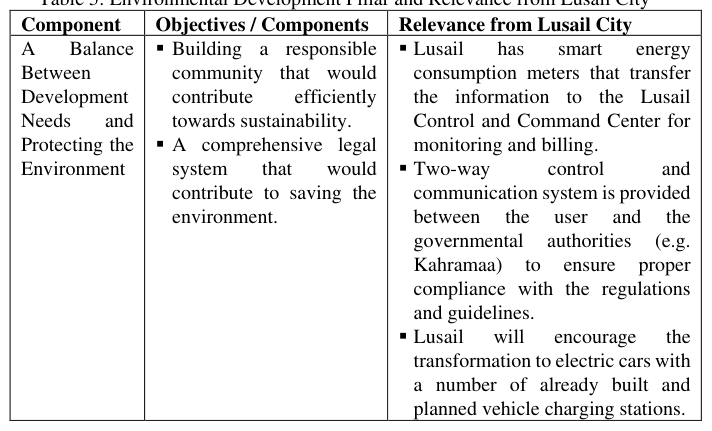
4. Environmental Development With the environmental pillar that the State of Qatar has in its vision, the pillars mentioned above would be accomplished and achieved with full responsibility towards Qatar's nature and environment along with future considerations in terms of consumption and gas emission.
Table 5: Environmental Development Pillar and Relevance from Lusail City Component Objectives / Components Relevance from Lusail City A Balance Between Development Needs and Protecting the Environment
CONCLUSIONS
Smart Cities are becoming an essential need for the growing urbanization and the associated requirements with it; therefore, developing countries need to properly integrate their vision scope with the advanced technologies from early stages. Although these systems of Lusail city are not working with their full capabilities, their design is strategically merged with the overall targets of the country.
Intelligent Human Systems Integration (IHSI 2022): Integrating People and Intelligent Systems https://openaccess.cms-conferences.org/#/publications/book/978-1-7923-8988-7
ACKNOWLEDGMENTS
This publication was made possible by the NPRP grant (NPRP 12S-0304-190230) from the Qatar National Research Fund (a member of the Qatar Foundation). The statements made herein are solely the responsibility of the author.
REFERENCES
Amiri Diwan - State of Qatar. (2021, September 26). Qatar National Vision 2030.
Retrieved from Amiri Diwan: https://www.diwan.gov.qa General Secretariat for Development Planning. (2008, July). Qatar National Vision
2030. Retrieved from Planning and Statistics Authority: https://www.psa.gov.qa Ministry of Transport and Communications. (2016, December 14). Publications - great achievements and ambitious plans for the future prosperity of Qatar. Retrieved from Ministry of Transport and Communications: https://www.motc.gov.qa/ Ministry of Transport and Communicatoins. (2019, October 20). Smart cities
initiative supercharges Qatar’s diversified economy. Retrieved from Ministry of Transport and Communicatoins: https://www.motc.gov.qa Planning and Statistics Authority. (2021). Qatar Monthly Statistics, Issue 91. Doha: Planning and Statistics Authority. Planning and Statistics Authority of Qatar. (n.d.). Qatar National Vision 2030.
Retrieved from Planning and Statistics Authority: https://www.psa.gov.qa/ Shaaban, K., & Adalbi, M. A. (n.d.). Smart City Transportation System in Developing Countries: The Case of Lusail City, Qatar. TASMU. (2020). View the Story. Retrieved from TASMU: https://tasmu.gov.qa
Intelligent Human Systems Integration (IHSI 2022): Integrating People and Intelligent Systems https://openaccess.cms-conferences.org/#/publications/book/978-1-7923-8988-7
LISTED IN THE AHFE DIGITAL BOOKSTORE CATALOGUE
Explore the complete digital volume
Intelligent Human Systems Integration (IHSI 2022): Integrating People and Intelligent Systems
Read this individual research paper free through the original publisher, or explore the full digital proceedings book.
ISBN 978-1-7923-8988-7
Explore this ISBN in the AHFE Bookstore ↗Listed in the July 2026 bookstore catalogue; search by ISBN to confirm current availability · Digital book purchase optional