Matthew Somiah, Matthew Kwaw Somiah, Clinton Aigbavboa, Wellington Didibuku Thwala, Jeriscot Henry Quayson, Isaac Yaw Manu, Micheal Kofi Biney, Benjamin Aidoo, Frederick Owusu Danso (2026). Exploring the Underlying Barriers to the Adoption of Intelligent Highway Transportation Systems: A Study from Ghana. In: Human Interaction and Emerging Technologies (IHIET-AI 2026): Artificial Intelligence and Future Applications. AHFE Open Access, vol. 201, pp. 628–640. https://doi.org/10.54941/ahfe1007216
1 Department of Building Technology, Takoradi Technical University, Takoradi, Ghana; Department of Civil Engineering, University of Johannesburg, Johannesburg, South Africa; Faculty of Engineering, Built Environment, and Information, Walter Sisulu University East London, South Africa ↗
2 Department of Civil Engineering, University of Johannesburg, Johannesburg, South Africa ↗
3 Faculty of Engineering, Built Environment, and Information, Walter Sisulu University East London, South Africa ↗
4 Department of Civil Engineering, Cape Coast Technical University, Cape Coast, Ghana ↗
5 Department of Building Technology, Takoradi Technical University, Takoradi, Ghana ↗
Adoption of intelligent highway transportation systems (ITS) is increasingly gaining wide acceptance among many countries due to their contribution to decongesting cities, combating climate change, and promoting quality of life, among others. However, the level of ITS adoption cannot be said to be the same in Ghana, and there is a dearth of studies that empirically investigated the barriers to ITS adoption in Ghana. This current study aimed to establish the critical barriers to the adoption of intelligent highway transportation systems (ITS) in Ghana. Structured questionnaire aided data collection from 182 respondents. Thirty-nine (39) barriers were identified and principal component analysis further organized the barriers into five (5): economic and institutional capacity barriers (0.8006); energy and system reliability barriers (0.8001); resource barriers (0.7813); facilitation condition barriers (0.7783); and social barriers (0.7194), with economic and institutional capacity barriers and energy and system reliability barriers being unique to the study in Ghana. Empirically, the study unravelled five main coherent barriers to ITS adoption in Ghana, which hither to was largely absent in existing literature. This will guide transport authorities, academics, policymakers, and industry stakeholders in eliminating the barriers to ITS adoption in Ghana from multi-stakeholders’ approach. Effectively eliminating the identified barriers can lead to the successful adoption of ITS in Ghana, which has potentials to reduce traffic congestion and reduce fuel consumption, contributing to attaining Sustainable Development Goal (SDG)11: sustainable cities and communities, and combating climate change, SDG 13: Climate Action.
ITS is an integrated system utilizing a wide range of communication, vehicle sensing, control, and electronics technologies to manage and solve traffic- related problems (Singh & Gupta, 2015; Guevara & Auat Cheein, 2020; Received January 26, 2026; Revised March 2, 2026; Accepted March 10, 2026; Available online April 1, 2026
Exploring the Underlying Barriers to the Adoption 629 Zaidan et al., 2022). The primary focus is to solve transportation engineering problems using Information Communication Technologies (ICT) (Guevara & Auat Cheein, 2020). ITS technologies include wireless communications computational technologies, floating car data/floating cellular data, sensing technologies, inductive loop detection, video vehicle detection, and Bluetooth detection (Qureshi & Abdullah, 2013; Guevara & Auat Cheein, 2020). ITS adoption ensures that vehicles can exchange information with everything (termed vehicle to everything (V2X) communication) including, vehicle-to- vehicle communications, vehicle-to-infrastructure communication, vehicle with the Internet, and vehicle-to-pedestrian communication (Guevara & Auat Cheein, 2020); thereby significantly improving the efficiency of travel and safety, reducing traffic incidents, and alleviating the impact of congestion (Alam et al., 2016), air pollution, travel speed, traffic flow, carbon emissions, and lowering vehicles’ fuel consumption (Qureshi & Abdullah, 2013; Alam et al., 2016).
Previous studies have predominantly focused on aspects of ITS, including applications of ITS (Waqar et al., 2023), and technologies for ITS (see Qureshi & Abdullah, 2013); while little is known of studies that have investigated the barriers to ITS adoption. Even the few studies that investigated barriers to the adoption of ITS, were country-specific, and their results could not be generalised to be the same across nations. Typical examples of such studies include the study by Shaaban et al. (2021) which focused on Qatar, Waqar et al. (2023) which had metropolitan regions in Malaysia as its focus, Tomaszewska (2021) focused on cities in Poland; Nguyen et al. (2021) focused on Ho Chi Minh City, Vietnam and Almatar (2024) had the Kingdom of Saudi Arabia as the focus. None had Ghana as the focus. Hence, the need for this study from Ghana to empirically establish the specific barriers to the adoption of ITS in Ghana. Knowing the specific barriers will, among others, inform policy formulation and direction germane to ITS adoption in Ghana. Thus, this current study aimed to establish the critical barriers to the adoption of intelligent highway transportation systems (ITS) in Ghana. The specific objectives that guided the study were:
To determine the main and sub-barriers that are critical to the adoption of the intelligent highway transportation systems in Ghana,
To determine the relative impact of each of the barriers critical to the adoption of intelligent highway transportation systems in Ghana.
THEORETICAL BASIS OF THE STUDY In explaining the barriers to ITS adoption, this study employed a combination of the unified theory of acceptance and use of technology (UTAUT), diffusion of innovation (DOI) theory, institutional theory, and the resource-based theory. A combination of the four theories aided in addressing the multidimensional nature of the barriers to ITS adoption.
The unified theory of acceptance and use of technology (UTAUT) organized the barriers to ITS adoption as effort expectancy, social influence, performance expectancy, and facilitating conditions (Venkatesh et al., 2003). Until the barriers are addressed, the acceptance and use of a new technology is not possible (Venkatesh et al., 2003). On the other hand, diffusion of innovation (DOI) theory argues that the barriers to the adoption of technology encapsulate the absence of data to inform society of a technology’s relative advantage, complexity, compatibility, observability, and trialability (Rogers, 2003). In addition, the institutional theory argued that the absence of a formal governance structure, norms, policies, regulatory framework, the existence of weak institutional arrangements, and bureaucratic fragmentations are barriers to the adoption of a technology (Scott, 2014; Tomaszewska, 2021). The resource theory asserts that resources are valuable, inimitable, and rare. They are the inputs for achieving the overall goal of an institution. Thus, when the internal resources of an institution are not accessible or of a desired quality, it affects the institution’s competitiveness and hinders it from achieving its overall goal (Barney, 1991; Somiah, 2018). The resources relate to, but are not limited to, finance, material, labour, and technology (Barney, 1991; Somiah, 2018). By extension, the non-availability and accessibility of resources are the barriers to the adoption of ITS.
By synthesising the theoretical underpinnings, the barriers to ITS adoption could be broadly organized or conceptualized as: social barriers, facilitating conditions, and resource barriers.
Social Barriers These barriers relate to the impediments posed by society, its cultures and governance towards ITS adoption. It includes the challenge of public acceptance (Waqar et al., 2023), and cultural differences (Behruz et al., 2013; Shaaban et al., 2021), the behaviour of driver’s non-compliance to ITS information (Shaaban et al., 2021), society’s scepticism about ITS (Nguyen et al., 2021), lack of regulation framework promoting the adoption of ITS, and inadequate legislation for ITS adoption (Menouar et al., 2017; Almatar, 2024). Lack of coherent policy, lack of policy framework for ITS adoption (Guevara & Auat Cheein, 2020), including lack of Traffic policies that regulate ITS adoption (Guevara & Auat Cheein, 2020). Lack of political will (Waqar et al., 2023; Almatar, 2024), stakeholders’ coordination challenge (Shaaban et al., 2021), and inappropriate organisational structure of agencies (Behruz et al., 2013).
Resources Barriers Operationally, resource barriers are challenges relating to the internal and external resources germane to the adoption of ITS. These barriers include high cost of initial installation, and high maintenance cost (Qureshi & Abdullah, 2013; Shaaban et al., 2021), high planning cost (Shaaban et al.,
Exploring the Underlying Barriers to the Adoption 631 2021), and insufficient funds (Almatar, 2024). Inadequately skilled persons (Behruz et al., 2013; Almatar, 2024); technological barriers (Sushma et al., 2022); budget constraints (Shaaban et al., 2021), apathy in ITS investment by investors (Nguyen et al., 2021).
Facilitating Condition Barriers These barriers relate to challenges peculiar to a particular geographical area, barring the adoption of ITS. They broadly include the challenge of internet coverage and accessibility (Guevara & Auat Cheein, 2020), deficiency and instability of bus operations (Qureshi & Abdullah, 2013), and lack of infrastructure (Almatar, 2024). Limited coverage problems in GPS-based sensors, inaccuracy in determining real-time traffic speed estimation (Qureshi & Abdullah, 2013). Interoperability barriers (Waqar et al., 2023), uncoordinated infrastructure development (Behruz et al., 2013), the dominance of automobiles with outdated technologies (Behruz et al., 2013), the challenge of adopting foreign ITS systems, and integration challenge with other systems (Shaaban et al., 2021), slum cities, and lack of a national ITS data center (Nguyen et al., 2021). Limited power (energy) supply, unreliable power (energy) supply (Menouar, 2017), limitation to CCTV video images, limited information sharing (Shaaban et al., 2021).
METHODOLOGY
This study employed a three-stage approach to research. Firstly, literature was reviewed, and thirty-seven (37) barriers to ITS adoption were identified. The second stage used a structured questionnaire to seek the views of fifteen (15) ITS experts in Ghana as to whether or not the 37 barriers constituted barriers to ITS adoption in Ghana.The experts were carefully selected to cut across a wide spectrum of representation, comprising two (2) academics in civil engineering, two (2) academics in transportation engineering, and one (1) representative from the Ghana Highway Authority, and two (2) lead members each from professional and association affiliates in the construction industry: Institution of Engineering and Technology (IET), the Ghana Institute of Architects (GIA), the Ghana Institution of Engineering, Ghana, the Ghana Institution of Surveyors (GhIS), and the Association of Building and Civil Engineering Contractors of Ghana (ABCECG). For the criteria for selecting the experts, see Appendix1. The names of the respondents were kept confidential. A 5-point scale was adapted, where (1) represents highly disagree, (2) disagree, (3) neutral, (4) agree, and (5) highly agree. Blank spaces were provided for the experts to suggest further barriers that were not captured in the structured questionnaire. This resulted in the inclusion of high illiteracy among commercial drivers, and ITS adoption is not driven by
the manifestos of political parties. Thus, bringing the total barriers to ITS adoption in Ghana to thirty-nine (39). The third stage used a structured questionnaire to validate the thirty-nine (39) barriers to ITS adoption in Ghana, conceptualised in stage two of this study. The respondents included civil engineers, transportation engineers, and construction engineers who worked with the 889 road contractors registered with the Ministry of Roads and Highways and are of good standing as published on the ministry’s website (see Ministry of Roads and Highways, 2025). The sample size of contractors was determined based on the principle that, for a population of around 500, 50% should be sampled, and for around 1500, 20% should be sampled (see Leedy and Ormrod 2005, Neuman, 2006; Somiah, 2018). Therefore, 20% of the population of 889 road contractors was equivalent to 178 road contractors. Also, the study purposively included four (4) road consultants who provide consultancy services in road infrastructure design and construction in Ghana. Thus, the total number of respondents was 182. In each firm, information was solicited from construction engineers, civil engineers, and/or transportation engineers, who were knowledgeable and had experience regarding barriers to ITS adoption. The respondents rated the 39 barriers to ITS adoption using a 5-point scale, where (1) represents highly disagree, (2) disagree, (3) neutral, (4) agree, and (5) highly agree based on their experience and/or knowledge. A 100% response rate was recorded. The questionnaire was administered with the help of twenty (20) field assistants from February 2025 to April 2025. Respondents spent at most 5 minutes on the survey, and further clarification was given when requested. Data collected were analysed using the principal component analysis (PCA) on the Statistical Package for Social Sciences (SPSS) version 27. It aided in identifying the number of principal components (groupings) that could represent the 39 barriers to ITS adoption in Ghana. The results from the data analysis were presented in tables.
RESULTS AND DISCUSSION
From Table 1, the academic background of the respondents comprised Civil Engineering (60.99%), Construction Engineering (34.07%), and Transportation Engineering (4.94%). This suggested the respondents have knowledge in the subject matter since ITS is one of the knowledge areas within those programs. The gender distribution of male (90.11%) and female (9.89%) only reflects the general notion that the construction industry is a male-dominated sector; thus, it requires cautious efforts and interventions on the part of stakeholders in bridging the gap towards achieving gender parity.
Table 1: Demographic characteristics of respondents.
Table available in the original PDF paper.
Demographic Frequency Percentage (%) Academic background
Civil Engineering 111 60.99 Construction Engineering 62 34.07
Transportation Engineering 9 4.94 Total 182 100 Gender
Male 164 90.11 Female 18 9.89 Total 182 100
Age in years Above 50 years 35 19.23
25-50 years 98 53.85 18- 25 years 49 26.92 Total 182 100
Work experience in years Above 10 22 12.09
6-10 years 140 76.92 1-5 years 20 10.99 Total 182 100
Firm classification A1B1 35 19.23
A2B2 43 23.63 A3B3 70 38.46
A4B4 30 16.48 Consultant 4 2.20 Total 182 100
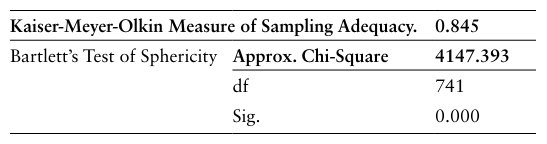
In realising the objectives of the study, factor analysis was employed for the data analysis to refine and reduce the 39 barriers to ITS adoption into a smaller number of coherent subscales (see Kissi et al., 2016; Somiah et al., 2021). Regarding the appropriateness of factor analysis for this study, Kissi et al. (2016), as affirmed by Somiah et al. (2021), informed that factor analysis is suitable for 20–50 factors because the extraction of common factors becomes inaccurate if the number of factors exceeds this range. The 39 barriers exceeded the minimum of 20 factors, hence the use of factor analysis was justified. Moreover, the prior requirements for appropriate statistical tests, such as the correlation matrix, Kaiser Meyer-Olkin (KMO), and Bartlett’s test of sphericity, for the use of factor analysis were met, making factor analysis appropriate for this study. From Table 2, the KMO value was 0.845, which was larger than 0.5, suggesting that Bartlett’s test had high sampling adequacy, and as a result, the data collected through the survey questionnaire were suitable for factor analysis (Kissi et al., 2016; Somiah et al., 2021).
Table 2: KMO and Bartlett’s Test.
Also, the high KMO value achieved in this instance suggested that there was no need to produce anti-image matrices to further check whether the sample size was adequate. The Bartlett’s test of sphericity indicated a p-value of 0.000. This was less than 0.05, an indication that the correlation matrix was not an identity matrix (see Kissi et al., 2016; Somiah et al., 2021). Each of the barriers to ITS adoption loaded heavily in one of the principal components only, while the absolute value of the loadings exceeded 0.50.
Table 3: Total variance explained by each component.
From Table 3, the total variance explained by each component was extracted as follows: component 1 (13.405%), component 2 (13.374%), component 3 (12.826%), component 4 (11.321%), and component 5 (10.962%). The five components explained cumulatively explained 61.888% of the variation in the dataset. This satisfied the requirement for the cumulative proportion of variance criterion, that the extracted components should together be at least 50% of the variation (Kissi et al., 2016; Somiah et al., 2021). This study adopted factor grouping based on the principal component analysis (PCA) and varimax rotation.
Table 4: Rotated component matrix of barriers to ITS adoption in Ghana.
High cost of initial installation 0.849 The challenge of internet coverage 0.842
Systems Interoperability Challenge 0.832 Insufficient funding for ITS adoption 0.811
Lack of locally available ITS technologies 0.807 High planning cost 0.792
Inadequately skilled persons 0.765 High maintenance cost 0.707
(Continued)
Table 4: Continued.
lack of a national ITS data center 0.872 Limited power (energy) supply 0.851
Limited coverage problems in GPS-based sensors
Inaccuracy in determining real-time traffic speed estimation Unreliable energy (power) supply 0.802
Dominance of slum cities 0.773
0.772
Limited information sharing among the populace Inadequate legislation for ITS adoption 0.678
0.858
Dominance of automobiles with outdated technologies Uncordinated infrastructure development 0.857
0.813
Lack of an observable piloted project in Ghana
0.808
Noncompliance of existing Traffic regulations with ITS
0.789
ITS adoption is not driven by the manifestos of political parties Stakeholders coordination challenge 0.732
Lack of coherent policy 0.694 Challenge of adopting foreign ITS systems 0.675
Lack of ITS infrastructure 0.85 Society’s scepticism about ITS 0.841
Apathy in ITS investment by investors 0.834 Budget constraints 0.822
0.736
Lack of a designated department setup to ensure ITS adoption The challenge of internet accessibility 0.711
0.675
Inadequate content on ITS in civil engineering training at the bachelor’s level Lack of political will 0.797
Low awareness of ITS among practitioners 0.778
0.760
The behaviour of drivers’ non-compliance with ITS informations High illiteracy among commercial drivers 0.730
cultural differences 0.711 Limitation to CCTV video images 0.704
The challenge of public acceptance 0.641 Uncoordinated policies for ITS adoption 0.634 Group average 0.8006 0.8001 0.7783 0.7813 0.7194
Accordingly, Table 4 presents the principal (main) and sub-barriers to ITS adoption in Ghana. The rotation converged in 5 iterations. Varimax rotation with Kaiser Normalization was employed because of its ability to simplify the interpretation of the factors compared to the other rotation methods (Kissi et al., 2016; Somiah et al., 2021). Varimax rotation connects each variable with one of the factors, and each factor only represents a small number of variables, which is interpretable (Kissi et al., 2016; Somiah et al., 2021). Therefore, the five components of this study were interpreted as follows: component (1) represents economic and institutional capacity barriers; component (2) represents energy and system reliability barriers; component (3) represents facilitation condition barriers; component (4) represents resource barriers; and component (5) represents social barriers. Relatively, economic and institutional capacity barriers, with a group average of 0.8006, ranked 1st among the five main barriers to ITS adoption in Ghana. Ranking 2nd was energy and system reliability barriers, with a group average of 0.8001. Resource barriers ranked 3rd with a group average of 0.7813. Ranking 4th was facilitation condition barriers with a group average of 0.7783, while social barriers ranked 5th with a group average of 0.7194.
Economic and Institutional Capacity Barriers Economic and institutional capacity barriers accounted for 13.405% of the cumulative 61.888% variance. This component aligns with Resource-Based Theory by Barney (1991), which informs that when internal resources of an institution are not accessible and of the desired quality, it hinders the attainment of the institution’s overall goal. The resources relate to, but are not limited to, finance, material, labour, and technology (Barney, 1991; Somiah, 2018). Economic and institutional capacity barriers were defined by eight (8) sub-barriers. Relatively, high cost of initial installation (0.849), which affirmed the study by Shaaban et al. (2021), was the leading contributing barrier, while high maintenance cost (0.707), which reflects the view of Shaaban et al. (2021), was the least contributing barrier and was ranked 8th.
Energy and System Reliability Barriers These are barriers relating to energy reliability and system reliability. Eight (8) sub-variables defined energy and system reliability barriers. Relatively, lack of a national ITS data centre recorded the highest factor loading (0.872). This barrier to ITS adoption was earlier unravelled in the study by Nguyen et al. (2021). Inadequate legislation for ITS adoption (0.678) was the least contributing sub-barrier and was ranked 8th. This barrier supported the view of Almatar (2024) that, among others, inadequate legislation has been a crucial barrier to ITS adoption.
Resource Barriers Seven (7) sub-variables constituted resource barriers, with lack of ITS infrastructure (0.85) being the leading contributing sub-barrier, while
Exploring the Underlying Barriers to the Adoption 637 inadequate content on ITS in civil engineering training at the bachelor’s level (0.675) was the least. Almatar (2024) and Waqar et al. (2023), in a separate study, identified lack of ITS infrastructure and awareness among graduates as major setbacks to ITS adoption, respectively.
Facilitation Condition Barriers These barriers are related to the enabling environment in Ghana. This component aligns with the view of the unified theory of acceptance and use of Technology (UTAUT) by Venkatesh et al. (2003), which highlights, among others, that facilitation condition barriers are barriers to technology adoption. Facilitation condition barriers were made up of seven (7) sub- barriers with dominance of automobiles with outdated technologies (0.858), which confirmed the view of Behruz et al. (2013) being the lead sub-barrier; while challenge of adopting foreign ITS systems (0.675), which affirmed the position of Shaaban et al. (2021), was the least contributing barrier among the seven sub-barriers.
Social Barriers Social barriers relate to the beliefs and practices that are barriers to ITS adoption in Ghana. Eight (8) sub-barriers constituted social barriers. Lack of political will (0.797), was the leading contributing sub-barrier. This barrier affirmed the view of Almatar (2024), who had earlier posited that lack of political will had been a critical barrier to ITS adoption. More so, uncoordinated policies for ITS adoption (0.634) was the least contributing sub-barrier among the seven sub-barriers defining social barriers. This barrier affirmed the view of Shaaban et al. (2021) when the researchers advanced that the extant uncoordinated policies for ITS adoption have become a barrier to ITS adoption.
CONCLUSION
In line with the aim of the study, thirty-nine (39) barriers were identified, organized, and discussed under five principal coherent components: economic and institutional capacity, energy and system reliability, facilitation condition, resource, and social barriers. Apart from social barriers, facilitating conditions barriers, and resource barriers, economic and institutional capacity barriers, and energy and system reliability barriers were unique to the study in Ghana. Empirically, the study has unravelled the five main coherent barriers to ITS adoption in Ghana, which hither to was largely absent in existing literature. This will guide transport authorities, academics, policymakers, and industry stakeholders in the quest to realise ITS adoption in Ghana. It has expanded the frontiers of existing knowledge on barriers to ITS adoption and provided a more comprehensive theoretical basis for future related research. The findings inform the need for a coordinated multisectoral approach in addressing the barriers of ITS adoption, instead of a fragmented approach, since the barriers cut across sectors. On the social front, effectively mitigating the identified
barriers to ITS adoption can lead to the successful adoption of ITS in Ghana, which has potentials to lower accident rates, reduce traffic congestion, and improve emergency response times. These culminate in attaining Sustainable Development Goal (SDG)11: Sustainable Cities and Communities, and SDG 3: Good Health and Well-being. This has direct social benefits, including lower travel stress, enhanced accessibility for road users, and reduced loss of life. ITS contributes to reducing fuel consumption and vehicular emissions, leading to a better air quality, public health outcomes, and combating climate change, SDG 13: Climate Action.
APPENDIX
Appendix 1: Criteria/checklist for selecting experts.
Questionnaire items Possible marks
Maximum expected mark
Minimum expected mark
Minimum obtained marks
Q1. Please indicate your highest level of education Bachelor’s Degree 1 point 1 point 1 point
Master’s Degree 2 points Doctoral Degree 3 points 3 points Q2. Are you a member of any professional body in Ghana
Yes 1 point 1 point 1 point 1 point No 0 point Q3. Please indicate your years of experience with ITS issues in Ghana
20 years 1 point 1 point
21 to 30 years 2 points 2 points
Above 30 years 3 points
16 years and above 4 points 4 points
Total points 8 points 3 points 4 points Note: The minimum mark obtained of 4 points qualified one to be an expert respondent.
REFERENCES
Alam, M., Ferreira, J., & Fonseca, J. (2016). Introduction to intelligent transportation systems. In Intelligent transportation systems: Dependable vehicular communications for improved road safety (pp. 1–17). Almatar, K. M. (2024). Smart transportation planning and its challenges in the
Kingdom of Saudi Arabia. Sustainable Futures, 8. Barney, J. (1991). Firm resources and sustained competitive advantage. Journal of Management, 17(1), 99–129. Behruz, H., Chavoshy, A. P., & Mozaffari, G. (2013). Challenges of implementation
of intelligent transportation systems in developing countries: case study–Tehran. WIT Transactions on Ecology and the Environment, 179, 977–987. Guevara, L., & Auat Cheein, F. (2020). The role of 5G technologies: Challenges in smart cities and intelligent transportation systems. Sustainability, 12(16).
Exploring the Underlying Barriers to the Adoption 639 Kissi, E., Boateng, E., Adjei-Kumi, T., & Badu, E. (2016). Principal component analysis
of challenges facing the implementation of value engineering in public projects in developing countries. International Journal of Construction Management, 17(2), 14. Leedy, P. D., & Ormrod, J. E. (2005). Practical research: Planning and design. 8th edn. . Upper Saddle River, NJ.: Prentice Hall. Menouar, H., Guvenc, I., Akkaya, K., & Tuncer, A. (2017). UAV-enabled intelligent
transportation systems for the smart city: Applications and challenges. IEEE Communications Magazine, 55(3), 22–28. Ministry of Roads and Highways. (2025, January 14th). List of Contractors in Good Standing as at 23RD April, 2024. Retrieved from mrh.gov.gh: https://mrh.gov.gh/ wp-content/uploads/2024/04/List-of-Contractors-in-good-standing-as-at-23rd- April-2024.pdf Neuman, W. L. (2006). Social research methods qualitative and quantitative
Approaches (6th ed.). Boston: Pearson. Nguyen, P. T., Nguyen, T. A., & Tran, T. T. (2021). Barrier factors affecting development of intelligent transport system projects. Journal of process management and new technologies, 9(3-4), 100–120. Qureshi, K. N., & Abdullah, A. H. (2013). A survey on intelligent transportation
systems. Middle-East Journal of Scientific Research, 15(5), 629–642. Rogers, E. (2003). Diffusion of innovations (5th ed.). Free Press. Scott, W. R. (2014). Institutions and organizations: Ideas, interests, and identities (4th ed.). SAGE. Shaaban, K., Elamin, M., & Alsoub, M. (2021). Intelligent transportation systems in
a developing country: benefits and challenges of implementation. Transportation Research Procedia, 55, 1373–1380. Singh, B., & Gupta, A. (2015). Recent trends in intelligent transportation systems: a review. Journal of transport literature, 9(2), 30–34. Somiah, M. K. (2018). An integrated competitive advantage model for indigenous
construction firms in the Ghanaian construction industry. Johannesburg: University of Johannesburg (South Africa). Somiah, M. K., Aigbavboa, C., & Thwala, W. D. (2021). Rethinking the Attributes for Competitive Advantage of Indigenous Construction Firms in Developing Countries: A Ghana Study. International Journal of Construction Education and Research, 17(3), 242–257. Sushma, M. B., Rashmitha, Y., & RoY, S. (2022). A Framework on Understanding
the Barriers of Smart Cities and Intelligent Transportation System in India. International Conference on Transportation Planning and Implementation Methodologies for Developing Countries (pp. 809–820). Singapore: Springer Nature . Tomaszewska, E. J. (2021). Barriers related to the implementation of intelligent transport systems in cities-the Polish local government’s perspective. Engineering Management in Production and Services,, 13(4), 131–147. Venkatesh, V., Morris, M., Davis, G., & Davis, F. (2003). User acceptance of
information technology: Toward a unified view. MIS Quarterly, 27(3), 425–478.
Waqar, A., Alshehri, A. H., Alanazi, F., Alotaibi, S., & Almujibah, H. R. (2023).
Evaluation of challenges to the adoption of intelligent transportation system for urban smart mobility. Research in Transportation Business & Management, 51. Zaidan, R. A., Alamoodi, A. H., Zaidan, B. B., Zaidan, A. A., Albahri, O. S., Talal, M., . . . Malik, R. Q. (2022). Comprehensive driver behaviour review: Taxonomy, issues and challenges, motivations and research direction towards achieving a smart transptransportation environment. Engineering Applications of Artificial Intelligence, 111, 104745.
LISTED IN THE AHFE DIGITAL BOOKSTORE CATALOGUE
Explore the complete digital volume
Human Interaction and Emerging Technologies (IHIET-AI 2026): Artificial Intelligence and Future Applications
Read this individual research paper free through the original publisher, or explore the full digital proceedings book.
ISBN 978-1-964867-77-9
Explore this ISBN in the AHFE Bookstore ↗Listed in the July 2026 bookstore catalogue; search by ISBN to confirm current availability · Digital book purchase optional