Massimo Di Nicolantonio, Emilio Rossi, Alessio D'Onofrio, Raffaella Massacesi (2022). DESK M.A.T.E.: Rapid Prototyped Desk for Teaching in Developing Countries and Emergency Situations. In: Additive Manufacturing, Modeling Systems and 3D Prototyping. AHFE Open Access, vol. 34, pp. 23–29. https://doi.org/10.54941/ahfe1001585
Issue of schooling in developing countries and in areas experiencing emergency conditions represents an important opportunity for the design research community. Contributing to the pupil’s growth, education and development, and increasing their potential, is part of the objectives of the human rights treaties, the United Nations Charter, and the values of the UN Convention about children’s rights. Disadvantaged communities require smart design interventions, sustainable and inclusive strategies, aimed at defining original and functional solutions, with account of the context, how these artefacts can be manage with respect to social, cultural and environmental backgrounds. Communities must look to the improvement of knowledge that goes from the aid of available or new technologies, the possibility of supplying and processing raw materials, know-how related to self-production, management, waste disposal; bad waste management in developing countries and in countries that are in emergency conditions represents one of the main problems that require clear lines of action to reduce the environmental impacts. Among the possible interventions, this research explored the concept of 3D rapid prototyping of sustainable furniture for teaching in developing countries and emergency situations – DESK M.A.T.E., which considers diversified insights from the student community ranging from 6 to 18 years, as well as elements from ergonomics, safety, and hygiene domains. It also brings attention on the purchasing factors affecting the school furnishing in these areas, which are almost exclusively guaranteed by humanitarian associations. Specifically, this paper focused on using natural fibres and vegetable resins, CNC (Computer Numerical Control) production processes, to adhere with the circular economic models.The result presented in the paper provides evidence and validity on the use of rapid prototyping technologies for sustainable design and production, as well as evidence on the development of intelligent solutions adaptable to those situational conditions affected by negative circumstances, with the aim of opening up to new research avenues for the design community.
In economically advanced countries, schooling is synonymous with inve- stment in infrastructure and equipment. Safe and welcoming buildings sup- port a wide range of learning activities, strengthening all tasks related to pedagogic opportunities. Accordingly, considerable financial resources are allocated to school buildings with the aim of ensuring long-term societal inno- vations. However, in areas affected by emergency situations (i.e: wars), the priority moves from the quality of places to ensuring pupils suitable equi- pment for teaching and learning. According to UNICEF (UN Educational, Scientific and Cultural Organization, 2020), 57 countries are in a context of fragility and host 23% of the world’s population, which means that around 258 million children, adolescents and young people, risk of not having access to basic education. Institutions and associations worldwide are committed to ensuring that this gap is filled, or that these disparities are reduced as much as possible. This is echoed by UN through the ‘2030 Agenda for Sustaina- ble Development’(UN, 2015) containing the Goal 4 – ‘Quality Education’ –
dealing with issues and endangered conditions related to the school sector worldwide. The aim is therefore to provide quality, equitable and inclusive education and to promote lifelong learning opportunities for all implemen- ting, among others, the action to build and adapt educational facilities, so that they are adapted to children’s needs, disability, and gender differences, along with to provide safe, non-violent, and effective learning environments for all.
How can the design community tackle this complex issue? How can desi- gners develop new inclusive artefacts for endangered education contexts? What sustainable manufacturing strategies can be employed in this scena- rio? How to improve the local production capabilities? How to link Social Inclusion and Sustainable Development when it comes to Design? This paper explores the concept of 3D Rapid Prototyping of sustainable furniture for teaching in developing countries and emergency situations – DESK M.A.T.E. Emergency areas’ purchasing factors, the role of NGOs in delivering the pro- ject, as well as the analysis of advanced manufacturing processes (i.e.: CNC) and the use of natural fibres and vegetable resins to meet sustainable design criteria have been considered to create an affordable project, which is rapidly manufacturable in situ, deliverable worldwide and, therefore, it might be a first eco-efficient solution to an open problem that extents the entire modern society.
RESEARCH ON SUSTAINABLE MANUFACTURING The production and the supply of school furniture in contexts characterized by emergencies is a social need, which is not exempt from critical manage- ment. Once the supplied products’ end of life is reached, we need to consider various aspects that lead to environmental impacts both at local and global level. In fragile contexts the ‘Waste Hierarchy1’ is not respected. It is inevita- ble that emergency situations, whatever they may be, will also have a major impact on waste collection and treatment. Yet, this refers both to the materi- als used to produce school furniture, and to techniques used to manufacture it. Accordingly, it is a rigid system lacking in ideas, specifically conceived for emergency scenarios.
Data suggest that the use of a single natural material can be a suitable strategy to solve the different critical aspects related to the manufacturing of products. For example, wood meets the international regulations that address both production and (re)use, it has recently been adopted with the aim of improving the safety of school environments and students. Through low-cost chemical treatments, it can also meet the criteria of hygiene and fire resi- stance. More specifically, bamboo shows better characteristics; alike wood, it is suitable for processing techniques and meets the international regulati- ons, with the plus to be historically used in developing areas, where it grows rapidly and spontaneously. Besides, it is renewable and sustainable, showing
1It is a model for the prevention and preparation for re-use through the elimination of immediate risks to health, safety, and the environment, along with the recycling and the recovery or disposal of waste itself (UNEP, 2013).
DESK M.A.T.E: Rapid Prototyped Desk for Teaching in Developing Countries 25
high potential in terms of aesthetics, functionality, ecological footprint, fle- xibility and processability. It therefore favors a wide range of uses in many sectors, including school furniture: multilayer plywood, panels, fibers, and cellulose. Bamboo’s sustainability-related features are proven by ecological labels certifications such as FSC (2020) and ISO (2016).
Glue and assembly techniques play an important role in the design of sustainable products. Glue ensures solidity and durability over time. Today, two adhesives are used: synthetic and structural, which withstand great mech- anical efforts and distribute the mechanical stress at the junction points, as well as provide greater resistance to vibration. Their pollution impact on the environment is considerable; it affects the emission of toxic substances into the atmosphere and makes it impossible to using panels as combusti- ble material. Natural adhesives are excellent to mitigate the green impact during the products’ life cycle. On the other hands, the recovery of traditional assembly techniques such as interlocking is another factor that could contri- bute to the reduction of harmful substances. It is a technique with ancient roots.
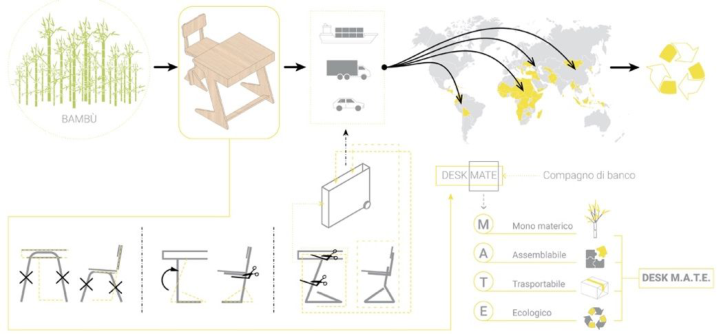
These studies offer the opportunity to work with 4.0’s production tech- niques, such as CNC, manufacturing, ICTs, Rapid Prototyping, Digital Modeling, Distributed Manufacturing, etc. Specifically, CNC manufacturing improves the design processes needed to bring creativity into NPD – re: inter- play between creative design processes, 2D/3D, CAD environment, and rapid manufacturing. Consistently with the optimization of development phases, CNC manufacturing allows to maximize the production by fully exploiting the material used –a bamboo panel in this case – which leads to mitigate the energy consumption, the environmental wastes, and finally, reducing of the cost of products to sell. In the described production process, the designer’s role is paramount because it now employs new technical skills bridging tra- ditional manufacturing with modern techniques. Therefore, to facilitate the diffusion among NGOs operating in developing countries, given the imme- diacy of the interventions that must be carried out in emergency situations proven by the high number of desks to be located, the product(s) to develop must be easily transportable, storable, lightweight, compact, durable, and without packaging (Figure 1).
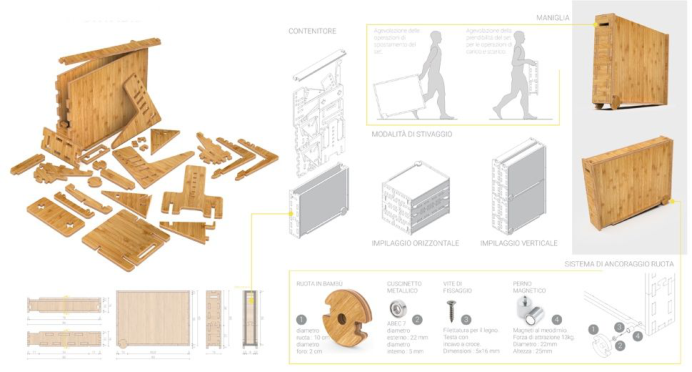
PRODUCT DESIGN DESK M.A.T.E. (Monomateric, Assemblable, Transportable, Ecological) is a desk with integrated chair, dimensionally suitable for a wide sample of users – from primary to secondary schools. It is designed following the ergonomic requirements and ISO standards2 including safety, hygiene, transportability, assembly, and disposal (Figure 2).
Therefore, by considering best practices and contextual features useful to define clear design guidelines, the main morphological, functional, and 2UNI EN 1729-1 and UNI EN 14434, which lay down the dimensions of seats and school desks, designed according to rigorous ergonomic criteria to promote a correct posture and avoid musculoskeletal damages. UNI EN 1729-2, UNI EN 527-3, UNI EN 717, and UNI 9177, which impose mechanical resistance parameters, structural integrity, fire resistance, and non-toxicity of materials.
Figure 1: Concept design developed using the data on Sustainable Manufacturing.Figure 2: DESK M.A.T.E disassembled / packaged.
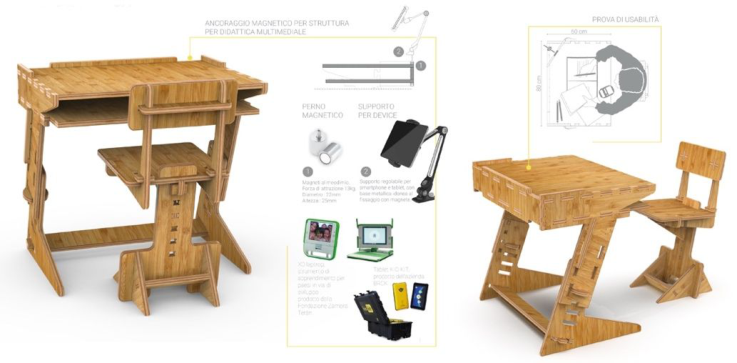
aesthetic parameters of the DESK M.A.T.E. can be identified and tailored on different contexts of use. The silhouette, along with the characteristics of material used, overcome the need of using packaging for the transport of the disassembled system of components. Finally, the dimensions of the worktop are compliant with the standards required by the school furniture regulations (Figure 3).
VISUAL DESIGN AND INSTRUCTIONS The communication of products’ usability is a fundamental element to con- sider for the correct use, efficiency, and safety during the entire life cycle, since it addresses the products’ congruity with laws and regulations. ISO standards (2019) provide general principles and detailed requirements for the design of instructions. Specifically, following the basic concepts of UX
DESK M.A.T.E: Rapid Prototyped Desk for Teaching in Developing Countries 27
Figure 3: DESK M.A.T.E assembled.
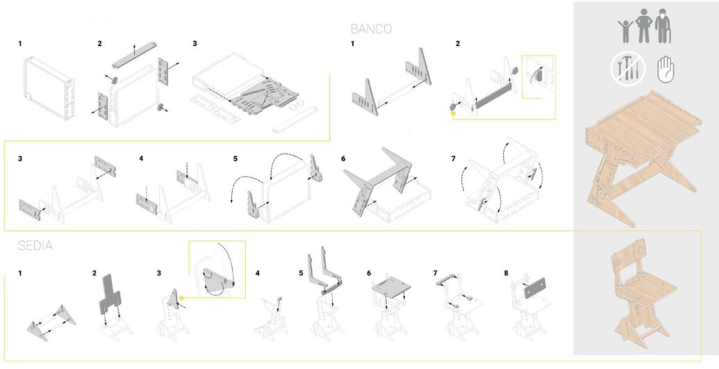
design, the standards highlight the need to develop accessible information, which means that aspects like age, gender, culture and geographical area, literacy, and language are investigated holistically, as these define the envi- ronment where users will use the products. About instructions, three main parameters have been considered for this project: (1) Users’ characteri- stics, (2) Familiarity with the product, (3) Instruction manual (Robinson, 2009). DESK M.A.T.E. is aimed at users of different ages; the simple and intuitive silhouette was specifically designed to support concentration and generate deep cognitive learning moments. This intent was also considered for the assembly/disassembly phases, where pupils can interact with it both indepen- dently and with the supervision of an adult. Specifically, information needed for assembly does not require technical language and pre-acquired skills, as instructions are graphical and integrated with easy-to-read images and signs to lead users to check the assembly sequences – this is important, for exam- ple, in low-literacy areas or in rural regions employing very particular reading grammars. Therefore, instructions are concise, and the assembly/disassembly mechanisms are intuitive (Figure 4). Once one is familiar with the assembl- y/disassembly, instructions can therefore be used just to check the congruence between the design and the result obtained. Instructions are therefore concise and enclosed in a foldable double-sided poster, characterized by non-fiction illustration, echoing tribalism and cultural coherence. This last aspect is also important because DESK M.A.T.E.does not require tools, and then, the intent is also to directly involve pupils in the creative tasks and playful moments of reflections bridging imagination and skills development. The graphical style used for the visual communication, with the so-called ‘clear line type of sign’, reduces the complexity of the information to share. As shown in Figure 4, instructions have a subtle, constant, and clean sign that simplify the overall understanding of complex tasks, making the use of technical symbols and descriptions unnecessary. About colors, the natural nuance of materials has
Figure 4: DESK M.A.T.E.: Instructions for assembly.
been preferred to reinforce the cultural and cognitive congruence between visual images and physical objects. Dimension and position of contents are based on the principles of storytelling, so that the manual is accessible to all types of users.
CONCLUSION
This research explored the concept of 3D Rapid Prototyping applied to sustai- nable furniture for teaching in developing countries and emergency scenarios. DESK M.A.T.E., considered diversified insights from the student community ranging from 6 to 18 years, as well as elements from ergonomics, safety, and hygiene domains. This project is consistent with the last design development and research advances concerning the theme of Sustainable Manufacturing, such as Rossi and Di Nicolantonio, (2020) and Rossi, Di Nicolantonio and D’Onofrio (2021). Specifically, this paper focused on the use of natural fibers and vegetable resins, CNC production processes, and sustainable design to follow the Circular Economy’s models. The result presented in the paper provides evidence and validity on the use of Rapid Prototyping technolo- gies for sustainable design and production, as well as evidence on how to create intelligent sustainable solutions suitable to intercept the needs of those living under negative circumstances (i.e.: wars) or underprivileged conditions. Through this project, it is possible to say that the design community can play a fundamental role in recognizing the value of contextual features affecting some areas – re: context-based bottom-up design approach – of the globe as well in designing affordable products aimed at increasing the quality of life, even starting from the development of learning skills (UN 2015; 2020). Therefore, this work also aims to elicit attention and opens to new research avenues for the design community where to test sustainable business models and creative projects.
DESK M.A.T.E: Rapid Prototyped Desk for Teaching in Developing Countries 29
ACKNOWLEDGMENT
This paper shows an extract of the research results contained a Master’s dissertation Product design authored by Paolo Belnudo (Advisor: Massimo Di Nicolantonio, Co-advisors: Emilio Rossi, Alessio D’Onofrio, and Raffaella Massacesi), Department of Architecture at the “G.D’Annunzio” University of Chieti-Pescara, Italy. All authors have equally contributed to the study design and implementation, including material preparation, data collection and results development. The writing of the various sections is attributed as follow: Di Nicolantonio wrote ‘Abstract’ and ‘Introduction’, Rossi wrote ‘Research on Sustainable Manufacturing’ and ‘Conclusions’, D’Onofrio wrote ‘Product Design’ and Massacesi wrote ‘Visual Design and Instructions’.
REFERENCES
European Commission (2018) Communication from the Commission to the European Parliament and the Council on Education in Emergencies and Protracted Crises – COM(2018) 304 final, 18 May 2018. European Commission: Brussels. Forest Stewardship Council (2020) Global Strategy 2021–2026: Demonstrating the
Value and Benefits of Forest Stewardship. Website: https://fsc.org/en/governance- strategy Hyman, M. (2013) Guidelines for National Waste Management Strategies: Moving from Challenges to Opportunities. Nairobi, Kenya: United Nations Environmen- tal Program. International Organization for Standardization (2016) EN 16785-2:2016 – Bio-
Based Products – Bio-based content – Part 2: Determination of the Bio-Based Content Using the Material Balance Method. Geneve: ISO International Organization for Standardization (2019) IEC/IEEE 82079-1:2019 – Preparation of Information for Use (Instructions for Use) of Products. Geneve: ISO. Robinson, P.A. (2009) Writing and Designing Manuals and Warning (4th Edition).
Boca Raton, FL: CRC Press. Rossi, E. and Di Nicolantonio, M. (2020) Integrating Human Centred Design Approach into Sustainable-Oriented 3D Printing Systems. Human-Intelligent Systems Integration, 2 (1). pp. 57–73. Rossi, E., Di Nicolantonio, M. and D’Onofrio, A. (2021). 3D Printing and Social
Inclusion: A Design Research Framework. In: Advances in Manufacturing, Production Management and Process Control: Cham: Springer. pp. 68–73. United Nations (2015) Resolution adopted by the General Assembly on 25 September 2015, Transforming our world: the 2030 Agenda for Sustainable Development. United Nations Educational, Scientific and Cultural Organization (2020) Global
Education Monitoring Report 2020: Inclusion and Education: All Means All. Paris: UNESCO.
LISTED IN THE AHFE DIGITAL BOOKSTORE CATALOGUE
Explore the complete digital volume
Additive Manufacturing, Modeling Systems and 3D Prototyping
Read this individual research paper free through the original publisher, or explore the full digital proceedings book.
ISBN 978-1-958651-10-0
Explore this ISBN in the AHFE Bookstore ↗Listed in the July 2026 bookstore catalogue; search by ISBN to confirm current availability · Digital book purchase optional