Amanda Coelho Figliolia, Erica Tobaro, Gilberto Gonçalves, Hamilton Mello, Frode Eika Sandnes, Fausto Orsi Medola (2022). The Influence of Filament Type and Number of Layers on Mechanical Resistance: Contributions for the Development of 3D Printed Prosthesis. In: Additive Manufacturing, Modeling Systems and 3D Prototyping. AHFE Open Access, vol. 34, pp. 47–53. https://doi.org/10.54941/ahfe1001588
3D printing has revolutionized the product development process in several areas including the healthcare field. In the context of assistive technologies, one of the main contributions includes personalizing the design of devices such as prostheses and orthotics. Assistive devices with personalized design may benefit users' acceptance and engagement to use, thus contributing to reducing product abandonment. Many studies have reported on the application of 3D printing (mainly FFF technology) in the design of prosthetics and orthotics, with a wide variation of filament materials and printing parameters. Understanding how these influence the mechanical resistance of the printed piece is therefore important as it may support the decision regarding the most appropriate printing parameters. This study was aimed at evaluating the mechanical properties of different types of filament and printing parameters applied in the manufacturing of 3D printed upper limb prosthesis. For this purpose, specimens were 3D printed in accordance with the international ASTM standards in six different conditions, varying the filament material (ABS, PLA and PETG) and number of layers (3 and 5). The specimens were subjected to mechanical tests to evaluate the flexural resistance and tensile strength. The results indicate that the mechanical performance of the parts was influenced by both the type of material and the number of layers, and PLA demonstrated higher mechanical properties compared to PETG and ABS. This study contributes to the design of 3D printed prosthetics by providing information that may support decision about filament type and printing parameters.
Assistive technology devices can be any item, equipment or product that is used to improve the functional capabilities of individuals with disabili- ties. When appropriate to the user and the user’s environment, they have been shown to be effective tools to increase independence and improve social inclusion (WHO, 2011).
The application of 3D printing in assistive devices has demonstrated seve- ral benefits such as the development of custom products that meet the user’s needs and preferences and improving the user’s acceptance (da Silva et. al. 2019 and Figliolia et. al. 2020). Many open-source 3D printed prosthesis designs have been made available online, enabling anyone with access to a 3D printer to manufacture a custom prosthesis. Despite the growing number of studies reporting the use of the 3D printing (mainly FFF technology) in these devices, few scientific publications were found about the materials and 3D printing parameters recommended to manufacturing these products (Pereira et. al., 2016). As reported by some researchers (Lovo et. al. 2017, Harpool et. al. 2021, Chacón et. al. 2017, Cou- tinho 2017), these parameters do influence the mechanical properties of the materials and consequently affects the 3D printed products. This preliminary study therefore aims to evaluate the mechanical properties (tensile strength and flexural resistance) of the most used materials in 3D printed upper limb prosthesis, that are ABS, PETG and PLA and with 3 and 5 printing layers.
METHOD
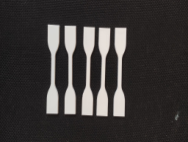
The flexural (three-point bending test) and the tensile tests were selected to evaluate these mechanical properties of filaments. Each test was performed in six different conditions, from two main factors: filament type, namely acry- lonitrile butadiene styrene (ABS), polyethylene terephthalate glycol-modified (PETG) and polylactic acid (PLA); and the number of layers (3 and 5). Five specimens were printed for each condition. All the specimens were 3D mode- led in a CAD file, in accordance with the international standards: ASTM D638 (ASTM, 2014) for tensile test specimens, type IV with 115 mm × 19 mm × 3.3 mm and having a rectangular cross-section of 6.0 mm × 3.5 mm; and the ASTM D790 (ASTM, 2017) for flexural test specimens with 127 mm × 12.7 mm × 3.2 mm of dimensions (see Figure 1). The specimens were 3D printed in white-coloured filaments with a fused filament fabrication (FFF) technology using the Mousta Mega 2 printer (Mousta, Brazil) available at the Center for Advanced Product Development (CADEP-UNESP). The environment conditions and printing parameters were controlled. The only parameters that varied were the temperature (because each of the three materials used have their specific printing temperature) and the number of layers (3 and 5 layers).
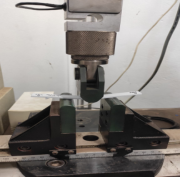
Before starting the mechanical tests, preliminary tests were conducted using only a few specimens to be assured that the thickness of the specimens was appropriate and to find the ideal speed of the equipment actuation. The equipment used was the universal testing machine (EMIC-DL 2000) with a 200kg load cell and the constant speed was set at of 2 mm/min (see Figure 2).
The Influence of Filament Type and Number of Layers on Mechanical Resistance 49
Figure 1: Specimens for tensile (left) and flexural (right) tests respectively. (Authors, 2021).Figure 2: Traction (left) and flexural (right) tests been performed respectively. (Authors, 2021).
Due to the small number of sample (n = 5) tested in each condition, only descriptive data by means of mean and standard deviation is presented.
RESULTS AND DISCUSSION
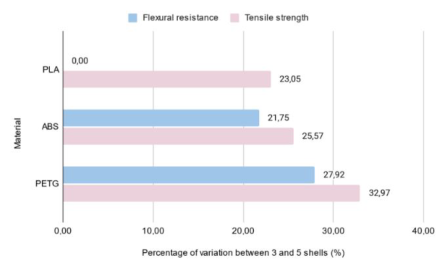
The results observed in the mechanical tests in all six conditions showed that the PLA had higher flexural resistance and tensile strength, followed by PETG and ABS. For all the materials, the use of 5 layers showed greater resista- nce and increased more than 20%, as described in the diagram below (see Figure 3).
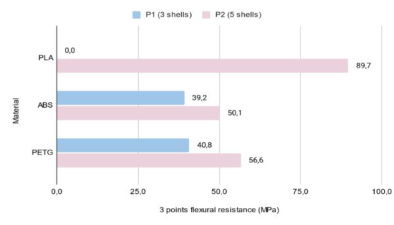
Regarding the flexural resistance (see Figure 4), in the condition with 3 layers, ABS (39.2 MPa + 0.33) showed lower resistance compared to PETG (40.8 MPa + 1.51). In this condition there are no results with PLA because of a project limitation where the PLA specimens with 3 layers could not be printed. In the specimens with 5 layers, the PLA had the greatest flexural resi- stance (89,7 MPa + 3.49), followed by PETG (56.6 MPa + 0.82) followed by ABS (50.1 MPa + 0.65). Another study limitation is that only 3 specimens of the 5-layers PETG were tested. Having a higher value of tension means that the material has a higher flexural resistance. The percentage of variation between the specimens with 3 and 5 layers was higher in PETG (27.9%) and ABS (21.8%).
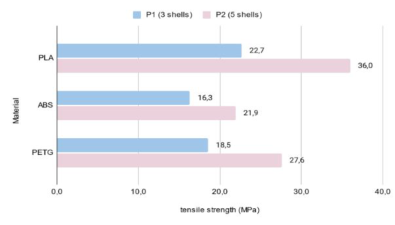
In the tensile strength test (see Figure 5) and condition with 3 layers, ABS had the lowest tensile strength (16.3 MPa + 0.12) and PLA the highest (22.7 MPa + 0.11), followed by PETG (18.5 MPa + 0.46). Similar results were observed in the specimens with 5 layers: ABS (21.9 MPa + 0.23), PETG (27.6 MPa + 0.36) and PLA (36.0 MPa + 0.26). The percentage of variation between the specimens with 3 and 5 layers was the highest in PETG with 33.0%, followed by ABS 25.6% and last PLA with 23.1%.
Figure 3: Results in percentage of the tensile strength and flexural resistance. (Authors, 2022).Figure 4: 3 points flexural resistance diagram. (Authors, 2022).Figure 5: Tensile strength diagram. (Authors, 2022).
The results are similar with the findings reported in other studies as the comparative study between PLA and PETG developed by Santana et. al. (2018), in which the materials in two different processes (3D printing and injection) were analysed by traction tests and thermal characterization. The tests suggested that PLA was more rigid and mechanical resistance. Although PETG showed a better resistance to thermal degradation, stronger thermal stability and flexibility which can be interesting for some specific applications and should be taken in consideration when developing 3D printed pieces.
The study of Martinez et. al. (2019) found that PLA had shown signi- ficantly greater mechanical resistance in the three points flexural test in
The Influence of Filament Type and Number of Layers on Mechanical Resistance 51
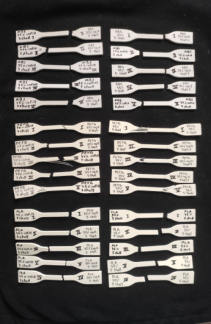
Figure 6: Tensile and flexural specimens after rupture respectively. (Authors, 2022).
comparison with ABS, having a higher flexural tension. However, the fle- xural modulus of elasticity in ABS was higher than those measured for PLA. Some of these findings are in agreement with Rodríguez-Panes et. al. (2018), where PLA also was more rigid than ABS.
Another finding is related to the specimen’s position of rupture (see Figure 6): the majority of the tensile strength specimens cracked in the same position, in the layers’ joints or in the air gaps. A few specimens had stretched without having a complete rupture. These air gaps and layer joints can be a consequence of the 3D printing process using FFF technology. A suggestion about the position of rupture is because such effects from the printing process can weaken the material, making it susceptible to the ruptures. Regarding the flexural specimens, it was observed that none of them ruptured, but they all bended close to the center. The study by Rodríguez-Panes et. al. (2018) analy- sed the rupture and suggested that some printing parameters can influence and contribute to the rupture, with the percentage of infill being one of the parameters observed to have a great influence.
This study has limitations that must be noted. First, a statistical test was not applied for comparison of the six conditions (3 types of filament, 2 amounts of layers), because only 5 specimens of each condition was tested. Additi- onally, due to operational issues, it was not possible to print and test the condition PLA with 5 layers, and only 3 specimens of the condition PETG with 5 layers were tested.
CONCLUSION
This paper reported a preliminary study based on interdisciplinary between engineering and design that aimed to evaluate the mechanical characteri- stics of 3D printing materials submitted to flexural and tensile strength tests. We addressed the mechanical resistance of three types of filament (ABS, PETG and PLA) in two different conditions (using 3 and 5 printing layers), that are amongst the most commonly used in 3D printing in the field of assistive technologies and, more specifically, manufacturing of 3D upper limb prostheses.
It was an experimental study with some limitations due to some printing problems and the restrictions due to the pandemic COVID-19. However, the findings bring contributions to the 3D printing applied to the design of upper limb prostheses by providing information that can support appropriate decision on the type of filament and printing parameters.
The main findings can be summarized as: PLA showed greater flexural resistance and tensile strength than PETG and ABS, respectively. Also, the number of printing layers (shells) can influence the mechanical properties of the 3D printed material, as it was observed that the increasing quantity of layers enhanced the resistance and strength. Another finding is related to the position of rupture, where it is suggested that the process of 3D printing - FFF showed some limitations and failures that can lead to the weakening of the material, which may contribute to a more fragile printed piece and even more possibility of rupture.
This study contributes to the knowledge on the influence of the mechani- cal properties of the 3D printing materials, as well as suggests the need for more studies on the mechanical resistance of the materials and the influe- nce of more printing parameters applied to the development of 3D printed customized prostheses. As a device that will be in direct contact directly with the user’s body, it needs to be safe and comfortable to the user. Ano- ther important aspect that has to be considered before choosing the material is related to the product’s context of use, because the material that has better tensile strength or flexural resistance may not be the better mate- rial for a specific type of use, for example, if the product needs to have strong thermal resistance, PLA is the less indicated when compared with PETG and ABS.
ACKNOWLEDGMENT
The authors would like to acknowledge the Norwegian Agency for Interna- tional Cooperation and Quality Enhancement in Higher Education (UTF- 2016-long-term/10053), CAPES (PROEX – 88887.371981/2019-00) and FAPESP (Process 2019.20433-5) for the financial support.
REFERENCES
ASTM D638-14, Standard Test Method for Tensile Properties of Plastics, ASTM International, West Conshohocken, PA, 2014 ASTM D790-17, Standard Test Methods for Flexural Properties of Unreinforced and
Reinforced Plastics and Electrical Insulating Materials, ASTM International, West Conshohocken, PA, 2017 Chacón, J.M., Caminero, M.A., García-plaza, E., Núnez, P.J. (2017) Additive manufacturing of PLA structures using fused deposition modelling: Effect of process parameters on mechanical properties and their optimal selection. Materials & Design, 124, 143–157, ISSN 0264-1275, https://doi.org/10.1016/j.matdes.2017. 03.065. Coutinho, R.R.T.P. (2016) Avaliação de Parâmetros de Processo nas Propriedades
de Peças de PBAT/PLA Fabricadas por Impressão 3D / Rafaella Rabello Teixeira Perdone Coutinho – Rio de Janeiro: UFRJ / ESCOLA POLITÉCNICA.
The Influence of Filament Type and Number of Layers on Mechanical Resistance 53
Da Silva L.A., Medola F.O., Rodrigues O.V., Rodrigues A.C.T., Sandnes F.E. (2019) Interdisciplinary-Based Development of User-Friendly Customized 3D Printed Upper Limb Prosthesis. In: Ahram T., Falcão C. (eds) Advances in Usability, User Experience and Assistive Technology. AHFE 2018. Advances in Intelligent Systems and Computing, vol 794. Springer, Cham. Figliolia, A., Medola F., Sandnes, F.E., Rodrigues A.C.T., Paschoarelli, L.C. (2020)
Avoiding Product Abandonment Through User Centered Design: A Case Study Involving the Development of a 3D Printed Customized Upper Limb Pros- thesis. In: Di Nicolantonio M., Rossi E., Alexander T. (eds) Advances in Additive Manufacturing, Modeling Systems and 3D Prototyping. AHFE 2019. Advances in Intelligent Systems and Computing, vol 975. Springer, Cham. https://doi.org/10.1007/978-3-030-20216-3_27 (2020). Harpool, T.D., Alarifi, I.M., Alshammari, B.A., Aabid, A., Baig, M., Malik, R.A., Mohamed Sayed, A., Asmatulu, R., El-Bagory, T. (2021) Evaluation of the Infill Design on the Tensile Response of 3D Printed Polylactic Acid Polymer. Materials (Basel, Switzerland), 14(9), 2195. https://doi.org/10.3390/ma14092195. Lovo, J., Silva, M., Pedroso, M., Fortulan, C. (2017) Posicionamento de um componente para fabricação por FDM baseado em otimização. DOI: 10.26678/ABCM.COBEF2017.COF2017-0161. Martinez, A.C.P., Souza, D.L. de, Santos, D.M. dos, Pedroti, L.G., Carlo, J.C., Mar-
tins, M.A. D. (2019) Avaliação do comportamento mecânico dos polímeros ABS e PLA em impressão 3D visando simulação de desempenho estrutural. Gestão & Tecnologia De Projetos, 14(1), 125-141. https://doi.org/10.11606/gtp.v14i1. 148289 Pereira, H.G., Rodrigues Jr, L.F., Volkmer, T.M., Pupim, V.M., Luz, F.F. (2016) Comportamento mecânico do poli (ácido láctico) com diferentes pigmentações para a impressão 3D de componentes para aplicação em próteses e órteses. 22° CBECi- Mat – Congresso Brasileiro de Engenharia e Ciência dos Materiais. Natal, RN, Brasil. Rodríguez-Panes A., Claver, J., Camacho, A.M. (2018) The Influence of Manu-
facturing Parameters on the Mechanical Behaviour of PLA and ABS Pieces Manufactured by FDM: A Comparative Analysis. Materials. 11(8):1333. https://doi.org/10.3390/ma11081333. Santana L., Alves, J.L., Sabino Netto, A.C., Merlini, C. (2018) Estudo comparativo entre PETG e PLA para Impressão 3D através de caracterização térmica, química e mecânica. Revista Matéria, v.23(4). World Health Organization: World Report on Disability. World Health Organiza-
tion, 2011.
LISTED IN THE AHFE DIGITAL BOOKSTORE CATALOGUE
Explore the complete digital volume
Additive Manufacturing, Modeling Systems and 3D Prototyping
Read this individual research paper free through the original publisher, or explore the full digital proceedings book.
ISBN 978-1-958651-10-0
Explore this ISBN in the AHFE Bookstore ↗Listed in the July 2026 bookstore catalogue; search by ISBN to confirm current availability · Digital book purchase optional