Letícia Garcez, Ana Claudia Tavares Rodrigues, Fausto Orsi Medola, Luciana Ramos Baleotti, Frode Eika Sandnes, Atiyeh Vaezipour (2022). Users’ Satisfaction with an Assistive Device and Quality of Life: A preliminary study on lower limb prosthetics. In: Human Factors in Accessibility and Assistive Technology. AHFE Open Access, vol. 37, pp. 60–68. https://doi.org/10.54941/ahfe1001643
1 Graduate Program in Design (PPGDesign), School of Architecture, Arts, Communication and Design, Sao Paulo State University (UNESP), Bauru, SP, Brazil ↗
2 Graduate Program in Human Development and Technologies, São Paulo State University (UNESP), Rio Claro, Brazil ↗
3 Oslo Metropolitan University (OsloMet), Oslo, Norway ↗
4 RECOVER Injury Research Centre, The University of Queensland, Brisbane, Australia ↗
Quality of life refers to the individual perception of each person regarding their objectives, expectations and achievements, according to their stage of life and contexts of material, physical, emotional and social conditions. Assistive Technology devices can improve the individual’s performance in many domains related to daily activities, which are linked to independence and social participation. The user’s satisfaction is an important factor for the successful use of assistive devices. This study aimed to analyze the correlation between the quality of life and the users’ satisfaction with their lower limb prostheses. Eleven individuals aged between 20 and 54 years participated in the study. All participants were interviewed by telephone responding to the Quebec User Evaluation of Satisfaction with Assistive Technology (QUEST 2.0) and the World Health Organization Quality of Life (WHOQOL-BREF), both in its Brazilian version. The highest frequency of positive responses (“very satisfied” or “quite satisfied”) were found in the professional service (90%), efficacy (81.8%) and weight (81.8%), while durability (27.3%), repairs and technical assistance (27.3%) and follow-up service (27.3%) were the factors with highest frequencies of dissatisfaction (responses of “not satisfied at all” or “not very satisfied”) in the QUEST 2.0. Participants indicated comfort (27.3%), durability (21.2%) and safety (21.2%) as the most important aspects for satisfaction with their prostheses. When it comes to the quality of life in the WHOQOL-BREF, the mean of the participants' scores was 74.2%, with similar scores for the domains of physical health (75.6±12.8), psychological (80.7±9.4), social relationships (74.2±15.1) and environment (66.5±16.2). This study contributed to the comprehension of the main factors of the assistive device and service that influence the satisfaction of prostheses’ users, and the correlation with their quality of life. Improvements are still needed in some aspects in lower limb prostheses in order to better meet the users’ needs.
Users’ Satisfaction with an Assistive Device and Quality of Life 61
INTRODUCTION
The technical note 01/2018 review of the census data on disability in the last Demographic Census carried out in Brazil in 2010 indicates that around 12.7 million people declared to have some type of disability (IBGE, 2018), while, worldwide, these data reach about 15% of the population (WHO, 2011).Certain deficiencies cause changes in body functions that can change the individual’s routine, restricting participation and autonomy in daily activities, such as mobility.
The scientific literature points to several benefits of Assistive Technology (AT) devices on people’s quality of life. The reasons for satisfaction include practical issues of use that relate to usability, comfort, but also psychological, aesthetic and symbolic aspects of AT (Phillips and Zhao, 1993; Hocking, 1999; Scherer, 2002; Scherer and Craddock, 2002 and Biddiss and Chau, 2007). Lower limb prostheses are AT devices that can help the user’s functional capacity in activities such as mobility, transfers, use of stairs and execu- tion of other Activities of Daily Living (ADLs) and Activities Daily Life Instruments(ADLIs). They are usually more satisfactory to users than upper limb prostheses due to the complexity of the manual function (Silva et al., 2019), although an inadequate lower limb prosthesis can bring discomfort to the residual limb and affect the efficiency of walking (Esquenazi, 2014). In addition, aspects of dissatisfaction among prosthesis users regarding com- fort, safety and rehabilitation services and dispensing of such equipment are evidenced in the literature, since adequate gait training is an essen- tial complement to the dispensing of lower limb prosthesis, important for social inclusion and Quality of Life (QoL) (Raddatz, Roveda and Lorenzett, 2012). Therefore, the QoL indices refers to the perception that the individual has in relation to material conditions (social position); subjective contexts (phy- sical, emotional conditions), knowledge (cultural, social) and its objectives, expectations, standards and concerns (WHO, 2001), involving feelings such as pleasure, happiness, anguish and sadness (WHO, 1998).
This study gain insight into the main factors that influence the satisfaction of lower limb prosthetic users with the device and how this correlates with their perceived quality of life.
METHOD
A cross-sectional, descriptive study with a quantitative approach was carried out. The questionnaires were applied to patients from the school clinic, Cen- ter for Education and Health Studies, linked to UNESP - Marília/SP and also to patients of Occupational Therapists and Physiotherapists in the city of Uberlândia/MG. The subjects were identified in a random, non-probabilistic manner and also by indication of the participants, which can be defined as snowball (Biernacki and Waldorf, 1981).
A total of eleven adults over the age of 18 years, who wore a lower limb prosthesis and had the cognitive ability to answer the questionnaires participated in this study.
The outcome measures consisted of two evaluation tools: The Quebec User Evaluation of Satisfaction with Assistive Technology (QUEST 2.0) to assess satisfaction with the device and related services the person received, and the World Health Organization Quality of Life (WHOQOL-BREF), to identify how the individual perceive their quality of life, health and other areas of their life, using the last two weeks as a reference. Both versions used were transla- ted into Portuguese and validated for Brazil (Panzini et al., 2011; Carvalho, Gois Júnior and Sá, 2014).
Data were collected using telephone interviews which lasted approxi- mately 30-40 minutes. Participants were responded to a series of questi- ons, including demographic, the QUEST 2.0 and WHOQOL-BREF. Data collection procedures started in October 2020 and ended in October 2021.
This research is part of a broader project approved by the Research Ethics Committee of the School of Philosophy and Sciences, UNESP- Marília, registered by the Certificate of Presentation for Ethical Appreciation 08393019.7.0000.5406, under opinion n.° 3.202.005, in accordance with Resolution n.° 466/2012, meeting the ethical precepts in research involving human beings.
RESULTS AND DISCUSSION
The collected data were tabulated in Microsoft Office Excel 2016 software. From the total of eleven participants, the majority of the them were male (81.8%), and the age groups with the highest representation were in the range 25 to 29 years (36.3%), followed by participants in the range 30 to 34 years (27.2%).
Five (45.4%) participants reported that they have been using a prosthesis for more than 10 years. The acquisition of the current lower limb prosthesis was made recently by most participants, with 45.4% having had the device for 1 to 2 years and 27.2% for less than one year (see Table 1).
Users’ Satisfaction with an Assistive Device and Quality of Life 63
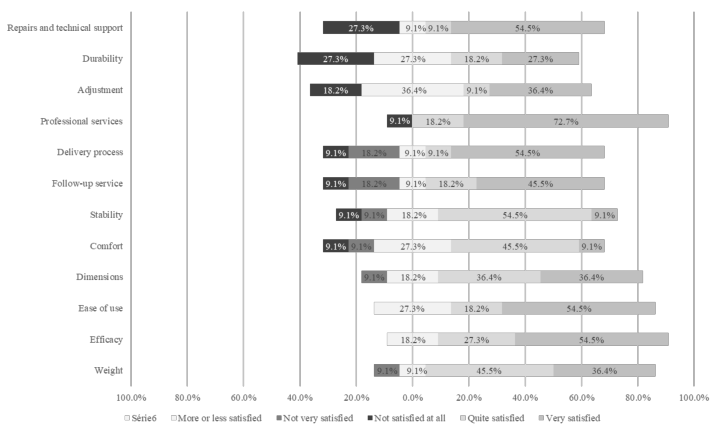
The results of the participants’ satisfaction are presented in Table 2 and Figures 1 and 2. As shown in Figure1, the instrument presents questions through a Likert scale from 1 to 5 (from “Not satisfied at all” to “Very satisfied”) about aspects of the AT it uses and the services that involve the acquisition of the device.
Figure 1: Participants’ satisfaction with their prosthesis.
The aspects that showed the highest frequencies of high satisfaction (“Very satisfied”) were ease of use and resource efficacy, with 54.5% satisfaction for both. The next best-rated factor was Weight, with scores “Quite satisfied” and “Very satisfied” with 45.5% and 36.3% successively, totalling 81.8% satisfaction.
As for the criteria with negative scores (“Not satisfied at all”), the frequ- ency of dissatisfaction was 27.3% in Durability and 18.2% in Adjustments, in addition to the same score of 18.2% in Stability and Comfort, with scores “Not satisfied at all” and “Not very satisfied”.
Evaluations of services have adverse results. Repair and Technical Support items received a high rate of negative scores (27.3% of “Not satisfied at all”). The Delivery Process and Follow-up Service items received “Not satisfied at all” and “Not very satisfied” scores, totalling 27.3% dissatisfaction for both. The item Services from professionals was the best rated with 90% of positive responses (“Quite satisfied” or “Very satisfied”).
The total score of satisfaction was (M=7.7+1.3). When it comes to the device mean rates of satisfaction for each aspect (Figure 1), overall the par- ticipants are quite satisfied (M=3.8±0.7), the item efficacy (M=4.4±0.8) also stands out, as it has the highest mean and the lowest standard deviation between the items evaluated successively, which also occurs with “Ease of use” (M=4.3±0.9).
The aspects with the lowest means were durability (M=3.2±1.5) and com- fort (M=3.4±1.1) which, as in the Likert Scale, present negative evaluations.
Table 2. Scores of QUEST 2.0.
Table available in the original PDF paper.
Alternative Mean SD Min Max Dimensions 4.0 1.0 2.0 5.0 Weight 4.1 0.9 2.0 5.0 Adjustment 3.5 1.4 1.0 5.0 Stability 3.5 1.1 1.0 5.0 Durability 3.2 1.5 1.0 5.0 Ease of use 4.3 0.9 3.0 5.0 Comfort 3.4 1.1 1.0 5.0 Efficacy 4.4 0.8 3.0 5.0 Total device 3.8 0.7 2.3 4.8 Delivery process 3.8 1.5 1.0 5.0 Repairs and technical support 3.6 1.7 1.0 5.0 Professional services 4.5 1.2 1.0 5.0 Follow-up service 3.7 1.4 1.0 5.0 Total services 3.9 0.8 2.0 5.0 Total 7.7 1.3 4.8 9.8
For the services aspects, the best average is found in the item services of professionals (M=4.5±1.2) and the lowest in maintenance and technical assistance (M=3.6±1.7).
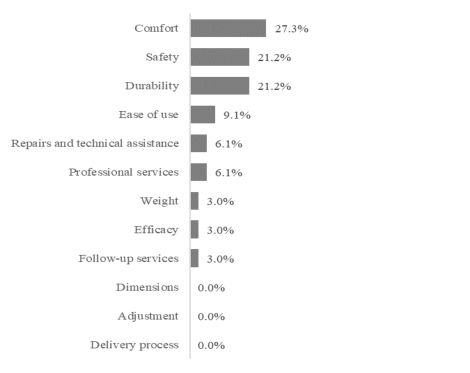
The users indicated comfort (27.3%), durability (21.2%) and safety (21.2%) as the most important aspects for the satisfaction with their prosth- eses (see Figure 2).
Figure 2: QUEST 2.0 Results - Item of highest importance.
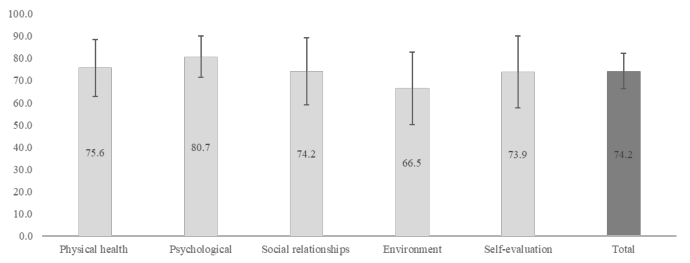
The WHOQOL–BREF presents 26 questions to assess the quality of life, consisting of four main domains that analyze physical capacity, psychological well-being, social relationships and the environment, as well as a domain in which the subject assesses himself (see Figure 3). The answers from each domain receive scores from the Likert scale from 1 to 5. The method proposed
Users’ Satisfaction with an Assistive Device and Quality of Life 65
Figure 3: WHOQOL–BREF Results: mean scores for domains and total score. Error bars show standard deviation.
by WHO (1996) was used to calculate the scores, understanding that the closer to a score of 100, the better the QoL.
The result of the total mean of QoL was 74.2%, that is, participants are considered to have a very good QoL, with a value close to 100%. The domains with the lowest and highest score were, respectively, environmental with (66.5 ± 16.2) and psychological with (80.7 ± 9.4). The physical health domains with (75.6 ± 12.8) and social relations with (74.2 ± 15.1) exhibited similar scores with little variation.
Correlation Analysis Spearman’s correlation analysis SPEARMAN (1904) assesses specific obje- ctives and the relationship between the variables of the present study. The results were analyzed in two perspectives, correlation between aspects of the same questionnaire and also correlation between factors of both questi- onnaires.Data were analyzed using JASP (2020) version 0.12.2.0 statistical software package.
The correlation of variables with significant effect found in QUEST 2.0 in terms of satisfaction were dimensions and adjustment rs(9) = .74, p = .008; adjustment and repairs and technical support rs(9) = .66, p = .027; stability and comfort rs(9) = .66, p = .026; ease of use and total device satisfaction rs(9) = .61, P = .044; comfort with professional services rs(9) = .77, p = .006; repairs and technical support and total satisfaction with services rs(9) = .60, p = .049 and professional services and follow-up service rs(9) = .64, p = .033.
In the WHOQOL-Brief the significant correlations between the domains are physical health and environment rs(9) = .80, p = .003; physical health and total QoL rs(9) = .72, p = .011; psychological and total QoL rs(9) = .86, p ≤.001 and environment and Total QoL rs(9) = .70, p =.017.
When comparing the QUEST 2.0 variables - (Q) with the WHOQOL-Bref - (W), the correlations were identified (Q)comfort and (W)physical health rs(9) = .81, p ≤.002; (Q)professional services and (W)physical health rs(9) = .75, p = .008; (Q) professional services and (W)psychological rs(9) = .62, p = .041; (Q)follow-up service and (W)physical health rs(9) = .68, p
= .021; (Q)follow-up service and (W)psychological rs(9) = .66, p = .025; (Q)total services satisfaction and (W)psychological rs(9) = .66, p = .027; (Q) total services satisfaction and (W)social relationships rs(9) = .60, p = .049; (Q)total device satisfaction and (W)physical health rs(9) = .65, p = .029; (Q)comfort and (W)total QoL rs(9) = .71, p ≤.014; (Q)professional services and (W)total QoL rs(9) = .78, p ≤.004 and (Q)follow-up service and (W)total QoL rs(9) = .67, p ≤.024.
Discussion
When comparing the mean of the QoL Self-Assessment score (73.9 ± 16.3) with the total mean (74.2%), there are similar results, representing that the way they self-evaluate themselves matches the result of the other domains.
The results correspond with what has been reported in the literature about the importance of AT in the independence and autonomy of its users (Rodri- gues et al., 2021). It is possible to compare the positive results (“Quite satisfied” or “Very satisfied) of the QUEST 2.0 instrument for Ease of Use (72.7%) and Efficacy (82.8%) with the average of the Physical (75.7%), and Environmental (66.5%) domain scores of the WHOQOL-BREF that address how the participant feels able to perform daily tasks, in addition to the relati- onship with freedom and participation, which can state that satisfaction with AT has correlation with the averages of QoL.
Previous research emphasize that satisfaction encompasses psychological, aesthetic and symbolic aspects (Phillips and Zhao (1993); Hocking (1999); Scherer (2002); Scherer and Craddock (2002) and Biddiss and Chau (2007). Thus, when analyzing the average of the psychological domain (80.7%), which shows how much the participants enjoy their life, their self-esteem and acceptance of their physical appearance, there is a following interesting finding in our study.
Despite the high average score in the physical domain (75.7%) of the WHOQOL-BREF, when we correlate items from QUEST 2.0 that present results of dissatisfaction to Comfort (18.2%) (“Not satisfied at all” or “Not very satisfied”) and Effectiveness (18.2%) (“Not very satisfied”), it can be concluded that there are still aspects to be considered and improved in the AT design, as the ease of achieving the desired goals interferes in the satisfa- ction with the comfort device (Jordan, 1998b; Lobach, 2001; Gomes Filho, 2003). Also according to Mont’Alvão and Damazio (2008) when we comparing satisfaction with ergonomic factors (safety and stability in use, ease of adju- stment) and its influence with a good QoL, it is observed in the results of QUEST 2.0 the dissatisfaction with the aspects, safety and stability 18.1% (“Not satisfied et all”or “Not very satisfied”) and ease of adjustment 18.2%. (“Not satisfied et all”), suggest attention issues to improve QoL.
This study has limitations that need to be noted. First, only 11 individuals participated in this study, therefore the results may not be fully representative of the population of lower-limb prosthetic users. Additionally, most of the participants (63.6%) had at least five years of experience using a prosthesis.
Users’ Satisfaction with an Assistive Device and Quality of Life 67
It is possible that less experienced, and novice users may report different levels of satisfaction with the device and QoL.
CONCLUSION
This preliminary study contributed to the comprehension of quality of life and satisfaction with the assistive device of people that use lower limb pros- theses. The positive results of satisfaction with AT corroborate with what the literature discusses about the correlation with QOL. It is important to observe the results with an index of dissatisfaction, both related to the device and the services that involve the use of AT, as they can interfere with physi- cal, psychological, environmental and social aspects. Improvements are still needed in some aspects in lower limb prostheses in order to better meet the users’ need.
ACKNOWLEDGMENT
This study was financed in part by the Coordenação de Aperfeiçoamento de Pessoal de Nível Superior - Brasil (CAPES).
REFERENCES
Bidiss, Elaine; Chau, Tom (2007) Upper-Limb Prosthetics. AMERICAN JOURNAL OF PHYSICAL MEDICINE AND REHABILITATION, [S.L.], Volume 86 No. 12. Biernacki, Patrick; Waldorf, Dan (1981) Snowball Sampling: Problems and techni-
ques of Chain Referral Sampling. SOCIOLOGICAL METHODS AND RESEA- RCH, Volume 10 No. 2. Carvalho, Karla E. C. de; Gois Júnior, Miburge B.; Sá, Katia N. (2014) Translation and validation of the Quebec User Evaluation of Satisfaction with Assistive Technology (QUEST 2.0) into Portuguese. REVISTA BRASILEIRA DE REUMA- TOLOGIA, Volume 54 No. 4. da Silva, Leticia A.; Medola, Fausto O.; Rodrigues, Osmar V.; Rodrigues, Ana
Cláudia T.; Sandnes, Frode E. (2019) Interdisciplinary-based development of user- friendly customized 3D printed upper limb prosthesis. In: Advances in Usability, User Experience and Assistive Technology. AHFE 2018. Advances in Intelligent Systems and Computing. Ahram, T.Z., Falcão, C. (eds.). Volume 794 pp. 899–908. Springer, Cham. Esquenazi, Alberto (2014) Gait Analysis in Lower-Limb Amputation and Prosthetic Rehabilitation. PHYSICAL MEDICINE AND REHABILITATION CLINICS OF NORTH AMERICA, Volume 25 No. 1. Gomes Filho, João (2003) Ergonomia do objeto: Sistema técnico de leitura ergo-
nômica. São Paulo: Escrituras. Hocking, Clare (1999) Function or feelings: factors in abandonment of assistive devices. TECHNOLOGY AND DISABILITY, Volume 11 No. 1-2. Instituto Brasileiro de Geografia e Estatística (2018). 01/2018: Releitura dos dados
de pessoas com deficiência no Censo Demográfico 2010 à luz das recomendações do Grupo de Washington. 1 ed. Rio de Janeiro: IBGE. JASP Team (2020): JASP (Version 0.12.2)[Computer software]. Jordan, Patrick W. (1998) Human factors for pleasure in product use. APPLIED ERGONOMICS, Volume 29 No. 1.
Lobach, Bernd (2001) Design Industrial: Bases Para a Configuração dos Produtos Industriais. São Paulo: Edgard Blucher. Mont’Alvão, Cláudia; Damázio, Vera, orgs. (2008). Design, ergonomia e emoção.
Rio de Janeiro: MauadX. Panzini, Raquel G.; Maganha, Camila; da Rocha, Neusa S.; Bandeira, Denise R.; Fleck, Marcelo P. (2011) Validação brasileira do instrumento de qualidade de vida/espiritualidade, religião e crenças pessoais. REVISTA DE SAÚDE PÚBLICA, Volume 45 No. 1. Phillips, Betsy; Zhao, Hongxin (1993). Predictors of assistive technology abandon-
ment. ASSISTIVE TECHNOLOGY, Volume 5 No. 1. Raddatz, Daiane B. F.; Roveda, Patrícia. O.; Lorenzett, Daniel B. Analysis of satisfaction of prosthesis users on legs for improvement of these prosthesis. ESPACIOS. Volume 33 No. 8. Rodrigues, Ana Cláudia T.; Garcez, Leticia V. M.; Medola, Fausto O.; Baleotti,
Luciana R.; Sandnes, Frode E.; Vaezipour, Atiyeh (2021) A Systematic Review of Differences Between Conventional Orthoses and 3D-Printed Orthoses. In: AHFE 2021: Advances in Manufacturing, Production Management and Process Control. Lecture Notes in Networks and Systems. S. Trzcielinski et al. (eds.). Volume 274 pp. 53–60. Springer, Cham. Scherer, Marcia J. (2002) The change in emphasis from people to person: introduction to the special issue on assistive technology. DISABILITY AND REHABILI- TATION, Volume 24 No. 1/2/3. Scherer, Marcia; Craddock, Ger (2002) Matching Person and Technology (MPT):
assessment process. TECHNOLOGY AND DISABILITY, Volume 14 No. 3. Spearman, C.E. (1904) Proof and measurement of association between two things.
American Journal of Psychology, Champaign, v.15, n.1, p. 72-101. World Health Organization (1996) WHOQOL-BREF: Introduction, Administration, Scoring and Generic Version of the Assessment. WHO. World Health Organization (1998) Health Promotion Glossary. Geneva: Division Of
Health Promotion, Education And Communications. WHO. World Health Organization (2001) ICF: International Classification of Functioning, Disability and Health. WHO. World Health Organization (2011) World report on disability. WHO.
LISTED IN THE AHFE DIGITAL BOOKSTORE CATALOGUE
Explore the complete digital volume
Human Factors in Accessibility and Assistive Technology
Read this individual research paper free through the original publisher, or explore the full digital proceedings book.
ISBN 978-1-958651-13-1
Explore this ISBN in the AHFE Bookstore ↗Listed in the July 2026 bookstore catalogue; search by ISBN to confirm current availability · Digital book purchase optional