Emilio Rossi, Massimo Di Nicolantonio, Alessio D'Onofrio, Raffaella Massacesi (2022). '3D-Printed Inclusive Modular System for Underprivileged Communities. In: Additive Manufacturing, Modeling Systems and 3D Prototyping. AHFE Open Access, vol. 34, pp. 30–36. https://doi.org/10.54941/ahfe1001586
The term ‘underprivileged communities’ describes groups of people experiencing some form of restrictions, such as economic, social, and political, which later lead to producing extensive forms of social exclusion. Although this phenomenon is mainly visible in crisis scenarios (i.e.: refugee camps), or emerging countries (i.e.: slums), some relevant examples can also be found in western countries. Accordingly, horizontal interdisciplinary socio-economic factors may produce remarkable disabling conditions affecting communities and producing non-inclusive situations for present and future generations.Unprivileged communities require intensive design interventions, from services to products, from housing to logistics, from shared goods to networked systems. Therefore, the design research community can start using unprivileged communities as a testing ground to experiment sustainable-based and inclusive-oriented design strategies to improve the quality of life of people living at the margin of society, as well as providing original solutions to improve the economic, social, and environmental qualities of such living ecosystems.Among the possible interventions, we explored the concept of ‘Inclusive 3D Printing’ by applying recent theories developed within Sustainable 3D Printing studies. Thus, an inclusive 3D-printed modular system for unprivileged communities is presented and discussed as the result of a rigorous research process connecting the main data found within the socio-economic literature with promising design trajectories and experimentations allowed using this new manufacturing technology. The design results presented in the paper provide evidence and validity on the use of sustainable 3D printing to design smart solutions, alongside initial reflections on the design opportunities to make a change, beyond mainstream markets.Discussions and considerations are provided to reinforce the need to work holistically and through interdisciplinary design approaches to opening new research avenues for the design community.
When using the term ‘Unprivileged Communities’ (UPCs), the scientific com- munity considers both large and small social groups, such as social, ethnic, economic, political, and cultural groups, but also tribal minorities and lin- guistic groups that experience a kind of exclusion from being involved in the socio-economic life. Accordingly, the marginalization and the negative conditions affecting these groups generate a problem of ‘social exclusion’ (UNESCO WWAP, 2019), which leads to a reduction in fully participation in the economic, social, and political life. Therefore, a multitude of complex social, economic, and human aspects revolve around the living conditions of UPCs. Trying to solve the social problems that occur within UPCs is para- mount to trigger the needed sustainable transition toward more inclusive living conditions. This idea is also echoed by UN through the Sustainable Development Goals (SDGs), such as SDGs 1, 5, and 101 (UN, 2015).
In this regard, it is believed that new inclusive artefacts, such as smart products, services, systems of sustainable solutions, etc. are therefore nee- ded to overcome the unsustainable and non-inclusive conditions on UPCs. Accordingly, the Design community can play a strategic role in understan- ding and tackling these instances to stimulate the reflection on how to create 1(SDG 1) No Poverty, (SDG 5) Gender equality, (SDG 10) Reduced Inequalities.
3D-Printed Inclusive Modular System for Underprivileged Communities 31
new enabling solutions. Some significant research questions can be proposed, for example: (1) What are the most suitable design strategies and concepts that can be employed in this sustainable design process? and then, (2) How to develop sustainable and inclusive solutions for UPCs?
AIMS This paper explores the concept of ‘Inclusive 3D Printing’ by using recent advances developed within Sustainable 3D Printing studies (Rossi and Di Nicolantonio, 2020). Therefore, this work aims to:
Offer evidence and explore relevant design opportunities linking Sustai- nable 3D Printing and UPCs (non-inclusive scenarios) (Rossi et al, 2021).
Test the ‘Inclusive 3D Printing’ concept in Design. Therefore, an inclusive 3D-printed modular system for UPCs is presented as the result of a rese- arch process combining social studies, design research, and advances in Additive Manufacturing (AM).
METHODOLOGY
The methodology employed in this study followed a five-stage process, synthetically described below. Conceptually this process is consistent with the action research process (Stringer, 2004), which allows cyclical design iterations and problem solving.
Stage 1: Contextual research. In the first stage, both positive and negative features concerning UPCs have been investigated. The analysis allowed to get an in-dept knowledge on the research context, composed by socio-economic issues, design problems, and inclusive/exclusive conditions. Later, data have been used to depict the design research framework, useful to set up the meta- design stage. Main criticalities and HCD-related topics were also considered to identify a promising design scenario – later called ‘inclusive seed idea’.
Stage 2: ‘Inclusive seed idea’. A design research scenario allowed to iden- tify a promising testing ground to be used in the experimentation stage. The scenario proposed was entitled ‘Resilient and inclusive places’, which aims to create inclusive places combining living activities that meet human needs and business. This seed idea explores the combination of living, professional and recreational activities in threatened scenarios by linking human needs and contextual opportunities.
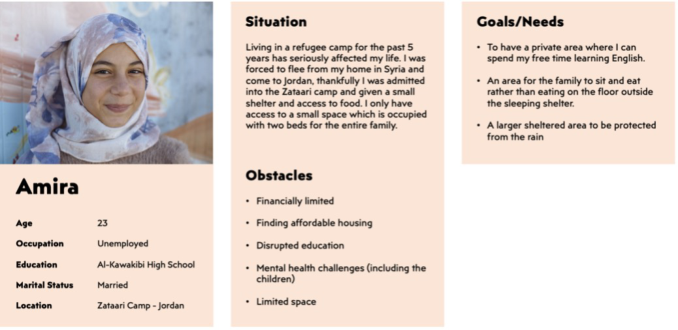
Stage 3: HCD research. In the third stage, the study focused on the explo- ration of human needs in relation to the contextual features portrayed in the seed idea. Persona analyses, economic issues, social instances and design opportunities have been collected to refine the scenario and detail promising design insights – design requirements – to be used in the concept design stage (Figure 1). In addition, case study analyses and cross-sectorial comparisons have been employed to get extended interdisciplinary data in relation to the use of sustainable AM technologies.
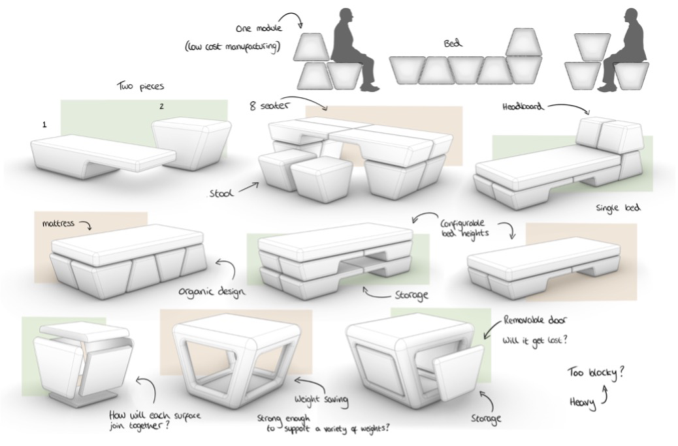
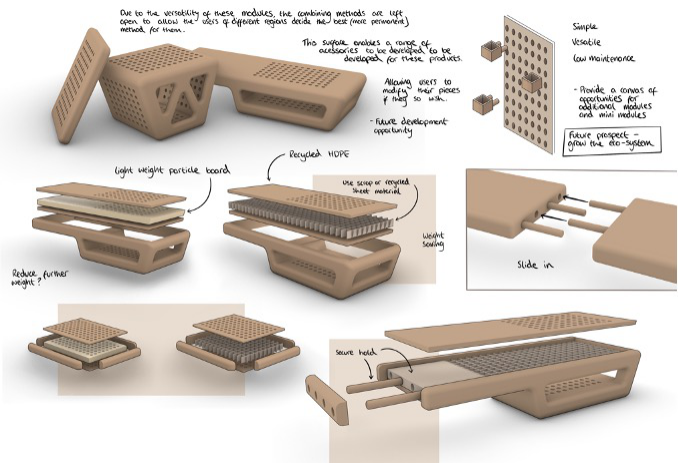
Stage 4: Concept design. A preliminary system of modular elements was created to meet the design requirements proposed in the Stage 3 (Figure 2).
Figure 1: Persona scenario in an UPC in Jordan (research by Zaeem Tahir).Figure 2: Concept design of the inclusive system for UPCs (design by: Zaeem Tahir).
Here, insights belonging to Design for Sustainability, Design for Social Inclu- sion, Ergonomics, and Sustainable Manufacturing were used to address the design of the sustainable modular elements. Specifically, the proposed inclusive concept was intended to:
Be used by those facing financial constraints. Accordingly, the inclu- sive modular system is intended to be both financially inclusive and sustainable.
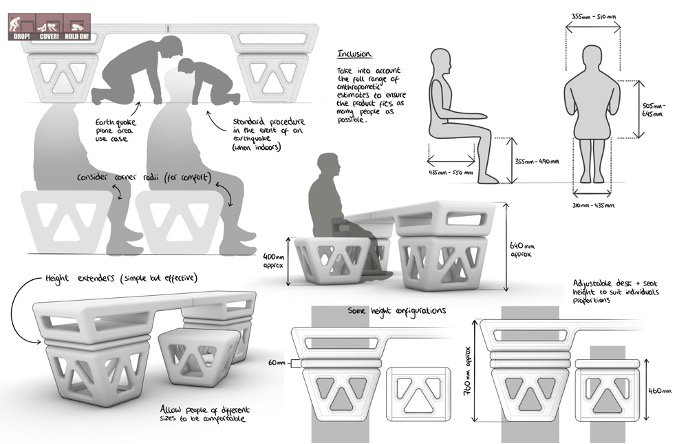
Consider individuals with varying body shapes and abilities. The ele- ments foster usability, flexibility, and multiple configurations by operating simple manipulations – supporting psychophysical inclusion.
3D-Printed Inclusive Modular System for Underprivileged Communities 33
Improve the quality of life of UPCs, including the creation of multiple pro- ducts, such as furniture and architectural elements. This was an inclusive aim needed to move toward inclusive contextual conditions.
Consider sustainable AM technologies for a cost-effective production.
Stage 5: Final design and adaptation to AM technologies. The last deve- lopment stage concerned the adaptation of the inclusive concept design to sustainable AM technologies. In this stage, the project implemented the pre- identified ‘Inclusive 3D Printing’ strategy. An overview of the 3D-printed inclusive modular system is shown in the RESULTS section.
RESULTS
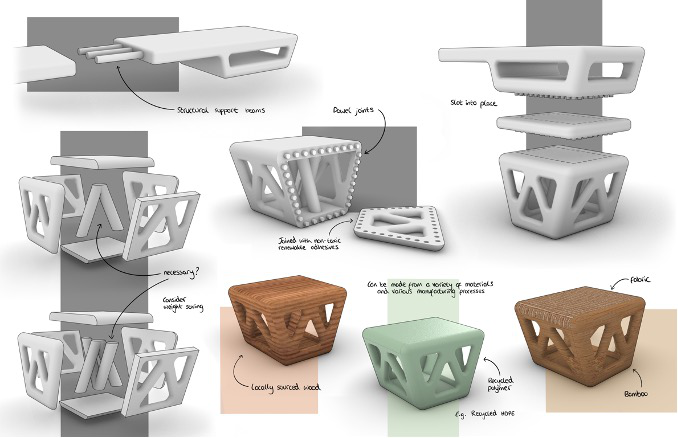
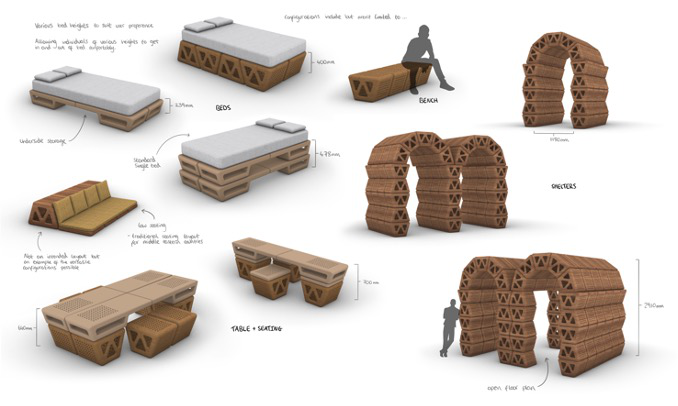
The inclusive modular system is a flexible and cost-effective solution that allows the creation of many furniture systems (Figure 3); it considers both manufacturing potentialities and HCD strategies; an affordable multi- functional solution improving the conditions of people living in UPCs. The system utilises local materials to be locally additively manufactured (Figures 4 and 5), which means that it can be considered as intrinsically sustainable. By using different or regional manufacturing methods, it is possible to create employment opportunities able to build local expertise and local economy.
Inclusive-wide design principles were considered, such as creating a multi- functional solution for people with different body sizes and abilities, different financial status, etc. (Figure 6). Thus, the project allows users to create a personal product that adheres to their specific needs. The innovative factors characterising the project are:
Versatility. The modular system can a flexible furniture system, but also a shelter and a workstation – creating facilities that UPCs lack.
Adaptability regarding manufacturing. Users living in specific regions can create personal accessories for the modules as they want, which means that the system can trigger sustainable business for local communities.
Aesthetics and visual pleasantness. The modular system is simple and allows manufacturers to propose an affordable and durable inclusive set of artefacts.
3D-Printed Inclusive Modular System for Underprivileged Communities 35
The multidisciplinary issues related to UPCs require smart design interven- tions able to meet the instances of the present and future sustainable and inclusive society. Although UPCs are characterized by complex phenomena that require a systemic and scenario-led approach, the Design discipline can play a significant role in coordinating and stimulating the cultural, scienti- fic and technical reflections needed to create enabling products, both at the human scale and at the social one.
The solution presented in this work is a 3D-printed inclusive modular system specifically conceived to mitigate the negative effects generated within UPCs, both in the emerging and developing scenarios (i.e.: refugee camps) and in the western countries (i.e.: slums). It employs modularity, additive manufacturing, contextual resources, and smart design to generate inclusive impacts across disadvantageous scenarios. Accordingly, the use of focu- sed sustainable design strategies for AM, such as use of local tangible and intangible resources, the rapid prototyping, the adherence with HCD and sustainability, and mostly, the use of the new concept of ‘Inclusive 3D Prin- ting, reinforce the cultural and methodological convergence between strategic sectors of the Design discipline – Design for Sustainability and Design for Social Inclusion specifically.
Finally, the proposed 3D-printed inclusive modular system can be conside- red as a meaningful answer to this complex and delicate research framework, which is spreading inequalities across the modern society.
DISCUSSIONS This work has shown the relevance of approaching unsustainable and non- inclusive contextual features by employing advanced and creative design
research strategies, which combine multiple approaches, theories, and recent insights.
In relation to Sustainable 3D Printing, this work provided evidence regar- ding the use of ‘Inclusive 3D Printing’ strategy (Rossi et al, 2021), a recent research line exploring and combining the last records promoted within social science studies with relevant Sustainable 3D Printing theories. Specifically, while the 3D printing industry continues to evolve through a technology- push approach, the opening toward Social Inclusion can open to new research avenues that are qualitatively able to improve the overall design process. Therefore, this work demonstrated that it is possible to rethink the way desi- gners employ AM’s potentialities – through new angles that are more socially oriented, human centered and sustainable. Accordingly, the design results presented in this paper provide methodological evidence and validity on the use of ‘Inclusive 3D Printing’ concept to design new generation of sustainable solutions, which collaterally promote in-dept reflections on the opportunities to make a change, beyond mainstream markets.
ACKNOWLEDGMENT
All authors have equally contributed to the study design and implementa- tion, including material preparation, data collection and results development. Rossi wrote ‘Methodology’ and ‘Results’; Di Nicolantonio wrote ‘Aims’ and ‘Conclusion’; D’Onofrio wrote ‘Abstract’ and ‘Introduction’; Massacesi wrote ‘Discussions’. Authors thank Zaeem Tahir for the valuable contribu- tion provided in the design of the 3D-printed inclusive system shown in the sections ‘Methodology’ and ‘Results’.
REFERENCES
Rossi, E. and Di Nicolantonio, M. (2020) Integrating Human Centred Design Approach into Sustainable-Oriented 3D Printing Systems. Human-Intelligent Systems Integration, 2 (1). pp. 57–73. Rossi, E., Di Nicolantonio, M. and D’Onofrio, A. (2021) 3D Printing and Social
Inclusion: A Design Research Framework. In: Advances in Manufacturing, Produ- ction Management and Process Control. Springer International Publishing, Cham, pp. 68–73. Stringer, E. (2004). Action Research in Education. Upper Saddle River, NJ: Pearson. UNESCO World Water Assessment Programme (2019) The United Nations World Water Development Report 2019: Leaving No One Behind. Paris: UNESCO. United Nations (2015) Resolution adopted by the General Assembly on 25 September 2015, Transforming our world: the 2030 Agenda for Sustainable Development.
LISTED IN THE AHFE DIGITAL BOOKSTORE CATALOGUE
Explore the complete digital volume
Additive Manufacturing, Modeling Systems and 3D Prototyping
Read this individual research paper free through the original publisher, or explore the full digital proceedings book.
ISBN 978-1-958651-10-0
Explore this ISBN in the AHFE Bookstore ↗Listed in the July 2026 bookstore catalogue; search by ISBN to confirm current availability · Digital book purchase optional