Satori Hachisuka, Haojie Li, Yuko Nishiura, Tadamitsu Matsuda, Nobuhiko Haga, Misato Nihei (2026). Applicability of Generative AI in Learning Systems for Assistive Technology Development Personnel Training. In: Training, Education, and Learning Sciences. AHFE Open Access, vol. 231, pp. 170–180. https://doi.org/10.54941/ahfe1008008
This study aims to develop effective personnel training methods for assistive technology development, which requires collaboration among members from multiple professional fields. We generated video materials and an interactive learning support tool using generative Artificial Intelligence (AI) and Retrieval-Augmented Generation (RAG), which draws on the same knowledge database. We conducted a questionnaire survey involving a trial of the prototype system to confirm its applicability. In the survey, 31 participants freely used a learning system prototype to view video materials and try out generative AI support tools. According to the survey results, 83.9% of participants watched all video materials, and 58.1% interacted with generative AI via text. Regarding the prototype try-out, the usefulness question received an average rating of 4.1 on a 5-point scale. The question of whether participants would like to use such an AI system in the future received an average rating of 4.0. The results suggested that our learning system was an acceptable way to acquire foundational knowledge.
In developing assistive technology for people with disabilities, it is crucial to assemble a team with diverse expertise and experience (World Health Organization, 2011). This is because it is necessary to appropriately address the wide range of needs arising from the individual differences in disability types, physical and mental functional characteristics, and living environments. Against this backdrop, a coordinator is indispensable for understanding evaluation criteria such as the safety and marketability of assistive technology, and for supporting the appropriate selection of personnel, team formation, and the smooth operation of the team (Dougherty, 1992). In particular, previous initiatives have made it clear that the required competencies are wide-ranging. These include the ability to facilitate information sharing within teams comprising healthcare and welfare professionals as well as
Applicability of Generative AI in Learning Systems 171 device development engineers; leadership to drive assistive technology development activities; a broad perspective encompassing expertise across different industries (Nishiura, 2023); and the ability to identify challenges from the perspectives of both assistive technology users and developers (Meiland, 2002).
However, in the current field of assistive technology development, there is a shortage of personnel capable of serving as coordinators, and the specific knowledge, experience, and skills required of such coordinators have not been clearly defined. Consequently, no established methods exist for training coordinators, and knowledge and skills are currently passed down only when experienced coordinators are available within the immediate environment. Given this situation, it is difficult to develop safe, highly useful assistive devices that are optimized for individual needs at the appropriate time.
To address this challenge, we are developing an educational program to train coordinators who can provide appropriate advice and make sound judgments at each stage of assistive technology development, and who can also manage cross-industry collaboration and team-based approaches.
RESEARCH ISSUES AND PURPOSE In developing an educational program to train assistive technology development coordinators, we have been examining appropriate teaching methods through interviews and surveys (Hachisuka, 2023). In developing an educational program to train assistive technology development coordinators, we have been examining appropriate teaching methods through interviews and surveys. The study revealed a high demand for video-based and e-learning programs for acquiring foundational knowledge that does not involve practical skills. Many professionals involved in assistive technology development often work on new product development while continuing their regular duties in fields such as healthcare and welfare or industrial development. Consequently, the study found significant interest in video- based and e-learning programs that allow individuals to freely adjust their study schedules.
Therefore, we aimed to build a prototype of a new learning system that utilizes generative AI to help users acquire the foundational knowledge required across multiple specialized fields relevant to assistive technology development, and to evaluate its potential for practical application. We established a plan to implement the newly developed learning system by combining video-based instructional materials—the need for which was identified in our prior research—with learning support functions that utilize interactive dialogue with AI. However, there were two challenges in realizing this plan. The first is that creating instructional materials is difficult in assistive technology development, which involves many practical elements and requires specialized knowledge and learning content spanning multiple disciplines. Second, it was unclear whether the learning system developed in this study would be applicable to personnel training.
In light of these circumstances, we set the objectives of this study as follows: first, to build a versatile platform that can generate learning materials from existing resources, focusing on areas without established textbooks; and
second, to verify whether an e-learning system using these materials enables learners to acquire foundational knowledge effectively.
CONFIGURATION OF THE PROTOTYPE LEARNING SYSTEM We have established that providing learners with support based on accurate, secure information is a guiding principle for the development of e-learning systems. With interactive generative AI systems that leverage widely available large language models (LLMs), there are concerns about the accuracy and safety of the information provided to learners, including inaccuracies in information sources, hallucinations, and copyright issues (Kalai, 2025). Therefore, in this study, we developed a system that combines the generation of original e-learning video materials using Retrieval-Augmented Generation (RAG)—based solely on information sources curated by educators operating the e-learning system—with learning support provided by an LLM closely integrated with those same sources.
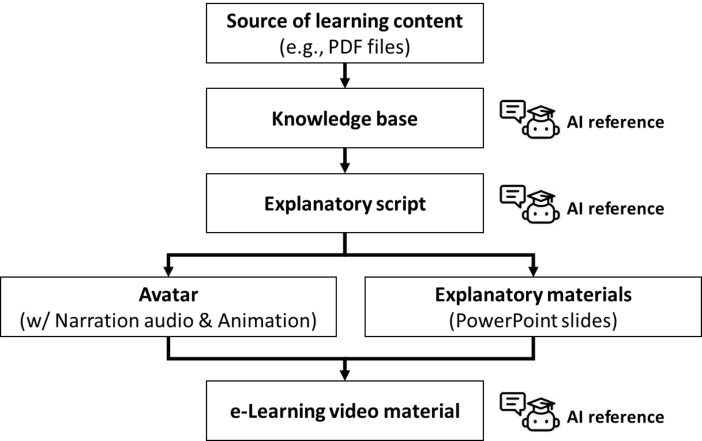
Specifically, we adopted our previous research reports on assistive technology development as an accurate source of learning content for this study. We constructed a knowledge base from the contents of these reports and used it as the foundation of the learning system. Using the knowledge base as a foundation, we first generated explanatory scripts for e-learning video materials. These scripts serve as the content read aloud by the avatar narrator in the video materials. Furthermore, we built an interactive learning support AI using an LLM that leverages RAG, referencing the knowledge base and explanatory scripts. This proprietary AI can provide information based on the knowledge base and explanatory scripts in response to learners’ text- based questions, as well as generate review questions (see Figure 1). Details regarding each component of the prototype system are described below.
Figure 1: The process of e-learning video generation and the role of AI reference information. Intermediate data generated from the source data serves as reference data for the AI-powered learning system.
Applicability of Generative AI in Learning Systems 173 Knowledge Base Creation
The knowledge base that serves as the foundation for the learning system described in this paper was generated based on three reports from prior research conducted by the authors. These reports summarize research conducted from 2022 to 2024 on the monitoring and evaluation of assistive device development, as part of the Comprehensive Research Project on Disability Policy funded by the Ministry of Health, Labour and Welfare’s Scientific Research Grant-in-Aid. The reports consist of 81, 67, and 35 pages, respectively (Nihei, 2022–2024). Specifically, the PDF files of each report were converted to Markdown, preserving the document’s heading structure— such as chapters, sections, and subsections. This allowed the documents to be treated as text data while maintaining their hierarchical structure. Next, the converted text was segmented to generate chunks that serve as search units. We used the text-embedding-3-large (OpenAI) as the embedding model and vectorized each chunk to enable searches based on semantic similarity. For the search method, we adopted a hybrid search combining vector search and full-text search, and further designed the system to extract information more relevant to user queries by performing re-ranking using a Rerank model. By retrieving the top two search results (Top-k = 2) and setting the score threshold to 0.7, we ensured the accuracy of the context used for answer generation. Through this process, we generated a knowledge base comprising 25 pieces of information from each report.
e-Learning Video Creation Using Generative AI The video content consisted of presentation slides accompanied by a narrator providing verbal explanations, a format commonly used in general online learning materials. First, based on the aforementioned knowledge base, we generated an explanatory script in colloquial language to serve as the narration for the verbal explanations. Specifically, we used OpenAI’s generative AI model, GPT-4o (OpenAI), to generate the explanatory script using the Markdown-formatted text data we prepared as the knowledge base. In the prompt, we explicitly instructed the model to ensure accuracy by basing the text solely on the knowledge base, to provide explanations for technical terms as needed, to use a conversational style that is easy for learners to understand, and to maintain a logical paragraph structure that aligns with the slide layout.
Next, based on the explanatory script, we generated an avatar to serve as the narrator. We generated the narration audio using HeyGen (HeyGen Inc.), and for the visual component, we used GPT-4o to create a female avatar with an anime-style appearance. We designed it to include a blank 16:9 area within the background so that the presentation slides described later could be overlaid. As a result, the avatar providing the commentary moves its mouth, hands, and neck in sync with the audio file as it delivers the explanation.
Furthermore, the explanatory materials were created by generating PowerPoint slides using Gamma (Gamma Tech, Inc.) based on the narration script, and the layout, font size, and other elements were manually adjusted to improve readability.
Finally, using the video editing software CapCut (ByteDance), we created a video that combined the narrator avatar with the presentation slides.
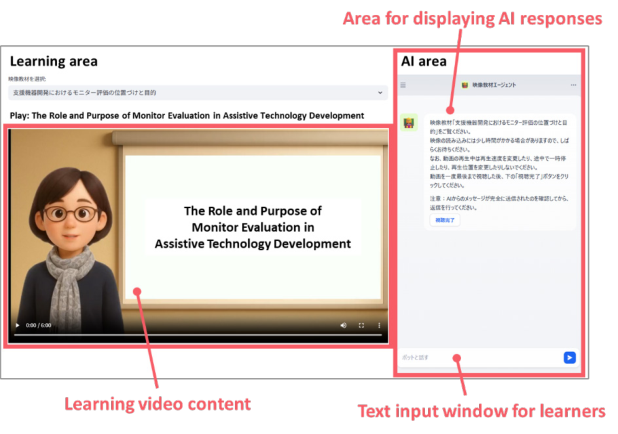
Each video was approximately 5 minutes long per unit. The video length was determined based on findings from prior research (Guo, 2014), which suggests that 6 minutes is the optimal length for on-demand educational materials. Figure 2 shows the appearance of the learning system.
The e-learning video materials generated by combining the components described above enable the retrieval of multifaceted answers to questions about the video’s information, as the knowledge base, explanatory script, and reference slides are linked to timestamps in the generated video.
Figure 2: Appearance of the AI-powered learning system. Learners can watch instructional videos in their browser and ask the AI questions or seek advice by typing text. (Display in Japanese during the experiment).
Interactive Learning Support Using Generative AI The learning system developed in this paper aims to deepen learners’ understanding by enabling them to interact with the AI via text input after watching the aforementioned e-learning videos. Therefore, we will describe the details of the learning support AI developed in this study.
We adopted OpenAI’s GPT-4o as the generative AI model. Furthermore, to enhance search functionality using RAG, we incorporated OpenAI’s text-embedding-3-large model to vectorize and search tokens derived from document data. We designed the system to deliver these features and content to learners via a Streamlit (Snowflake Inc.) browser interface.
With this configuration, the developed learning system can provide learners with the following features:
- Answers to questions regarding keywords in video contents - Providing time stamps for recommended re-viewing segments within the video for unclear points
- Providing excerpted video clips of recommended re-viewing segments for unclear points - Answers from the knowledge base when the video does not contain a response to the question - Providing information on external sources (e.g., report titles, URLs) - Generating comprehension questions (number of questions can be specified) - Generating correct answers and explanations for comprehension questions
EXPERIMENT METHOD To assess the applicability of our original e-learning system—designed to teach foundational knowledge regarding assistive technology development— we had potential users test the system and conducted a survey on its usability and their motivation to learn. We conducted this experiment with the approval of the University of Tokyo Ethics Review Committee (Approval No. E2025ALS111).
Recruitment of Experimental Participants We recruited experiment participants for the learning system developed in this study primarily from healthcare and social welfare professionals, using snowball sampling. For recruitment, we utilized mailing lists of medical and welfare-related academic societies and various community mailing lists. The target users are not limited to medical and welfare professionals. However, since the learning system we developed includes information on the process of assistive technology development, we defined the target users as those with a basic understanding of assistive technology. The participants voluntarily joined the experiment.
Participants Experience Experiment participants experienced the e-learning system trial following the procedure below: (1) Participants voluntarily accessed the trial URL provided in the participant recruitment email. (2) They accessed the Google Forms, read the explanation of the trial, and submitted their consent to participate. (3) They entered their basic information (occupation, years of experience in their current position, gender, and prior experience in assistive technology development). (4) They read the instructions for using the learning system and accessed the learning system URL. (5) They watch the e-learning video materials. (6) After finishing the video, participants freely ask questions or communicate with the AI via text input in the AI learning support area. (7) After completing the trial, they return to the Google Forms and answer the 5-question survey. The survey questions and response formats are shown in Table 1.
Table 1: The survey questions and response formats.
Table available in the original PDF paper.
Survey Questions Response Formats (Q1) Have you watched the provided video content? Three choices
(Q2) Have you interacted with the AI via text? Two choices (Q3) Do you think this AI system is helpful for acquiring Five-point Likert scale basic knowledge?
(Q4) Would you like to continue using this type of AI system
Five-point Likert scale
in the future?
(Q5) What features you think would be useful in an
Free-text answer
AI-powered learning system like this?
DATA ANALYSIS Survey Responses
Regarding the survey results, for questions requiring respondents to select from a list of options, we calculated the percentage of respondents who chose each option. For questions with options assigned numerical scores (such as a Likert scale), we calculated the average score for each question. Additionally, for free-text answers, we established categories using a bottom-up approach based on the content provided and quantified the frequency of each category’s occurrence.
Conversation With Generative AI During the trial of this learning system, we examined the types of interactions participants had with the generative AI. We extracted the text- based exchanges between the generative AI and learners recorded in Dify (LangGenius, Inc.)—the platform that manages the workflow of the learning system we developed—and analyzed the content participants entered. For the analysis, we established categories using a bottom-up approach based on all participants’ inputs and calculated the percentage of participants in each category.
RESULTS AND CONSIDERATIONS Participants Basic Information
We finally recruited 31 participants for the experiment. The gender breakdown of the participants was 83.9% male (26 participants) and 16.1% female (5 participants). The occupational breakdown was 77.4% physical therapists, 19.4% occupational therapists, and 3.2% manufacturing industry employees. Regarding the participants’ years of experience in their current positions, 12.9% had less than 5 years, 22.6% had 5 to less than 10 years, 16.1% had 10 to less than 15 years, 22.6% had 15 to less than 20 years, and 25.8% had 20 or more years. Furthermore, regarding experience in assistive technology development, 29.0% had participated in such projects, while 71.0% had not; thus, the majority had never been involved.
Applicability of Generative AI in Learning Systems 177 Survey Results
The survey results are summarized below. In response to the question regarding whether participants watched the e-learning video materials during this trial of the learning system (Q1), 83.9% reported watching them all the way through, 9.7% reported stopping partway through, and 6.5% reported not watching them at all. Next, regarding whether participants engaged in text-based interactions with the AI (Q2), 67.6% responded that they did, while 32.3% responded that they did not. However, upon reviewing the logs of text-based interactions with the generative AI, 58.1% had entered text at least once, while 41.9% had not. This suggests that individual learners may perceive interactions with generative AI differently. Nevertheless, it is clear that more than half of the participants engaged in dialogue with the generative AI during the trial.
Next, when asked whether they believed the AI system tested in this study would be helpful for acquiring basic knowledge, participants rated their responses on a 5-point Likert scale (1: Not at all helpful to 5: Very helpful) (Q3). The average score across all participants was 4.1 (SD = 0.72). Furthermore, regarding whether they would like to continue using such an AI system in the future, the average score for all participants on a 5-point Likert scale (1: Not at all likely to use it – 5: Very likely to use it) (Q4) was 4.0 (SD = 0.80). These results suggest that the learning system developed in this study is expected to be applicable for the acquisition of basic knowledge.
Furthermore, the free-text answers (27 valid responses) to the question about desired features in an AI-powered learning system (Q5) were categorized into the nine items shown in Table 2. These results reveal that, in addition to high expectations for generative AI to understand learner characteristics and provide tailored responses, there is also a strong expectation for the expansion of adjustment functions that empower learners to take the initiative.
Table 2: Categories of desired features in an AI-powered learning system.
Table available in the original PDF paper.
Categories of Desired Features Frequency of Category Occurrence Personalized feedback 22.2%
Enhanced instructional content 18.5% Improved usability and visibility 11.1%
11.1%
Customization options based on individual characteristics and preferences Provide review quizzes 11.1%
Explanations on how to use the AI 7.4% Features to make asking questions easier 7.4%
Expansion of AI knowledge base 7.4% Support for questions regarding diagnosis and rehabilitation 3.7%
Results of Conversations With generative AI In interactions between the generative AI and participants, participants entered text an average of 1.7 times. Furthermore, as shown in Table 3, the content of participants’ text entries was categorized into eight items.
Table 3: Categories of text entered by participants during conversations with generative AI and the percentage of participants in each category.
Table available in the original PDF paper.
Categories of Text Entered by Participants Percentage of Participants Questions about the learning material 44.4%
Personal impressions 38.9% Requests to summarize key points 11.1%
Confirmation of key points 11.1% Questions unrelated to the learning material 11.1%
Requests for review questions 5.6% Questions about how to use the system 5.6%
Comments regarding the user interface 5.6% When calculating the percentage of participants by category to determine what types of utterances (text input) each participant made, the results showed that 44.4% asked questions about the learning content, and 38.9% entered their impressions. Note that in some cases, the same participant submitted multiple entries within the same category; however, in such instances, they were counted as a single participant for that category. These results indicate that among the 18 participants who submitted text input this time, questions regarding the learning content were the most common.
CONCLUSION AND FUTURE WORK In this study, we prototyped an e-learning system to effectively train assistive technology development coordinators, for whom it is difficult to provide comprehensive educational opportunities. The first challenge addressed in this study is the difficulty in creating instructional materials due to the interdisciplinary nature of the specialized knowledge and learning content, as well as the high degree of practicality involved. To address this, we added the RAG function to generative AI and built a system capable of autonomously generating e-learning materials from reports and documents related to the assistive technology development field. The ability to generate slides and explanations from document materials, such as Portable Document Format (PDF) files, is becoming available in other systems as well, such as Google’s NotebookLM (Google). However, in our system, we have devised a method to further enhance learners’ understanding by aligning the knowledge from the source documents and the video material with the AI system itself. The architecture of this system allows the generation of various e-learning materials by simply changing the source documents, making it a valuable tool for future coordinator training.
Applicability of Generative AI in Learning Systems 179 The second issue to be addressed in this paper is the evaluation of the applicability of the learning system developed as a prototype. In this study, we conducted a questionnaire survey following a trial of the learning system, with 31 participants—primarily healthcare and welfare professionals—who were the intended users. The survey results confirmed that the learning system has the potential to help users acquire basic knowledge of assistive technology development and left a positive impression, with many expressing a desire to use it. The additional features requested in the questionnaire survey included learning support tailored to the learner’s individual characteristics, as well as an expansion of options that learners can adjust according to their own preferences.
Going forward, we will explore ways to incorporate the additional features and learning support methods identified in this study into the system. Through repeated prototyping with prospective learners, we aim to build a learning system suitable for practical use. Regarding the learning content, we will also expand it to include content specifically tailored to coordinators. Furthermore, we will strengthen collaboration with workshops and classroom sessions, which are currently being developed as a training program for assistive technology development coordinators. In the future, we aim to improve the effectiveness and accelerate the development of assistive technology, thereby contributing to the independence of people with disabilities.
ACKNOWLEDGMENT
This research was conducted with support from grants JPMH21GC1001, JPMH23GC1003, and JPMH24GC1016 from the Ministry of Health, Labour and Welfare (MHLW).
capcut.com/ja-jp/ Dougherty, Deborah. (1992). Interpretive barriers to successful product innovation in large firms. Organization Science, 3(2), pp. 179–202. Gamma Tech, Inc. (2026). Gamma (Build Version: cf8rmljm8) [AI generator tool].
https://gamma.app/ Google. (2026). NotebookLM (Build Version: 853388154) [AI tool]. https:// notebooklm.google.com/ Guo, P. J., Kim, J., Rubin, R. (2014), “How video production affects student
engagement: an empirical study of MOOC videos”, Proceedings of the first ACM conference on Learning @ scale conference, pp. 41–50. Hachisuka, S., Nihei, M., Ishii, A., Moriyama, H., Uchida, T., Shirogane, S., Nishijima, K. (2023), “Consideration of human resource development method in monitoring evaluation of assistive devices for persons with disabilities”, Proceedings of the 64th Annual Conference of Japan Ergonomics Society, P2E1-06. (in Japanese) HeyGen Inc. (2025). HeyGen (October 2025 Release) [AI generator tool]. https://
www.heygen.com/
Kalai, A. T., Nachum, O., Vempala, S. S., Zhang, E. (2025), “Why Language Models Hallucinate”, arXiv, 2509.04664. LangGenius, Inc. (2026). Dify (Version: 1.32.1) [Open-source platform]. https://dify.
ai/ Meiland, F. J. M., Hattink, B. J. J., Overmars-Marx, T., de Boer, M. E., Jedlitschka, A., Ebben, P. W. G., Stalpers-Croeze, Ir I. N. W., Flick, S., van der Leeuw, J., Karkowski, I. P., Dröes, R. M. (2014). Participation of end users in the design of assistive technology for people with mild to severe cognitive problems; the European Rosetta project. International Psychogeriatrics. 26 (5), pp. 769–779. Nihei, M., Nishijima, K., Ishii, A., Moriyama, H., Uchida, T., Shirogane, S., Hachisuka,
S. (2022, 2023), “Research on the Development of Monitor Evaluation Methods for Assistive Technology for People with Disabilities and the Development of a Training Program to Cultivate Personnel Capable of Conducting Monitor Evaluations”, in Research Report of the Health Labour Sciences Research Grant (PI: Misato Nihei) (in Japanese). Nihei, M., Haga, N., Matsuda, T., Nishiura, Y., Hachisuka, S. (2024), “Research to Support the Development of a Training Program for Coordinators of Assistive Technology for Persons with Disabilities”, in Research Report of the Health Labour Sciences Research Grant (PI: Misato Nihei) (in Japanese). Nishiura, Y., Matsuda, T. (2023), “Clarifying the skills and knowledge required of
coordinators”, in Research Report of the Health Labour Sciences Research Grant (PI: Misato Nihei) (in Japanese). Open AI. (2024). GPT-4o (January 2024 Release) [AI model]. https://openai.com/ ja-JP/index/hello-gpt-4o/ Open AI. text-embedding-3-large [Embedding model]. https://developers.openai.
com/api/docs/models/text-embedding-3-large Snowflake Inc. (2025). Streamlit (Version: 1.52.0) [Open-source framework]. https:// streamlit.io/ World Health Organization. (2011). World report on disability. WHO Press.
LISTED IN THE AHFE DIGITAL BOOKSTORE CATALOGUE
Explore the complete digital volume
Training, Education, and Learning Sciences
Read this individual research paper free through the original publisher, or explore the full digital proceedings book.
ISBN 979-8-950676-07-9
Explore this ISBN in the AHFE Bookstore ↗Listed in the July 2026 bookstore catalogue; search by ISBN to confirm current availability · Digital book purchase optional