Satori Hachisuka, Kayoko Kurita, Shinichi Warisawa (2023). Relationship between preference for the existence of teacher images and learning effects in online learning for junior high school students. In: Training, Education, and Learning Sciences. AHFE Open Access, vol. 109, pp. 22–28. https://doi.org/10.54941/ahfe1003147
This research focuses on online learning, which has rapidly become widespread in recent years, and shows the results of examining the ideal way of showing teacher images in online learning content. The purpose of this study is to clarify the impact of teacher images on the learning effect. We showed the knowledge retention rate verification results up to one month after the quiz with 53 junior high school students. We conducted five quizzes with multiple choices as pseudo-online learning content without interactivity as an experimental method. We also divided the participants into two groups, one group provided content with a teacher image on the screen, and the other was not. As an index of the learning effect, we adopted the percentage of entirely correct answers in the analysis, and comparisons were made at three different timings (1) during the experiment, (2) immediately after the experiment, and (3) one month later. The entirely correct answer means the correct answer after understanding the reason for the correct explanation of the quiz. As a result, there was no clear relationship between the presence or absence of teacher images and the learning effect. It indicates that displaying the teacher image does not directly affect the knowledge retention rate. However, on the other hand, we found that the knowledge retention continued even after one month when the preference for the existence of the teacher image and the actual display matched. Furthermore, even when the preference for the presence of the teacher image and the display matched, the knowledge retention rate after one month was significantly higher in the group with the teacher image display than in the group without the presence. These results suggested that the learning effect may be seen in the matching between the preference for the existence of the teacher image and the actual presented content.
In recent years, classes adopting an online style have begun in various grades. In Japan, due to the spread of COVID-19, the use of Information and Com- munication Technology (ICT) in education using tablet teaching materials at
Relationship Between Preference for the Existence 23
elementary schools has accelerated. At universities, face-to-face, online, and hybrid lectures will continue to be adopted depending on the situation.
Mayer (2001) suggested the recommended direction and posture of the tea- cher’s body in online classes. Bhat et al. (2015) are researching how teachers project as a demonstration experiment using Massive Open Online Course (MOOC), which are actual online education sites. As a result, the students prefer the teacher image as the superimposed display to the picture-in-picture display. On the other hand, some studies also suggested that the teacher’s pro- jecting style does not affect the comprehension of the class content. Pi et al. (2017) studied the size of the teacher image projected on display for MOOC students. The results showed that learners performed better with the smaller size of the teacher’s picture. In addition, Goh et al. (2017) and Colliot and Jamet (2018) show that the presence or absence of teacher images does not affect the learning effect from experiments on university students. With the spread of COVID-19, many studies, such as Yates et al. (2021) and Ng et al. (2021), have been conducted on the influence of teacher images on learning in online education, and the result information is beginning to be shared. How- ever, the ideal state of teachers has not yet been established. Furthermore, no research examples propose teachers’ responses that match individual online learners’ characteristics.
Our previous research surveyed the display of teacher images on online learning screens, mainly for graduate students in 2020, when most uni- versities introduced online lectures due to the spread of infectious diseases worldwide. As a result, we found that only 14% of graduate students prefer to display teacher images. According to the interview, the reason was that the teacher image was a factor that hinders attention to learning (Hachisuka et al. 2021). On the other hand, a similar survey of 53 junior high school stu- dents revealed that 45% of the experiment participants preferred to display teacher images. The percentage was three times as many as graduate students. Thus, there might be a relationship between the age group and the prefere- nce for the teacher images existence (Hachisuka et al. 2021). Therefore, we next focused on the relationship between the preference for the existence of teacher images and the learning effect. In this paper, we examined the lear- ning effect based on long-term retention of learning content in matching the learner’s preference and the teacher image existence of video content.
EXPERIMENT METHOD This study used videos, including quiz questions and explanations, to simu- late online teaching materials. We prepared videos with and without the teacher’s image. Then, we measured the correct answer rate of the quiz and the degree of comprehension of the explanation in the group who watched each video. Details of the experimental setup are given below.
Participants The experimental participants were 53 healthy junior high school students, 68% male, and 32% female. The grade composition was 43% in the first year of junior high school (7th grade), 40% in the second year (8th grade),
and 17% in the third year (9th grade). Since junior high school students are 12 to 15 years old and are minors, they were allowed to participate in the experiment voluntarily after obtaining parental consent.
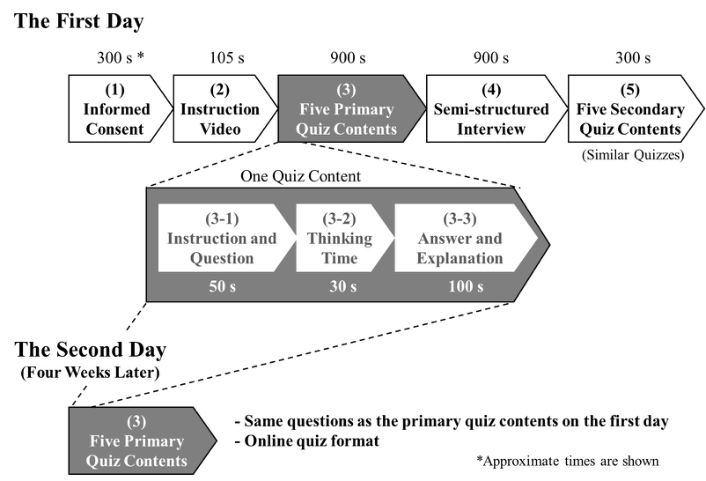
Procedure Participants’ tasks consisted of two days, with a four-week interval between the first and second days. On the first day, in an environment facing the experimenter, we conducted the following steps: (1) Informed consent, (2) An instruction of the experiment, (3) Quizzes (primary), (4) Semi-structured interview, and (5) Similar quizzes (secondary) (see Figure 1).
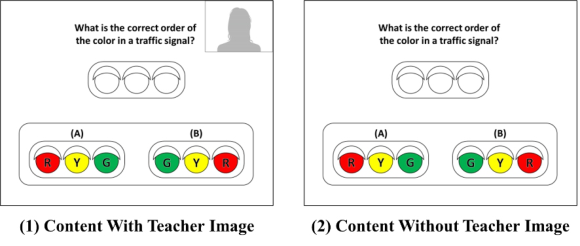
We prepared and played the video content, including (2) An instruction of the experiment and (3) Quizzes (primary) of the first day as imitated online teaching material. We prepared two types of videos, one with and one with- out the teacher image (see Figure 2). Each participant was set to watch one of them. The only difference between the two videos was the presence or absence of the teacher image as visual information, and the same material was used for the audio data. In addition, each quiz in the part of (3) Quizzes (primary) on the first day is divided into three components shown in Figure 1: (3-1) Instruction and quiz questions, (3-2) Thinking and answering time, and (3-3) Correct answers and explanations. In viewing (3-3) Correct answers and explanations, the participants understood the correctness of their answers and how to solve the quizzes.
On the second day, we asked participants to answer the same questions online as (3) Quizzes (primary) conducted on the first day. At that time, we
Figure 1: We experimented according to this procedure. The four-week interval was set between the two-day experiment.
Relationship Between Preference for the Existence 25
Figure 2: The two types of displayed quiz content examples (Japanese was used in actual).
also asked them whether they remembered the contents of the explanations on the first day. The teacher’s image was set not to be displayed in the online quiz content. On the second day, we designed the experiment to be performed four weeks after the investigation on the first day.
We conducted this experiment with the approval of the University of Tokyo Ethics Review Committee (Approval No. 21-123).
Quiz Contents We conducted five questions each in the primary and secondary quiz parts. The contents of the quizzes were designed to be answered based on common sense or on-the-spot inspiration since the strengths and weaknesses of the participants in the school subjects refrain from directly affecting them. For example, we asked about the order and reasons for the three colors of stan- dard traffic lights. The participants in the experiment chose one option that they thought was the correct answer from among two to four options and orally answered the question along with the reason for the choice. The order of the questions presented was counterbalanced among the participants.
Data Analysis Regarding the correctness of the answer to the quiz, in addition to the correct choice, the case where the reason for selecting the option was also valid was defined as an entirely correct answer. This definition excludes cases where the correct answer was given by chance without knowing the right reason. This paper used the percentage of correct answers to quizzes that conformed to this definition as an index for data analysis.
We classified the preference data based on the responses obtained during the semi-structured interviews, regardless of whether the content was provi- ded with or without a teacher image at the time of the experiment, for the preference for the presence or absence of the teacher’s image. In addition to the preference, we used the information on the presence or absence of pre- sentation of teacher images during the experiment. To compare the correct answer rate between each quiz time, 46 people who answered all the quizzes, including four weeks later, were analyzed.
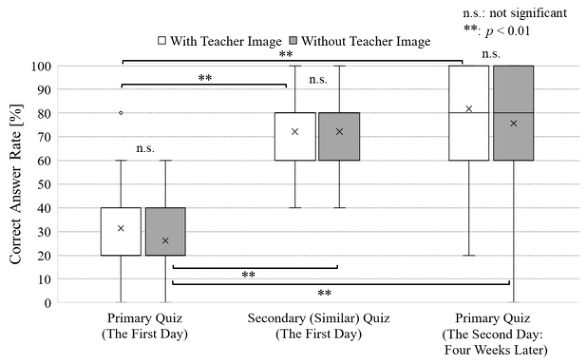
RESULTS AND CONSIDERATION First, Figure 3 compares the average percentage of correct answers to quizzes with and without the presence of a teacher image. As a result of verifying the difference in the average rate of correct answers by the t-test for each group with and without a teacher image at each timing of quiz implementation shown on the horizontal axis, no significant difference was observed between the groups at any time. This result suggests that the presence or absence of the teacher image does not affect the learning effect. On the other hand, Scheffe’s multiple comparison test confirmed significant differences at a significance level of 1% (p < 0.001) between the primary quiz on the first day and the other two quizzes in each group.
Next, Figure 4 compares the average rate of correct answers based on whether or not each participant’s preference for the presence or absence of
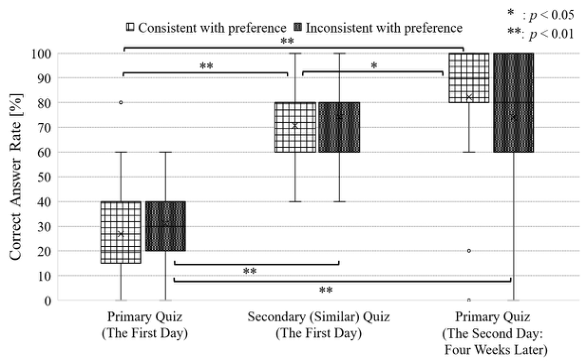
Figure 3: Correct answer rates according to the teacher image existence.Figure 4: Correct answer rates by preferences for the existence of teacher images.
Relationship Between Preference for the Existence 27
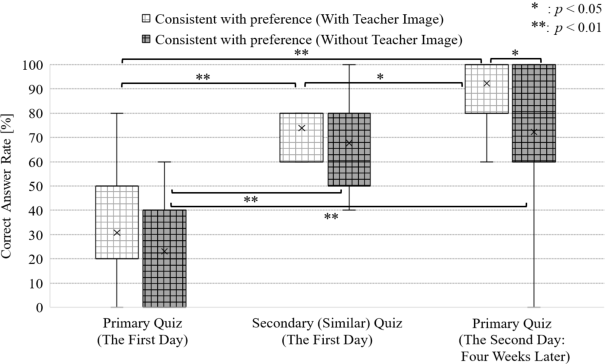
Figure 5: Correct answer rates in the group whose preference for the presence of the teacher image matched the displayed contents.
a teacher image and the content presented during the experiment matched. According to Scheffe’s multiple comparison test, the results found that the correct answer rate improved over time when the display method fit the participants’ preferences at a significance level of 1% (p < 0.001) and 5% (p = 0.03), respectively.
Finally, Figure 5 shows the results of comparing the group with and with- out the teacher’s image among the group in which the preferences of the participants and the content display method matched. This result shows that when the learner’s preference and the display method of the learning content were matched, the learning effect continued to improve after four weeks with the teacher’s image. Furthermore, comparing the correct answer rate of each group after four weeks by the t-test, the group presented with the teacher image had a significantly higher correct answer rate at a significance level of 5% (t (24) = 2.14, p = 0.04).
CONCLUSION AND FUTURE WORK From the results of this paper, the presence or absence of the teacher’s image in the learning content possibly improve the learning effect by adjusting it to the learner’s preference. Since the continuity of the learning effect was higher with the teacher image presence, we believe that it is necessary to incorporate into the learning content a device that will make the learner prefer the teacher’s image display. In future work, we will increase the age groups and characteristics of learners and learning contents and proceed with a more detailed examination.
REFERENCES
Bhat, S., Chinprutthiwon, P., and Perry, M. (2015). Seeing the Instructor in Two Video Styles: Preferences and Patterns, Proceedings of the 8th International Conference on Educational Data Mining, Madrid, Spain, June 26-29, pp. 305–312.
Colliot, T. and Jamet E. (2018). Understanding the effects of a teacher video on learning from a multimedia document: an eye-tracking study, Educational Technology Research and Development, 66, pp. 1415–1433. Goh, W. W., Nyub, E., Won, S. Y., and Lim, C. L. (2018). The Importance of Teacher’s
Presence and Engagement in MOOC Learning Environment: A Case Study, Miri, Malaysia, November 16-17, 2017 IEEE Conference on e-Learning, pp. 127–132. Hachisuka, S., Kurita, K., Warisawa, S. (2021). Confirmation of the Significance of Facial Images in Online Learning Using Eye Gaze Tracking Measurement, Vir- tual, June 14-18, The 21st Triennial Congress of the International Ergonomics Association (IEA 2021), pp. 595–599. Hachisuka, S., Kurita, K., Warisawa, S. (2021). The Eye Gaze Features and Preference
of Teacher Image Existence in Junior High Students During Online Learning, Real & Virtual Hybrid, March 7-9, 2022 IEEE 4th Global Conference on Life Sciences and Technologies (LifeTech 2022), pp. 418–419. Mayer, R. E. (2001). Multimedia Learning, Cambridge University Press, United Kingdom. Ng, Y. Y., and Przybyeek, A., Instructor Presence in Video Lectures: Preliminary
Findings From an Online Experiment. Pi, Z., Hong, J., and Yang J. (2017). Does instructor’s image size in video lectures affect learning outcome?, Journal of Computer Assisted Learning, 33, pp. 347–354. Yates, A., Starkey, L., Egerton, B., and Flueggen, F. (2021). Technology, Pedagogy,
and Education, 30 (1), pp. 59–73.
LISTED IN THE AHFE DIGITAL BOOKSTORE CATALOGUE
Explore the complete digital volume
Training, Education, and Learning Sciences
Read this individual research paper free through the original publisher, or explore the full digital proceedings book.
ISBN 978-1-958651-85-8
Explore this ISBN in the AHFE Bookstore ↗Listed in the July 2026 bookstore catalogue; search by ISBN to confirm current availability · Digital book purchase optional