Stefano Filippi, Franco Zuliani, Francisco Daniel Montoya Buteler (2022). Generative Design and 3D Printing to Develop a Hi-tech Cartesian Cutting Machine for Non-metallic Materials. In: Additive Manufacturing, Modeling Systems and 3D Prototyping. AHFE Open Access, vol. 34, pp. 54–61. https://doi.org/10.54941/ahfe1001589
This paper describes the development of a Hi-tech Cartesian cutting machine for non-metallic materials in the laser converting field. The challenge stands in developing a better machine than the existing ones by speeding up the cutting process, allowing more formats of the material to cut and increasing versatility to better respond to different applications. Since extremely high accelerations, specific materials, sophisticated component shapes, critical mechanical properties, etc., are involved and required, state-of-the-art design tools, belonging to the collaborative design paradigm, come in real help to actors owning different competencies. Generative design allows defining the components of the core of the machine and 3D printing helps in evaluating the results in terms of dimensions, assembly, workspaces, etc. Other than starting to reach the expected result, this study highlights the added value of the design tools involved as well as some limitations and related expectations about possible upgrades of them in the future.
Day by day, Hi-tech R&D goes challenging technological limits to satisfy market requirements in terms of product quality, production performances, time-to-market, design flexibility, etc. Moreover, novel collaborative design paradigms allow interdisciplinary activities where scientists, digital modeling experts, technicians, etc., interact easily and effectively, aiming at developing innovative, outstanding products.
The University of Udine and the ENDICO Srl R&D studio are carrying on the development of a Hi-tech Cartesian cutting machine for non-metallic materials (Bottin et al., 2021). Although many examples are already on the market, the challenge stands in making a better machine than existing ones by speeding up the cutting process, allowing more formats of the material to cut and increasing the versatility in order to better respond to different appli- cations. Ultimately, the aim is to design an affordable machine with equal or higher performances than the competitors’ in order to access the market with a winning product.
Generative Design and 3D Printing to Develop a Hi-tech Cartesian Cutting Machine 55
Since extremely high accelerations, specific materials, sophisticated com- ponent shapes, critical mechanical properties, etc., are involved and required, state-of-the-art design tools, belonging to the collaborative design para- digm, come in real help to actors owning different competencies. At the beginning, designers follow the generative approach to shape definition (Buonamici et al., 2020). Generative design modules of current 3D modeling software packages allow defining the components of the core of the machine. Materials engineers and technicians proceed with the evaluation of the results in terms of dimensions, assembly, workspaces, etc., thanks to the involve- ment of manufacturing technologies like 3D printing (Gibson et al., 2015). Mechanical engineers and digital modeling experts perform finite element analysis (Kalaiyarasan et Sundaram, 2021) for additional evaluations focused on fatigue, wear, etc.
Other than starting to reach the expected results, this study highlights the added value of the design tools involved as well as some drawbacks and expectations about possible upgrades of them in the future.
Regarding the document structure, the following section summarizes the materials and methods used to carry on the research. After that, the activities to develop the machine are described. The results and discussion about them, together with some conclusions, close the paper.
MATERIALS AND METHODS
Laser Converting The laser converting considered here refers to the manufacturing processes of everything related to the transformation of paper, closely linked to the packaging industry. Nowadays, almost every product from all kinds of mar- kets needs some sort of packaging with different sizes and materials. In this context, in which different field applications interact, paper laser converting industry needs to provide machines with high performances and flexibility.
The state of the art of the current machines shows two major technologies: Cartesian cutting machines (Bottin et al., 2021) and galvo head cutting mach- ines (Vazquez-Martinez et al., 2021). Cartesian cutting machines are cheaper but have lower performances in terms of productivity; the galvo head ones show increased productivity but are very expensive.
In order to enter the market with a competitive machine, the partnership University of Udine - ENDICO Srl is developing a Cartesian cutting machine showing performances comparable to the galvo head cutting machines, all of this with the help of cutting-edge technologies such as generative design and 3D printing.
Generative Design Generative design (GD) is an emerging approach to the shape definition of industrial products (Filippi et al., 2022; Aameri et al., 2019). GD defines shapes from scratch, being able to consider requirements about materials, safety factors, manufacturing processes and, more importantly, mechanical properties. Once described the problem to solve (the shape definition) by
setting the condition values, the GD algorithms generate a set of solutions, all of them obeying to those conditions. Then, designers and engineers apply their skill and knowledge in selecting those solutions embodying the opti- mum from their points of view. In this particular application, GD allowed engineers and designers to get the embodiment of all the functions required to the components in a quite satisfactory way.
3D Printing Additive manufacturing is the formal term for what is used to be cal- led rapid prototyping and what is popularly called 3D printing. The term rapid prototyping is used in a variety of industries to describe a process for rapidly creating a system or part representation before final release or commercialization (Gibson et al., 2015).
During the experience described in this paper, designers and engine- ers use the fused deposition modeling (FDM) 3D printing technology (Liu et al., 2019) to create the physical representation of what they consi- der the most promising and feasible results from several GDs. The polylactide (PLA), a thermoplastic polyester, is the material used; its characteristics allow validation from the dimensional/aesthetical point of view only. Further prints will occur using materials closer to the final ones (steel, aluminum, titanium, etc.) and those prototypes will allow mechanical properties verifications to be performed; for now, finite element analysis is used instead.
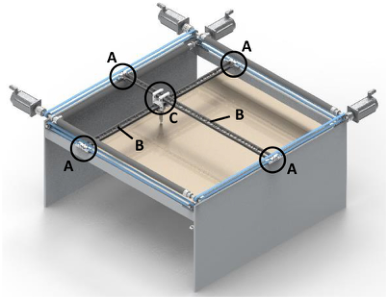
RESEARCH ACTIVITIES The main ideas behind the research are to prefer a Cartesian plotter mech- anism instead of a galvo head and the exploitation of relative movements between the cutting tool and the material to cut (both move during the cut- ting process). Starting from this, the focus moves on the development of three main components of the machine core: the clamp, the arm and the support. As figure 1 shows, four clamps (A) connect two arms (B) to the outer moving gear; the support (C), fixed at the intersection of the two arms, moves the cut- ting tool on the material to cut, moving as well in the meantime. The design of the three components contributes to the highlighting of added values and criticalities of GD and 3D printing.
What follows describes the two phases of the development: the GD for shape definition and the evaluation of the results thanks to the 3D printing.
GD for Shape Definition Designers and engineers use the GD modules of the 3D modeling software packages easily and effectively. They appreciate the possibility to focus the attention to the characteristics of the results in terms of dimensions, mecha- nical properties, performances, manufacturability, etc., rather than spending their effort in the shape definition, delegated to the GD algorithms. The GD adoption brings also some added value to the project by allowing “obsolete” technologies (the Cartesian plotter mechanism) returning to the stage and competing against more recent ones (the galvo head) by obtaining more or less the same performances but at lower costs. Here, all of this occurs thanks
Generative Design and 3D Printing to Develop a Hi-tech Cartesian Cutting Machine 57
Figure 1: The machine core with highlights on the components considered in the research: the clamps (A), the arms (B) and the support (C).
to the mass optimization and to the accurate material selection made avai- lable by the GD. Also, the inner nature of GD makes finite element analysis (FEA) of the final models less used than in traditional design experiences. The guarantee that the resulting models will respect loads and constraints represents surely another GD plus, being FEA expensive and time consuming.
Nevertheless, some criticalities emerge during the development of the components, both generally speaking and locally.
Regarding the GD criticalities common to the definition of all the compo- nents, designers and engineers clash against the impossibility to assign loads to portions of surfaces rather than to whole ones. The need to apply loca- lized loads on larger surfaces cannot be satisfied. Again, another important limitation is the impossibility to assign more than one acceleration (gravity). At the same time, there is also the impossibility to deal with aesthetic mat- ters during the condition setting. Moreover, although the GD results (when available, i.e., when the algorithms converge) respect all the conditions impo- sed, there are doubts about the real manufacturability of them using the final materials and processes. Other than this, doubts exist also about the conve- nience to use GD instead of classic design paradigms in terms of design time and effectiveness. Moreover, sometimes the user interface of the GD modules is lacking in clarity. For example, during the condition setting, forces, pres- sures, etc., are represented ambiguously and this leads to misunderstandings. Also, GD algorithms manage the materials used in this research as isotro- pic even if they are not since the arms are designed to be made in carbon fiber material and their mechanical properties depend on the manufacturing processes of the raw material. While designers and engineers can deal with dependencies on the manufacturing process of the design result, they expect that the intrinsic material anisotropy is managed by the GD algorithms as well. Finally, although the GD module shows “3D printing” among the allo- wed technology to choose, it does not allow specifying the kind of technology (i.e., FDM,Selective Laser Melting, etc.). This prevents from seconding at best the peculiarities and requirements of the different technologies.
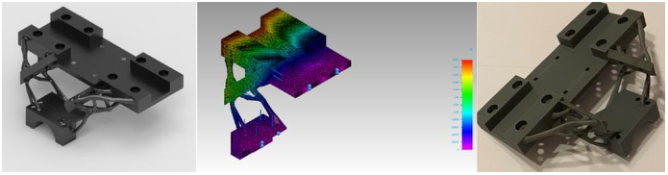
Regarding the clamp, although GD gives a fundamental contribution to the definition of the shape, the resulting model appears as suitable for 3D printing only, since that morphology would be too complex to manufacture using conventional processes. Moreover, some doubts arise about the mechanical properties, mainly about the stiffness, doubts which are partially confirmed by the FEA.
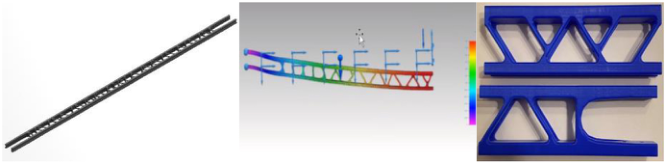
Arm GD is particularly hard. Other than respecting the requirements, the challenge is to gain as much symmetry as possible although loads and constraints are not symmetric due to the limitations in the way they are imple- mented in the GD module. All of this in order to guarantee a symmetric behavior of the arm in all the possible load conditions. Also, a nonsym- metric arm could lead, in the long-time use, to a non-homogenous wear and therefore to unpredictable failures. Three GDs are required with condi- tion refinements throughout. This is the case where designers and engineers more suffer the impossibility to control symmetries in the results directly at condition setting time.
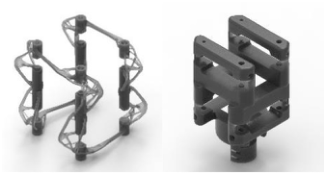
Regarding the development of the support, for now, classic design activities are preferred to GD. This because, although the GD result appears as intere- sting from the mechanical properties and lightness points of view, the missing symmetries make machining requirements too complex to satisfy. Moreover, computational failures of the GD algorithm force to consider only the upper half of the support devoted to the connection to the two arms; the lower half, the shell for the cutting tool, is neither present nor there are features to fix the result of the GD to it.
3D Printing to Evaluate the Results Once the shape definition of the components reaches the end, the B_rep models are translated into triangle meshes and the STL files encoding them are processed using a dedicated software package. The resulting g-code is used as input for a Creality Ender_3 printer (Creality Ender_3 3D printer). There are not big differences in generating the physical representation of four clamps, two arms and one support regarding the effectiveness of the 3D printing role in the research. The resulting prototypes allow reasoning about dimensions, assembly procedures, working spaces, etc.
Clearly, the use of the FDM technology and, as a consequence, that of the PLA material makes evaluations about performances almost impossible. FEA, multiphysics simulation, etc., are still required and this makes the design time longer, harder and more expensive. Moreover, 3D printing cannot be of help to study the real behavior of the machine because it does not build the components as a whole (they are too big); joining the printed sections intro- duces bias in the measurements. Also, the specific technology used is very slow, much slower than the computation of the shapes by the GD algori- thms. Therefore, the bottleneck in evaluating the results on the way is in the generation of the physical representation of the components rather than in the definition of their shapes. Finally, the communication between the GD module and the software package to prepare the jobs for 3D printing is con- sidered as a suboptimal experience. Designers and engineers face problems
Generative Design and 3D Printing to Develop a Hi-tech Cartesian Cutting Machine 59
Figure 2: Clamp: the digital model of the GD result (left), the FEA evaluation (center) and the physical representation from 3D printing (right).Figure 3: Arm: the digital model from the GD (left), the FEA evaluation (center) and the physical representation of two sections from 3D printing (right).Figure 4: Support: the digital model from the GD (left) and the result of the classic design without the GD involvement (right).
in selecting the tessellation (translation of the models into triangle meshes) parameters to minimize the loss of information and in loading the STL files in the dedicated software package (models appear as wrong scaled and with bad orientations).
RESULTS AND DISCUSSION
At the time of writing, the design process is still on the way. Nevertheless, the digital model of the machine core is complete and available, prototypes of many components are printed to perform the first evaluations focused on dimensions as well as aesthetics; FEA starts validating the design results from the mechanical point of view. Figures 2, 3 and 4 show several representati- ons of the design results regarding the three components considered in this research: the clamp, the arm and the support, respectively.
Digital and physical models of the components start demonstrating that the goals the research aimed at are going to be reached. Thanks to the choice
Table 1. Summary of GD and 3D Printing added value and limitations highlighted during the machine development.
Table available in the original PDF paper.
Design tool Added value Limitations
coarse definition of loads and constraints
GD
focus on performances rather than on shape definition
no control on aesthetics
“obsolete” technologies competitive again
doubts about real manufacturability of the results
accurate material selection
FEA less crucial
doubts about convenience of GD over classic design approaches
poor UX sometimes
poor management of anisotropic materials
scarce attention to peculiarities and requirement of different 3D printing technologies
symmetries impossible to control
complex geometries rarely converge to a solution 3D printing
easy to use
impossibility to reason about performance
FEA, multiphysics simulation, etc. still required
reasoning about dimensions, assembly procedures, working spaces, etc.
size of objects limited by the 3D printer workspace
FDM 3D printers very slow
translation into STL difficult to control
for a Cartesian plotter mechanism instead of a galvo head and to the relative movements between the cutting tool and the material to cut, cutting seems 100% faster in average than that of the competitors on the market; allowed material formats are 20% more in average (with an improved flexibility in selecting different formats on the fly instead of having them fixed at assembly time) and the machine appears as suitable for more applications instead of being bounded to very specific ones. Finally, the machine cost on the market should be comparable to that of the competitors.
Table 1 summarizes the added value of GD and 3D printing as well as their limitations as emerged during the machine development.
Those limitations lead to expectations about possible improvements. A deep investigation about them will be meaningful once the machine develo- pment reaches the end; nevertheless, some of them could be seen as follows. Regarding the GD, possible improvements could be the ability to manage complex geometries, loads and constraints (e.g., symmetries, accelerations, aesthetics, etc.), the consideration of more parameters devoted to the pro- duction technologies and more attention to UX matters. 3D printing could be improved thanks to a smoother communication between GD modu- les and dedicated software packages to prepare the jobs for 3D printing.
Generative Design and 3D Printing to Develop a Hi-tech Cartesian Cutting Machine 61
Starting from a different file format than the STL like the 3MF (3MF file format) could help in avoiding information loss and obtaining the goal.
CONCLUSION
The research described in this paper aimed at developing a Hi-tech Cartesian cutting machine for non-metallic materials using Generative Design and 3D Printing. Current results, although they represent - both digitally and phy- sically - only the first development stage of the core of the machine, start demonstrating the goodness and effectiveness of the design tools and meth- ods involved. At the same time, the research highlighted some limitations and some corresponding suggestions for possible improvements in their future development.
Next activities will carry on the development of the machine to exploit the added value of GD and 3D printing as well as investigate about other tools and methods to boost product innovation even more. Among the others, digital twins and an AI-driven control system will be considered and critically evaluated similarly to what happened for GD and 3D printing.
REFERENCES
3MF file format: https://3mf.io/. Last accessed 02/02/2022 Aameri, B., Cheong, H., Beck, J.C., 2019. Towards an ontology for generative design of mechanical assemblies. AO 14, 127–153. https://doi.org/10.3233/AO-190207 Bottin, M., Cipriani, G., Tommasino, D., Doria, A., 2021. Analysis and Control of
Vibrations of a Cartesian Cutting Machine Using an Equivalent Robotic Model. Machines 9, 162. https://doi.org/10.3390/machines9080162 Buonamici, F., Carfagni, M., Furferi, R., Volpe, Y., Governi, L., 2020. Generative Design: An Explorative Study. CADandA 18, 144–155. https://doi.org/10.14733/cadaps.2021. Creality Ender_3 3D printer: https://www.creality3dofficial.com/products/officialcreality-ender-3-3d-printer. Last accessed 02/02/2022 Filippi, S., Robiony, M., Tel, A., Montoya Buteler, F.D., 2022. Limitations of
Using Generative Design for Maxillo-Facial Reconstructive Surgery Applications, in: Rizzi, C., Campana, F., Bici, M., Gherardini, F., Ingrassia, T., Cicconi, P. (Eds.), Design Tools and Methods in Industrial Engineering II, Lecture Notes in Mechanical Engineering. Springer International Publishing, Cham, pp. 801–808. https://doi.org/10.1007/978-3-030-91234-5_81 Gibson, I., Rosen, D.W., Stucker, B., 2015. Additive manufacturing technologies: 3D printing, rapid prototyping and direct digital manufacturing, Second edition. ed. Springer, New York; London. Kalaiyarasan, A., Sundaram, S., 2021. Finite element analysis of beam with
different loading condition. Materials Today: Proceedings 43, 2189–2193. https://doi.org/10.1016/j.matpr.2020.12.112 Liu, Z., Wang, Y., Wu, B., Cui, C., Guo, Y., Yan, C., 2019. A critical review of fused deposition modeling 3D printing technology in manufacturing polylactic acid parts. Int J Adv Manuf Technol 102, 2877–2889. https://doi.org/10.1007/s00170- 019-03332-x Vazquez-Martinez, J.M., Illana, I.D.S., Arrien, E.U., Batista, M., Salguero, J., 2021.
Laser surface texturing as a finishing process for aerospace alloys. Advanced Machining and Finishing.
LISTED IN THE AHFE DIGITAL BOOKSTORE CATALOGUE
Explore the complete digital volume
Additive Manufacturing, Modeling Systems and 3D Prototyping
Read this individual research paper free through the original publisher, or explore the full digital proceedings book.
ISBN 978-1-958651-10-0
Explore this ISBN in the AHFE Bookstore ↗Listed in the July 2026 bookstore catalogue; search by ISBN to confirm current availability · Digital book purchase optional