Jia Xiaoyu, Chien-Hsiung Chen (2022). Effects of Social Cues on Robot’s Gaze and Head Rotation on Users’ Perception. In: Human Factors in Robots, Drones and Unmanned Systems. AHFE Open Access, vol. 57, pp. 10–18. https://doi.org/10.54941/ahfe1002304
The social cues embodied by social robots may greatly affect people’s impressions of them, thereby affecting the human-robot interaction (HRI) experience. This study focuses on the impact of two social cues on participants’ impressions in human societies, i.e., robot eyes blinking and head rotating. The conclusion was generated as follows: (1) The social cues of social robots in specific scenes included rotating head or blinking eyes, can improve participants’ perception of robots on anthropomorphism, animacy, likeability and perceived intelligence. (2) The social cues of robots will attract the attention of visitors to a certain extent, leading them to follow the robot on the tour. (3) At the same time, the ability to attract attention is limited. On the one hand, social robots need to have more social cues to bring people a feeling of being alive and intelligent. On the other hand, according to different usage scenarios, the attributes of social cues should also be different.
Currently, service robots or social robots have been applied in many situati- ons, such as hospitals, shopping malls, and hotels, etc. In anthropological and sociological research, it has been found that social cues, especially nonverbal social cues (NVSCs), can affect a series of different human reactions and sub- jective judgments (Gilboa-Schechtman and Shachar-Lavie, 2013). In general, the perception of NVSCs can be divided into faces (expressions, gaze and head tilt) (Todorov et al. 2013), voices and bodies.
In the field of robotics, social cues also dynamically bring huge differences in the experience of human-robot interaction (HRI). The interaction between humans and robots is usually dynamic, therefore, the social cues displayed by the robot should belong to a dynamic HRI. For example, social robot spe- ech (Torre and White, 2021), facial expression changes (Danev et al. 2017), extended gaze (Fiore et al. 2013), head rotation or tilt (Mara and Appel, 2015), Even the different personalities displayed (Salem et al. 2015; Robert, 2018). These are no different from the characteristics of real human beings. Study shows that tilt robot head has been found to look more human- like and cutter than upright robot head (Mara and Appel, 2015), even if the social robots were static. Studies have also shown that more complex and detailed social cue feedback, such as head tilting and nodding, can lead to
Effects of Social Cues on Robot’s Gaze and Head Rotation on Users’ Perception 11
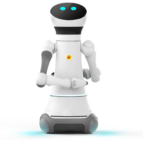
Figure 1: Service Robots Provider in UAE. (Brain Quest, 2018).Figure 2: Navigation robot for the experiment.
participants’ more positive feedback (Liu et al. 2012). Besides, social gaze or eyes interaction has a significant positive effect to HRI (Zaga et al. 2017). Appropriate robot eye gaze improves task efficiency and conveys robot emo- tions (Ruhland et al. 2015). Despite this, there is still little research on the impact of social cues displayed by robots in specific dynamic scenarios on participants’ perceptions.
METHODS
The purpose of this study was to explore the influence of social cues shown on service robots on human perception and evaluation. The experiment was conducted with a 2×2 mixed two-way ANOVA design, the research variables were robot eyes (i.e., eyes blinking vs no eyes blinking) and the robot head rotation (i.e., head rotating vs no head rotating). The robot eyes were the within-subjects factor, the head rotation was the between-subjects factor.
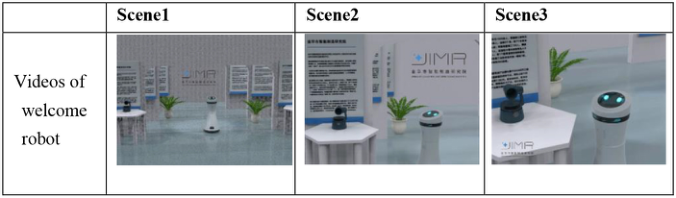
Participants and Materials A total of 24 participants were invited by convenience sampling (12 males and 12 females); the number of participants with smart robot experience was 45.8%. In addition, the main age distribution of the participants was 19-30 years old (75%). The experiment was designed as a virtual guide scene, and the service robot and scene are presented on the computer screen in the form of virtual ani- mation. The participants needed to sit in front of the computer and observe the three scenes in turn. Participants were randomly assigned to one of the groups in the experiment. We referred to the service robot in Figure 1 and designed the experimental robot which was shown in Figure 2. The video was divided into 3 parts, including scene1, scene2 and scene3 (see Figure 3). Among them, the scene1 content of each group of videos was the same. As the introduction of each video, the robot will welcome the participants to visit the research institute.
12 Xiao-Yu and Chien-Hsiung
Figure 3: Introduction videos of service robot (introducing Jinhua Intelligent Manufa- cturing Research Institute).
Procedure The experimental process of this study was as follows:
Step1: Fill in the basic information. The participant needed to complete the basic personal information.
Step2: Calibration of the eye tracker. Then they needed to calibrate the eye tracking device after sitting down in front of the screen in the fixed position.
Step3: Observe the videos of virtual robot to visit the exhibition hall of a research institute. The participant needed to follow the guidance of the virtual robot to visit the exhibition hall of a research institute. They did not need to operate, just watch the video, while the eye-tracking device records their eye movements. Each participant needed to watch 2 videos in turns.
Step4: Subjective evaluation questionnaire. At the end of each video, the experimenter would ask them to fill out a subjective evaluation questionnaire (Bartneck, Croft and Kulic, 2008) pertinent to this video. A 5-point Likert Scale was adopted for the questionnaire in which 1 represented most disagree and 5 indicated most agree.
It should be noted that in the treatment of the experimental group, the eyes and head rotation of the robot would move according to the voice of the robot, as if the robot would see the operation of the participant (Kelley, 1984).
RESULTS
The collected data were analyzed using a mixed two-way analysis of variance (ANOVA) in SPSS with the robot head as the within-subjects factor, and the robot eyes as the between-subjects factor. The significant value α was set to 0.05.
The perceptions of service robot scores on Anthropomorphism The main effect of the robot eyes (F = 12.778, P = 0.002 < 0.01) and robot head (F = 18.772, P = 0.000 < 0.01) were both significant on Anthropomor- phism. The robot with eyes blinking (M = 4.28, SE = 0.11) was significantly more humanlike than the robot with no eyes blinking (M = 3.49, SE = 0.16). The robot with head rotating (M = 4.39, SE = 0.11) was significantly more humanlike than the robot with no head rotating (M = 3.49, SE = 0.16) (see Table 1).
Effects of Social Cues on Robot’s Gaze and Head Rotation on Users’ Perception 13
Table 1. The mixed two-way ANOVA of Anthropomorphism score.
Table available in the original PDF paper.
Source SS df MS F P Post Hoc
0.333 1 0.333 0.650 0.429
Robot eyes 5.672 1 5.672 12.778 0.002** eyes blinking > no eyes blinking Robot head 9.630 1 9.630 18.772 0.000** head rotating > no head rotating Robot head Robot eyes
* Significantly different at α = 0.05 level (*P < 0.05). ** Significantly different at α = 0.01 level (**P < 0.01).
Table 2. The mixed two-way ANOVA of Animacy score.
Table available in the original PDF paper.
Source SS df MS F P Post Hoc
0.630 1 0.630 2.291 0.144
Robot eyes 1.687 1 1.687 2.902 0.103 Robot head 9.630 1 9.630 35.007 0.000** head rotating > no head rotating Robot head Robot eyes
* Significantly different at α = 0.05 level (*P < 0.05). ** Significantly different at α = 0.01 level (**P < 0.01).
Table 3. The mixed two-way ANOVA of Likeability score.
Table available in the original PDF paper.
Source SS df MS F P Post Hoc
0.001 1 0.001 0.002 0.963
Robot eyes 1.021 1 1.021 3.651 0.069 Robot head 3.101 1 3.101 8.046 0.010* head rotating > no head rotating Robot head Robot eyes
* Significantly different at α = 0.05 level (*P < 0.05). ** Significantly different at α = 0.01 level (**P < 0.01).
The Perceptions of Service Robot Scores on Animacy The main effect of the robot head was significant on Animacy (F = 35.007, P = 0.000 < 0.01). The robot with head rotating (M = 4.20, SE = 0.12) was significantly more animacy than that of the robot with no head rotating (M = 3.34, SE = 0.15) (see Table 2).
The Perceptions of Service Robot Scores on Likeability The main effect of the robot head was significant on Likeability (F = 8.046, P = 0.010 < 0.05). The robot with head rotating (M = 4.44, SE = 0.10) was significantly more liked than the robot with no head rotating (M = 3.93, SE = 0.13) (see Table 3).
The Perceptions of Service Robot Scores on Perceived Intelligence The main effect of the robot head was significant on Perceived Intelligence (F = 5.024, P = 0.035 < 0.05). The robot with head rotating (M = 4.23,
14 Xiao-Yu and Chien-Hsiung
Table 4. The mixed two-way ANOVA of Perceived Intelligence score.
Table available in the original PDF paper.
Source SS df MS F P Post Hoc
0.120 1 0.120 0.268 0.610
Robot eyes 0.563 1 0.563 2.041 0.167 Robot head 2.253 1 2.253 5.024 0.035* head rotating > no head rotating Robot head Robot eyes
* Significantly different at α = 0.05 level (*P < 0.05). ** Significantly different at α = 0.01 level (**P < 0.01).
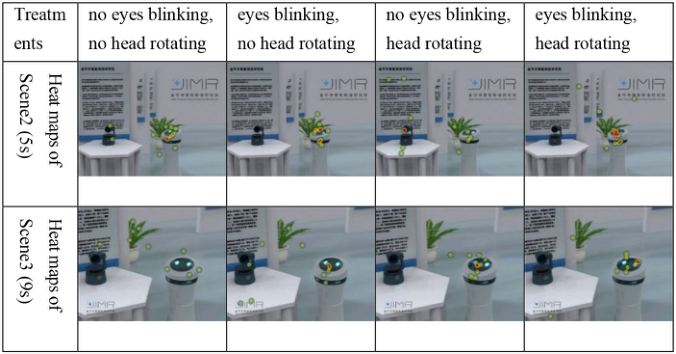
Figure 4: The heat maps of four treatments at several key points.
SE = 0.13) was significantly more intelligent than the robot with no head rotating (M = 3.79, SE = 0.12) (see Table 4).
The Heat Maps and Average Fixation Time of Eyetracking Data The time of four key frames of scene2 and scene3 was selected to analyze the heat maps and average fixation time of different treatments. These nodes were all where the robot blinked or rotated its head.
It could be seen from the heat map that when the robot was explaining, the participants’ attention was relatively concentrated. Especially when the robot could both blink and rotate its head, the participants’ attention was mostly focused on the robot’s head and face compared to the robot without any movement, so the color reaches red (see Figure 4).
The robot was divided into 3 areas of interest (AOI), including AOI001 (the robot’s display or face), AOI002 (the middle part that can rotate), and AOI003 (other parts) (see Figure 5).
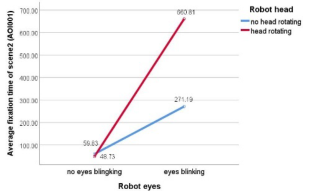
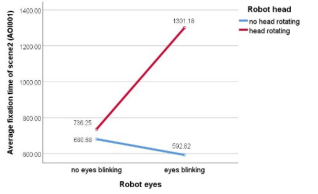
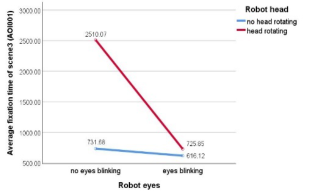
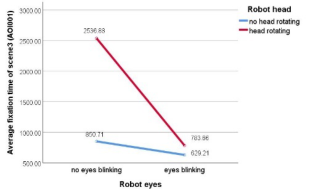
The results of average fixation time showed that the main effect of the robot eyes and robot head were both significant on average fixation of scene2 and scene3 (see Table5 and Table 6). In addition, there was a significant inte- raction between the robot head and the robot eyes of scene2 (see Figure 6 and Figure 7).
Effects of Social Cues on Robot’s Gaze and Head Rotation on Users’ Perception 15
Figure 5: Example of areas of interest (scene2-eyes blinking, head rotating).Table 5. The mixed two-way ANOVA of Average fixation time on scene 2.
Table available in the original PDF paper.
Measurements AOI001 (5s) AOI001 (12s) Robot eyes F 1869.65 51.49 P 0.000** 0.000**
Average fixation time
Robot head F 142.61 140.18 P 0.000** 0.000** Robot head Robot eyes F 159.82 102.36 P 0.000** 0.000**
* Significantly different at α = 0.05 level (*P < 0.05). ** Significantly different at α = 0.01 level (**P < 0.01).
It could be seen that at the fifth second of scene2, the robot without head rotating and blinking (M = 59.83) received slightly higher attention than the robot with head rotating and no eyes blinking (M = 48.73). The robot with head rotating and blinking (M = 660.81) received higher attention than the robot without head rotating but blinking (M = 271.19) (see Figure 6). At the twelfth second of scene2, the robot with head rotating but no eyes blinking (M = 736.25) received higher attention than the robot without rotating head and blinking (M = 680.68). The robot with eyes blinking and head rota- ting (M = 1301.18) received higher attention than the robot without head rotating (M = 592.82) (see Figure 7).
At the ninth second of scene3, the robot with head rotating and without eyes blinking (M = 2510.07) received higher attention than the robot with- out head rotating and without eyes blinking (M = 731.68). The robot with head rotating and blinking (M = 725.85) received higher attention than the robot without head rotating but eyes blinking (M = 616.12) (see Figure 8). At the fifteenth second of scene3, the robot with head rotating but no eyes blinking (M = 2536.88) received higher attention than the robot without head rotating and without eyes blinking (M = 850.71). The robot with head rotating and eyes blinking (M = 783.66) received higher attention than the robot without head rotating but eyes blinking (M = 629.21) (see Figure 9).
DISCUSSIONS From the experimental results, it is not difficult to find that the social cues of social robots in specific scenes, such as rotating their heads or blinking their eyes, can improve participants’ perception of social robots to a certain extent, such as anthropomorphism, animacy, likeability and perceived intelligence.
16 Xiao-Yu and Chien-Hsiung
Table 6. The mixed two-way ANOVA of Average fixation time on scene 3.
Table available in the original PDF paper.
Measurements AOI001 (9s) AOI001 (15s) Robot eyes F 644.81 1383.24 P 0.000** 0.000**
Average fixation time
Robot head F 936.94 758.95 P 0.000** 0.000** Robot head Robot eyes F 731.79 525.58 P 0.000** 0.000**
* Significantly different at α = 0.05 level (*P < 0.05). ** Significantly different at α = 0.01 level (**P < 0.01).
Figure 6: The interaction of Average fixation time of scene2 (AOI001-5s).Figure 7: The interaction of Average fixation time of scene2 (AOI001-12s).Figure 8: The interaction of Average fixation time of scene3 (AOI001-9s).
This study sets up a social robot simulation in an institute’s exhibition hall, and it is believed that if we apply the scenario to other similar scenarios, the results will be similar.
At the same time, the social cues embodied by these robots will also attract the attention of visitors to a certain extent, leading them to follow the robot
Effects of Social Cues on Robot’s Gaze and Head Rotation on Users’ Perception 17
Figure 9: The interaction of Average fixation time of scene3 (AOI001-15s).
on the tour. Of course, the results also show that the ability to attract atten- tion is limited. On the one hand, social robots need to have more social cues to bring people a feeling of being alive and intelligent. On the other hand, according to different usage scenarios, the attributes of social cues should also be different. For example, directing visitors to pay more attention to the exhibits or the exhibition hall environment, etc.
CONCLUSION AND FUTURE IMPLICATIONS The generated results are as follows: (1) The social cues of social robots in specific scenes included rotating head or blinking eyes, can improve partici- pants’ perception of robots on anthropomorphism, animacy, likeability and perceived intelligence. (2) The social cues of robots will attract the attention of visitors to a certain extent, leading them to follow the robot on the tour. (3) At the same time, the ability to attract attention is limited. On the one hand, social robots need to have more social cues to bring people a feeling of being alive and intelligent. On the other hand, according to different usage scenarios, the attributes of social cues should also be different.
This study also has some limitations. There are many social cues, and this study only involves eyes blinking and head rotating. In addition, the usage scenarios of robots can be more universal, which will be reflected in further research. The results of this research can be used as a pre-test experiment to further explore the improvement of HRI interaction by social cues.
REFERENCES
Bartneck, C., Croft, E., & Kulic, D. (2008). Measuring the anthropomorphism, animacy, likeability, perceived intelligence and perceived safety of robots. Brain Quest (2018). Interacion Federation of Robotics. Retrieved from: https://www.brainquest.org/service-robots-1. Danev, L., Hamann, M., Fricke, N., Hollarek, T., & Paillacho, D. (2017). Develo-
pment of animated facial expressions to express emotions in a robot: RobotIcon. In 2017 IEEE Second Ecuador Technical Chapters Meeting (ETCM), 1–6. Fiore, S. M., Wiltshire, T. J., Lobato, E. J., Jentsch, F. G., Huang, W. H., & Axelrod, B.
(2013). Toward understanding social cues and signals in human–robot interaction: effects of robot gaze and proxemic behavior. Frontiers in psychology, 4, 859. Gilboa-Schechtman, E., & Shachar-Lavie, I. (2013). More than a face: a unified theoretical perspective on nonverbal social cue processing in social anxiety. Frontiers in human neuroscience, 7, 904.
18 Xiao-Yu and Chien-Hsiung
Kelley, J. F. (1984). An iterative design methodology for user-friendly natural language office information applications. ACM Transactions on Information Systems, 2(1), 26–41. Liu, C., Ishi, C. T., Ishiguro, H., & Hagita, N. (2012). Generation of nod-
ding, head tilting and eye gazing for human-robot dialogue interaction. In 2012 7th ACM/IEEE International Conference on Human-Robot Interaction (HRI) (pp. 285–292). Mara, M., & Appel, M. (2015). Effects of lateral head tilt on user perceptions of humanoid and android robots. Computers in Human Behavior, 44, 326–334. Robert, L. (2018). Personality in the human robot interaction literature: A review
and brief critique. In Robert, LP (2018). Personality in the Human Robot Intera- ction Literature: A Review and Brief Critique, Proceedings of the 24th Americas Conference on Information Systems, Aug (pp. 16–18). Ruhland, K., Peters, C. E., Andrist, S., Badler, J. B., Badler, N. I., Gleicher, M., ... & McDonnell, R. (2015). A review of eye gaze in virtual agents, social robotics and hci: Behaviour generation, user interaction and perception. In Computer graphics forum (Vol. 34, No. 6, pp. 299–326). Salem, M., Lakatos, G., Amirabdollahian, F., & Dautenhahn, K. (2015). Would
you trust a (faulty) robot? Effects of error, task type and personality on human- robot cooperation and trust. In 2015 10th ACM/IEEE International Conference on Human-Robot Interaction (HRI) (pp. 1–8). Todorov, A., Dotsch, R., Porter, J. M., Oosterhof, N. N., & Falvello, V. B. (2013).
Validation of data-driven computational models of social perception of faces. Emotion, 13(4), 724. Torre, I., & White, L. (2021). Trust in Vocal Human–Robot Interaction: Implications for Robot Voice Design. In Voice Attractiveness (pp. 299–316). Zaga, C., de Vries, R. A., Li, J., Truong, K. P., & Evers, V. (2017). A simple nod of the
head: The effect of minimal robot movements on children’s perception of a low- anthropomorphic robot. In Proceedings of the 2017 CHI conference on human factors in computing systems (pp. 336–341).
LISTED IN THE AHFE DIGITAL BOOKSTORE CATALOGUE
Explore the complete digital volume
Human Factors in Robots, Drones and Unmanned Systems
Read this individual research paper free through the original publisher, or explore the full digital proceedings book.
ISBN 978-1-958651-33-9
Explore this ISBN in the AHFE Bookstore ↗Listed in the July 2026 bookstore catalogue; search by ISBN to confirm current availability · Digital book purchase optional