This paper presents assessment findings of the “i-Walk” robotic rehabilitation assistant. i-Walk provides support to target groups of people with cognitive and/or mobility deficits via a pioneer robotic rollator that utilizes innovation in multimodal robot perception, user-adaptive robot autonomy and natural human-robot interaction. The i-Walk rollator was thoroughly evaluated in terms of its usability and acceptance from its intended end users (patients and therapists) in a rehabilitation centre. i-Walk was tested (i) as a whole, and in terms of (ii) its navigation and human-robot interaction functionalities, (iii) the provided walking support, and (iv) the rehabilitation exercises it offers. In total, twenty-two patients and twelve therapists evaluated the device under real conditions. The paper presents the findings from the evaluation testing of the i-Walk platform. A systematic methodology and protocol were used to test the intelligent robotic rehabilitation assistant in three different scenarios. The PYTHEIA scale was used to evaluate the subjective assessment of the device. With 5 being the highest score and 1 the lowest one, both i-Walk user groups (patients and therapists) rated the device very high to excellent (mean score of therapists = 3,74 and mean score of patients = 4,14). The same holds for the three different functionalities examined (mean score for patients and therapists relevant to: navigation and human-robot interaction support = 4.25 and 4.67; walking support = 4.27 and 4.51; rehab exercises offered = 4,33 and 4,80). As a conclusion, the i-Walk robotic rehabilitation assistant was found very good to excellent in all different domains examined.
One of the biggest challenges facing modern developed societies is the rapid change in demographic data associated with increasing life expectancy and the general aging of the population. In addition, impaired functionality
occurs in patients with chronic illness or after accidents. An immediate consequence is the increase in the percentage of people who experience sym- ptoms such as mobility disorders and cognitive level deterioration. The motor limitations that may arise during a person’s lifetime are inextricably linked to his/her functionality, significantly affecting his/her level of independence (Efthimiou et al., 2019). The need to support mobility and vitality in old age, as well as enhancing the independent living and quality of life of older peo- ple, has inspired technological solutions for the development of intelligent assistance robots by providing a user-centered environment (Fotinea et al., 2015). The primary goal of Assistive Technologies (AT) is to maintain or improve the functioning and independence of an individual, to facilitate par- ticipation and enhance quality of life. In order to support gait and preserve functionality (Bertrand et al., 2017), various gait aids are used to compensate for the mobility limitations of the population (Jones et al., 2011; Kegelmeyer et al., 2013). There is a wide range of patients who benefit from the use of a walker, such as: patients with Parkinson’s disease (Bryant et al. 2012, Kegel- meyer et al. 2013), people who have had a stroke (Morone et al., 2016), people with neurodegenerative diseases such as chorea (Kloos et al., 2012), and many others. The user needs and limitations of existing mobility devices have led the research community to develop new innovative platforms for the specific target group (Koumpouros, 2018).
The i-Walk project aimed to develop a new innovative robotic rehabi- litation assistant of rollator type, which provides a range of functions to improve fitness and facilitate living, through the use and physical intera- ction with an intelligent robot through which support tailored to different types of patients and their needs can be provided. One of the main concerns, thus, in developing the i-Walk rollator was its adaptability to human acti- vities. To this end, it should be able to analyze the multi-sensory and physiological signals associated with gait and posture and perform adaptive testing aimed at compliance with optimal physical support (Koumpouros et al., 2017). The i-Walk system aims to support the elderly and patients with mobility deficits and / or cognitive difficulties, achieving the following results:
More effective mobilization of patients in the clinical environment of a rehabilitation center and / or care unit for the elderly;
Reduction of the burden of clinical staff;
Increase of the effectiveness of rehabilitation programs;
Improvement of the physical and cognitive condition of the patients through interaction;
Continuous support at home through technologies that monitor patients’ progress but also mobilize them through cognitive and motor support interfaces;
Increase of the degree of independence and improvement of the quality of life of patients (Efthimiou et al., 2019).
The paper presents the findings from the evaluation phase of the i-Walk rollator.
Assessment of an Intelligent Robotic Rehabilitation Assistant 3
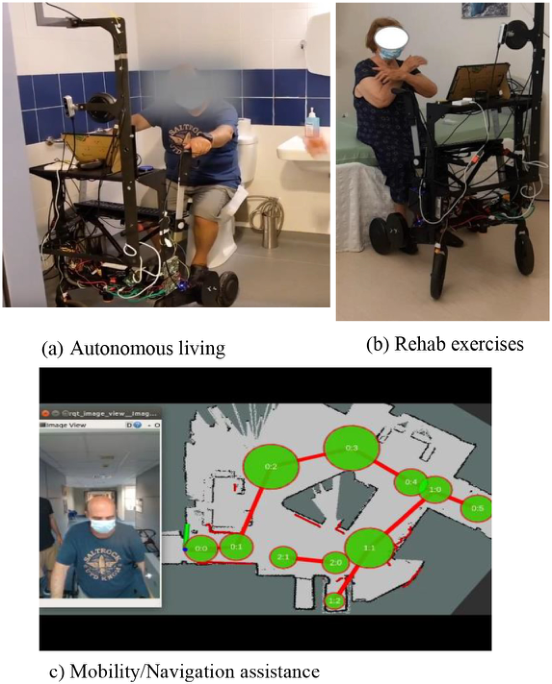
Figure 1: Tested scenarios.
MATERIALS AND METHODS
For the evaluation, three main scenarios were used which are directly related to the daily life, the needs, and the rehabilitation of the end user-patients, as well as the needs of their doctors/therapists (see Figure 1). These involve (i) autonomous living, (ii) rehabilitation exercising, and (iii) mobility and navigation assistance.
A more detailed analysis of the three scenarios follows.
Scenario 1: Autonomous Daily Activities The patient is lying in bed. He/She is raised in a sitting position with the soles of the feet resting on the floor and the torso with the hips forming a right angle. The patient uses verbal and/or gesture commands to call the i-Walk assistant near him/her. Then, after the rollator has approached the patient, he/she utters the verbal command “I want to get up”. He/She places the hands on the handles, bends slightly forward, pushes his/her torso and stands up. He/She corrects the posture with aid from the rollator interface and stays in that position for a few seconds. He/She then starts walking towards the toilet at a constant pace. By reaching the entrance to the toilet, he/she turns
the lights on, then opens the door and performs a body rotation in order to approach the toilet. He/She steps backwards until the back surface of the legs touches the toilet, activates the brakes and sits down following the rollator’s interface instructions. Similarly, he/she then grabs the handles, leans forward slightly, pushes the torso and stands up. After correcting the posture, he/she can start walking out of the toilet, perform on-site turn to close the door and turn the lights off. He/She approaches the bed, makes a turn on the spot, takes steps backwards until the back surface of the lower limbs rest on the bed, activates the brakes and sits down.
Scenario 2: Exercises The patient uses verbal and/or gesture commands to call the i-Walk rollator near him/her. i-Walk stands in front of the patient. After a dialogue with the rollator, the patient chooses to perform a series of rehabilitation exercises, guided by a virtual trainer who demonstrates the exercises like human tainers do. For the first exercise he/she has to cross the arms over the chest and turn the torso to the right and left. Then, he/she spreads the arms to the side and performs right-left torso turns. He/She then rests the arms on the right and left sides and projects the chest while inhaling through the nose and exhaling through the mouth. The patient performs 10 repetitions of each exercise. He/She then informs the i-Walk with the verbal command “I want to get up”. After standing up with the help of the platform, he/she starts performing a series of exercises from an upright position. The virtual trainer shows him/her again each exercise at the built-in screen of the rollator. Initially, body weight transfers to the right and left are performed, to be followed by on-site steps with low knee lifts, and then on-site steps with higher knee lifts. The patient performs 10 repetitions of each exercise. The patient is then informed by the platform that the exercise program is completed, so he/she can continue the rehabilitation programme by choosing the gait activity or state that he/she wants to stop.
Scenario 3: Navigation The patient is walking with the help of i-Walk following the navigation instru- ctions given by the platform (e.g. “go straight / turn right / turn back to the secretariat”, etc.). The instructions are pre-determined with the first desti- nation being the reception desk of the rehabilitation centre on the ground floor of the building. When he/she reaches the reception, the device informs him/her accordingly “You have reached your original destination”. Follow- ing the scenario, the user is further instructed to walk to the elevator to the canteen, which is located on the second floor.
Patients who participated in the evaluation of the i-Walk rollator had to meet specific inclusion criteria. More specifically: (i) they should have no severe cognitive deficit (MMSE>17), (ii) they should walk and perform the Gait Speed Test 4 meters at a speed <0.6 m/sec, (iii) they should suffer a moderate mobility impairment (5 repetition seat-upright test >16.7 sec).
For assessing the different functionalities implemented and the scenarios described above, we used the PYTHEIA scale, which is one of the most
Assessment of an Intelligent Robotic Rehabilitation Assistant 5
reliable scales to test technology-based rehabilitation and assistive devices and robots (Koumpouros et al., 2016; Koumpouros et al., 2017). The first part of the PYTHEIA scale was used to test the device as a whole, while the three scenarios were evaluated using the second part of the scale. The whole process followed the required General Data Protection Regulation (GDPR) guidelines, and the collected data were pseudoanonymized and encrypted appropriately to guarantee their security. Prior to evaluation, an ethics approval was obtained from the ATHENA RC Ethical Board (assembly of 25/02/2020) the institution which designed the human-robot communica- tion model. Appropriate statistical analysis was conducted on the collected data using the IBM SPSS software (IBM Corp., Armonk, NY, USA).
RESULTS
The i-Walk rollator was thoroughly evaluated in terms of its usability and acceptance by its intended end users (patients and therapists) in a rehabilita- tion centre. In total, twenty-two patients and twelve therapists evaluated the device under real conditions. The patients’ descriptive characteristics were as follows: mean age = 66.4 years (SD = 20.2), mean Mini-Mental State Exa- mination score = 25.5 (SD = 3.1), mean Berg Balance Scale score = 25.0 (SD = 8.0), mean Performance Oriented Mobility Assessment score = 13.5 (SD = 2.8). As far as the underlying diseases of the patients are concerned, the distribution was as follows: multiple sclerosis (13.6%), fracture (27.3%), Friedreich’s ataxia (4.5%), stroke (13.6%), quadriplegia (4.5%), head injury (4.5%), total hip replacement (13.6%), myelopathy (13.6%), cerebral palsy (4.5%), myasthenia (4.5%), and spastic paraplegia (9.1%). It is pointed out that the above percentages may exceed 100% since a patient can have more than one disease. The group of therapists consisted of 12 people: 5 phy- siotherapists, 2 occupational therapists, 1 speech therapist, 1 gymnast, 1 psychologist and 2 physicians. 66.7% of them were women.
The PYTHEIA scale was used to evaluate the different aspects of the final intelligent robotic assistant (Koumpouros et al., 2016; Koumpouros et al., 2017). With 5 being the highest score and 1 the lowest one, both i-Walk user groups (patients and therapists) rated the device very high to excellent (mean score of therapists = 3.74 and mean score of patients = 4.14). The same exists for the three different functionalities examined (mean score for patients and therapists relevant to: navigation and human-robot interaction support = 4.25 and 4.67; walking support = 4.27 and 4.51; rehab exercises offered = 4.33 and 4.80). Moreover, the majority of the patients believe that the most important elements of i-Walk are the safety of the device (22.2%), the feeling of security when using it (17.5%) and how much it helps them to improve their daily life (15.9%). Therapists, on the other hand, believe that the most important features are its adaptability (27.8%), the improvement of everyday life (22.2%) and the feeling of security for the end user (19.4%).
We first checked the normality of the data with the Kolmogorov-Smirnov test. Because no normal distribution was found, we then applied the non-parametric Mann-Whitney U test. We also examined if there is a correla- tion between patient satisfaction and one of the following characteristics: fall
risk (according to the POMA test), ability/inability to safely balance during a series of predetermined tasks (according to BERG score), and the cogni- tive deficit (MMSE score). According to the statistical analysis conducted, PYTHEIA follows a normal distribution in terms of the median, and thus the t-test was used to examine the correlation of the patient satisfaction with the BERG score, while the ANOVA method checked the correlation with the MMSE and POMA scores. The correlation of the total score from the PYTH- EIA questionnaire in relation to the POMA, BERG and MMSE was checked through the Spearman test. More specifically, the coefficients for each vari- able were found to be: p value = −0.147 for MMSE, p value = 0.090 for POMA and p value = 0.468 for BERG.
DISCUSSION
The assessment of the i-Walk robotic rollator opens the discussion on the wider benefits of using the specific device in home and rehab settings. The satisfaction of users with the platform was measured in patients facing a vari- ety of diseases and disabilities. Participants were initially screened against the inclusion criteria (i) Mini Mental State Examination (MMSE), (ii) the Berg Balance scale (BERG), (iii) Performance-Oriented Mobility Assessment scale (POMA), (iv) Timed Up and Go score (TUG), (v) Chair Stand test, and (vi) Gait Speed test. Sex and age details were also considered. According to the results, only patients’ dependence on an aid seems to have a positive effect on patient satisfaction. Cognitive deficits and fall risk are not related to users’ satisfaction. The t-test results (p value = 0.923) reveal that there is no diffe- rence in satisfaction from the i-Walk if the patient is completely wheelchair dependent (0 <BERG <20) or if he/she is moving with some help (21 <BERG <40). As a conclusion, the i-Walk robotic rehabilitation assistant was found very good to excellent in all different domains examined.
The processing of the data showed in several points / questions conver- gence of views between patients and therapists. The only differences were found: in the satisfaction with the support device and its services (i) in rela- tion to the ease of learning all its individual functions, where patients rated i-Walk higher than therapists, with 19.50 (Mean Rank of patients) compa- red to 12.63 of therapists (p value = 0.031); (ii) in relation to its weight, where patients rated this question higher -Mean Rank of patients: 20.69-, compared to therapists -Mean Rank of therapists: 10.54- (p value = 0.001). It is clear that for patients the weight of the i-Walk is considered quite sati- sfactory, while therapists believe that it should be even lighter. Therapists, having in mind the very light “π” seem to desire a version that could appro- ach this weight class. However, the technology and materials available today do not allow, at least not yet, a lighter construction. In the future, with the further downsizing of computers and the creation of lighter frame con- struction materials/alloys this could be possible; (iii) in terms of whether its features are sufficient, where patients rated this question higher -Mean Rank of patients: 20.29-, compared to therapists -Mean Rank of therapists: 11.25- (p value = 0.002). Additionally, patients rated higher i-Walk platform regar- ding the feeling of (iv) security (more secure -protected, confident- when using
Assessment of an Intelligent Robotic Rehabilitation Assistant 7
this support device), where the Mean Rank of patients was 19.95 and the one of therapists was 11.83 (p value = 0.013). Patients seem to be quite satisfied with how safe they feel using i-Walk. On the other hand, therapists, knowing in advance more details, since they participated in the design by giving advice to the technical partners, have a stricter view; (v) autonomy when using this support device, where the Mean Rank of patients was 19.40 instead of 12.79 of therapists (p value = 0.045).
As far as the “Exercises” scenario is concerned, the satisfaction of the pati- ents was rated higher than the one of the therapists in relation to: (i) the ease of use (Mean Rank of patients was found 19.38 and the one of therapists was 12.83 (p value = 0.013); (ii) the help it provides in daily life, where the Mean Rank of patients was 19.52 and the one of therapists was 12.58 (p value = 0.014); (iii) how safe it is, where patients’ Mean Rank was 19.71 and therapists’ one was 12.25 (p value = 0.003); (iv) its reliability (i.e. whe- ther it will always be applied correctly), where Mean Rank of patients was found 19.86 and the one of therapists was 12.00 (p value = 0.005). Patients find the i-Walk’s reliability in rehab exercises almost excellent, and therapi- sts quite satisfactory. Of course, the criteria of therapists, being experts, are much stricter in this domain.
Regarding the “Mobility assistance” scenario, the only difference was found in the satisfaction of patients with the specific function in relation to its reliability (i.e. whether it will always be applied correctly), which was rated higher (Mean Rank of patients: 19.86) compared to therapists (Mean Rank of therapists: 12.00), with p value = 0.005. Patients consider the reli- ability of the i-Walk in relation to the movement to be almost excellent and the therapists quite satisfactory.
Finally, in the “Navigation and Communication Assessment” scenario, patients rated higher their satisfaction with the specific function in relation to: (i) its ease of use, where Mean Rank of patients was 20.14 and the one of therapists was 11.50 (p value = 0.005). Nevertheless, both groups are quite satisfied with the ease of use of the i-Walk Navigation and Communi- cation function; (ii) how safe it is, where Mean Rank of patients was 19.14 and therapists was 13.25 (p value = 0.029). Patients consider the safety of i-Walk in Navigation and Communication excellent, while therapists con- sider it almost excellent; (iii) the feeling of security (I will feel more safe -protected, confident- when I use it), where patients’ Mean Rank was 19.52 and therapists was 12.58 (p value = 0.014). Nevertheless, both groups are quite satisfied with the feeling of security offered by the operation of i-Walk during Navigation and Communication.
In conclusion, patients rated i-Walk higher in all dimensions, even in the above categories, where there was a statistically significant difference in their views compared to the one of the therapists. More specifically, the following mean scores were recorded during assessment: (i) navigation and communi- cation score: 4.67 patients > 4.25 therapists; (ii) mobility assistance score: 4.51 patients > 4.27 therapists; (iii) exercises score: patients 4.80 > 4.33 the- rapists. According to the results, both patients and therapists rate the i-Walk very highly to excellent in all three different scenarios. It is pointed out that all scores are above 4, with 5 being excellent. Most of patients believe that
the most important elements of i-Walk are the safety of the device (22.2%), the feeling of security when using it (17.5%) and how much it helps them to improve their daily life (15.9%). Therapists believe that the most impor- tant features are its adaptability (27.8%), the improvement of everyday life (22.2%) and the feeling of security for the end user (19.4%).
It is a fact that finding an appropriate scale for the subjective evaluation of rehabilitation and assistive robot devices is very hard (Koumpouros, 2016). Another conclusion of the study is that the PYTHEIA scale is a really valuable and reliable tool for testing such devices. Its reliability and validity in diffe- rent pathologies and platforms makes it appropriate for any kind of assistive technologies (Koumpouros, et al., 2020; Koumpouros, 2017; Schladen et al., 2020a; Schladen et al., 2020b). Another exceptional characteristic that makes PYTHEIA unique is the fact that it can be used to test not only the device as a whole, but also any of its individual functionalities. This was considered critical in our study, since we wanted to evaluate the i-Walk in three diffe- rent scenarios, which respond to different functions of the i-Walk platform. In addition, PYTHEIA can be used in any stage of the production or in other words in any Technology Readiness Level (TRL). This means that it can be used in the widest available range of development (from research and design phase – TRL 5, to commercially available prototypes – TRL 9). Finally, the fact that it has been adapted to the Greek and English population, culture and language is another advantage of the specific tool as used for evaluating the i-Walk rollator (Koumpouros, 2017; Koumpouros, et al., 2020; Schladen et al., 2020a; Schladen et al., 2020b).
CONCLUSION
The paper presents the results from the assessment of the i-Walk intelligent robotic rollator in different dimensions: as a whole, and in terms of its assi- stance in navigation, communication, mobility and rehab exercises. Both patients and therapists found i-Walk very satisfying to excellent, with pati- ents’ view being more positive almost in every aspect examined. In addition, the PYTHEIA scale was found to be a very useful tool for evaluating reh- abilitation and assistive devices, as it can evaluate the platform as a whole and its different functions independently. This is the only known tool in the literature that can be used in this way.
ACKNOWLEDGMENT
This research has been co-financed by the European Union and Greek natio- nal funds through the Operational Program Competitiveness, Entrepreneur- ship and Innovation, under the call RESEARCH—CREATE—INNOVATE (project i-Walk, code: T1EDK-01248/MIS: 5030856).
REFERENCES Bertrand, K., Raymond, M.H., Miller, W.C., Martin Ginis, K., Demers, L., 2017.
Walking Aids for Enabling Activity and Participation: A Systematic Review. American Journal of Physical Medicine & Rehabilitation, 96(12), pp. 894–903.
Assessment of an Intelligent Robotic Rehabilitation Assistant 9
Bryant, M.S., Pourmoghaddam, A., Thrasher, A., 2012. Gait changes with walking devices in persons with Parkinson’s disease. Disability and Rehabilitation: Assistive Technology, 7(2), pp. 149–152. Efthimiou, E., Papageorgiou, X., Fotinea, S., Karavasili, A., Vacalopoulou, A. and
Goulas, T., 2019. User Centered Design in Practice: Adapting HRI to Real User Needs. In: The Pervasive Technologies Related to Assistive Environments (PETRA ‘19) conference. New York, USA: ACM. Fotinea, S.E., Efthimiou E., Koutsombogera, M., Dimou, A.L., Goulas, T., Maragos, P., Tzafestas, C., 2015. The MOBOT human-robot communication model. In: 6th IEEE International Conference on Cognitive Infocommunications (CogInfoCom 2015). Gyor, Hungary: IEEE. DOI: 10.1109/CogInfoCom.2015.7390590. Jones, A., Silva, P., Silva, A., Colucci, M., Tuffanin, A., Jardim, J. and Natour, J.,
2011. Impact of cane use on pain, function, general health and energy expenditure during gait in patients with knee osteoarthritis: a randomised controlled trial. Annals of the Rheumatic Diseases, 71(2), pp. 172–179. Kegelmeyer, D., Parthasarathy, S., Kostyk, S., White, S. and Kloos, A., 2013. Assistive devices alter gait patterns in Parkinson disease: Advantages of the four-wheeled walker. Gait & Posture, 38(1), pp. 20–24. Kloos, A., Kegelmeyer, D., White, S. and Kostyk, S., 2012. The Impact of Different
Types of Assistive Devices on Gait Measures and Safety in Huntington’s Disease. PLoS ONE, 7(2), p.e30903. Koumpouros, Y., 2018. User Needs and Limitations of Existing Mobility Devices. International Journal of Reliable and Quality E-Healthcare, 7(4), pp. 1–19. Koumpouros, Y., Karavasili, A., Efthimiou, E., Fotinea, S.E., Goulas, T., Vacalopou-
lou, A., 2017. User Evaluation of the MOBOT Rollator Type Robotic Mobility Assistive Device. Technologies, 5(4). Koumpouros, Y., 2016. A Systematic Review on Existing Measures for the Subjective Assessment of Rehabilitation and Assistive Robot Devices. Journal of Healthcare Engineering, pp. 1–10. Koumpouros Y., Papageorgiou E., Karavasili A. (2017) Development of a New
Psychometric Scale (PYTHEIA) to Assess the Satisfaction of Users with Any Assi- stive Technology. In: Duffy V., Lightner N. (eds) Advances in Human Factors and Ergonomics in Healthcare. Advances in Intelligent Systems and Computing, vol 482. Springer, Cham. https://doi.org/10.1007/978-3-319-41652-6_32. Koumpouros, Y., Papageorgiou, E., Karavasili, A., Koureta, F. (2016), PYTHEIA: A Scale for Assessing Rehabilitation and Assistive Robotics. World Academy of Sci- ence, Engineering and Technology, Open Science Index 119, International Journal of Mechanical and Materials Engineering, 10(11), 522–526. Koumpouros, Y., Toulias, T., Tzafestas, C. and Moustris, G., 2020. Assessment of
an intelligent robotic rollator implementing navigation assistance in frail seniors. Technology and Disability, 32(3), pp. 159–177. Morone, G., Annicchiarico, R., Iosa, M., Federici, A., Paolucci, S., Cortés, U. and Caltagirone, C., 2016. Overground walking training with the i-Walker, a robo- tic servo-assistive device, enhances balance in patients with subacute stroke: a randomized controlled trial. Journal of NeuroEngineering and Rehabilitation, 13(1). Schladen, M.M., Cleary, K., Koumpouros, Y., Monfaredi, R., Salvador, T., Talari, H.,
Slagle, J., Coley, C., Kovelman, S., Belschner, J. and Evans, S., 2020a. Toward Eva- luation of the Subjective Experience of a General Class of User-Controlled, Robot- Mediated Rehabilitation Technologies for Children with Neuromotor Disability. Informatics, 7(4), p. 45. Schladen, M., Koumpouros, Y., Sandison, M., Casas, R. and Lum, P., 2020b. Conceptualization of Hand-TaPS to measure the subjective experience of dynamic hand orthoses in promoting functional recovery at home after stroke. Technology and Disability, 32(4), pp. 285–294.
LISTED IN THE AHFE DIGITAL BOOKSTORE CATALOGUE
Explore the complete digital volume
Human Factors in Robots, Drones and Unmanned Systems
Read this individual research paper free through the original publisher, or explore the full digital proceedings book.
ISBN 978-1-958651-33-9
Explore this ISBN in the AHFE Bookstore ↗Listed in the July 2026 bookstore catalogue; search by ISBN to confirm current availability · Digital book purchase optional