Maureen Hassall, Ben Seligmann, Danellie Lynas, Joel Haight, Robin Burgess-Limerick (2022). Predicting Human-System Interaction Risks Associated with Autonomous Systems in Mining. In: Human Factors in Robots, Drones and Unmanned Systems. AHFE Open Access, vol. 57, pp. 78–85. https://doi.org/10.54941/ahfe1002313
Industry is implementing increasing amounts of automation into operations. The Australian mining industry is no exception as it is introducing autonomous mining vehicles and trains, remote controlled processing plants and the use of drones and robots to do survey and inspection work. Often these technologies are adopted to improve operational efficiencies and to reduce workers' exposure to high risk situations. However, in most mining environments, the adoption of automated technologies has not completely removed humans from the operation. Humans still need to interact with the technology to clean, service and maintain it. Humans also have to perform other tasks in the automated mining environment such as inspection of ground conditions, mapping mining and dump areas, maintaining roads and infrastructure etc. Thus, introducing automation into mining environments has the potential to introduce new and significant human-system interaction safety risks. The emergence of these new safety risks are evident in recent accidents in the mining industry as well as in other industries that have introduced automation. Traditionally, risk based approaches have been used in the Australian mining industry and other industries to identify and treat safety related risks. Such approaches include the use of hazard identification techniques (HAZID), Workplace Risk Assessment and Control (WRAC), Failure Mode and Effects Analysis or Failure Modes and Effects Criticality Analysis (FMEA or FMECA), and Process or Job based Hazard Analysis (PHA or JHA). These traditional techniques have helped reduce fatal and catastrophic incidents in the mining industry but deficiencies in their application has also been highlighted in a number of major accident investigation reports. In addition, recent research has suggested that that traditional risk identification techniques by not be effective for new, software-enabled technologies that are embedded in socio-technical systems with complex or dynamic human-system interactions. In response new socio-technical risk assessment approaches have been develop such as System Theoretic Process Analysis (STPA) and Strategies Analysis for Enhancing Resilience (SAfER). However no publications could be found that seek to understand from a end-user perspective the efficacy of the traditional and new techniques in assessing human-system interaction risks associated with the introduction of autonomous and automated technologies in mining environments.To begin to address this gap, research was conducted that sought to answer the question - What combination of risk assessment techniques delivers the most effective means of identifying risks associated with human-system interactions in remote and autonomous mining operations? The research method involved have mining industry professionals trial four techniques - Preliminary Hazard Analysis (HAZID), Failure Mode and Effects Criticality Analysis (FMECA), Strategies Analysis for Enhancing Resilience (SAfER), and System Theoretic Process Analysis (STPA) (Systems-theory Method) - in a workshop environment. Three different workshops were conducted each of which focused on a different automated technology. The first focused on identifying human-system interaction safety risks in surface mine automated haulage areas. The second focused on identifying human-system interaction safety risk associated with autonomous longwall mining operations underground. The third focused on human-system interaction safety risks associated with remote controlled operation of ore processing plants. After the workshop trialed each technique, the participants were survey to collect their perceptions of the usability and usefulness of each technique. Results from the participant feedback suggest that each techniques was able to identify potentially hazardous human-system interactions but that each had strengths and weaknesses depending on whether risks were being assessed risks pre or post implementation. A hybrid or combination approach was suggested with further testing of the proposed approach being recommended.
Industry is implementing increasing amounts of automation into operations. The Australian mining industry is no exception as it is introducing autono- mous mining vehicles and trains, remote controlled processing plants and the use of drones and robots to do survey and inspection work. Often these technologies are adopted to improve operational efficiencies and to reduce workers’ exposure to high-risk situations. However, in most mining environ- ments, the adoption of automated technologies has not completely removed humans from the operation. Humans still need to interact with the techno- logy to clean, service and maintain it. Humans also have to perform other
Predicting Human-System Interaction Risks Associated with Autonomous Systems 79
tasks in the automated mining environment such as inspection of ground conditions, mapping mining and dump areas, maintaining roads and infra- structure etc. Thus, introducing automation into mining environments has the potential to introduce new and significant human-system interaction safety risks. The emergence of these new safety risks are evident in recent acci- dents in the mining industry as well as in other industries that have introduced automation.
Traditionally, risk-based approaches have been used in the Australian mining industry and other industries to identify and treat safety related risks. Such approaches include the use of hazard identification techniques (HAZID), Workplace Risk Assessment and Control (WRAC), Failure Mode and Effects Analysis or Failure Modes and Effects Criticality Analysis (FMEA or FMECA), and Process or Job based Hazard Analysis (PHA or JHA). These traditional techniques have helped reduce fatal and catastrophic incidents in the mining industry but deficiencies in their application has also been highli- ghted in a number of major accident investigation reports. For example the Pike River Mine Royal Commission found “that even though the company was operating in a known high-hazard industry . . . and the executive mana- gers did not properly assess the health and safety risks that the workers were facing. . . and exposed the company’s workers to unacceptable risks.” (Royal Commission on the Pike River Coal Mine Tragedy, 2012).
In addition, recent research has suggested that traditional risk identifica- tion techniques are not very effective for new, software-enabled technologies that are embedded in socio-technical systems with complex or dynamic human-system interactions (Leveson, 2011, Dekker et al., 2011). In response, new socio-technical risk assessment approaches have been developed such as System Theoretic Process Analysis (STPA) (Leveson, 2011) and Stra- tegies Analysis for Enhancing Resilience (SAfER) (Hassall et al., 2014). However, no publications could be found that seek to understand from an end-user perspective the efficacy of the traditional and new techniques in assessing human-system interaction risks associated with the introduction of autonomous and automated technologies in mining environments.
To begin to address this gap, research was conducted that sought to answer the question - What combination of risk assessment techniques do end-users perceive as being most effective for identifying risks associated with human- system interactions in automated and autonomous mining operations?
METHOD
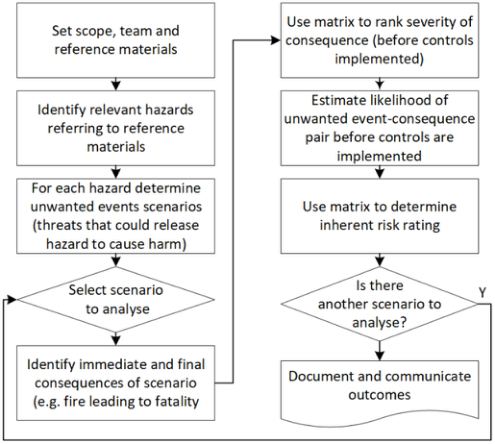
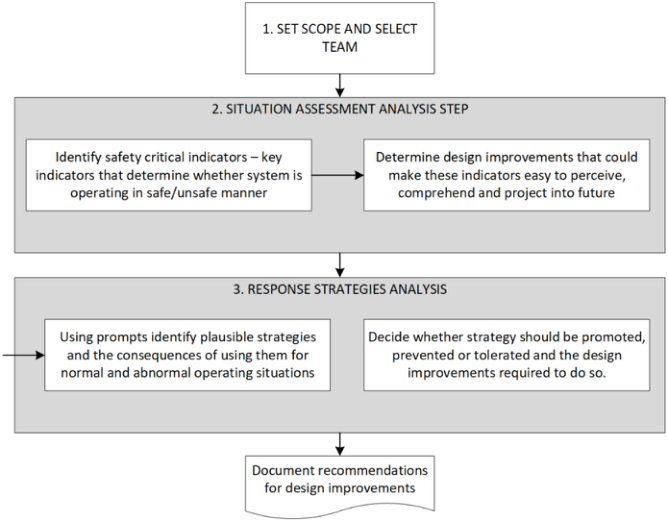
The research method involved mining industry professionals trialing four techniques across three different workshops. The four techniques were Pre- liminary Hazard Analysis (HAZID) which followed the process set out in Figure 1; Failure Mode and Effects Criticality Analysis (FMECA) which followed the process described in IEC60812:2018 (International Electrote- chnical Commission, 2018); Strategies Analysis for Enhancing Resilience (SAfER) approach as outlined in Figure 2 and described in detail in Hassall (2013), and System Theoretic Process Analysis (STPA) using guidance pro- vided by Leveson and Thomas (2018). In using these techniques, the work
Figure 1: The HAZID process used in workshops.
focused on identifying risk scenarios and not on determining appropriate risk treatments.
Three workshops were conducted, each focused on a different automated technology. The first workshop focused on identifying human-system intera- ction safety risks in surface mine autonomous haulage operations. The second focused on identifying human-system interaction safety risks associated with underground mine automated longwall mining operations. The third focused on human-system interaction safety risks associated with remote controlled operation of ore processing plants.
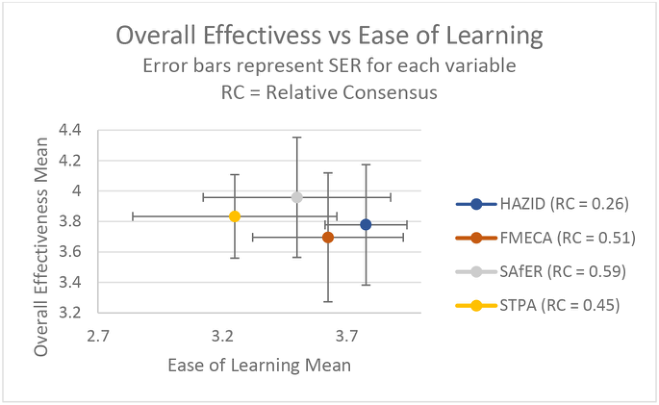
Before and after each technique was trialed, the participants were surve- yed to collect their experience with each technique (in survey given before the technique was trialed) and their perceptions of the ease of use and effe- ctiveness of each technique (in survey given after the technique was trialed). Responses from Likert survey questions were then analysed using Shannon Entropy Ratio to produce measures of “overall effectiveness” and “ease of learning”. Free text responses were also examined. Results are described next.
RESULTS
The surface mine autonomous haulage workshop was held May 25, 2021 and was attended by 9 industry personnel. The underground mine automa- ted longwall mining workshop was held August 2, 2021 and by 8 industry personnel. The remote controlled ore processing plant workshop was held August 23, 2021 and attended by 9 industry personnel. All workshops were attended by four researchers.
During each workshop all four techniques were able to be tested. The researchers’ made a number of observations during the workshop and when reviewing the documented risk assessment information. These observations
Predicting Human-System Interaction Risks Associated with Autonomous Systems 81
Figure 2: Outline of the SAfER process.
including the following: (1) The HAZID process seemed to be familiar to the attendees, perhaps because similar risk assessment techniques are used in mining (although they may be called different things like WRAC, BBRA etc); (2) The FMECA process was slightly more challenging to focus it on human-system interactions rather than on the equipment automation. Better understanding of the component function (e.g. the function of the human- system interaction) should help improve the efficacy of the technique; (3) The SAfER technique provided new insights around situation awareness requi- rements and strategy options. The approach was new to participants so it took more effort and time to elicit information and a complete analysis was not produced from any of the workshops; (4) The control diagram produ- ced by the STPA also seemed to be a new process for participants it took some time to develop but it helped identify and clarify interactions. The resul- tant diagram made the analysis of deviations in human-system interactions reasonably straight forward.
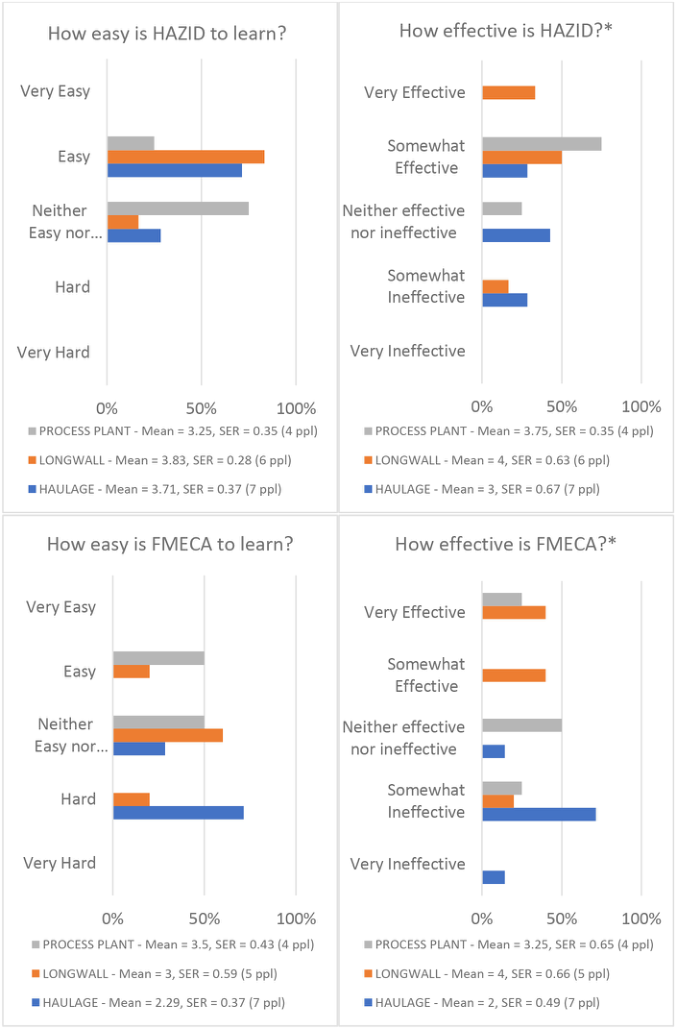
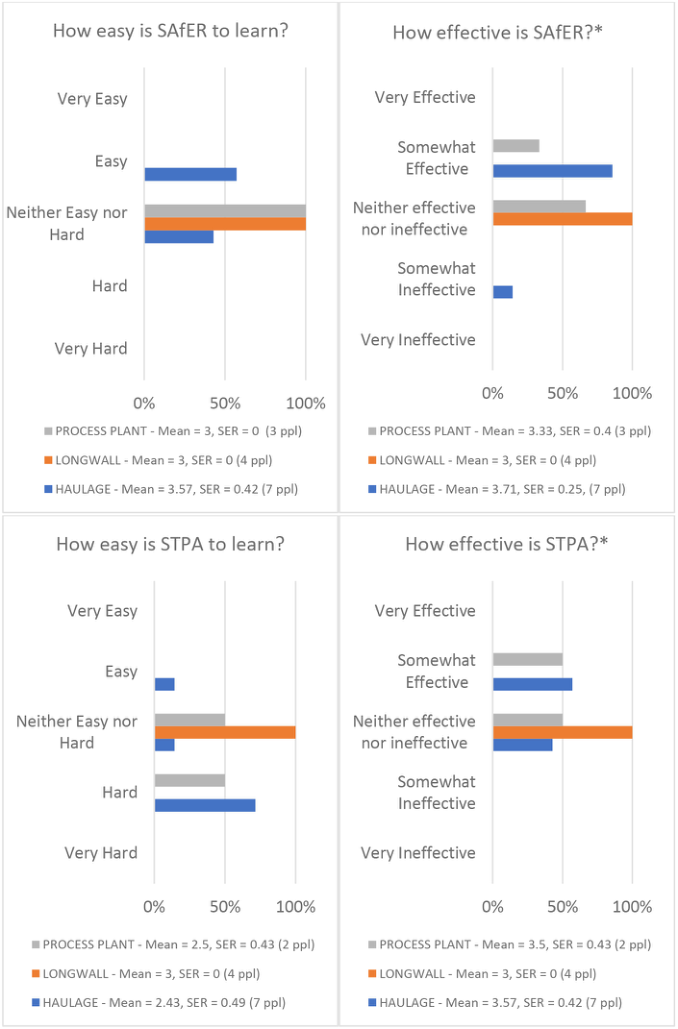
The participants’ responses to ease of use and effectiveness for each techni- que are illustrated in Figure 3 for the traditional approaches of HAZID and FMECA and Figure 4 for the socio-technical techniques of SAfER and STPA. The summary from the Shannon Entropy Ratio analysis is shown in Figure 5.
DISCUSSION AND CONCLUSION This study had a number of limitations. Due to COVID-19 restrictions and the availability of industry personnel during the pandemic the work- shops were restricted to one-day timeslots which were run either partly for
Figure 3: Results from traditional risk assessment processes.
fully online. Participation was also voluntary. Despite these constraints, all risk assessment processes were able to the trialed with industry practitio- ners across the three case study scenarios. These risk assessments were able to identify insightful human-system interactions that could be potentially hazardous and therefore warrant further analysis to determine how best to
Predicting Human-System Interaction Risks Associated with Autonomous Systems 83
Figure 4: Results from socio-technical risk assessment processes.
manage them. Feedback from the participants and analysis of workshop information suggest that no single approach is significantly more effective than any other for any of the case studies nor across the range of automation case studies trialed. Therefore, it is suggested that further work be done to
Figure 5: Summary of results from Shannon Entropy Ratio analysis.
leverage off the feedback provided and investigate whether a hybrid or combi- nation of approaches might be best the analysis of human-system interactions in mines. Such an approach might consist of the following steps: (1) Set- ting the scope and this should include a human-system interaction diagram (as was produced in STPA); (2) For existing systems, performing a HAZID or and refined version of SAfER; (3) For new systems, performing a STPA based FMECA and refined version of SAfER. The refined version of SAfER should involve referencing the human-system interaction diagram, perfor- ming the situation assessment analysis with the addition of a risk ranking if indicator was absent/overlooked and/or incorrect/misleading. The identi- fication of causes and consequences of strategies along with a risk ranking of them should also be added. The efficacy of these suggestions should be assessed with further research.
ACKNOWLEDGMENT
The research was undertaken with funding from Whitehaven Coal.
REFERENCES
Dekker, S., Cilliers, P. & Hofmeyr, J.-H. 2011. The complexity of failure: Implications of complexity theory for safety investigations. Safety Science, 49, 939–945. Hassall, M. E. 2013. Methods and tools to help industry personnel identify
and manage hazardous situations. Doctor of Philosophy, The University of Queensland. Hassall, M. E., Sanderson, P. M. & Cameron, I. T. 2014. The Development and Testing of SAfER: A Resilience-Based Human Factors Method. Journal of Cognitive Engineering and Decision Making, 8, 162–186. International Electrotechnical Commission 2018. IEC 60812:2018 Failure modes
and effects analysis (FMEA and FMECA). Brussels: European Committee for Electrotechnical Standardization.
Predicting Human-System Interaction Risks Associated with Autonomous Systems 85
Leveson, N. G. 2011. Engineering a safer world: systems thinking applied to safety, Cambridge, Mass, The MIT Press. Leveson, N. G. & Thomas, J. P. 2018. STPA handbook. Royal Commission on the Pike River Coal Mine Tragedy 2012. Volume 1 + Ove-
rview. Wellington New Zealand.
LISTED IN THE AHFE DIGITAL BOOKSTORE CATALOGUE
Explore the complete digital volume
Human Factors in Robots, Drones and Unmanned Systems
Read this individual research paper free through the original publisher, or explore the full digital proceedings book.
ISBN 978-1-958651-33-9
Explore this ISBN in the AHFE Bookstore ↗Listed in the July 2026 bookstore catalogue; search by ISBN to confirm current availability · Digital book purchase optional