Yi Pei Wu, Chien-Hsu Chen (2022). Design a Visual Communication Platform for curators and artists to curate an exhibition remotely. In: Human Factors in Communication of Design. AHFE Open Access, vol. 49, pp. 43–50. https://doi.org/10.54941/ahfe1002034
Art is an expression of emotion; art exhibitions bring artists' creations and perceptions to the visitors. International art exhibitions present diverse and high-quality artistic creations through the curator's elaborate exhibition planning, and the connection between artworks and visitors is established to allow visitors to admire and understand; on the contrary, it also challenges the digital communication tools for curators and artists when conducting co-curation remotely. This study utilizes interviews and field study to collect pain points and ultimately provides guidelines and crucial functions for curators and artists to design a visual communication platform during international curation collaboration.
International exhibitions have become frequent; the intention is to promote global exchanges and enhance the diversity of transnational cultures. Interna- tional exhibitions can bring exotic art, history, lifestyle. Through the planning and creation of exhibitions by professional curators (Bjerregaard, 2019), completely transmit knowledge and meaning to visitors (Krasny, 2019), so that visitors can get the information while participating in the exhibition (Wolff & Mulholland, 2013). During the cross-border cooperation, the artist necessity goes to the physical exhibition venue for location scouting. Nevertheless, there are limitations; the artist cannot regularly be in physical exhibition venues due to overlapping exhibitions or unaffordable transporta- tion costs. Instead, the curator will send 2D photos, floor plans, and videos of the exhibition venue’s actual condition to the artist via email. Artists can only list expected exhibits through rare information and resend them to the cura- tor. Through the discussion, the spread of artworks, the height of hanging, the color and texture of the wall, balance of the layout, proper visitor flow, the above require deliberate and calculation (Dean, 2002), those contents will be discussed in the pre-exhibition details along with emails. However, these unintegrated data can easily cause curators and artists to blunder away
several important information; those documents make it difficult for both sides to imagine the final look of the exhibition (Acord, 2010).
The pandemic comes unexpectedly, and most exhibitions are facing cancel- lation or postponement. Most art institutions face this common difficulty and challenge, and international cooperation has become unpredictable. Fortu- nately, technology has provided strong support through Google meet, Zoom, Microsoft Teams, Skype (Ramzan & Parveen, 2020), which has become the new normal of remote cooperation. However, the use of traditional digital remote communication platforms also reflects some shortcomings, such as the inability to visualize the communication content immediately, and multi- type data is also inconvenient in the process of collation. By the impact of the pandemic, the demand for virtual exhibitions has increased rapidly, and virtual reality has been widely used in many fields (Yu, 2011), including the field of art. 3D modeling can simulate the appearance of the real environ- ment and create a unique virtual space, supplying visitors with an immersive experience (Gifreu-Castells, 2019).
Through semi-structured interviews and field study methods, this study summarizes the pain points curators and artists will encounter when planning and discussing international exhibitions. Therefore, this research provides a visual communication platform integrated with augmented reality, vir- tual reality, and 360 camera assistance, so artists and curators can increase efficiency and improve collaboration accuracy during remote curation.
RELATED WORK
The cross-border cooperation of curators and artists is crucial for interna- tional exhibitions to overcome. Due to the pandemic, people’s movements are restricted; working from home, taking turns to the office, and working off-site has become a trend. People are getting used to working remotely and cooperating. Remote working can reduce commute time, decrease fuel consumption, and balance work and life. With the aid of technology, telepre- sence robots have emerged (Beno, 2018), making teleworking more flexible, improving productivity, and increasing the quality of communication, allo- wing people to work in any place. The most considerable dissimilarity from the traditional digital communication platform is that the telepresence robot possesses mobility. Even being at home can also feel the sense of presence by remotely controlling the telepresence robot. The museum uses the teleprese- nce robot as an avatar for the disabled as well; with telepresence robot, the disabled can perceive the feeling of being in the museum when they are phy- sically at home and freely control the direction of movement to explore the entire art museum, and even allow for zooming in on the details of the artw- ork, making the viewing experience more intuitive (Ng, Primatesta, Giuliano, Lupetti, Russo, Farulla, & Bona, 2015).
Recent research shows that augmented reality and virtual reality are widely used in art exhibitions (Oyelude, 2018); moreover, virtual exhibitions are the future trend (Yan, 2006) and can be preserved for the long term, save vast funds, have unlimited digital space, visitors from the worldwide, and unli- mited visits frequency. The intervention of technology makes art exhibitions
Design a Visual Communication Platform for Curators and Artists to Curate 45
more interactive, diverse, and immersive; the presentation goes beyond tradi- tional physical exhibitions (Carrozzino, & Bergamasco, 2010). Conversely, virtual reality and augmented reality are mostly used in the final display of the exhibition; the curation process is also vital for curators even though there is currently no visual communication platform specially provided for curators and artists to discuss remotely in the early stage of the exhibition planning, through the interview and field study from curators and artists in the real world, the researcher is able to understand and gain insight into difficulties and demands in the process of exhibition planning and discussion remo- tely, after which become the design guidelines of the visual communication platform for this study.
THE DEVELOPMENT OF VISUAL COMMUNICATION PLATFORM SYSTEM DESIGN This section is divided into two parts. The former section analyzes qualitative data and discovers some crucial design features for the visual communication platform via the field study and semi-structured interview. The latter half of the section will illustrate the specific vital functions of the platform. This study aims to design a visual platform for curators and artists when faced with remote discussion for curating the international exhibition.
Analysis of Qualitative Data Through the interview and field study to investigate the real-world expe- rience, numerous problems need to be conquered during the curation of cross-border cooperation; for instance, the curators and artists cannot arrive in the chosen country on time or even be banned from going abroad cause of the pandemic. As a result, the pre-planning and curation of the exhibition can only be carried out with each other by digital online tools.
The method of the interview was a semi-structured interview. The resea- rcher drew up the interview outline in advance and guided the interviewee in a purposeful way of conversation without restricting the direction of the interviewee’s reaction during the process. The interviewees included two independent curators and an artist. Both curators had more than ten years of working experience, curated various international exhibitions, and had many cooperation experiences with foreign artists. The artist has participa- ted in more than five international exhibitions and collaborated several times with multinational curators. The three interviewees continued to involve in cross-border exhibitions during the pandemic, and each encountered some difficulties and challenges. The field study records collection from the resea- rcher’s existent participation in the curatorial process and observing the pain points that the curator and the artist will encounter during the remote cura- tion. Besides, the researcher personally participates in the curation process without prior assumptions and observes in realistic situations to fully capture the physical condition.
The following (Table 1) shows the result after integration and analysis from semi-structured interviews and field study.
46 Wu and Chen
- E-mail is the most frequently used for discussions as data can be reserved - Diverse data types are time-consuming and complicated to classify - Email takes high acceptance and ease of use - Sometimes the curators or artists do not speak English, which will become a burden for discussions - When the artist receives the photos, floor plans, and videos of the physical exhibition venue, still unfamiliar with the venue, and cause difficulties to select suitable artworks for the curator - The floor plan dimensions of the exhibition venue did not match the physical surroundings - It takes a long time for a reply and confirmation of details - Reply via text is easy to cause misunderstanding - Difficulty conveying images in the brain accurately - Unable to visit the physical exhibition venue due to the impact of the pandemic - When participating in a group exhibition, the overall appearance of the exhibition will not be known until the opening - Incur inconvenience transportation and time costs.
Table 1. Based on the above results, the keywords and main factors that need to be included in the visual communication platform are summarized.
Table available in the original PDF paper.
Accessible High efficiency High acceptance Reminder function Accurate space size Easy to use Data Preservation Instantly translation Instantly feedback Support for different types of the file transfer
Visual communication details
Data automatic integration and classification
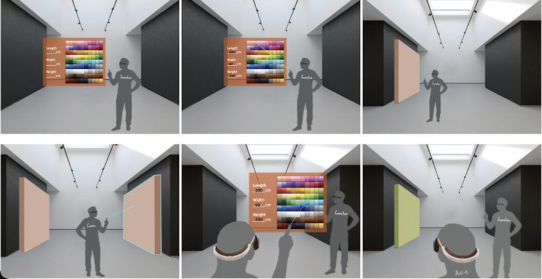
System Design This section provides a storyboard from Figures 1–11 to explain the function of the visual communication platform; those functions were according to the qualitative data and produced the design guidelines.
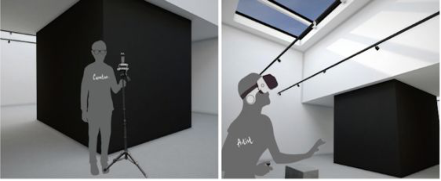
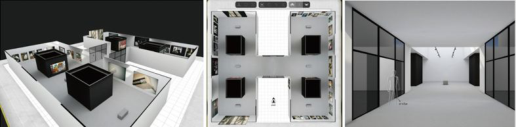
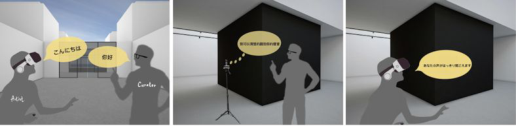
Figure 1: While the curator and the artist are in different locations, the curator will go to the physical exhibition venue with 360 cameras and augmented reality devices. On the other hand, the artist in other sites will wear the virtual reality head-mounted display; through the 360 camera, the artist will have a sense of presence just like staying in the physical exhibition venue. The artist can see the surroundings and experience the atmosphere of the space.
Design a Visual Communication Platform for Curators and Artists to Curate 47
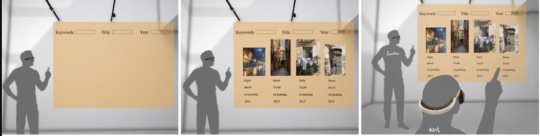
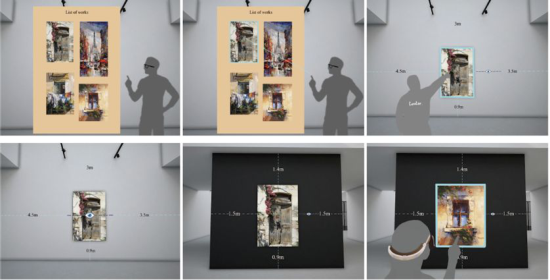
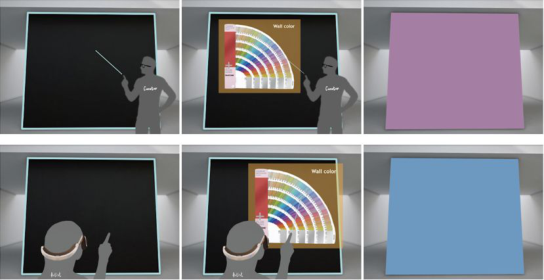
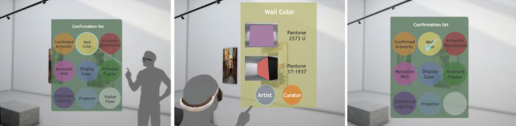
Figure 2: The curator and the artist can select the proper artworks for exhibit together, and the virtual interfaces and objects will appear.Figure 3: Arrange each artwork in an appropriate position; both the curator and artist are allowed to decide the accurate position for the exhibits, which will show the precise dimension on the virtual interface.Figure 4: Select the color of the wall, the Pantone color interface will appear, choose the color, and the wall will change instantly. Color can be altered or replaced at any time.Figure 5: Install the movable wall; this step can let the exhibition venue have different looks. Firstly, import the size and color to the interface, and the movable walls will appear; it can easily place the movable wall anywhere.
48 Wu and Chen
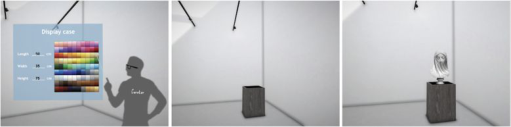
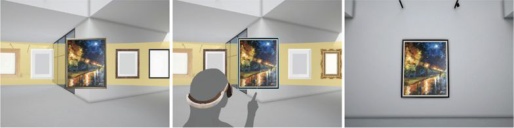
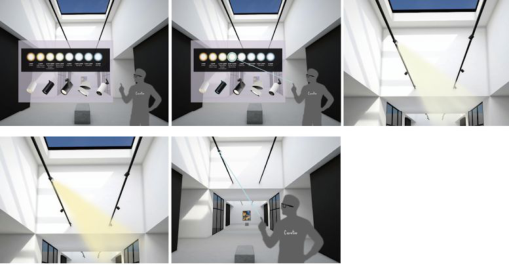
Figure 6: Add the display case, import the size, color, and texture to the interface, and put the pre-scanned sculpture on the display case; it will be easier to show the final version and make adjustments more intuitively.Figure 7: The system will provide various types of frames, choose one of the artworks and add the proper frame.Figure 8: High-quality lighting design will bring the artworks to a better present situa- tion for the lighting design. The system offers diverse types of light, selects the right color temperature, and places the light in the right position and proper angle.Figure 9: Pacing is the crucial part for the visitor to visit and understand the exhibition, the curator and the artist can directly plan the path for visitors.Figure 10: When curators and artists are faced with language barriers, the system pro- vides an instant translation function to convert into a language that both parties can understand immediately.
Design a Visual Communication Platform for Curators and Artists to Curate 49
Figure 11: In the last step, a requirement to confirm all of the details, the whole curation process and data will be recorded and completely saved. Both the curator and the artist will not lose any important information.
DISCUSSION
The study was evaluated by interviewing experienced curators to verify the effectiveness and feasibility of the platform. Firstly, explain the platform functions to the curators through storyboards and videos to demonstrate the system usage status, collecting the curator’s feedback and suggestions. The curators expressed high interest in this platform and are looking forw- ard to using this platform for cross-border curation. The data storage and integration functions of the platform can indeed help prevent the omission of details during the curation process; the function of visualizing the details of the discussion process not only makes the discussion more intuitive and can also be more accurate and efficient; the curator remarked that when arti- sts no need to travel long distances, they could have the sense of presence through the visual communication platform, which could save a lot of cost and time. Lastly, the curator mentioned that there is currently a lack of a digital platform for pre-exhibition curation and is anticipating a new type of cross-border curation and cooperation.
LIMITATION There are three potential restrictions in the visual communication platform. Firstly, the 360-camera will be staying in the fixed point, so the artist in the remote location cannot autonomously and freely move in the virtual space. Secondly, Virtual Reality and Augmented Reality are costly; not most peo- ple own the device and need to be concerned about accepting the emerging technologies. Lastly, we need to be concerned about face-to-face communi- cation cause the platform cannot let curators and artists see each other when discussing. Those limitations mentioned above will be designed in further action.
CONCLUSION
This study proposed a visual communication platform that supplies cura- tors and artists when conducting art exhibition curation with international collaboration, expected prompt remote curation intended to be more accu- rate and efficient. Regarding the potential challenges mentioned in the above limitation, to provide curators and artists directly facing each other, the need for further work utilizes installing a screen on the 360 camera for curators and artists, allowing them to own a face-to-face discussion during the pro- cess. Instead, the artist can operate the desktop VR, allowing the camera to
50 Wu and Chen
capture itself and avoid motion sickness. The system can be widely used in various areas. For instance, in art exhibition curation, architectural design, and spatial arrangement. This study provides design guidelines and specific functions for curators and artists to curate an exhibition remotely and create a brand-new experience for cross-border cooperation.
REFERENCES
Acord, S. K. (2010). Beyond the head: The practical work of curating contemporary art. Qualitative sociology, 33(4), 447–467. Beno, M. (2018, November). Work flexibility, telepresence in the office for remote
workers: A case study from austria. In International Conference on Multidiscipli- nary Trends in Artificial Intelligence (pp. 19-31). Springer, Cham. Bjerregaard, P. (2019). Exhibitions as research, curator as distraction. In Curatorial challenges (pp. 108–119). Routledge. Carrozzino, M., & Bergamasco, M. (2010). Beyond virtual museums: Experiencing
immersive virtual reality in real museums. Journal of cultural heritage, 11(4), 452–458. Dean, D. (2002). Museum exhibition: Theory and practice. Routledge. Gifreu-Castells, A. (2019). Approach to the Curatorship of Virtual Reality Exhibitions. A Companion to Curation, 360–374. Krasny, E. (2019). Curating without Borders: Transnational Feminist and Queer
Feminist Practices for the Twenty-first Century. A Companion to Curation, 111–133. Ng, M. K., Primatesta, S., Giuliano, L., Lupetti, M. L., Russo, L. O., Farulla, G. A., ... & Bona, B. (2015, April). A cloud robotics system for telepresence ena- bling mobility impaired people to enjoy the whole museum experience. In 2015 10th International Conference on Design & Technology of Integrated Systems in Nanoscale Era (DTIS) (pp. 1–6). IEEE. Oyelude, A. A. (2018). Virtual reality (VR) and augmented reality (AR) in libraries
and museums. Library Hi Tech News. Ramzan, S. I., & Parveen, S. (2020). Effectiveness of social media platforms in remote learning during lockdowns Wolff, A., & Mulholland, P. (2013, May). Curation, curation, curation. In Procee-
dings of the 3rd Narrative and Hypertext Workshop (pp. 1–5). Yan, W. (2006, November). Application of virtual technology in the exhibition-of virtual exhibition. In 2006 7th International Conference on Computer- Aided Industrial Design and Conceptual Design (pp. 1–4). IEEE. Yu, X. (2011). Research and practice on application of virtual reality technology in
Read this individual research paper free through the original publisher, or explore the full digital proceedings book.
ISBN 978-1-958651-25-4
Explore this ISBN in the AHFE Bookstore ↗Listed in the July 2026 bookstore catalogue; search by ISBN to confirm current availability · Digital book purchase optional