Jianbin Wu, Kin Wai Michael Siu, Linghao Zhang (2022). A Collaborative Co-creation Design Approach to Intergenerational Integration among Communities. In: Human Factors in Communication of Design. AHFE Open Access, vol. 49, pp. 93–100. https://doi.org/10.54941/ahfe1002041
In this study, we develop an intervention to promote communities’ social innovation activities. We apply the methodology and theory of co-creation and take an intergenerational perspective. Our aim is to promote communication, encourage role switching, build trusting relationships, and change the inherited perceptions of elderly groups and other generations. The ultimate goal is intergenerational integration (I-I), and we offer suggestions on how the challenges of ageing populations can be addressed and how “all-age communities” can be developed in the future. The model developed in this study using the co-creation design methodology, including the stages of concept development, evaluation, prototype iteration, and practice implementation, can promote I-I in communities and the innovation activities of intergenerational groups.
Throughout history, strong intergenerational relationships have been essen- tial for socialization and human survival (Bengtson, 1973). Sociologists have recently focused on the social aspects of ageing, such as the shift in the functi- ons of family pensions, services for elderly communities, and innovations in social security structures (Groeneveld et al., 2019). Current social trends have prompted research into issues related to ageing populations, such as methods of improving the living conditions of elderly people (in terms of both hardw- are and software) and the relationship between the elderly and other groups in a community. Various corresponding design strategies have been proposed for dealing with aging populations (Souza, 2011).
Theoretical frameworks for studying intergenerational issues have been developed in social psychology, sociology, and communication studies, which stress the communication. However, fully achieving intergenerational identity requires a multidimensional form of integration, particularly in psychological and cultural terms. This study’s innovative approach is to explore how inter- generational communication (I-C) and interaction between communities can be developed at the design level. The goal is to achieve integration. Our the- oretical and methodological strategies for intergenerational co-creation are
applied to practical project activities, and the drivers and constraints that influence the model of “intergenerational dialogue” are analyzed in depth to provide theoretical guidelines for intergenerational co-creation.
Our research applies the co-creation method to social design, specifically the promotion of intergenerational communication and interaction between communities, with the aim of achieving integration.
RELATED WORK
We analyzed current trends in design, sociology, semiotics, and psychology, and then systematically explored how intergenerational groups (I-Gs) build trusting relationships and construct intergenerational cognition.
Intergenerational Integration in the Context of Active Ageing The current global trend of ageing populations and the need for correspon- ding social policies has led to increasing research into ageing. From the perspective of intergenerational studies, an active ageing environment that is responsive to elderly people will lead to a more inclusive and integrated “age- friendly society” (Chen, 2019). Intergenerational integration (I-I), which has been defined as a consensus between elderly and younger generations when building social identities and harmonious social interactions, is the basis of an ideal approach to ageing issues. In the context of this study, it refers to the sharing of social and spatial resources.
I-I is an ideal intergenerational relationship state. Encouraging the promo- tion of I-I and the harmonious coexistence of different age groups, particu- larly the elderly and younger generations, has been identified as essential for addressing global ageing challenges.
The social issues surrounding intergenerational relationships (I-Rs) have been explored in depth. For example, Freeman (2019) used intergeneratio- nal conflict theory to study the attitudes and interactions between elderly people and children through doll games and found that long-term inte- rventions such as games and communication effectively improved I-Rs. Thiantai (2019) applied the social tool of intergenerational family activities to create themes for family relationships based on activity theory. Transfor- ming everyday communication into meaningful family activities was found to make communication between younger and elderly people more effective, and intergenerational interactive learning was identified as a new feature of grandparent-grandchild relationships in Asia, in the context of contempo- rary ageing societies. Weckström (2017) found that when children and elderly people participate in collaborative activities, factors such as the respect older adults have for children’s participation can increase the children’s motiva- tion to participate, while constraints such as ignoring children’s feelings and dismissing their ideas affect their sense of participation and experience. Ach- ieving a “society for all ages” is important, and requires the physical and psychological needs of elderly people to be met and their social participation encouraged.
A Collaborative Co-Creation Design Approach to Intergenerational Integration 95
Co-Creation Theory and Methodology as a Key Pathway to Promote I-I in Communities A community can be defined as a social unit formed of interconnected indi- viduals and shared areas of activity in a specific field that involves some level of interaction and common cultural ties. The renowned German sociologist Tönnies (2016) noted that “community”and “society”are two structural ele- ments essential to the organization of any group. The internal latent aspect of a group is the conscious association of people; association can also be externally promoted through institutions.
The role of co-creation in the I-I of communities can be viewed from multiple perspectives. Hutter’s (2019) study of community networking com- petitions suggested that the simultaneous emphasis on the oppositional concepts of competition and cooperation enables participants to express their own opinions, thus enhancing the quality of their creativity while demon- strating collective intelligence. The co-creation approach can therefore be regarded as a design tool for balancing the relationship between cooperation and competition, particularly in the process of intergenerational interaction. Controlling the focus points between the processes and treating the “disa- dvantaged” equally can reduce the misconceptions resulting from excessive concern for the elderly group. Younger groups can also gain more autonomy in expressing their “voice,” so that they feel respected and recognized. I-Rs are thus developed through a dynamic process, and the value of collective wisdom is maximized, contributing to the stable development of society.
To achieve integration in community I-I, convergence must be achieved in terms of I-Cs, trust-building, and perception improvement (Bentzen, 2020). In the co-creation approach, design tools that reveal opportunities and dilem- mas, equalize generations, stimulate group creativity, and act as a bridge for integration and communication can enable elderly and younger groups to collaborate and communicate through participation in innovative and dyna- mic activities that can promote mutual awareness, build relationships, and encourage role switching, thereby leading to valuable outcomes that meet the group’s needs.
METHOD AND THE EXPERIMENTS Experimental Objective
I-Gs are typically considered at specific points in the design process, such as when researching the requirements or in concept development, but compre- hensive and continuous cooperation among the participants is often lacking. The effectiveness of the output and the cultivation of relationships thus requi- res further discussion. In addition, the cultural differences between I-Gs and national cultural contexts require tailored design mechanisms to address context-specific co-creation. The aim of this study was to promote I-I by inte- rvening in all stages of the innovation design process, investigating how I-Gs can facilitate information communication, and improving group co-creation and the effectiveness of value output in innovation activities.
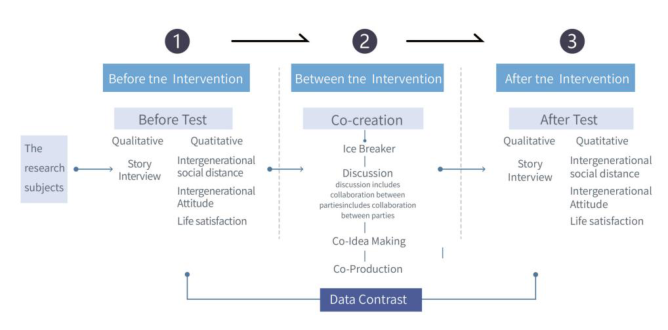
Figure 1: Intervention Experiment. The social distance, social attitudes, life satisfaction, and other aspects of the participants were measured before the intervention. The co- creation method was used in the intervention, which focused on group activities. A re-test was then conducted to compare the values before and after the activities and to verify the effectiveness of the co-creation method.
We addressed the following research question: how can strategies of integration, divergence, and neutrality be weighed in the process of inter- generational co-creation to generate new understandings and promote inter- generational identity? Our research hypothesis systematically explored this question.
We applied a single-group front-side/back-side design model combined with an interview method for experimental validation. The participants were randomly selected from the pilot community. A questionnaire was used to measure intergenerational attitudes, social distance, and life satisfaction, and the story interview method was used to glean further information about the participants’ perceptions of I-Rs. They then participated in workshops on various topics. A second round of questionnaires was administered after the workshops, and the variance was calculated using SPSS; we compared the differences between the two survey rounds to assess the validity of the co-creation model. The experimental procedure is illustrated in Figure 1.
The time dimension of intergroup relationships was considered in this co-creation project, which was focused on the topic of “How to build an all-age-friendly community public space.” After the workshop, the partici- pants were asked to repeat the survey to test the effect of the intervention. Our intergenerational social distance scale was based on the reverse social distance scale developed by Lee (1996), with the original wordings of the items adjusted to suit the research sample. Examples include “Would you like to befriend younger/older people?” and “Are you happy to interact with younger/older people.” The reliability coefficient of this scale was 0.82 for both measurements. The life satisfaction scale contained five items, including “I feel that my life is better in many ways.” The reliability coefficient for this scale was 0.88 for the first measurement and 0.91 for the second.
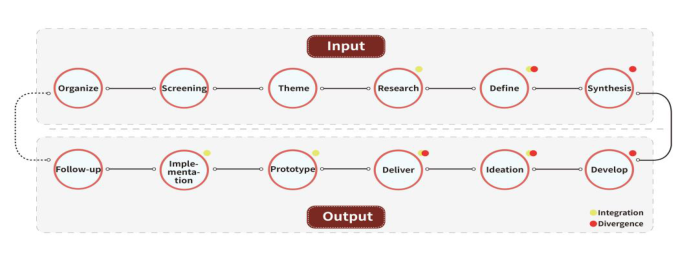
The specific components of the intervention stage of the co-creation pro- ject are shown in Figures 2 and 3. In the input stage, the needs of the group were established through participatory research. In the output section,
A Collaborative Co-Creation Design Approach to Intergenerational Integration 97
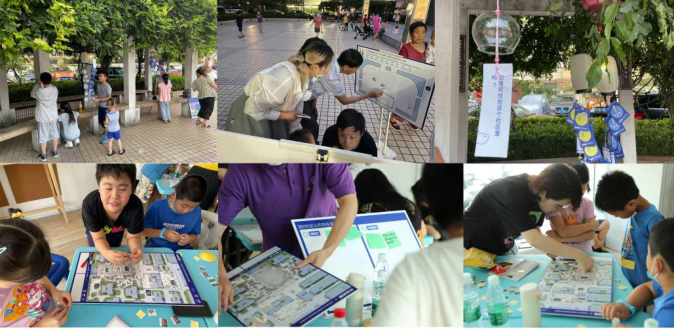
Figure 2: Intervention Experiment Flow. The participants’ social distance, social attitu- des, life satisfaction, and other aspects were measured before the intervention. The co-creation method was used in the intervention, which focused on group activities. A re-test was conducted to compare the values before and after the activities and verify the effectiveness of the co-creation method.Figure 3: Co-creation activities with friendly communities.
residents were supported while they produced valuable design solutions for the community through a co-creation workshop.
As illustrated in Figure 2, the co-creation process was divided into two parts: inputs, consisting of organizing activities, screening participants, set- ting up themes, researching, defining concepts, and developing questions; and outputs, consisting of concept development, ideation, delivery, prototyping, implementation, and follow-up. A separate intervention, each including the elements of integration and divergence, occurred at each node of the process. For example, in the concept definition phase all different age groups engaged in collaborative discussions and active debate. They generated original conce- pts through cognitive exchanges, and through cooperation between elderly people and younger generations.
Data Analysis The pre-intervention and post-intervention data on intergenerational attitu- des, social distance, and life satisfaction are shown in Figure 4. Before the
Figure 4: Comparison of survey results before and after intervention.
Figure available in the original PDF paper.
intervention, the participants’ intergenerational attitudes (I) were not highly developed, they had low levels of life satisfaction (L), and that they had high levels of intergenerational social distance. However, I and L increased signi- ficantly and social distance decreased significantly over the course of the co-creation project.
As shown in Figure 4, our hypothesis was supported: the incorporation of co-creation into workshops contributed to a reduction in social distance and an increase in intergenerational attitudes and life satisfaction. Many of the interview participants pointed out that this approach facilitated com- munication and co-creation among the participants, leading to a deeper understanding of other groups’ ideas and a gradual reduction in intergene- rational prejudice. The combination of integration and the diverse ideas of the participants allowed for a more democratic and fair exchange of ideas, leading to a deeper understanding between groups and the creation of new experiences (Kraff, 2020).
Discussion
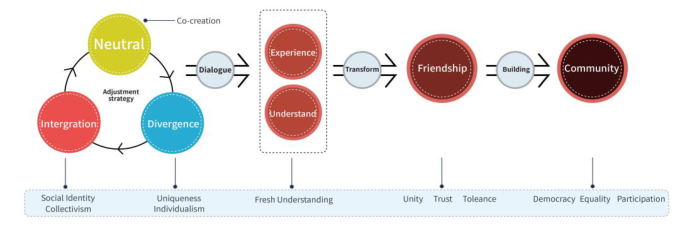
The experimental interventions demonstrate that co-creation can act as a mediator linking “integration” and “divergence.” Co-creation can also improve interpersonal relationships to some extent, as shown by the com- parative analysis of the pre- and post-intervention data. A preliminary model of the theory of adjustment strategies in I-Rs from an intergenerational perspective, which combines drivers and constraints, is presented in Figure 5.
Figure 5 shows that the I-I aspect of the co-creation adjustment stra- tegy must be directed at the convergence of generations. Disengaging from inherent postures can contribute to an equal relationship. The divergence strategy emphasizes the uniqueness of the individual, particularly during the process of implementation. Groups such as the elderly should be conside- red as individuals rather than viewed in terms of stereotypes and prejudices.
A Collaborative Co-Creation Design Approach to Intergenerational Integration 99
Figure 5: A theoretical model of a co-creation and adjustment strategy promoting intergenerational community integration.
The neutral strategy consists of a co-creation intervention when constructing the relationship, in which the designer plays a neutral role while activating and interacting with the participants to establish significance. Through the appropriate use of adjustment strategies (integration, divergence, and neu- trality), an “intergenerational dialogue” is formed, which is not limited to conventional verbal communication but includes non-verbal methods such as thematic seminars (workshops), I-G collaborative activities, and other forms of interaction (Bentzen, 2020). Effective dialogue facilitates I-Cs and genera- tes new understandings that can then be transformed into intergenerational friendships and identities (Rehema et al., 2016). In this process, collabora- tive interactions are gradually created and re-translated and encoded into new perspectives, which facilitates the reshaping of intergroup relations and ultimately leads to intergenerational consensus and the formation of social communities (Piredda et al., 2017).
CONCLUSION
In this study, we explored how co-creation methods can promote I-I in com- munities, which is relevant to the current social issue of ageing populations. The research team developed posited that co-creation facilitates I-I and medi- ates integration and divergence. The theoretical model was then applied to a case study project to test the effectiveness of the method. A multidimensional analysis including quantitative data, qualitative interviews, and a comparison of the project outputs was used to assess the results. The design enabled the researchers to identify the drivers and constraints of the co-creation method, leading to the development of tailored design strategies that can be applied in future community scenarios.
However, this project has some limitations, in addition to scalability. For example, we selected Shanghai, a first-tier Chinese city, for the pilot. We con- sidered the cognitive level of the participants and the practicability of the project, but also chose Shanghai because of its strong cultural identity and sense of community belonging. This guaranteed that the audience would take some initiative in subsequent workshop sessions. Our co-creation approach to intervention led to a relatively smooth and productive collaboration betw- een groups but lacked universality. This research will therefore be extended
to other contexts, so we can explore a wider range of development possibili- ties. We hope this project can promote the harmonious coexistence of elderly people with other generations.
ACKNOWLEDGMENT
We would like to acknowledge the funding support of Eric C. Yim Endowed Professorship and the Joint Supervision Scheme with the Chinese Mainland, Taiwan and Macao Universities, The Hong Kong Polytechnic University (PolyU). We also thank the Jiangnan University and the SD and RISUD of PolyU for the research support.
REFERENCES
Bentzen, T. L. (2020). “Continuous Co-creation: How On-going Involvement Impacts Outcomes of Co-creation”. Public Management Review (1): 1–21. Bengtson, V. L., & Black, K. D. (1973). Intergenerational relations and continuities
in socialization. In Life-span developmental psychology (pp. 207–234). Academic Press. Chen, Z. (2019). “Research on the Design of Community Elderly Services Based on Intergenerational Inclusion”. Industrial Design (8): 75–77. Freeman, S., Martin, J., Nash, C., Hausknecht, S., & Skinner, K. (2019). “Use
of a Digital Storytelling Workshop to Foster Development of Intergenerational Relationships and Preserve Culture with the Nak’azdli First Nation: Findings from the Nak’azdli Lha’hutit’en Project”. Canadian Journal on Ageing/La Revue Canadienne Du Vieillissement. 39(S2), 284–293. Groeneveld, B., Dekkers, T., Boudewijn Boon, B., & D’Olivo, P. (2018). “Challenges for Design Researchers in Healthcare”. Design for Health. 2(2), 305–326. Hutter, K., Hautz, J., Füller, J., Mueller, J., & Matzler, K. (2011). “Communitition:
The Tension between Competition and Co-creation in Community-Based Design Contests”. Creativity and Innovation Management. 20(1), 3–21. Kraff, H. (2020). “A Critical Exploration of Agonistic Participatory Design”. The Design Journal. 23(1), 31–48. Lee, M. Y., Sapp, S. G., & Ray, M. C. (1996). The reverse Social Distance Scale. The
Journal of Social Psychology, 136(1), 17–24. Piredda, F., Bertolotti, E., & Venditti, S. (2017). “Masters of Ceremonies: A Design Approach to Participatory Video”. The Design Journal. 20(sup1), S3340–S3353. Rehema, M. W., & Koten, H. V. (2016). “Co-designing for Sustainability: Strategi-
zing Community Carbon Emission Reduction through Socio-ecological Innova- tion”. The Design Journal. 19(1), 25–46. Souza, E. M. D. (2011). “Intergenerational Integration, Social Capital and Health: A Theoretical Thianthai, C. (2019). “Health Connections in Intergenerational Relationships: A
Case Study on the Impact of Familial Activities on the Health and Well-being of Young and Elderly People in Bangkok, Thailand”. Journal of Intergenerational Relationships. 18(2), 156–174. Tönnies, F. (2016). “Introduction to Sociology”. China Renmin University Press. Weckström, E., Jääskeläinen, V., Ruokonen, I., Karlsson, L., & Ruismäki, H. (2017).
Steps together: Children’s experiences of participation in club activities with the elderly. Journal of intergenerational relationships, 15(3), 273–289.
LISTED IN THE AHFE DIGITAL BOOKSTORE CATALOGUE
Explore the complete digital volume
Human Factors in Communication of Design
Read this individual research paper free through the original publisher, or explore the full digital proceedings book.
ISBN 978-1-958651-25-4
Explore this ISBN in the AHFE Bookstore ↗Listed in the July 2026 bookstore catalogue; search by ISBN to confirm current availability · Digital book purchase optional