Yunhe Du, Brian Yu Hin Lee, Kin Wai Michael Siu (2022). Promoting Elderly Residents' Quality of Life: Design Consideration for Bathing Experiences in the Nursing Home. In: Human Factors in Communication of Design. AHFE Open Access, vol. 49, pp. 86–92. https://doi.org/10.54941/ahfe1002040
Bathing elderly residents with assistance is a daily service provided in the Nursing Home (NH). However, it has been widely discussed that assisting bathing is one of the most challenging tasks in caregivers’ service process, and bathing experiences are closely related to the residents’ Quality of Life (QoL). Based on the findings from previous ergonomic studies, elderly residents’ agitated behaviors in the bathing process like repetitious vocalizations, used to communicate or express elderly residents’ unmet needs, are the primary cause of stress for caregivers. Thus, this study proposes design considerations for bathing activities in NHs under the theoretical models of QoL and needs, and it also assumes appropriate design for products and services can minimize the elderly’s agitated behaviors by addressing their unmet needs, which may help improve user experience and release care workers’ workload.
Nursing Home (NH) is one type of residential care centers providing personal care, assistance on daily lives, medical service, and social support for the elderly who generally have a mild or high level of disability with chronic dis- eases (Anderson et al., 2020). However, according to the studies on elderly residents, aging life in the NHs might have negative influences on their Qua- lity of Life (QoL) (Burack et al., 2012). On the other hand, the shortage of care workers increases the workload for nursing staff within NHs, which might also have a negative effect on elderly residents’ QoL due to the quality of care (Anderson et al., 2020; Vaarama et al., 2007).
In the routines within NHs, care workers need to assist residents with a series of daily lives, such as dressing, toileting, bathing or eating (Lee et al., 2002). Among these care services, bathing is a challenging task for care wor- kers due to the complexity of bathing activity and longer duration, which could be the critical point in the whole service flow (D’Hondt et al., 2012). It can be categized into self-bathing and assisting bathing in the context of these residential care centers (Cohen-Mansfield & Parpura-Gill, 2007). However, it has been widely discussed that assisting bathing, the essential daily service provided in NHs, is one of the most challenging tasks in caregivers’ service
Promoting Elderly Residents’ Quality of Life: Design Consideration 87
process. What’s more, elderly residents’ agitated behaviors in the bathing process are the primary cause of stress for caregivers (Holroyd & Holroyd, 2015). Therefore, this study will discuss possible reasons that may influence elderly residents’ bathing experiences and care workers’ working experience in assisting bathing under the QoL model, justify the importance of fulfilling elderly’s unmet needs in their bathing activities, and then propose possible research directions in defining design considerations for further study.
Quality of Life The concept of QoL has been widely discussed as a critical concept in multi- disciplinary studies on aging. World Health Organization defines QoL as “an individual’s perception of his or her position in life in the context of the culture and value system” (WHO, 2002), which provides a simple expla- nation but easily for the public to perceive. In academia, Walk’s definition of QoL is comparatively accepted among other scholars: “QoL an amorphous, multi-layered and complex concept with a range of components—objective, subjective, macro-societal, micro-individual, positive and negative—which interact together” (R. Fernández-Ballesteros et al., 2021; Pieper & Vaarama, 2008). Various models expand the QoL from the primary health-related domain into multi-dimensional directions, such as Schenk’s 10-dimensional Model, Lawton’s Good Life Model, Kelley-Gillespie’s Integrated Conceptual Model, Raphael’s 3B (Being, Belonging and Becoming) Model, and Pieper & Vaa- rama’s Care-related QoL Model (Kelley-Gillespie, 2009; Lawton, 1983; Pieper & Vaarama, 2008; Raphael et al., 1996; Schenk et al., 2013). Based on semi-structured interviews conducted by the researcher in 2022, Raph- ael’s 3B model is found to be comparatively applicable and intuitive for design practitioners. It is not confined to the specific expressions of domains. Instead, Raphael’s 3B model with three levels and six subdimensions provi- des a holistic and explicit view towards possible directions of the elderly’s QoL (Fernández-Ballesteros, 2011). Therefore, this study will adopt it as the theoretical basis to analyze the bathing experience in NHs.
Elderly Residents’ Needs NHs are faced with higher levels of demands on service since senior resi- dents are increasingly older, frailer and more dependent on personal care or other medical services due to their physical and cognitive impairments (Cobo, 2014; Martin et al., 2012). It is difficult to know whether their complex needs are fulfilled or not, especially for the elderly with dementia, who probably have unmet demands (Cohen-Mansfield, 2008). However, few studies show how NHs identify and address the unmet needs of elderly residents (Ferreira et al., 2016). Some studies find that when residents live in long-term care set- tings, unmet needs have been found to be associated with increased distress (Hoe et al., 2006)) and dissatisfaction with services (Orrell et al., 2008).
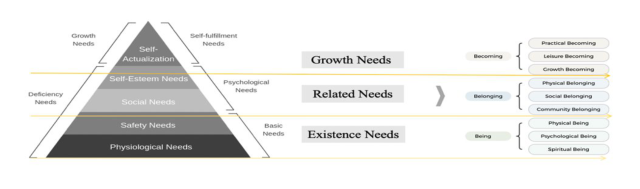
Maslow divided people’s needs into five levels: physiological needs, safety needs, self-esteem needs, and self-actualization (Maslow & Frager, 1987).
Figure 1: Mapping Maslow’s pyramid and Alderfer’s ERG theory with Raphael’s 3B QoL model. (By authors).
Based on his theory of human motivation, Alderfer developed ERG moti- vation theory into three categories: Existence, Relatedness and Growth (Alderfer, 1989). After physiological and safety needs are fulfilled, the follow- ing part is about social needs involving the feelings of love and belongingness, which are related to friendship, intimacy, trust, acceptance, receiving and giving affection and love (Maslow & Frager, 1987). The higher human needs seem to be self-esteem, and they are partially classified into dignity, achieve- ment, mastery, and independence. As mentioned in Raphael’s 3B QoL model, it seems that the being, belonging and becoming domains partly correspond to existence needs, related needs and growth needs respectively. Although this mapping is explored by the researcher, which needs more justificati- ons in further exploratory studies, it could be found that the hierarchy of elderly’s demands is closely related to their QoL under the view of Raphael’s 3B Model. Thus, understanding and fulfilling elderly residents’ unmet needs could be the opportunities for design intervention to enhance their bathing experience.
Elderly’s Unmet Needs from Cognitive Ergonomic Aspects Based on the findings from previous ergonomic studies, agitated behaviors are probably used to communicate or express residents’ unmet needs, and what’s more, these behaviors in the bathing process are the primary cause of stress for caregivers. (Cohen-Mansfield & Parpura-Gill, 2007; Konno et al., 2013; Minyo, 2020; Sloane et al., 2004). According to the Cohen-Mansfield and Werner’s Unmet Needs Model, most of these needs arise because of cognitive-related impairments in both communication and the ability to uti- lize the environment appropriately to accommodate needs (Cohen-Mansfield et al., 2015). Cohen-Mansfield defined agitated behaviours as “inappropri- ate verbal, vocal or motor activities that may be abusive or aggressive toward oneself or others and deviate from social norms” (Cohen-Mansfield et al., 2015; D’Hondt et al., 2012). On the other hand, the elderly’s self-bathing experiences in NHs are related to a series of concerns on autonomy, security, privacy and hygiene issues (Zingmark & Bernspång, 2011). These challen- ging behaviors may not only affect residents’ own QoL in bathing but also could increase the workload and unpleasant working experiences of care wor- kers. In that case, finding and fulfilling residents’ unmet needs can help to decrease unexpected scenarios in their assisting bathing experiences.
Promoting Elderly Residents’ Quality of Life: Design Consideration 89
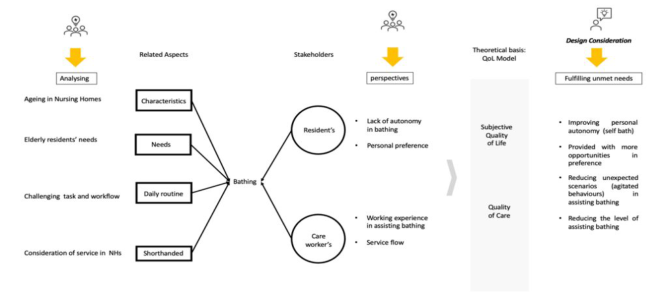
Figure 2: The research framework for “Promoting elderly residents’ quality of life: Design consideration for bathing experiences in the nursing home”. (By authors).
In addition, other qualitative studies on residents’ attitudes towards bath- ing experiences, find that two aspects are perceived as important for the elderly participants. One is the personal significance of bathing, and the other is the need to account for attitudes and preferences in bathing modes and the intervention ways of care or assistances (Ahluwalia et al., 2010; Tai et al., 2019). Although more justifications are needed from further studies, the need to promote personal autonomy and preferences in bathing might also be possible directions for design intervention.
Limitations of Current Design Studies on Bathing A few studies on design for the elderly’s bathing focus on the development of assisting bathing machines or robots which are mainly from the engineering perspective without more combination of services (Chang et al., 2021; Manti et al., 2016). Some of these are combined with the inventions as a result of the cooperation of academics and enterprise (Chang et al., 2021). A small number of studies describe the ergonomic design or human factors of bath- ing robots (He et al., 2019; Zhao et al., 2018). Other studies about elderly people’s bathing issues state the modification of bathroom design in commu- nity center (Liu & Lapane, 2009), which limit the consideration of bathing experiences solely on the physical environment without concerns about the interaction among residents, caregivers, bathing factifies and services. These studies not only lack the design consideration for products and services from a systematical view in the service flow of NHs, but also have few concerns about the elder’s QoL or other gerontological perspectives in the discussions.
Proposed Design Considerations According to the discussions above, four directions of design considerations are summarized as followings (See Figure 2).
Reducing unexpected scenarios in assisting bathing by reducing residents’ agitated behaviors.
Reducing the degree of care workers’ assistances in elderly residents’ bathing.
Promoting elderly residents’ autonomy towards self-bath.
Providing residents with more opportunities in bathing preference.
Based on these points, applicable design interventions with appropriate products and services might improve elderly residents’ QoL by enhancing their bathing experiences, care workers’ working experiences, and the whole service flow of NHs.
CONCLUSION
This study focuses on bathing experience in NHs and proposes design con- siderations for the experience of elderly residents, care workers, and their interaction within bathing activities. By analyzing elderly residents’ chara- cteristics from cognitive ergonomics, this paper describes the unmet needs linked to their QoL and identifies the key aspects of fulfilling these unmet needs. The key design suggestions for design are improving the elderly’s autonomy in self-bath and assisting bath, increasing communication modes among elderly residents and care workers, and providing multiple options in fulfilling elderly residents’ diverse preferences. These findings will help the design researcher map the user scenario with underpinning theories about problems among elderly users suffering from cognitive impairment. The pos- sible directions of further study may focus on the investigation of specific unmet needs of elderly residents and care workers’ workload in bathing activities by case studies.
ACKNOWLEDGMENT
The authors would like to acknowledge the RPg studentship of The Hong Kong Polytechnic University. The authors also thank the Eric C. Yim Endo- wed Professorship in Inclusive Design (Ref: 8.73.09.847K).
REFERENCES
Ahluwalia, S. C., Gill, T. M., Baker, D. I., & Fried, T. R. (2010). Perspectives of older persons on bathing and bathing disability: a qualitative study. Journal of the American Geriatrics Society, 58(3), 450–456. Alderfer, C. P. (1989). Theories reflecting my personal experience and life develo-
pment. The Journal of Applied Behavioral Science, 25(4), 351–365. Anderson, D., Grey, T., Kennelly, S., & O’Neill, D. (2020). Nursing home design and COVID-19: balancing infection control, quality of life, and resilience. Journal of the American Medical Directors Association, 21(11), 1519–1524. Burack, O. R., Weiner, A. S., Reinhardt, J. P., & Annunziato, R. A. (2012). What
matters most to nursing home elders: quality of life in the nursing home. Journal of the American Medical Directors Association, 13(1), 48–53. Chang, W., Liu, H., Lu, J., & Chen, Y. (2021). Assist the elderly bathing machine.
Paper presented at the Journal of Physics: Conference Series. Cobo, C. M. S. (2014). The influence of institutionalization on the perception of autonomy and quality of life in old people. Revista da Escola de Enfermagem da USP, 48, 1013–1019.
Promoting Elderly Residents’ Quality of Life: Design Consideration 91
Cohen-Mansfield, J. (2008). Agitated behavior in persons with dementia: the relationship between type of behavior, its frequency, and its disruptiveness. Journal of psychiatric research, 43(1), 64–69. Cohen-Mansfield, J., Dakheel-Ali, M., Marx, M. S., Thein, K., & Regier, N. G.
(2015). Which unmet needs contribute to behavior problems in persons with advanced dementia? Psychiatry research, 228(1), 59–64. Cohen-Mansfield, J., & Parpura-Gill, A. (2007). Bathing: A framework for intervention focusing on psychosocial, architectural and human factors considerations. Archives of gerontology and geriatrics, 45(2), 121–135. D’Hondt, A., Kaasalainen, S., Prentice, D., & Schindel Martin, L. (2012). Bathing
residents with dementia in long-term care: critical incidents described by personal support workers. International Journal of Older People Nursing, 7(4), 253–263. Fernández-Ballesteros. (2011). Quality of life in old age: Problematic issues. Applied Research in Quality of life, 6(1), 21–40. Fernández-Ballesteros, R., Sánchez-Izquierdo, M., & Santacreu, M. (2021). Active
Aging and Quality of Life. In Handbook of Active Ageing and Quality of Life (pp. 15–42): Springer. Ferreira, A. R., Dias, C. C., & Fernandes, L. (2016). Needs in nursing homes and their relation with cognitive and functional decline, behavioral and psychological symptoms. Frontiers in aging neuroscience, 8, 72. He, Z., Yuan, F., Chen, D., & Wang, M. (2019). Ergonomic Design of Multi-
functional Bathing Robot. Paper presented at the 2019 IEEE International Conference on Real-time Computing and Robotics (RCAR). Hoe, J., Hancock, G., Livingston, G., & Orrell, M. (2006). Quality of life of people with dementia in residential care homes. The British Journal of Psychiatry, 188(5), 460–464. Holroyd, A., & Holroyd, H. (2015). Bathing in residential care: understanding the
experiences of residents and their care providers. Quality in Ageing and older Adults. Kelley-Gillespie, N. (2009). An integrated conceptual model of quality of life for older adults based on a synthesis of the literature. Applied Research in Quality of life, 4(3), 259–282. Konno, R., Stern, C., & Gibb, H. (2013). The best evidence for assisted bathing
of older people with dementia: a comprehensive systematic review. JBI Evidence Synthesis, 11(1), 123–212. Lawton, M. P. (1983). Environment and other determinants of weil-being in older people. The Gerontologist, 23(4), 349–357. Lee, D. T., Woo, J., & Mackenzie, A. E. (2002). A review of older people’s experiences
with residential care placement. Journal of advanced nursing, 37(1), 19–27. Liu, S. Y., & Lapane, K. L. (2009). Residential modifications and decline in physical function among community-dwelling older adults. The Gerontologist, 49(3), 344–354. Manti, M., Pratesi, A., Falotico, E., Cianchetti, M., & Laschi, C. (2016). Soft assistive
robot for personal care of elderly people. Paper presented at the 2016 6th IEEE international conference on biomedical robotics and biomechatronics (BioRob). Martin, M., Schneider, R., Eicher, S., & Moor, C. (2012). The functional quality of life (fQOL)-model. GeroPsych. Maslow, A., & Frager, R. (1987). Motivation and Personality (book). In: New York:
Harper and Row. Minyo, M. J. (2020). Understanding the Unmet Needs and Need-Driven Behaviors of Individuals with Mild to Moderate Dementia. Cleveland State University,
Orrell, M., Hancock, G. A., Liyanage, K. C. G., Woods, B., Challis, D., & Hoe, J. (2008). The needs of people with dementia in care homes: the perspectives of users, staff and family caregivers. International Psychogeriatrics, 20(5), 941–951. Pieper, R., & Vaarama, M. (2008). The concept of care-related quality of life. 65–101. Raphael, D., Renwick, R., Brown, I., & Rootman, I. (1996). Quality of life indicators
and health: Current status and emerging conceptions. Social indicators research, 39(1), 65–88. Schenk, L., Meyer, R., Behr, A., Kuhlmey, A., & Holzhausen, M. (2013). Quality of life in nursing homes: results of a qualitative resident survey. Quality of life research, 22(10), 2929–2938. Sloane, P. D., Hoeffer, B., Mitchell, C. M., McKenzie, D. A., Barrick, A. L., Rader,
J., . . . Zink, R. C. (2004). Effect of person-centered showering and the towel bath on bathing-associated aggression, agitation, and discomfort in nursing home residents with dementia: A randomized, controlled trial. Journal of the American Geriatrics Society, 52(11), 1795–1804. Tai, Y., Saeki, K., Yamagami, Y., Yoshimoto, K., Kurumatani, N., Nishio, K., & Obayashi, K. (2019). Association between timing of hot water bathing before bedtime and night-/sleep-time blood pressure and dipping in the elderly: a lon- gitudinal analysis for repeated measurements in home settings. Chronobiology International, 36(12), 1714–1722. Vaarama, M., Pieper, R., & Sixsmith, A. (2007). Care-related quality of life in old age:
Concepts, models, and empirical findings: Springer Science & Business Media. WHO. (2002). Active Aging: A Policy Framework for Non-Communicable Disease Prevention and Health Promotion, Ageing and Life Course. Geneva, Switzerland. WHO. Zhao, J., Zhou, X., & Yin, Z. (2018). Bathing device for disabled-the design and
analysis of the double lift-type bath. Paper presented at the 2018 International Conference on Advanced Mechatronic Systems (ICAMechS). Zingmark, M., & Bernspång, B. (2011). Meeting the needs of elderly with bathing disability. Australian Occupational Therapy Journal, 58(3), 164–171.
LISTED IN THE AHFE DIGITAL BOOKSTORE CATALOGUE
Explore the complete digital volume
Human Factors in Communication of Design
Read this individual research paper free through the original publisher, or explore the full digital proceedings book.
ISBN 978-1-958651-25-4
Explore this ISBN in the AHFE Bookstore ↗Listed in the July 2026 bookstore catalogue; search by ISBN to confirm current availability · Digital book purchase optional