Poyen Hsu, Yi Xiang Su, Chien-Hsu Chen (2023). Interface design for 360°real scenes-based virtual reality system with pedaling devices. In: Healthcare and Medical Devices. AHFE Open Access, vol. 79, pp. 76–83. https://doi.org/10.54941/ahfe1003475
As the elderly get older, they often have problems such as a gradual decline in physical function, it may even lead to the risk of lower limb disability if they stay at home or sit for a long time without regular exercise. In order to prevent the lower limbs of the elderly from being disabled, stepping devices are often used as a kind of exercise, which can not only control the amount of exercise but also improve cardiopulmonary function, and can also reduce the risk of injury during training. However, the elderly cannot maintain regular exercise due to insufficient training motivation.To understand and explore the motivation of 360° real scenes-based virtual reality for the elderly to use the lower limb pedaling device, we created VBike, a system that combines 360° real scenes-based virtual reality based on a pedaling device and a heart rate watch connected with Bluetooth. From this study, we can understand the design steps and implementation methods of the combination of 360° real scenes-based virtual reality with pedaling devices and confirm that 360° real scenes video will affect the motivation of the elderly to use the pedaling device. In the future, this study suggests adding the design of guide signs and audio-visual guides to help the elderly see and explore more in-depth 360° real scenes-based virtual reality and increase the experience of pedaling by the elderly.
According to data from the United Nations (World Population Prospects 2022: Summary of Results), the world’s population over the age of 65 will reach 11.7% in 2030 and 16.4% in 2050, at which point the global aging population will be more than twice the number of children under the age of 5 (World Population Prospects 2022: Summary of Results, 2022). Aging has become one of the most important global issues. For the elderly, the first thing to be impacted is the loss of physical function and cognitive ability (Zhang et al., 2016). Common reasons may be that elderly people stay at home and sit for a long time, and in recent years, the impact of the new coronavirus pandemic has led to a growing number of older people who lack exercise. In addition to affecting lower limb function, it also leads to physical risks (Gao et al., 2020; Zhang et al., 2016). Lack of exercise can easily lead to a
decrease in muscle strength, is more likely to affect overall muscle and cardio- respiratory function, leading to a decline in the ability to adapt to internal and external pressures, and triggering a vicious cycle of aging and disease death risk (Fedarko, 2011). Therefore, how to help the elderly establish a habit of continuous exercise of lower limbs is an important issue to prevent disability in the elderly.
VR videos and receive feedback. Compared to computer-generated virtual environment content, real 360
VR content is more easily connected to the real world for older adults and can also meet their needs based on their memories and backgrounds (Toshima, 2019). Relevant research has found that combining HMD and computer-generated VR simulations with fixed treadmills can bring immersive experiences and improve user motivation. However, for older adults, the effects of using HMD are not strong because they are more likely to experience dizziness (Arlati et al., 2019; Grani & Bruun-Pedersen, 2017; Q. Liu et al., 2020; Pedroli et al., 2019). In previous research, we also applied VBike to three display environments to test older adults’ feelings towards different environments and found that older adults had problems with HMD adaptation (Su & Chen, 2021). Therefore, this study focuses on PC and Android application versions as the software presentation of 360
virtual reality videos and fixed treadmill systems.
This research summarizes the observations and test results of the past elderly life and uses software design methods to deduce system functions and present information. In addition, considering the characteristics and intera- ction habits of the elderly population, it serves as a normative for the software interface design operation process. The development is based on the inte- grated design of software and hardware, to ensure the subsequent interface design in the software and hardware system testing and functions.
BACKGROUND RESEARCH Taiwan currently has established a complete care service from community to hospital, intending to improve the health of the elderly, reducing the length of time spent in hospitals, decreasing disability, and enhancing the quality of life. Additionally, it also hopes to increase the independence and self-care of the elderly. To alleviate the effects of aging, health promotion is an impor- tant key for the elderly to maintain good health. As the elderly age, they often face significant changes in their social roles and social status, which can lead to difficulty in adapting to their society. Therefore, during the process of health promotion, the companionship or care of family and caregivers is an important part. Health promotion factors mainly include self-realization,
health responsibility, exercise, nutrition, social support, and stress manage- ment. Besides their efforts, the elderly need the encouragement, support of family members, and healthcare professionals if they want to maintain their physical function to age healthily (Hsu & Hu, 2018). For the elderly, parti- cipating in exercise training in indoor places such as homes, community and nursing homes is particularly important (Arlati et al., 2019). Cycling is a form of exercise that is suitable for promoting health in older adults. In addition to balance and gait, it enhances cardiovascular function while controlling the amount of exercise and reducing the risk of injury during training, providing a safer training environment for older adults.
Additionally, cycling is easy to operate for older adults, and it is easy to incorporate into subconscious exercise, making it very suitable to become a regular activity for most people. Therefore, cycling is a very suitable form of exercise for promoting lower limb health in older adults.
Virtual reality (VR) is a method of applying computer simulation to create virtual environments in a three-dimensional space. Users can feel as if they are in the real world and can observe objects and events in a three-dimensional space without any restrictions. Currently, virtual reality is mainly divided into fully immersive virtual reality and non-immersive virtual reality. With the maturity of virtual technology, it has been widely applied to many diffe- rent industries and has had a significant impact (Liao et al., 2019; Peng & Crouse, 2013). Some studies have shown that immersion can generally pro- duce more fun, thus obtaining greater motivation for movement and that the use of virtual reality can enhance training motivation, thereby making the- rapy more effective (Van Diest et al., 2013). In addition, the combination of virtual reality and elderly rehabilitation not only improves motivation and training effects but also reduces users’ anxiety and depression, and improves overall psychological and health status (Zeng et al., 2018). Physical therapi- sts and occupational therapists can use virtual reality interactive software to receive real-time physiological information feedback in a non-clinic or hospi- tal environment, reducing the pressure of medical services. In addition, virtual reality also allows the elderly to partially recover from training outside of the hospital, allowing them to focus on higher- quality care (Gao et al., 2020). Furthermore, during the COVID-19 pandemic, to avoid the risk of infection, older adults are more likely to want to engage in activities at home. Therefore, if virtual reality can be placed in nursing homes, communities, etc. indoors, it will bring more benefits to older adults and their caregivers.
In various virtual reality technologies, using VR technology that records real 360
video environments allows users to immerse themselves more dee- ply in the environment. Users can use VR software that is matched with actual 360
video to experience education and training, high-risk occupa- tional training, high-risk cultural events, and even extreme sports (Chang et al., 2019; K.-H. Liu et al., 2020). Liu, Sasaki, Kajihara, Hiyama, Inami, and Chen (2020) proposed the use of 360
video in VR to combine cultural navigation experience research, and actual 360
virtual reality video techno- logy should have potential benefits and motivation for the rehabilitation of the elderly. In addition, Toshima (Toshima, 2019) recorded real-life scenes and brought them to nursing homes for the elderly to watch. He surveyed
Interface Design for 360
Real Scenes-Based Virtual Reality System 79
what the elderly in nursing homes wanted to see, and used HMDs to allow the elderly to watch, increasing the connection between the elderly’s memory and the real world, and increasing their motivation and willingness to use. Although VR can increase the elderly’s interest in the operation, if viewed using HMDs, long-term use usually causes dizziness and reduces the elderly’s interaction with others. Therefore, using real 360 panoramic video instead of HMD virtual reality is more in line with the habits of the elderly.
Real 360
VR video technology can make people feel connected to the real world, but when recording, the camera angle, video content, and camera movement need to be considered, and attention should be paid to sound prompts to make the audience more attentive. A study also pointed out that if the behavior in the recording environment occurs within 3 meters of the vie- wer, there will be a better sense of immersion, 4 meters will feel too far away and affect attention, and 2 meters will feel too close and distort (Sheikh et al., 2016). In hardware selection, if a single panoramic lens is used for shooting, the transition between the upper and lower images on the video will usually cause distortion, but it can be minimized through design or lens movement. Therefore, when recording real 360
videos, it is necessary to consider whe- ther the moving objects in the scene are too close or too far away from the camera, which will affect the overall realism of the scene.
DESIGN CONSIDERATION AND DEVELOPMENT Previous literature has concluded the application of lower limb exercise equi- pment for promoting health in older adults through on-site observations and interviews. We have summarized the conclusions from the literature into the following points: (1) Lower limb training equipment with a certain degree of feedback can improve the training motivation of older adults. (2) Older adults resonate with nostalgic elements of activities and things they have experienced.
(3) Encouragement from family and acquaintances can help older adults maintain their exercise motivation. (4) Social activities among older adults can enhance their sense of belonging and willingness to exercise. (5) Providing real-time data feedback during or at the end of training can help older adults understand their health status.
For older adults, simple and clear design steps can help them adapt to the system while reducing operational errors and increasing older adults’ confidence in the system. In addition, considering the deterioration of older adults’ vision, the system interface should also use bright and high-brightness colors, making it easy for older adults to identify system content. The text should focus on clearly presenting the content and achieving a balance betw- een design aesthetics. At the same time, buttons should also maintain a certain distance, making it easier for older adults to identify each button. The VBike system includes hardware such as a pedaling device, controller, heart rate monitor, and software display screen. We use Unity as the software interface tool, Unity allows the development of hardware-software communication, with visual operation interface and software program interaction applicati- ons, which can help developers control the interaction between hardware and
software. The software design architecture uses the MVC application deve- lopment framework, dividing the system content into three parts: Model, View, and Controller, which decomposes the functions, information, etc. in each system scene, making it easier for subsequent system development and testing. The main display screen of this system is a 32-inch PC screen and the Android platform, the content displayed includes 360
reality videos and control button interfaces. The 360
reality videos include Tainan Park, Zheng Chenggong Memorial Hall and Anping Fort.
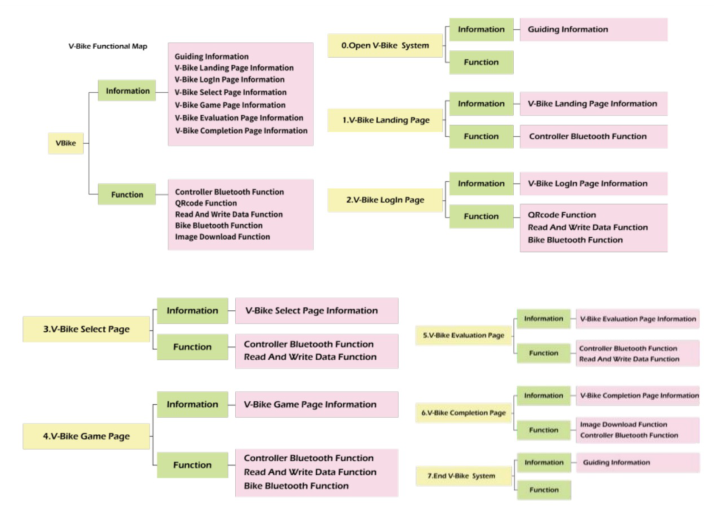
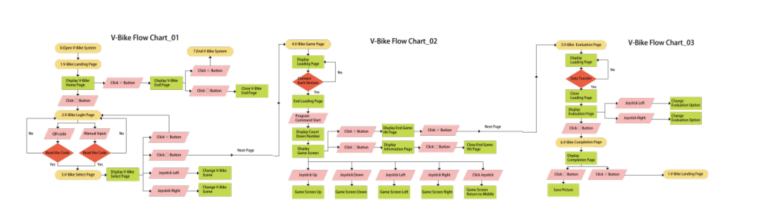
VBIKE INTERFACE DESIGN In interface design, we use software design methods and particularly con- sider the feasibility of the MVC architecture for future software-hardware integration. We first list the information and functions that the software inter- face needs to present using a Functional Map, to identify the content that needs to be covered in the interface design. The information presented in the Functional Map plays an important role in subsequent software-hardware integration testing, and in the MVC architecture, it allows for independent testing of functions. We continue the content of the Functional Map and integrate the steps of the system execution and the logic of user operation into a Flow Chart. We set older adults as our main users, so we particularly consider real-time feedback and prompts, so that older adults can discover changes in system functions or states. In addition, we also eliminate overly complex or hidden functions, making each action’s purpose singular, to help older adults easily operate or view functions. Next, we use simple geometric
shapes to design UI Flow for each stage in the Flow Chart, to confirm the design elements and objects needed in each system scene.
In summary of the above design process, we ultimately used Unity as the software for interface development. The system screen size is set to 1920*1080 and considering different platform devices’ application scena- rios, we chose a responsive interface design method to adapt to various size interface environments.
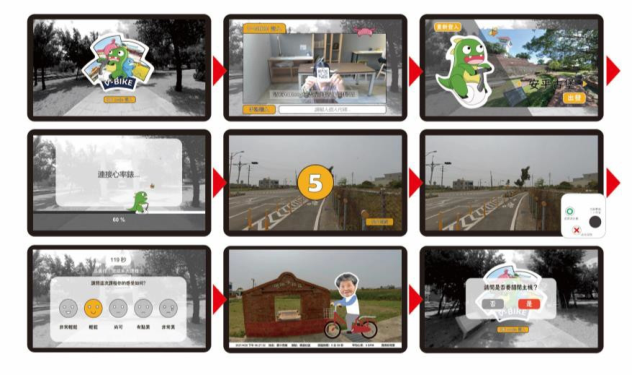
By integrating the information from the Functional Map and Flow Chart, we divided the system scenes into the following six scenes. (1) The start scene is the initial screen of the system, including the system logo and the start button. (2) In the login scene, users can log in to the system through their personal QR code or by entering their user code, and the system can record user information. (3) In the selection scene, users can choose the 360
video environment for subsequent playback, including Tainan Park, Cheng Kung Shrine, and Anping Fort. After selecting, users can start exercising by pres- sing the “depart”button. (4) In the game scene, users can exercise by pedaling while watching the scenery of famous places through 360
videos. Users can see information such as exercise time and the number of circles from the course information button, the personal information button will show users’
names, heart rates, and RPM, and the setting button allows users to control the resistance of the pedal to control the intensity of exercise. (5) In the evalu- ation scene, users will be evaluated by a 5-level score based on their subjective feelings, as a basis for subsequent experiments. (6) In the sharing scene, users can share their exercise results and data with their friends and family. Apart from their own exercise results from this interface, users can use it as proof of sharing results with friends and family.
CONCLUSION
This study builds on the conclusions of past VBike tests and interviews, inte- grating the functions and information presentation of software and hardware systems, and planning and designing the system interface. In the design of the system interface, we consider the characteristics and technology interaction patterns of the elderly population, using vibrant colors, larger text, and a simple interface configuration for visual presentation, to be friendly to the elderly. This will make the operation process more intuitive for the elderly, increasing users’ trust in the system. In our next step, the VBike system will continue to optimize the PC and Android versions. In addition, we also plan to introduce the VBike system to long-term care centers for testing, to under- stand the elderly’s feelings about the application of this research in real-world settings, and also as a consideration for future improvements to the system.
REFERENCES
Arlati, S., Colombo, V., Spoladore, D., Greci, L., Pedroli, E., Serino, S., Cipresso, P., Goulene, K., Stramba-Badiale, M., & Riva, G. (2019). A social virtual reality- based application for the physical and cognitive training of the elderly at home. sensors, 19(2), 261. Chang, C.-Y., Sung, H.-Y., Guo, J.-L., Chang, B.-Y., & Kuo, F.-R. (2019). Effects of spherical video-based virtual reality on nursing students’ learning per-
formance in childbirth education training. Interactive Learning Environments, 1–17. Fedarko, N. S. (2011). The biology of aging and frailty. Clinics in geriatric medicine, 27(1), 27–37. Gao, Z., Lee, J. E., McDonough, D. J., & Albers, C. (2020). Virtual reality exercise
as a coping strategy for health and wellness promotion in older adults during the COVID-19 pandemic. In (Vol. 9, pp. 1986): MDPI. Grani, F., & Bruun-Pedersen, J. R. (2017). Giro: better biking in virtual reality. 2017 IEEE 3rd Workshop on Everyday Virtual Reality (WEVR), Hsu, C., & Hu, H. (2018). Retrospect and prospect of promoting health promotion
for the elderly in Taiwan. Health Promotion & Health Education Journal, 42, 39–65. Liao, Y.-Y., Chen, I., & Wang, R.-Y. (2019). Effects of Kinect-based exergaming on frailty status and physical performance in prefrail and frail elderly: A randomized controlled trial. Scientific reports, 9(1), 1–9. Lim, G., & McIvor, W. R. (2015). Simulation-based anesthesiology education for
medical students. International anesthesiology clinics, 53(4), 1–22. Liu, K.-H., Sasaki, T., Kajihara, H., Hiyama, A., Inami, M., & Chen, C.-H. (2020).
Virtual kayaking: a local culture-based virtual reality paddling experience. Human
Interface Design for 360
Real Scenes-Based Virtual Reality System 83
Aspects of IT for the Aged Population. Healthy and Active Aging: 6th Inter- national Conference, ITAP 2020, Held as Part of the 22nd HCI International Conference, HCII 2020, Copenhagen, Denmark, July 19–24, 2020, Proceedings, Part II 22. Liu, Q., Wang, Y., Yao, M. Z., Tang, Q., & Yang, Y. (2020). The effects of viewing an uplifting 360-degree video on emotional well-being among elderly adults and college students under immersive virtual reality and smartphone conditions. Cyberpsychology, behavior, and social networking, 23(3), 157–164. Pedroli, E., Cipresso, P., Greci, L., Arlati, S., Boilini, L., Stefanelli, L., Rossi, M.,
Goulene, K., Sacco, M., Stramba-Badiale, M., Gaggioli, A., & Riva, G. (2019). An Immersive Motor Protocol for Frailty Rehabilitation [Perspective]. Frontiers in neurology, 10. https://doi.org/10.3389/fneur.2019.01078 Peng, W., & Crouse, J. (2013). Playing in parallel: The effects of multiplayer modes in active video game on motivation and physical exertion. Cyberpsychology, behavior, and social networking, 16(6), 423–427. Sheikh, A., Brown, A., Watson, Z., & Evans, M. (2016). Directing attention in 360-
degree video. Su, Y.-X., & Chen, C.-H. (2021). Virtual Reality Based System with a Stationary Bike to Enhance Lower Limb Training for Elderly. Advances in Human Factors and Ergonomics in Healthcare and Medical Devices: Proceedings of the AHFE 2021 Virtual Conference on Human Factors and Ergonomics in Healthcare and Medical Devices, July 25-29, 2021, USA. Toshima, K. (2019). Transforming Elder Care through VR: Nursing Tech Pioneer.
https://www3.nhk.or.jp/nhkworld/en/tv/rising/20191128/2042090/ Van Diest, M., Lamoth, C. J., Stegenga, J., Verkerke, G. J., & Postema, K.
(2013). Exergaming for balance training of elderly: state of the art and future developments. Journal of neuroengineering and rehabilitation, 10(1), 1–12. World Population Prospects 2022: Summary of Results. (2022). United Nations.
https://www.un.org/development/desa/pd/content/World-Population-Prospects- 2022 Zeng, N., Pope, Z., Lee, J. E., & Gao, Z. (2018). Virtual reality exercise for anxiety and depression: A preliminary review of current research in an emerging field. Journal of clinical medicine, 7(3), 42. Zhang, H., Shen, Z., Lin, J., Chen, Y., & Miao, Y. (2016). Familiarity design in exe-
rcise games for elderly. International Journal of Information Technology, 22(2), 1–19.
LISTED IN THE AHFE DIGITAL BOOKSTORE CATALOGUE
Explore the complete digital volume
Healthcare and Medical Devices
Read this individual research paper free through the original publisher, or explore the full digital proceedings book.
ISBN 978-1-958651-55-1
Explore this ISBN in the AHFE Bookstore ↗Listed in the July 2026 bookstore catalogue; search by ISBN to confirm current availability · Digital book purchase optional