Yu-Lien Shen, Chien-Hsu Chen, I-Hsin Chen (2023). Designing a system using telepresence technology to enhance the feeling of "being there" for elderly individuals at healthcare centers. In: Human Factors in Aging and Special Needs. AHFE Open Access, vol. 88, pp. 21–29. https://doi.org/10.54941/ahfe1003658
The study focuses on enhancing the "being there" presence by using 360 real-time video technology to create a remote interactive device system for the elderly in health care centers. By enhancing the “being there” presence of elderly, we can improve the physical and mental health of the elderly.In the experiment, the guide put on a wearable device to make a tour of a specific place, and the elderly watched the tour from a remote location on a monitor. After the test, we conducted a semi-structured interview with the participant to understand their feelings about the operation of the device, the content of the system, and their sense of "being there" presence. We also conducted expert interviews with the experimental results to establish the device's design direction, usability, and usage patterns.From the study, we have concluded that the design and usability of the navigation device and the viewer device, as well as the clarity of the viewing screen, are the main factors that affect remote presence. Devices that meet the usability of both parties can increase the sense of "being there" presence. Additionally, the interaction process between the elderly and the remote guide, as well as the content design and the process of interaction between the two people, can help enhance the remote presence of the elderly.
Aging has been a common phenomenon in developed countries worldwide for the over past decade. According to data, in 2018, the number of people over 65 years old exceeded that of children under 5 years old, and by 2050, the elderly population is expected to reach one-sixth of the global population (United Nations World Population Prospects 2019). In Taiwan, the elderly population is also expected to reach 20.1% by 2025, officially reaching the standard of a super-aged society (National Development Council, Executive Yuan, 2021). Therefore, it is essential to plan ahead and develop the needs of the upcoming super-aged society.
The increase in the number of elderly populations in Taiwan has led to a growing demand for care, companionship, and assistance in daily affairs. While government measures and management of long-term care institutions aim to maintain the safety of elderly people’s activities within a specific range,
this also means that the range of activities is limited. However, studies show that the frequency of going out and the physical and mental health of the elderly are positively related. By looking at the outside scenery, creating a sense of deviation from regular schedules and daily life, or temporarily chan- ging the location of activities (Bengtsson & Carlsson, 2013; Dahlkvist et al., 2016), the elderly can relax, reduce emotional behavior, and improve their quality of life, sleep, and mental state (Kowitt et al., 2020; van den Berg et al., 2019). In recent years, the widespread use of Information Communication Technology (ICT) and Computer Mediated Communication (CMC) functi- ons has provided the elderly with instant contact with the outside world, such as chat software, voice and video functions, and other remote communication technologies (Salman, Ahmad, & Sulaiman, 2018). However, existing remote technologies focus more on face-to-face communication, allowing people in different locations to communicate, connect emotionally, or handle business. They lack consideration from the perspective of presence, making it difficult for people to feel themselves in the external environment. Additionally, exi- sting technologies rarely take the elderly as the main consideration for design direction (Mohadisdudis & Ali, 2014), making the elderly unfamiliar and averse to learning about technological products.
Furthermore, in recent years, virtual reality has begun to be developed for multi-purpose use, providing a more immersive experience. However, the operation is more difficult, and motion sickness is more likely to occur (C.-L. Liu & Uang, 2012), making it uncomfortable and challenging for the elderly to learn. Due to the limitations of existing devices and the lack of design objects for the elderly, it is challenging for the elderly to achieve an immersive effect in use.
Therefore, this study aims to create a remote interactive device system that can be used by the elderly at home or in long-term care centers, using remote presence with panoramic real-time image technology. This device system will be worn by remote guides, allowing the elderly to interact with remote people and things with the guidance and accompaniment of remote guides, thereby enhancing the remote presence of the elderly and maintaining their physical and mental health.
Background Research According to statistics from the Taiwan Network Information Center (2019), smartphones are the most commonly used devices by elders today. The most used functions among elders are “using communication software (36.4%),” “watching online videos (34.0%),” and “using social media (26.7%),” indi- cating that they have a need for socializing with people remotely. Video communication allows elders to participate in distant activities with family members and view the outside world, increasing their sense of remote participation and presence and making them feel more connected to the world (Hayashi & Suzuki, 2018). However, older adults who are not fami- liar with smartphone devices may encounter some difficulties during video communication.
Designing a System Using Telepresence Technology 23
To enable older adults to operate mobile phones on their own, designers can adopt the concept of universal design (Universal Design Approach) when designing the device system’s usability. Universal design is defined as “design or an environment that can be understood and used by anyone regardless of age, gender, and ability” (CEUD, 2017). In addition, designers should con- sider customization design for the abilities of older adults, including human factors, interaction design, and aesthetics. The adjustments should focus on simple, easy-to-understand, and intuitive design in the interface (Kane & Pernice, 2021). If learning is needed, many prompts should be designed, with the goal of making older adults able to operate the device independently in the future (Wu et al., 2021).
To achieve a more realistic feeling, remote presence technology can be applied. Minsky (1980) introduced the concept of telepresence, which refers to the phenomenon of users controlling remote objects to create a sense of being there. Studies have shown that virtual reality can enhance the sense of being there in telepresence technology between the physical and virtual environment, allowing older adults to break away from the domain of long- term care centers and feel as if they have entered another domain (Malloy & Milling, 2010). According to research results, older adults find the most attractive aspect of using virtual reality technology to be the experience that they cannot achieve in real life or physically (Mosadeghi, Reid, Martinez, Rosen, & Spiegel, 2016). Therefore, the use of virtual reality can help enha- nce the sense of being there in telepresence technology, allowing older adults to explore places they want to go to, instead of passively waiting for the opportunity to go out.
The choice of remote hardware also affects the realism of virtual reality in terms of human perception. According to Mujber, Szecsi, and Hashmi (2004), virtual reality systems are divided into three categories based on the intensity of immersion: non-immersive systems, such as desktop computers; semi-immersive systems, such as projection methods; and fully immersive systems, such as virtual reality systems. This indicates that different devices will bring users different levels of immersion, thereby affecting the feeling of remote presence. In a study by Q. Liu, Wang, Yao, Tang, and Yang (2020), the elderly used the 360-degree image player inside the iPhone 8 to watch 360-degree videos, and the head-mounted display to watch virtual reality 360-degree videos. The results showed that watching with a mobile phone is safer and more familiar for the elderly, and that 360-degree videos played on a mobile phone were more comfortable for them and did not cause visual diz- ziness. It can be seen that the elderly still prefer devices that are more familiar and easy to control.
As shown in the literature above, the design and usability of remote pre- sence devices will affect the degree of remote presence feeling of the elderly. Different devices for transmitting information, various visual stimuli, and the location of the devices are all parameters that can be designed and adjusted. The scope of this study focuses on discussing remote presence technology and the feeling of remote presence. The interaction mode between the user and the elements in the environment will affect the user’s perception of remote
presence, and by sorting out the elements with a high influence from these interaction modes, it can provide a reference for the design of devices.
Design Considerations and Development As discussed in the literature above, combining remote presence with tou- rism guidance and social companionship, along with real-time images, can help older adults feel more present in the external environment. This allows them to detach from reality and focus on the present environment, leading to a feeling of relaxation and happiness (Kaplan, 1995). This method can be applied to older adults in long-term care centers and may enable them to temporarily shift their focus away from their surroundings, leading to a sense of stability and happiness. Therefore, this study aims to use remote presence methods to enhance this feeling of detachment from the current environment, creating a suitable remote presence tourism interaction device and system for older adults.
The design of the device and system should be based on the user’s age, living environment, physiological functions, and social situation, among other factors. This approach will promote the psychological health of older adults and provide valuable insights for subsequent device and system design research.
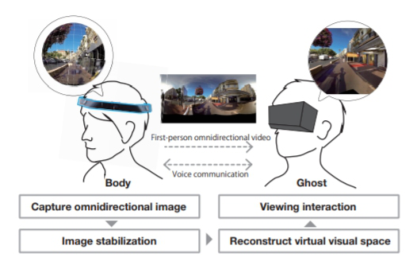
JackIn Head (Figure 1) is a head-mounted remote presence device that allows local users to transmit the scene they are currently viewing to remote users, enabling them to explore and interact in a reconstructed virtual reality environment (Kasahara, Nagai, & Rekimoto, 2017). JackIn Head utilizes a first-person perspective and combines a head-mounted device with a pano- ramic camera and stabilizer. To apply this technology to situations of remote travel and outings for the elderly, it is important to study the effect of dif- ferent perspectives, including the first-person perspective, on the sense of remote presence. According to the literature, users will experience different degrees of remote presence depending on the device’s position (Pfeil et al., 2019). Therefore, finding the most suitable device design, usability, and posi- tion that can enhance the sense of remote presence for the elderly is crucial. The literature suggests that the most common body position for wearing the
Figure 1: JackIn head (Kasahara et al., 2017).
Designing a System Using Telepresence Technology 25
device is near the front of the body close to the chest (Pfeil et al., 2019). This study references the device design of Kimber et al. (2015) and Manabe et al. (2020) and prototypes device placement at the chest and neck positions.
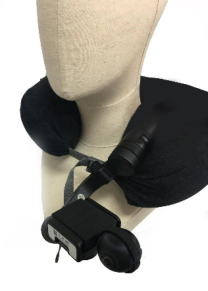
Figure 2 shows the first version of the device prototype. We used soft mate- rial to surround the neck as the stand of the device to better fit different body types, and combined the camera with the stabilizer and placed it on the left side. However, the stand was not heavy enough, causing the camera to tilt and become unstable. Additionally, the cable’s strength could force the stabilizer to change direction.
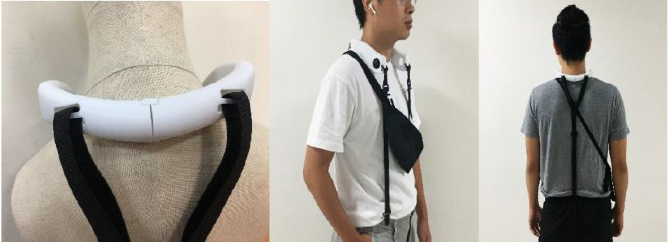
To provide a more stable vision, we designed the second version of the wearable device system (Figure 3). To improve the problem of insufficient support strength from the original soft material, we used 3D printing to make
Figure 2: The first prototype.Figure 3: Final prototype.
the stand for the wearable device. The streamlined appearance fits the body’s shoulder and neck lines, and we placed two 360-degree camera lenses on the left and right sides of the stand. To enhance the overall stability of the device, we used a rope to connect the stand and the user’s pants waist.
The equipment used on the guide side of the system includes a Microsoft Surface Pro and an Insta 360 Air lens for 360-degree streaming. Interactive conversations and explanations with remote elderly individuals are condu- cted using Bluetooth headphones and an Emeet microphone. On the elderly side, a Galaxy Tab S7 is used for operation. The system software uses Unity 3D to create real-time video technology. The base for creating the system is the WebRTC Video Chat package purchased from the Unity Asset Store, and the video output format of the original package is modified to output 360-degree video.
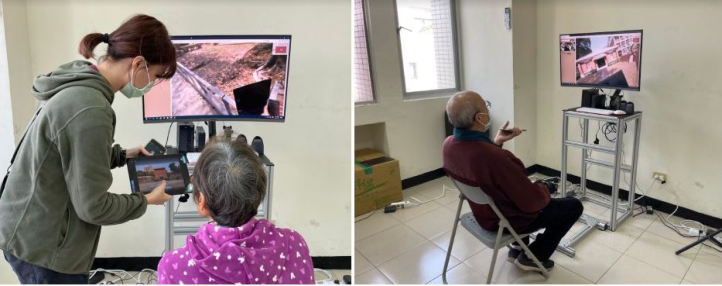
User Testing This usability test recruited 5 elderly people over the age of 65 to participate. The test was conducted at a community center, and a 23-year-old student wearing the wearable device served as a guide for remote guidance (Figure 4). The content selected was any famous Tainan attraction that the elderly parti- cipants were familiar with or had heard of before. The purpose of this test was to understand the possible usage scenarios and interaction modes of elderly people in tourism guidance scenarios. The main focus of observation was (1) the elderly participants’ feelings towards the viewing content, (2) the inte- raction between the elderly participants and the remote guide, and (3) the usability of the device for the elderly participants.
The testing process was divided into three stages. First, a semi-structured interview was conducted to understand the participants’ technology usage and travel experience at the selected location. Then, the participants were given the choice to conduct a 5-minute in-depth tour of one location. During the tour, the participants could choose to view the front, which was the per- spective of the remote guide’s camera, and they could also move the mouse to control the 360-degree perspective. For the voice call portion, this test used LINE to make voice calls, and the participants were asked to hold their
Figure 4: User testing.
Designing a System Using Telepresence Technology 27
phone close to their mouth to speak. After the test, another semi-structured interview was conducted with the participants to ask about their feelings on device operation and viewing content and to understand their level of remote presence.
CONCLUSION
Through this experiment, the following conclusions were drawn: (1) From the testing process, it was found that there is often a discre- pancy in the perception of viewing angles between remote tour guides and older adults. Both parties have difficulty identifying each other’s current view, resulting in various obstacles in communication and navigation. These situ- ations decrease older adults’ sense of remote presence. Therefore, the device worn by remote tour guides can be positioned in front of the chest as a reference, which can align the viewing angles of the remote tour guide and older adult.
(2) From the testing of side-view videos, it can be seen that older adults encounter many obstacles in the process of operating the mouse to view 360-degree angles. For example, they may be less accustomed to and comfor- table with the position of using the mouse and viewing the screen, and may experience difficulties controlling the angle when the cursor moves outside the screen. These situations make older adults feel confused and unable to fully engage in the experience. Therefore, the viewing device and its operation need to be more in line with older adults’ habits, such as using a mobile phone or tablet instead of a desktop computer. The way to control the 360-degree angle also needs to be modified to be more intuitive and simpler, such as using a tablet or mobile phone to directly rotate the device to achieve the same effect.
(3) The hardware devices of remote guides need to be more portable and user-friendly. In this test, remote guides had to walk around with laptops and mobile power supplies, which made it difficult for them to freely introduce themselves, and holding laptops also obscured the view for some viewers, affecting the viewing experience of the elderly.
(4) The image quality of the screen presented on the elderly viewer’s end also affects the degree of remote presence of the elderly. In this test, mobile hotspots were used as the network source for both the tour guide and the viewer’s end, and wireless connections reduced the quality of network speed. Mobile hotspots are generally 4G networks, which cannot provide higher network speeds, resulting in blurred viewing images and video and audio time mismatch. This situation makes it difficult for the elderly to see the scenery introduced by the remote guide clearly and makes it impossible for them to interact and communicate more deeply with the remote guide.
In summary, through the test results, it can be concluded that the design and usability of the guide and viewer’s devices, as well as the clarity of the vie- wing images, are the main factors affecting remote presence. Additionally, the interaction process between the elderly and remote guides can also strengthen the feeling of remote presence. For example, conversation, going to a certain place together, watching the same object together, etc. Content design and the
interaction process of both parties can also help enhance the elderly’s remote presence. The conclusions obtained from the above experimental results can be used as a reference for future design.
REFERENCES
Bengtsson, A., & Carlsson, G. (2013). Outdoor environments at three nursing homes-qualitative interviews with residents and next of kin. Urban Forestry & Urban Greening, 12(3), 393–400. CEUD. (2017). What is Universal Design. http://universaldesign.ie/What-is-Univers
al-Design/. Dahlkvist, E., Hartig, T., Nilsson, A., Högberg, H., Skovdahl, K., & Engström, M.
(2016). Garden greenery and the health of older people in residential care faci- lities: A multi-level cross-sectional study. Journal of advanced nursing, 72(9), 2065–2076. Hayashi, T., & Suzuki, K. (2018). Development of Video Chat System Based on Space Sharing and Haptic Communication. Sensors and Materials, 30(7), 1427–1435. https://doi.org/10.18494/SAM.2018.1884. Kane, L., & Pernice, K. (2021). UX Design for Senior Citizens (Ages 65 and Older). Kaplan, S. (1995). The restorative benefits of nature: Toward an integrative frame-
work. Journal of environmental psychology, 15(3), 169–182. Kasahara, S., Nagai, S., & Rekimoto, J. (2017). JackIn Head: Immersive Visual Telepresence System with Omnidirectional Wearable Camera. IEEE Transactions on Visualization and Computer Graphics, 23(3), 1222–1234. https://doi.org/10. 1109/TVCG.2016.2642947. Kowitt, S. D., Aiello, A. E., Callahan, L. F., Fisher, E. B., Gottfredson, N. C.,
Jordan, J. M., & Muessig, K. E. (2020). Associations among neighborhood poverty, perceived neighborhood environment, and depressed mood are media- ted by physical activity, perceived individual control, and loneliness. Health & place, 62, 102278. Liu, C. L., & Uang, S. T. (2012, May). A study of sickness induced within a 3D virtual store and combated with fuzzy control in the elderly. In 2012 9th International Conference on Fuzzy Systems and Knowledge Discovery (pp. 334–338). IEEE. Liu, Q., Wang, Y., Yao, M. Z., Tang, Q., & Yang, Y. (2020). The effects of
viewing an uplifting 360-degree video on emotional well-being among elderly adults and college students under immersive virtual reality and smartphone con- ditions. Cyberpsychology, Behavior, and Social Networking, 23(3), 157–164. https://doi.org/10.1089/cyber.2019.0273. Malloy, K., & Milling, L. (2010). The effectiveness of virtual reality distraction for pain reduction: A systematic review. Clinical psychology review, 30, 1011–1018. https://doi.org/10.1016/j.cpr.2010.07.001. Minsky, M. (1980). Telepresence. OMNI Magazine, 44–52. Mohadisdudis, H. M., & Ali, N. M. (2014, September). A study of smartphone
usage and barriers among the elderly. In 2014 3rd international conference on user science and engineering (i-USEr) (pp. 109–114). IEEE. Mosadeghi, S., Reid, M. W., Martinez, B., Rosen, B. T., & Spiegel, B. M. R. (2016).
Feasibility of an immersive virtual reality intervention for hospitalized patients: an observational cohort study. JMIR mental health, 3(2), e28. https://doi.org/10. 2196/mental.5801. Mujber, T. S., Szecsi, T., & Hashmi, M. S. (2004). Virtual reality applications in manufacturing process simulation. Journal of materials processing technology, 155, 1834–1838. https://doi.org/10.1016/j.jmatprotec.2004.04.401.
Designing a System Using Telepresence Technology 29
Pfeil, K., Wisniewski, P., & LaViola, J. (2019). An Analysis of User Perception Regarding Body-Worn 360
Camera Placements and Heights for Telepresence. ACM Symposium on Applied Perception 2019. https://doi.org/10.1145/3343036. 3343120. Salman, H. M., Ahmad, W. F. W., & Sulaiman, S. (2018). Usability evalua-
tion of the smartphone user interface in supporting elderly users from experts’ perspective. Ieee Access, 6, 22578–22591. Wu, X., Nix, L. C., Brummett, A. M., Aguillon, C., Oltman, D. J., & Beer, J. M.
(2021). The design, development, and evaluation of telepresence interfaces for aging adults: Investigating user perceptions of privacy and usability. Internatio- nal Journal of Human-Computer Studies, 102695. https://doi.org/10.1016/j.ijhc s.2021.102695.
LISTED IN THE AHFE DIGITAL BOOKSTORE CATALOGUE
Explore the complete digital volume
Human Factors in Aging and Special Needs
Read this individual research paper free through the original publisher, or explore the full digital proceedings book.
ISBN 978-1-958651-64-3
Explore this ISBN in the AHFE Bookstore ↗Listed in the July 2026 bookstore catalogue; search by ISBN to confirm current availability · Digital book purchase optional