Hu Zhe, Yi Li (2023). The Design of the Upper and Lower Limb Somatosensory Rehabilitation System Based on Users’ Requirements. In: Human Factors in Aging and Special Needs. AHFE Open Access, vol. 88, pp. 10–20. https://doi.org/10.54941/ahfe1003657
In the context of China's aging population and the increasing number of paralyzed patients due to stroke and other diseases, the demand for rehabilitation training services for the elderly is gradually increasing. However, the intensity and repetitiveness of exercise training for upper and lower extremity rehabilitation make patients bored with rehabilitation training, leading to slower recovery. From the perspective of promoting the user's active participation in rehabilitation training, this study is based on the affinity diagram method (KJ), KANO model, and analytic hierarchy process (AHP), combined with a user journey map, to sort out and analyze the user needs of the upper and lower limb somatosensory rehabilitation system and identify critical design requirements to optimize the user's medical rehabilitation experience.The user journey map is a full-stage process analysis tool that obtains the behavioral paths of users at different stages of performing upper and lower extremity rehabilitation through observation and interviews, based on which pain points and opportunity points are uncovered and can be used as initial user requirements. The Kano model is a qualitative demand analysis method that helps to classify the demand attributes of users of upper and lower limb somatosensory rehabilitation systems and filter out the most core user needs. AHP theory is a combination of qualitative and quantitative analysis and research methods, using the method of solving the eigenvectors of the judgment matrix, which can quantify and calculate the importance weight of user needs, and design according to the quantified results can help improve user satisfaction.The combination of the Kano model and AHP theory can quantify the user requirements obtained from the research and obtain the core design requirements. Therefore, the research path is divided into five steps: first, the initial identification of user requirements based on the user journey map; second, the organization of user requirements based on the KJ method; third, the screening of user requirements based on Kano model; fourth, the quantification of user requirements based on AHP theory; fifth, the design output based on data conclusion, this innovative research method can help designers accurately identify key requirements.According to the conclusion of the research data, the physiological rehabilitation needs and the professional guidance needs of users in the process of rehabilitation training have the greatest weight, and the design of the upper and lower limb somatosensory rehabilitation system revolves around these two types of core needs, including two main modules: (1) Somatosensory rehabilitation game module: Based on the mirror neuron rehabilitation therapy, the rehabilitation training movements are designed into a rehabilitation movement game based on somatosensory technology, which increases the fun of rehabilitation training. (2) Virtual Assistive Robot Module: It acts as a virtual therapist during the rehabilitation training, guiding patients to perform correct rehabilitation exercises and providing real-time and continuous feedback.By constructing the KJ-Kano-AHP design research model and combining it with the user journey map to acquire, analyze and quantify user requirements, it provides direction and theoretical support for the design of upper and lower limb somatosensory rehabilitation systems, and also provides ideas for solving similar problems.
As the population ages, the incidence of stroke and other diseases is incre- asing. Clinical studies have shown that timely and effective rehabilitation training can significantly improve a patient’s upper and lower extremity motor abilities. In contrast, general motor rehabilitation training usually requires patients to perform repetitive exercises for specific task-oriented trai- ning, which makes patients bored or lose interest in rehabilitation training, thus leading to a slower recovery rate (Hatem et al., 2016). To address this problem, research scholars have integrated rehabilitation games into motor intervention therapy to promote patients’ motivation for rehabilitation trai- ning (Peña, Cibrian and Tentori, 2020). Nevertheless, existing studies have rarely considered the psychological and cognitive needs specific to the elderly population. Based on the Kano model and AHP theory, this study combi- nes user journey diagram and KJ method to observe the influence of each user requirement on user satisfaction through Better-Worse four-quadrant
The Design of the Upper and Lower Limb Somatosensory Rehabilitation System 11
diagram, and quantitatively calculates the importance weight of user requi- rements to construct a user requirement importance ranking model to make reasonable design decisions.
ACQUISITION OF UPPER AND LOWER LIMB SOMATOSENSORY REHABILITATION SYSTEM USER REQUIREMENTS Innovative Research Methods Based on the KJ-Kano-AHP Model
To accurately explore the needs of elderly patients for an upper and lower limb somatosensory rehabilitation system, this study conducted in-depth inte- rviews and utilized user journey maps to analyze the users’ process of using the product. Through this process, pain and opportunity points were disco- vered, and user requirements were obtained. The combination of the Kano model and analytic hierarchy process (AHP) quantified the user needs obtai- ned from the research, and core design requirements were obtained. The research paper is divided into five steps (see Figure 1): First, identify user requirements based on the user journey map; Second, organize user requi- rements based on the KJ method; Third, screen user requirements based on the Kano model; Fourth, quantify user requirements based on the AHP method; Fifth, design output based on data conclusion. This innovative rese- arch method can help designers accurately identify key requirements and develop reasonable functional design solutions.
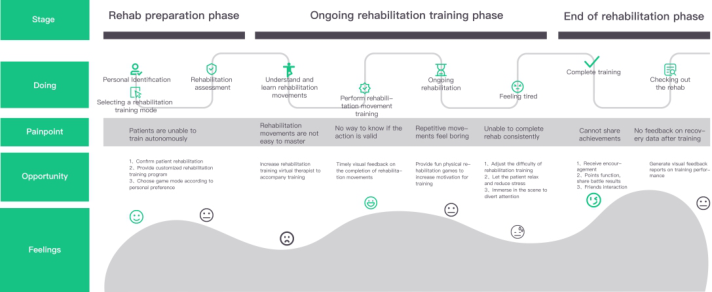
Upper and Lower Limb Somatosensory Rehabilitation System User Journey Map Analysis The study utilized the in-depth interview method to conduct extensive discus- sions with different groups, including rehabilitation patients, rehabilitation therapists, patients’ family members, and nursing staff. The upper and lower limb somatosensory rehabilitation process was categorized into three main stages: the rehabilitation preparation phase, ongoing rehabilitation training phase, and end of rehabilitation phase. Based on the feedback obtained from the interviews, the users’ behaviors and emotional experiences in each stage were organized, and pain points and opportunity points were identified and summarized in user journey maps (see Figure 2).
Requirement Classification Model Based on the KJ method The KJ method, also known as the affinity diagram method, is capable of clas- sifying data inductively according to the correlation between different items
Figure 1: Research path.
12 Hu and Li
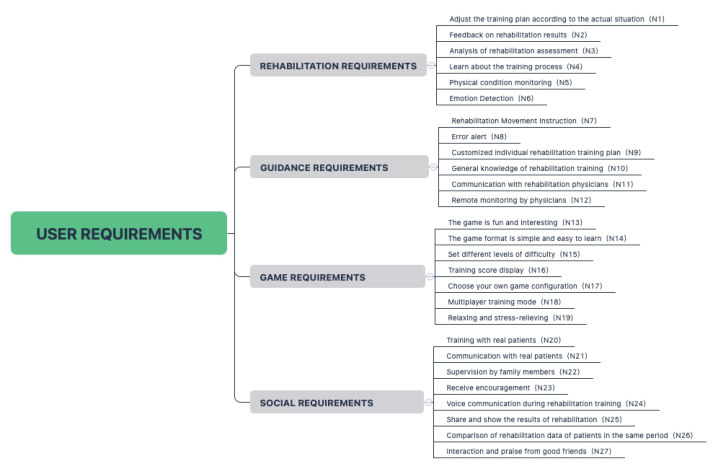
Figure 2: User journey map. (Chen and Zhao, 2022). To address the problem of unclear and fragmen- ted requirement points in user journey diagrams, this study distills user pain points and opportunity points into user requirements and uses the KJ method to organize and classify them. Firstly, the design team members organized and collected as much relevant user requirement information as possible, made the summarized 27 upper and lower limb somatosensory rehabilitation system requirement items into cards, and categorized them according to the similarity degree between each requirement item to obtain a preliminary clas- sification model of upper and lower limb somatosensory rehabilitation game user requirements, which were divided into 4 categories in total: rehabili- tation requirements, guidance requirements, game requirements, and social requirements(see Figure 3).Figure 3: User requirements information.
The Design of the Upper and Lower Limb Somatosensory Rehabilitation System 13
FURTHER FILTERING USER REQUIREMENTS BASED ON THE KANO MODEL Analysis of Kano Questionnaire Results
The research method was divided into the paper questionnaire and the electronic questionnaire. 113 valid questionnaires were collected from reha- bilitation therapists, rehabilitation patients, patients’ families, and caregivers. The user data obtained from the questionnaires were collected and organized, and the impact of a certain demand item on user satisfaction and dissatisfa- ction was measured by calculating the satisfaction coefficient Better and the dissatisfaction coefficient Worse for each user demand item (Berger, Blauth and Boger, 1993). The specific formulas are (1) and (2).
Equation reproduced from the original PDF.
In the calculation, A indicates the number of charm demand options, O indicates the number of desired demand options, M indicates the number of essential demand options, and I indicates the number of undifferentiated demand options.
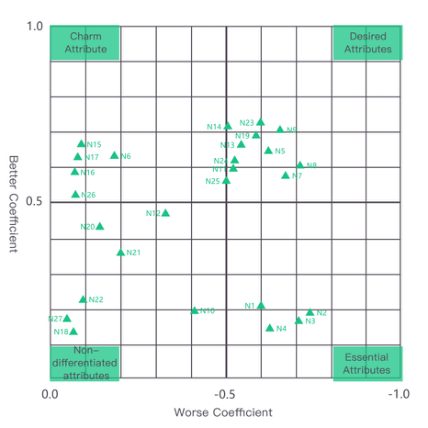
According to the calculation results of Better and Worse coefficients, the 27 user requirement items were divided into 4 essential requirements, 11 desired requirements, 5 charming requirements, and 7 non-differentiated require- ments. The Better and Worse values are drawn to form a coordinate diagram which is the demand quadrant diagram (see Figure 4).
Screening User Requirements Items Based on the Kano Model The Kano model is applied to differentiate user satisfaction with different categories of product requirements, so the initial user requirements should be
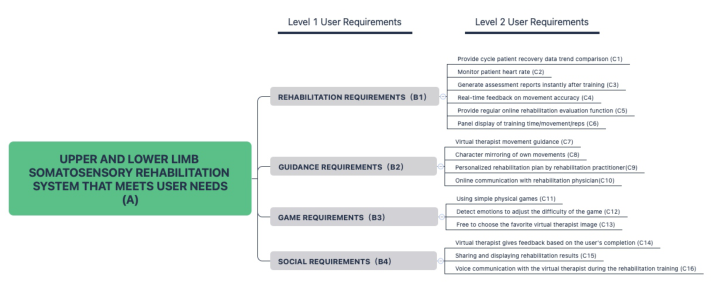
filtered according to the results of each requirement categorization in order to identify the user requirements more precisely (Yuan et al., 2021). In the Better-Worse requirements quadrature, for the “Essential attributes” require- ments in the fourth quadrant, users consider that these requirements must be satisfied, and if they are not satisfied, they will feel very dissatisfied or even abandon the product; the requirements in the first quadrant are “Desired attribute” requirement, If the upper and lower limb somatosensory rehabi- litation system includes the functional requirements in this area, the user’s satisfaction will be increased; for the second quadrant, the “Charm attribute” requirements are usually the requirements that the user is not aware of, if the product meets these requirements, the user’s satisfaction will be increased; while the “Non-differentiated attribute” requirement in the third quadrant is a product requirement that is not valued by users and has no impact on user satisfaction, so it is not necessary to consider this type of requirement too much in the actual design. After optimization, the hierarchical model of user requirements is formed (see Figure 5).
Figure 5: The hierarchical model of user requirements.
QUANTIFYING USER REQUIREMENTS ITEMS BASE ON AHP The analytic hierarchy process (AHP) is a combined qualitative and quantita- tive analysis research method that uses the method of solving the eigenvectors of the judgment matrix to obtain the priority weights of each layer element to the upper layer element (Luo and Li, 2021). The Kano model has cer- tain superiority in analysing user requirements, but only qualitative analysis results can be obtained, and there is a certain subjective bias. Therefore, this study will improve user satisfaction of the upper and lower limb somatosen- sory rehabilitation system by combining the user requirements derived from the Kano model with the AHP method, which can quantitatively calculate the importance weights of the user requirements of the upper and lower limb somatosensory rehabilitation system for the design requirements.
Demand Hierarchy Calculation Sorting A total of 18 raters including upper and lower limb somatosensory rehabilitation therapists, patients, and designers scored the demand items of
The Design of the Upper and Lower Limb Somatosensory Rehabilitation System 15
the same tier in a two-by-two comparison and recorded them on the follow- ing scale xi/xj, with rating values as integers in the middle of 1-9, as a way to compare the degree of importance between the two elements and construct a judgment matrix for each tier.
In this study, the sum-product method was applied to calculate the ranking weights of each demand item, and the judgment matrix A was normalized by column to obtain matrix B = (bij)n × m, as shown in equation (3). The matrix B normalized by column is summed for each row, see equation (4). The matrices A, B1, B2, B3, B4 and the weights ωi are obtained (see Tables 1, 2, 3, 4, and 5).
Equation reproduced from the original PDF.
(3)
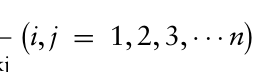
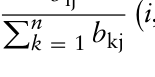
bij = bij Pn
Equation reproduced from the original PDF.
ωi =
Equation reproduced from the original PDF.
Consistency Verification of Judgment Matrix The random consistency ratio CR is calculated and the formula is given in (5).
Table 1. Level 1 requirement items (B1-B4) judgment matrix A and weights.
Judgment Matrix Maximum characteristic root λ CI RI CR A 4.01 0.03 0.90 0.030 B1 6.35 0.07 1.24 0.056 B2 4.09 0.03 0.90 0.030 B3 3.06 0.03 0.58 0.051 B4 3 0 0.58 0
CR = CI
RI (5) If CR is less than 0.1, it means that the judgment matrix satisfies the con- sistency (Xi, Dong and He, 2019) and its data is reasonable, otherwise, there is no reasonable consistency, and it can be seen from the calculated results that CR is less than 0.01 (see Table 6), which means that the judgment matrix passes the consistency test.
Calculation of Integrated Weight Value By multiplying each weight value of the secondary user requirement item layer by the weight value of its corresponding primary requirement item layer, the comprehensive weight value of each requirement for the design of the upper and lower limb somatosensory rehabilitation system can be calculated (see Table 7).
DESIGN PRACTICE BASED ON KJ-KANO-AHP MODEL Data Conclusions Based on Research Practices
Based on the overall weighting of user requirements, it is evident that the highest-ranking design requirements should be prioritized as key factors in designing an upper and lower limb somatosensory rehabilitation system. Specifically, design requirements such as “real-time feedback on movement
The Design of the Upper and Lower Limb Somatosensory Rehabilitation System 17
Table 7. Comprehensive weight value table.
Table available in the original PDF paper.
Weight value
Weight value
Level 1 User Require- ments
Combined weight value
Level 2 User Require- ments
upper and lower limb somatosensory rehabilitation system that meets user needs (A)
accuracy” (C4), “virtual therapist” (C7), “panel display of training time- /movement/repetition” (C6), “instant evaluation report after training” (C3), “simple and common physical games” (C11), etc. were identified as priority design concerns. By prioritizing and optimizing these design requirements, the specific basis for designing an upper and lower extremity physical reha- bilitation system was established, with the aim of addressing the core needs of upper and lower extremity rehabilitation patients and improving user sati- sfaction. Based on the results of the preliminary research, the design practice phase proceeded with the development of system modules, game content, and functional interfaces.
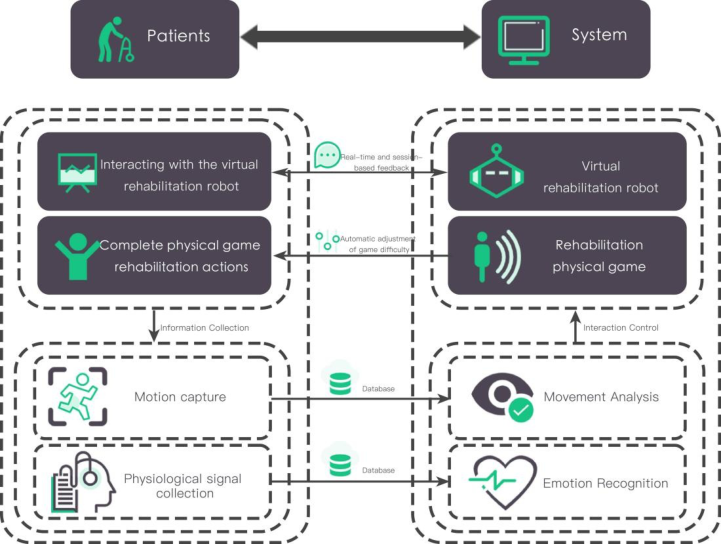
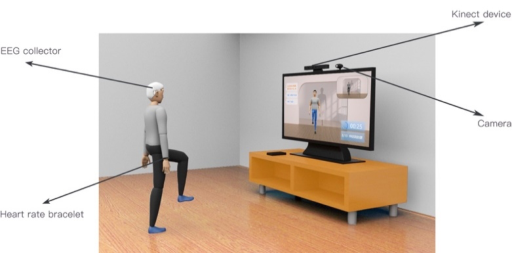
Design Practice In order to meet the rehabilitation needs of patients at different levels and effectively enhance their motivation for rehabilitation training, this study pro- poses a rehabilitation somatosensory game system, which consists of three main modules (see Figure 6): (1) somatosensory rehabilitation game module: based on mirror neuron rehabilitation therapy (Wu, Zeng and Wang, 2021), the rehabilitation training movements are designed as rehabilitation move- ment games based on somatosensory technology, which enables patients to use simple body movements to play (Lu, Ou and Ya, 2022), increasing the fun of rehabilitation training and testing the standard of patients’ rehabilitation movements in the process of the game. (2) Virtual assistant robot module: acts as a virtual therapist during the whole rehabilitation training process, guiding patients to perform correct rehabilitation exercises and providing real-time continuous feedback (see Figure 7). (3) Physiological signal reco- gnition module: identifies the patient’s physical state based on the patient’s heart rate, and will suggest suspending the training when abnormal heart rate
18 Hu and Li
Figure 6: System architecture.Figure 7: Virtual assisted therapist features page.
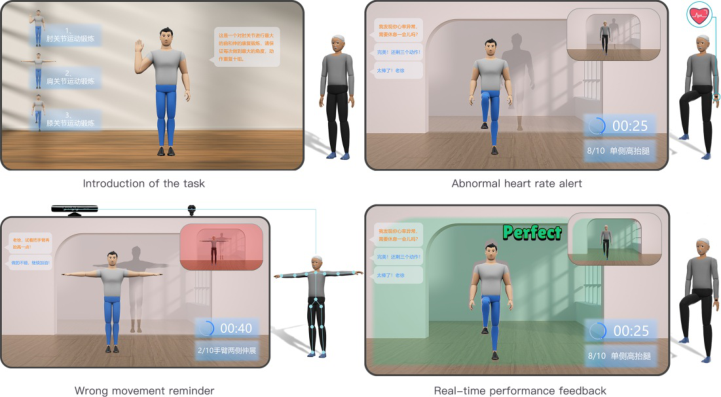
is monitored; identifies the patient’s emotional state based on the patient’s EEG signal data, and dynamically adjusts the game difficulty based on the patient’s emotion and performance to develop training tasks that are more suitable for the patient’s individual ability (see Figure 8).
The Design of the Upper and Lower Limb Somatosensory Rehabilitation System 19
Figure 8: Usage scenario diagram.
CONCLUSION
In this study, quantitative research methods have been added to the qua- litative analysis. During the user requirements acquisition stage, real user requirements are obtained using user journey maps and the KJ method. In the user requirements analysis stage, the Kano model is employed to quali- tatively analyze the user requirements and classify them into attributes for easy screening. Finally, in the requirements determination stage, the AHP is used to quantify the requirements and rank their importance. This enables the identification of key design points more accurately and provides guida- nce for the design of the upper and lower limb somatosensory rehabilitation system.
REFERENCES
Berger, C., Blauth, R. and BOGER, D. (1993). Kano’s methods for understanding.
customer-defined quality. Center for Quality Management Journal, 2(4), pp. 3–36. CHEN, L. and Zhao, C. (2022). Update of the Service Model of Shixing Vegetable Market Based on KJ Method. Packaging Engineering, 43(08), pp. 348–357. Hatem, S. M., Saussez, G., della Faille, M., Prist, V., Zhang, X., Dispa, D.
and Bleyenheuft, Y. (2016). Rehabilitation of Motor Function after Stroke: A Multiple Systematic Review Focused on Techniques to Stimulate Upper Extremity Recovery. Frontiers in Human Neuroscience, [online] 10(442). doi:10.3389/fnhum.2016.00442. Lu, W., Ou, D. and Ya, R. (2022). Phoenix blue print interactive game design based on somatosensory technology. Packaging Engineering, 43(04), pp. 182–188. Luo, T. and Li, T. (2021). Research on Humanized Design of Intelligent Bank Space
Based on AHP. Art & Design, 07(1), pp. 120–123. doi:10.16272/j.cnki.cn11- 1392/j.2021.07.025. Peña, O., Cibrian, F. L. and Tentori, M. (2020). Circus in Motion: a multimodal exergame supporting vestibular therapy for children with autism. Journal on Mul- timodal User Interfaces, 15(3), pp. 283–299. doi:10.1007/s12193-020-00345-9. Wu, M., Zeng, X. and Wang, L. (2021). Application effect of modified mirror therapy
in patients with upper limb hemiplegia after stroke. Chinese Nursing Research, 35(11), pp. 2042–2045.
20 Hu and Li
Xi, Y., Dong, J. and He, X. (2019). Design Evaluation of Children Accompany Robot Based on AHP-PUGH. Design, 32(21), pp. 54–57. Yuan, Y., Liu, Y., Gong, L., Chen, H., Zhang, S., Kitayama, A., Takashi, E. and Liang,
J. (2021). Demand Analysis of Telenursing for Community-Dwelling Empty-Nest Elderly Based on the Kano Model. Telemedicine and e-Health, 27(4), pp. 414–421. doi:10.1089/tmj.2020.0037.
LISTED IN THE AHFE DIGITAL BOOKSTORE CATALOGUE
Explore the complete digital volume
Human Factors in Aging and Special Needs
Read this individual research paper free through the original publisher, or explore the full digital proceedings book.
ISBN 978-1-958651-64-3
Explore this ISBN in the AHFE Bookstore ↗Listed in the July 2026 bookstore catalogue; search by ISBN to confirm current availability · Digital book purchase optional