Xavier Latortue ab (2021). Impact of Multidisciplinary Teams on the End-User Consideration in the Building Industry. In: Advances in Affective and Pleasurable Design. AHFE Open Access, vol. 14. https://doi.org/10.54941/ahfe100590
Building construction projects are characterized by a sequential process that includes an important amount of stakeholders. In most cases the end-user is a direct customer of the contracting body which is a direct customer of AEC (Architecture, Engineering and Construction) companies. Literature tends to describe the consideration of end-user needs by the building construction industry as less developed than the manufacturing industry. The objective of the paper is to study how the multiplicity of actors impacts the consideration and therefore satisfaction of the end users by the companies. The study was realized with the help of a contracting body company throughout a project which allowed us to interview actors from different professions. Exploratory analysis is divided in two parts. First of all we produced a mapping of the building design process, then we identified to what extent decisions of professionals are based on identified end-users needs. The first results tend to indicate that the level of awareness of companies toward the requirement of the other stakeholders differs depending on their level of interaction with those stakeholders. Further development of this analysis will help to conclude on the interdependence between the fragmented organization and the end-users needs consideration by the companies.
With the application of new thermal and accessibility building regulations, French AEC industry is facing new challenges, and has to adapt his working process to these new constraints. In this context of change, we had the opportunity to follow a French company which activity consists of developing council house projects. This company is in charge of three main functions: country planner, property developer and property manager. In order to maintain and develop its market share in a tense and dense building market area, with a lot of bigger competitors, this company has taken the decision to concentrate its future strategy into giving a higher focus on the end-users consideration to increase their satisfaction.
Proceedings of the 5th International Conference on Applied Human Factors and Ergonomics AHFE 2014, Kraków, Poland 19-23 July 2014 Edited by T. Ahram, W. Karwowski and T. Marek
This paper reports the findings of a study that was a first step in the development of this new strategy. The objective was to study the interactions between the different professionals during the development of a new building project, in order to be able to identify how and when in the building process would it be pertinent to implement end-users input. The study was realized The paper will start by reviewing how the literature describes the specific characteristics concerning the actors and the process of a building project and how it differs from a manufacturing project. Theses peculiarities have consequences on the end-users consideration in the AEC industry. Even if they have to work together to produce a building for a common “end-user”, AEC professionals in charge of those projects have different tasks and objectives to fulfill. Naturally those companies have also different backgrounds, cultures, procedures and vocabulary to achieve their work. In order to be able to complete the construction, all professionals from the architects to the engineers and craftsmen have to consider each other requirement as well as those from the entity from which they are accountable for, which is frequently different from the end-users. We believe that the multiplicity of professions and the complex multiple level of customer ship could be a reason that explains the lack of consideration for the end users that is described by the literature.
Secondly the study will focus on the specific process of the company and explain their design process. First of all we produced a mapping of the building design process through interviews and document analysis which allowed us to ponder the interactions between different categories of actors. The second step consisted in semi-structured interviews that helped to identify to what extent the decisions of professionals are based on identified end-users needs. Finally we will discuss on the importance of integrating end-users in the design process of a building project to increase their satisfaction.
CHARACTERISTICS OF THE BUILDING INDUSTRY The Actors of a Building Project
In this section we are going to present the main actors of a construction project and what are their functions and responsibilities.
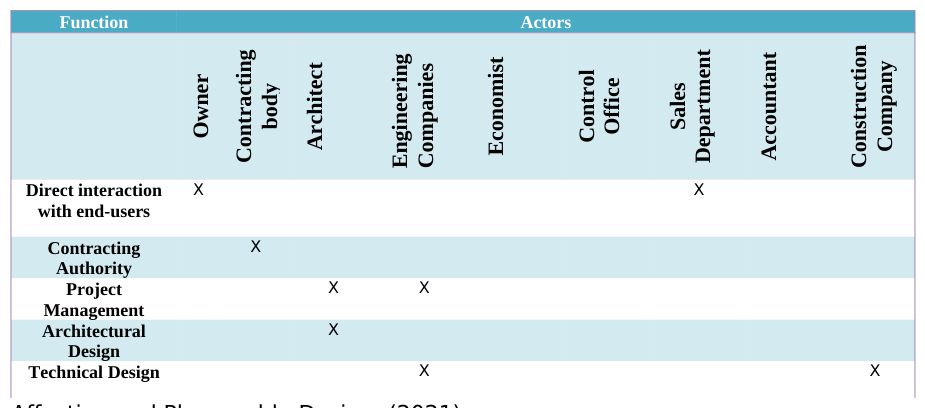
Most of the time, the end-users or the owner doesn’t actively take part in the building design process. Generally they hire a Contracting Body (CB) that is in charge of supervising and validating the proposition of the Project Managers, who generally consists of Architects and Engineers. The CB is in charge of embodying the owner needs and most of its work is realized on the early stages of the design process.
Table 1: Function and Actors of a Building Project (Inspired by Morand, 1994) Function Actors body
Proceedings of the 5th International Conference on Applied Human Factors and Ergonomics AHFE 2014, Kraków, Poland 19-23 July 2014 Edited by T. Ahram, W. Karwowski and T. Marek
The CB has to produce a feasibility study then realize (or hire someone to assist him to do it) the architectural program. This program defines the needs, the requirements, and the environment surrounding the future building, and will help to produce the future design. The program is a base for the Architects and Engineers (PM) to develop and design concepts that will have to be validated by the CB. Once that the Project Managers are hired, the CB is responsible for controlling and validating each of the design suggestions made by the PM along the whole building project. The Project Managers need to have their proposition validated by the Contracting Owner as well as comply with the different regulations. The coordination between the architect and the different categories of engineers (Structural, Thermal, Fluid etc…) is essential for a good completion of the project even if it is difficult. Apart from the technical functions, there are other professional that play an important function during the building construction process; especially those who are in charge of assuring the economical and safety parts of the project. It’s important to not underestimate their weight because economic and safety issues can have an important weight on some design decision.
Even if they have to work together to produce a building for a common “end-user”, AEC professionals in charge of those projects have different tasks and objectives to fulfill. Naturally those companies have also different backgrounds, cultures, procedures and vocabulary to achieve their work. In order to be able to complete the construction, all professionals from the architects to the engineers and craftsmen have to consider each other requirement as well as those from the entity from which they are accountable for, which is frequently different from the end-users.
A Sequential process AEC design process follows generally a sequential process, with a rather clear definition of tasks assigned to each actor along the different stages of a project. (Lee & Jeong, 2012, Kamara, Anumba, & Evbuomwan, 2001)). It generally consists of a series of distinct stages during which the contractor asks for a feasibility study, technical specifications, defines a budget and has a tender before designing and constructing the building. Obtaining the cooperation and a constructive dialogue between the different actors is a complex but necessary task to complete the project. According to Carassus (2003), French AEC industry fragmentation is a consequence of the diversity of building requests as well as the diversity of technical expertise required for said projects.
Contrary to the manufacturing industry, the AEC activity does not produce a repeatable product that will be produced at an industrial scale. A building is generally designed and built once (Tric, 1999) by several actors that will generally work together once. Reaching collaboration, as well as a constructive dialogue between the different actors is a complex yet necessary task in order to achieve the construction process. This fragmentation between actors all along the different stages and the temporary nature of relationship between organizations (Crespin-Mazet & Ghauri, 2007) are mentioned as an obstacle to the use of manufacturing industries project management methods (Kubicki, 2006). For Bougrain & Carassus (2003, cited by Kubicki, 2006) «On multiple occasions, the teams involved on a project decompose after a project. In fact, any experience capitalization is delicate. (Lahdenperä, 1998 ; Egan, 1998).
However the fragmentation of the process and the actors is also considered as a necessary evil for some because it allows a lot of flexibility in a system under a high uncertainty (Egan, 1998). The construction site is "outdoor, ephemeral, complex, and uncertain" (Bougrain & Carassus, 2003), it is not a controlled or reproducible environment, on which it is possible to anticipate potential disruptions that will affect the work or even be totally sure you can transpose local solutions for future projects.
Proceedings of the 5th International Conference on Applied Human Factors and Ergonomics AHFE 2014, Kraków, Poland 19-23 July 2014 Edited by T. Ahram, W. Karwowski and T. Marek
According to Tertre (1995), “fragmentation should not be considered as a negative factor neither as an anachronism, but as an essential characteristic of the sector that is actually its strength and its dynamism.”. For Hoyet (2007), the fragmentation and instability of the system of actors is a rather positive thing that prevents the industry from adopting a routine in intellectual behaviors. Moreover this kind of organization allows an important adaptability.
End-User consideration in AEC industry Customer’s and end-user’s needs are a crucial data for building projects. An appropriate understanding of those requirements is essential in order to achieve results that fulfill user’s expectation. In order to develop a privileged relationship between a client and a company then maybe reiterate the commercial experience afterward, customer satisfaction is primordial in any commercial activity. However, the “one-off” nature of building construction projects from a customer point of view, impacts on the significance of customer loyalty comparing to, for example the manufacturing industry where the consumption act is more frequent and strengthening the customer loyalty more essential. Nonetheless in an industry where informal communication is preponderant, reputation and word-to-mouth can have a considerable effect on company’s image.
While integrating end-user’s requirements is important, it is necessary to clearly define who the end-users are, and take into account their diversity as well as the multiplicity of their needs. If the buyer is represented by the contracting owner which isn’t necessarily the future user of the building, the contracting owner could be more focused on deadline and budget factors rather than functionality or other specifications...The diversity of end-users that need to be satisfied, as well as the divergences between their priorities, explains the difficulty of integrating their requirements into the design (Zeisel, 1981, quoted by Kamara et al., 2000).
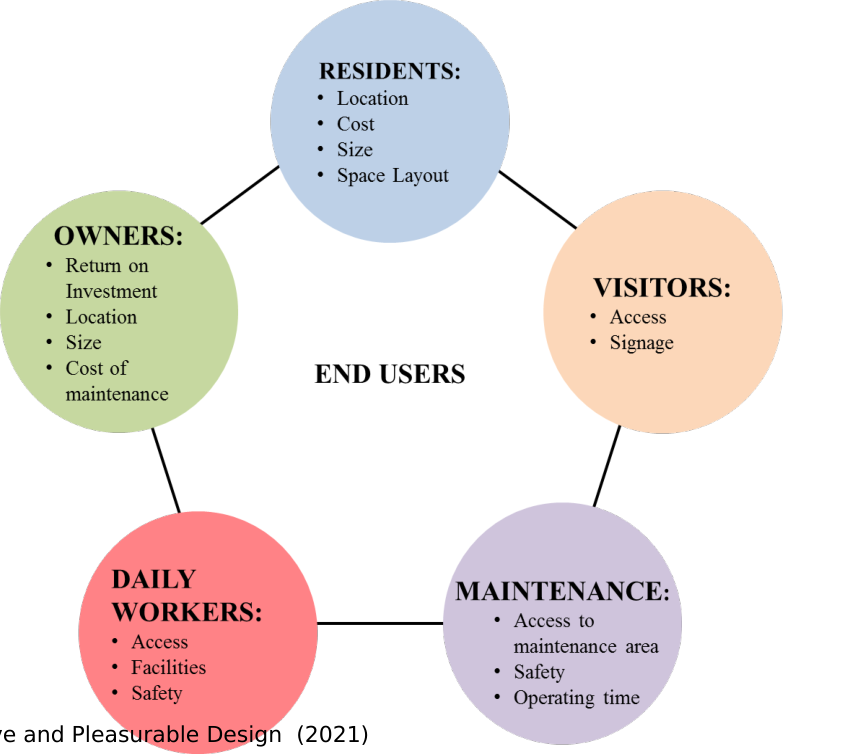
Figure 1. Building end-users diversity
Proceedings of the 5th International Conference on Applied Human Factors and Ergonomics AHFE 2014, Kraków, Poland 19-23 July 2014 Edited by T. Ahram, W. Karwowski and T. Marek
Figure 1 illustrates the diversity of end-users that is observable in a building. It would be incomplete to reduce the end-users to the residents of a building. A building is used by multiple categories of people that have all their satisfaction criteria. While it could be considered that the residents are more focused on the location, cost, size ,and general space layout, for the owners (if not living in the building), the building is an investment, and requires to be profitable. Therefore owners will be more prone to be focused on the Return on Investment, the cost of maintenance, and the general attractively of the product. All these factors will have an impact on the price of the rent, then its profitability. Visitors, Maintenance technicians, and Daily Workers (Postman, building manager, delivery men) have also specific needs even if their use frequency of the building is lower than the residents.
This diversity of needs and the materialization of end-users expectations have consequences on all the stages of the project, and would need a collective effort from all the project’s actors on a common and neutral vision of users. This common vision requires to be translated into quantitative and qualitative terms that would be understable by all the professionals in charge of the project, and depending on their respective tasks (Kamara et al., 2000).
CASE STUDY Company’s building design process.
The partner of the study has the particularity of having multiple responsibilities and activities during the building construction process. The company is not only country planner, but also a property developer and a property manager. It means that in some of its projects, it is not only the owner, but also the project manager, the real estate programmer, the accountant and the sale department. They rent and sell council houses. This specificity allows the company to have a wide vision of the process and to develop numerous interactions with the end-users at different stages of the process. One of their objectives is to develop a long-term relationship with their customers and allow them to evolve from a tenant position to a home ownership status. Having both kind of activity (rent and sell), this status evolution from their customer allows the company to maintain and develop their activity by having an important customer base. However, in order to maintain this customer base, their objective is to increase the satisfaction of their clientele by a better integration of their customer needs in the design process of the new buildings.
Figure 2. First stages of the building design process
Figure available in the original PDF paper.
Figure 2 represents the first stages of a new building design process. Activities with a dotted circle indicate the activities that have a direct impact on the end-users functional needs.
Proceedings of the 5th International Conference on Applied Human Factors and Ergonomics AHFE 2014, Kraków, Poland 19-23 July 2014 Edited by T. Ahram, W. Karwowski and T. Marek
The project begins with the finding of a land by the real estate programmer. Once that the land is identified and corresponds to the company’s requirements, the feasibility study starts and consists of analyzing the possibilities associated with the land: from a technical, economical, and legal point of view. This feasibility study requires for the programmer to gather public decision-makers advice to ensure the compliance of the project with local real estate regulations. Once that legal compliance is validated, the economical and functional aspects are validated by the contracting body and the sales department of the company. If the feasibility study is positive, the program is defined by the programmer with the help of the contracting body, which allows the contracting body to give a first estimation of the budget to the sales department that start to open application submissions to its customers. With the program validation by the company begins the contracting of Project Managers (Architects, Engineers etc…) that will have to produce a preliminary design then submit this preliminary design to the approval of both the sales department and the contracting body (Figure 3). Once that the building permit will be released, the project managers will have to complete a final design of the building while the contracting body updates the budget estimation (Figure 4).
This brief summary of the company’s design process allows showcasing that a lot of different actors have a direct impact on the end-users need but that the only one to have direct interaction with the future residents is the sales department. Moreover the weight of the sales department on the design process consists primarily in giving a feedback to designs that are produced by the Project Managers. Furthermore architects and engineers base their design on a
Figure 3. Preliminary Design Stage program that is already defined by the real estate programmer and the contracting body. What appears from a brief analysis of the building design process of the company is the fact that the sale department is the only one to have a direct interaction with end-users yet only have a low impact on design decision. However, it doesn’t mean that end- users needs are not taken into account by the other professionals.
Figure available in the original PDF paper.
Proceedings of the 5th International Conference on Applied Human Factors and Ergonomics AHFE 2014, Kraków, Poland 19-23 July 2014 Edited by T. Ahram, W. Karwowski and T. Marek
Figure 4. Final Design Stage
Figure available in the original PDF paper.
End-users needs and specification are taken into account by some of the building regulations, and of course professionals can rely on their experience and their knowledge to take decision that translate end-users requirements, however these inputs are some general inputs that are not necessarily pertinent for each end-users and/or the specific and identified customers of the company.
These arguments lean to promote an increase of the implication of the sale department in the design process by increasing the communication between the real estate programmer, the contracting body and the sales department who are part of the same company. Nevertheless, as explained in the literature review, this communication between different professionals that have different backgrounds, vocabulary and objectives is a complex task. Moreover, if the goal of the company is to increase their customers’ satisfaction, what is the guarantee that increasing the focus on the integration of the end-users needs will increase their satisfaction?
DISCUSSION
According to Kärnä et al. (2004), consideration of end-user’s satisfaction in the AEC industry is something relatively recent, moreover “The innovation (…) based on market analysis or the expected behavior of potential users or customers, has a minor weight in construction” (GTM, 1997). Nonetheless the importance of satisfaction of end-users for the evaluation of building quality is perceived as essential by numerous authors (Kärnä, 2004)).
According to Soetanto et al. (2001), satisfaction differs between categories of actors, for example architects tend to have a less positive perception of buildings than the future owners of the same building. Moreover, Torbica and Stroh (2001) explain that the observation of the customers satisfaction isn’t possible until the last stages of a project, when a large part of the investments have already been spent, and when the questioning and modification of the construction works would be problematic.
Proceedings of the 5th International Conference on Applied Human Factors and Ergonomics AHFE 2014, Kraków, Poland 19-23 July 2014 Edited by T. Ahram, W. Karwowski and T. Marek
The ignorance of end-users requirements during construction briefings has been criticized for a long time. Kaya (2004) highlights the “insufficiencies of the construction industry in the way that the client’s needs are met”. However end-users have little background to consider different spatial solutions (Dewulf and Van Meel, 2002). They are far from being experts, but still have some knowledge and opinions in relation to their own goals (Lai and Yik, 2007). This lack of skills may explains the” communication gap between end-users, designers and owners as well as the negative stereotypes and images that can exist among professionals (Pemsel, 2010). The effect of this situation is that end-users can feel like a hostage, because the building design issues cannot be understood by them (Mumford and Sackman, 1975).
Nevertheless, when end-users aren’t involved in the design stages of building, they tend to be more reactive and critical of the building (Kaya, 2004). According to Pemsel (2010), “End-user satisfaction is contingent not only on the outcome but the way it is achieved”. For Auchterlounie and Hinks (2001), customer satisfaction is based on several aspects, from the inherent quality of the building and facilities to the relation with the different stakeholders. This emphasizes the fact that considering user-needs is not enough to gather customer’s satisfaction, the relationship and interaction factors also appear to be essential. End-users have to own their space and feel they have control over their environment in order to feel more comfortable (Kaya, 2004). Moreover a need is often hard to express, while requirements are statements related to existing products. For Peña and Parshall (2001) only the understanding of the real needs can help succeeding in improving the quality of the building.
CONCLUSION
The nature of the building design process, the number and nature of its stakeholders and the diversity of end-users can explain part of the difficulty of integrating end-users needs into the design process. Regulations and experience from the professional help to consider users’ requirements, but it is essential to distinguish requirement from real needs. Moreover integration of the real needs of end-users into the design briefing of a building is not a guarantee to satisfy future residents. Not only end-users require to be understood but they also need to feel they are part of the process in order to increase their satisfaction. As a conclusion to the case study, it appears that the company not only should give more input to the sales department because they are the one with direct interaction with future residents, but they should also find a way to integrate directly the future end-users to the process. As a result, one of the decisions that were taken by the company to increase the customer satisfaction was to test to produce a building including participative design stages where future residents participate to the design decisions. It will be interesting to study how the direct consideration of future residents needs impacts their satisfaction as well as the quality of the design in a future study.
REFERENCE Auchterlounie, A. and Hinks, J. (2001) Assessing customer criteria for quality in new housing, First post-graduate
research conference University of Salford, Manchester. Bougrain, F., & Carassus, J. (2003). Bâtiment: de l’innovation de produit à l’innovation de service. Paris: PUCA. Crespin-Mazet, F., & Ghauri, P. (2007). Co-development as a marketing strategy in the construction industry.
Industrial Marketing Management, 36(2), 158–172. doi:10.1016/j.indmarman.2006.02.011 Dewulf, G., & van Meel, J. (2002). User participation and the role of information and communication technology.
Journal of Corporate Real Estate, 4(3) Du Tertre, C. (1995). LE BATIMENT: une régulation sectorielle spécifique. Primer Seminario.e Egan J., 1998. Rethinking construction. Report of the Construction Task Force on the Scope for Improving the Quality and Efficiency of UK Construction. Department of the Environment, Transport and the Regions, London, 1998. Egan, J. (1998). RETHINKING THE REPORT OF THE CONSTRUCTION TASK FORCE. Finnish, B. C., & Lahdenperä, P. (1998). The inevitable change: why and how to modify the operational modes of
the construction industry for the common good. Finnish Building Centre Ltd.. GTM (1997), « A la conquête des marchés », Prix de l'innovation 1997
Proceedings of the 5th International Conference on Applied Human Factors and Ergonomics AHFE 2014, Kraków, Poland 19-23 July 2014 Edited by T. Ahram, W. Karwowski and T. Marek
Hoyet, N. (2007). Conception de la matérialisation en architecture : l ’ expérimentation comme facteur d ’ innovation industrielle Doctorat de l ’ Institut National Polytechnique de Lorraine Discipline : Sciences de l ’ architecture Nadia Sallé , épouse Hoyet. Kamara, J. M., Anumba, C. J., & Evbuomwan, N. F. O. (2000). Establishing and processing client requirements—a
key aspect of concurrent engineering in construction. Engineering Construction and Architectural Management, 7(1), 15-28. Kamara, J. M., Anumba, C. J., & Evbuomwan, N. F. O. (2001). Assessing the suitability of current brie ® ng practices in construction within a concurrent engineering framework, 19. Kärnä, S. (2004). Analysing customer satisfaction and quality in construction – the case of public and private
customers, 2. Kaya, S. (2004). Relating building attributes to end user's needs:“the owners-designers-end users” equation.
Facilities, 22(9/10), 247-252. Kubicki, S. (2006). Assister la coordination flexible de l’activité de construction de bâtiments. Lai, J. H., & Yik, F. W. (2007). Perceived importance of the quality of the indoor environment in commercial buildings. Indoor and built environment, 16(4), 311-321. Lee, J., & Jeong, Y. (2012). User-centric knowledge representations based on ontology for AEC design
collaboration. Computer-Aided Design, 44(8), 735–748. doi:10.1016/j.cad.2012.03.011 Morand, D. (1994). Liaison entre la conception et la gestion de projet de bâtiments: PROJECTOR, un prototype pour la planification (Doctoral dissertation, Université de Savoie). Pemsel, S., Widén, K., & Hansson, B. (2010). Managing the needs of end-users in the design and delivery of
construction projects. Facilities, 28(1/2), 17-30. Pena, W. M., & Parshall, S. A. (2001). Problem seeking: An architectural programming primer. John Wiley & Sons.
C Carassus, J. (2003). Construction: La mutation: De l'ouvrage au service. Presses des Ponts. Soetanto, R., D.G. Proverbs and G.D. Holt (2001). Achieving quality construction projects based on harmonious working relationships. Clients’ and architects’ perceptions of contractor performance. International Journal of Quality & Reliability Management, Torbica, Z.M. & Stroh, R.C. (2001) Customer Satisfaction in Home Building. Journal of Construction Engineering
and Management. Tric, O. (1999). Conception et projet en architecture. Editions L'Harmattan. Zeisel, J. (1984). Inquiry by design: Tools for environment-behavior research (No. 5). CUP Archive.
LISTED IN THE AHFE DIGITAL BOOKSTORE CATALOGUE
Explore the complete digital volume
Advances in Affective and Pleasurable Design
Read this individual research paper free through the original publisher, or explore the full digital proceedings book.
ISBN 978-1-4951-2109-8
Explore this ISBN in the AHFE Bookstore ↗Listed in the July 2026 bookstore catalogue; search by ISBN to confirm current availability · Digital book purchase optional