Sheila Cordeiro Mota (2022). Ergonomic Intervention and Sustainable Innovation. In: Advances in Ergonomics In Design, Usability & Special Populations: Part III. AHFE Open Access, vol. 20. https://doi.org/10.54941/ahfe1001327
Among the reasons interfering with the product development are the human being necessities concerning with activities that one has to do to make possible the action in his/her environment. In order to satisfy such necessities, the practice of Design allow us to find project solutions that yield the balance among several factors inherent to the process of product development, with exchange between the designers, who aims a positive reception for their products, and the end user, in conformity with their necessities. However, the process should take into account the preoccupations with the sustainable development that, according to the Brundtlando report, should be the simultaneous search for economic efficiency, social justice, and environmental harmony. The report also states that the industry should produce more with fewer resources, as well as adopt clean technologies, and proliferate the knowledge by means of financial support of the local and international organizations. This work describes the adaptation of two systems, the traditional roasting furnace of manioc flour and the combustion system by clean burning (downdraft). By making use of a clean technology for production, the resulting system pursues economical feasibility that can lead to social fairness, promoting environmental harmony.
The context of this research fits into the requirements that define the focus of this work, having in mind the insertion of Ecodesign as a project tool that enable us to find means to conceive a regional-purpose product (a hardware for producing manioc meal), widely spread and essential for the local food habit. The production, trade, and deployment of manioc meal become technical and economically feasible, and culturally acceptable as well since it does not oblige the use of new productive techniques that do not fit the use and habit of the local people.
This work describes the adaptation of two systems, the traditional roasting furnace of manioc flour and the combustion system by clean burning (downdraft). The resulting system pursues economical feasibility that can lead to social fairness, by making use of a clean technology for production, thereby promoting environmental harmony. So, the objectives of this research are: a) identify the aspects that involve the production processes, environmental and technological and social level (taking as reference general industrial models); b) identify, evaluate and suggest ways that do not interfere in cultural aspects of rural communities; c) Developing Human Systems Integration Tools to Support Systems Design
DEVELOPMENT - PROBLEM STATEMENT The manioc flour house is the place where the manioc flour is processed and produced. It plays an important and traditional role in the cultural and economical context, mainly in the north and north-eastern regions of Brazil. The manioc flour house has a common peculiarity across several Brazilian states: its the intrinsic rustic characteristics were preserved.
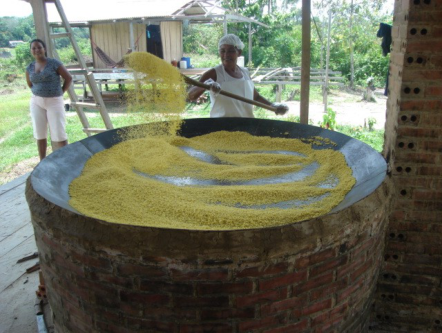
The production process of the manioc flour is carried out by using tools and techniques suitable for the required tasks, and configured by hand in familiar work. The inappropriate conditions of both hygiene and storage are the most prominent characteristic of this practice as shown in Figure 1. Such harmful conditions favor the appearance of aflatoxin, a common carcinogen substance in food such as peanut, chestnut and maize.
Figure 1: Production of manioc flour in Amazonas state
Figure available in the original PDF paper.
A survey carried out in traditional houses of manioc flour in the Amazonas State has evidenced that tools used in the production process are of elementary rusticity, associated with a peculiar and common performance. It is evident the necessity of improvement and technological adaptation for those tools. However, it is worthwhile to say that this work focus to the furnace and the associated tasks conducted by the local people.
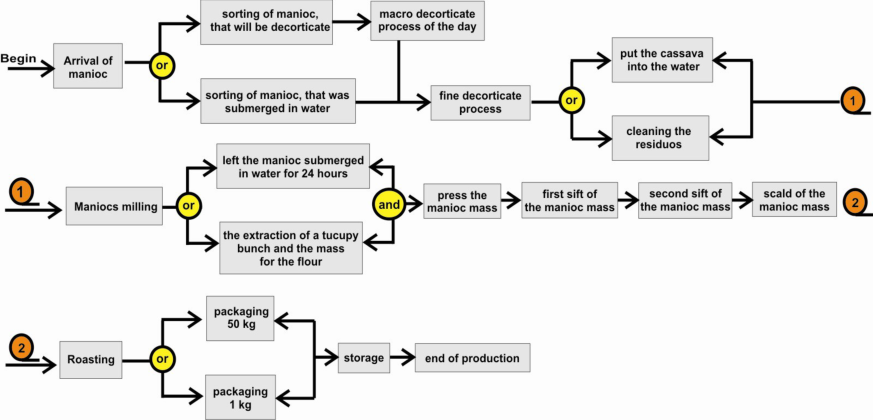
The production process of cassava flour (Figure 2) begins at the planting of manivas (pieces of cassava). After the harvest, the cassava is transported to the house of flour, where by means of hand tools it is peeled and scraped. The maturation process starts when the cassava is placed in tanks of water. Next, it is squeezed in a rustic press of indigenous origin. Then it is sieved and roasted in the oven. The manioc flour is ready to be consumed, but it can also be packed, weighted and stored for sale.
Figure 2: Flow of production process of manioc flour.
QUALITY AND PRODUCTIVITY According to Cleland and Ireland (2002), a quality program must follow principles that guarantee the results by following a disciplined process. Possible deviations of such principles yield dissatisfaction of clients since their necessities are not fulfilled. Therefore, the authors claim that the quality of the process interferes directly in the production results, and, consequently, in the final product.
In face of such approach, the aspects of improving the production process of one of the most consumed products on the north and northeast Brazilian regions, the manioc flour, are associated with a set of factors that motivated the search of a quality improvement program related with its production means.
By Cleland and Ireland (2002), the concept of production flow management evolved during the 1990 decade. From a restrictive vision of the logistic aspect related to the physical flow of the product, it achieved a managerial vision with a more systemic emphasis, which main goal is to satisfy the end user and optimize the chain development.
With respect to the agroalimentary products, clients and consumers are even more demanding with respect to the quality attributes directly related to the product (such as nutritional value, appearance, flavor and security), a quality attributes indirectly related to the product (such as the adoption of production of proper impact acceptable to the environment in conformity to the social norms.
Toledo (2001) defends that the quality of an agroalimentary product results from its own characteristics and properties perceived by the consumers. These points of views are intrinsic, hidden product characteristics as the nutritional value and hygienic order, objective characteristics of the product that can jeopardize ones health and security, even when they are not perceived. Concerning the subjective features of a product, sensorial characteristics, such as appearance and flavor, can interfere in the product acquisition.
About the agroalimentary chains, Cia (2001) claims that there are three generic categories of representativeness for a product, which are characterized by events occurring in the production and commercialization, namely: (a) The final product, the food already processed, wrapped up and ready for transportation;
(b) Available goods, exposed to be sold; (c) The consumed delicacy, the food in the phase of being prepared for degustation by the consumer.
Cia (2001) also stands out the success requirements for a delicacy by stating that all previous events (industrial product and goods) should be successfully achieved. Since the costs with storage and nutritional loss are reduced, the faster the delicacy event approximates the industrial product and goods events, the closer the product quality the consumer requires.
Based on such considerations about the food quality characteristics are clear, one can see that quality management of the chain agents is essential by applying well-defined procedures and practices one can explain it. Therefore, in order to satisfy these criteria, we developed a production system by taking the Ecodesign and ergonomic interventions to improve the relation man-task-machine.
ERGONOMIC VALUES Considering the nature of the project, experimental and applied character, was used as a methodological basis of ergonomics, which according to Iida (2005), allows to build knowledge from observations and experiments, the conditions should be checked and proven by measurement of phenomena. However, recognizing the need to adapt two systems of peculiar characteristics, it employed a hybrid methodological approach that can provide expected to systemic adaptation and simultaneously ergonomic intervention support.
For this research we used the methods of ergonomic intervention suggested by Iida (2005) and Moraes and Mont'Alvão (2003), which apply not only anthropometric consistency of the relationship between product and user, as well as the interaction between systems man, job, machine and production environment. Also made use of the Ecodesign strategies to guide the development of the system as well as development of design tools for systemic analogy, which allowed systematic mapping guidelines and procedures to achieve the proposed objectives, resulting in technological adaptation that involves the traditional oven roasting of cassava flour and combustion system for clean burning.
METHODOLOGICAL APPROACH AND ECODESIGN Ecodesign is a project method that aims to avoid or reduce the adverse environmental impacts. Not only to clean, but also and mainly not to make dirty. Both should be envisioned in every phase of the project, in such a way that the results d not generate contradictions.
The reasoning of this investigation was the use of Ecodesign-oriented strategies that can provide means for the development of products ecologically correct Ramos (2001) since it orients the rational use of energy, raw material, biodiversity preservation, residue minimization, the deployment of clean technologies and renewable fuels.
This development took into account two fundamental strategies:
1. the reduction strategy, adopted during the product conception, by making the most of deployment reduction of raw material, natural resources, and by optimizing the residues employment, and;
2. the extension strategy, adopted for increasing the product lifetime.
The reduction strategy is divided into three fundamental branchings forming categories of its action as a concept inherent to product development: use reduction of natural resources, use reduction of energy, and use reduction of residues.
In order to improve the roasting process of manioc flour, we inserted a technological adaptation based on the combination of the traditional roasting process and the clean-burning combustion technology. To achieve this goal, it is necessary to observe the origins of this technology and how it can be seen as a function for development of a productive application.
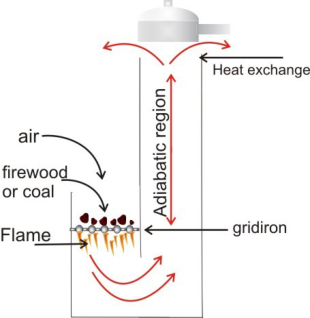
TECHNOLOGICAL ADAPTATION The works of Khan et al. apud Borges (1994) showed that the downdraft combustion provides the almost complete wood burning, what makes it different to other traditional burning processes. It occurs by means of morphological and geometrical modifications in the combustion room, achieving the adiabatic combustion temperature and inverting the air flow as one can see in Figure 3.
The previous knowledge of the elements forming this technology allowed us to adapt it to the traditional roasting system in terms of product configuration. The methods of ergonomic intervention allow us to obtain information for comprehension of the functional questions, detailed recordings for deeper analyses, production cadence, and comfort and hygiene aspects. It has been taken into account the classification of problems.
To understand the universe involving the task of roasting the manioc flour and the cultural context of the task executors, it was necessary to visit a number of manioc flour houses since the research has an experimental and applied character.
To get a better comprehension of the cultural context, we developed a methodology for data collection. In order to get statistically reliable results, we applied the methodology in 30 manioc flour producers, randomly selected in Amazonas state. More specifically in the rural municipalities of Iranduba, Rio Preto da Eva and Manaus. The collected information provided us to outline the social and economical profile of the producer, to know aspects related with the production ad commercialization of the manioc flour, as well as the destination of the generated residues.
Taking as a starting point the observations of the man-task-machine furnace system in the manioc flour house, different classes of problems were found: interface, instrumentation, usability, movement, displacement, architectural, environmental and biological, accidents and operational aspects.
The problems detected yielded malfunction of the system, and can be classified as: a) thermal discomfort; b) air pollution; c) risks for the health of the users and their families; d) accidental risks and; e) lack of productive efficiency.
The structural configuration of the traditional furnace has cylindrical walls, one meter high, approximately 30 to 40 cm breadth. There is a circular opening of approximately length of 150 cm. A plate made of iron is used as a pan, and its dimensions vary according to the diameter of the furnace, and can be easily found in the local commerce.
PROJECT DEVELOPMENT The development of a systematic project, suggested by Bonsiepe (1986), consists of analytical phases composed by checklists, product analysis regarding its use, diachronic analysis, synchronic analysis, structural analysis, functional analysis, and morphological analysis. After carrying out these analyses, we defined the problem by elaborating a list of requirements, structuring the problems to construct a hierarchy.
However, the application of the conceptual project method for this study was restricted to a structural analysis that consists of recognizing and comprehending the types and the number of subsystems components, assembly principles, union types, types of product bodies, and the problem definition.
In the sequence, by grouping the project requirements into profiles according to similarities, the project was structured and its parameters were defined. It is possible, in general, to represent this structure by means of a hierarchical tree that establishes priorities for meeting the requirements. This approach is necessary since almost Ergonomics In Design, Usability & Special Populations III always the profiles are antagonistic, and the optimization of a factor can lead to a under optimization of another factor. The interaction among the factors can be presented in matrix form, indicating positive, neutral or negative interactions.
From the problem definition, we made use of a tool suggested in Baxter (2001) for structuring the problem, through the functional tree of the product. The tool allow us to proceed with the fusion of questions that justify and point out the requirements and the project parameters, formatted by means of a parallel approach frame.
The execution of the analysis of the traditional manioc flour roasting system from the modeling of its functional tree, allow us to compare the actions according to its levels, as a function of its characteristics and single components.
The modeling of the product functions confirm the main and secondary activities of the manioc flour roasting system, allowing us the elaboration of the requirements and parameters according to the objectives previously established. Therefore, by analyzing the actual system aiming to improve it, it is defined what the new (improved) system must have to fulfill the necessities that establish the concepts of the new system.
Conception and tests We conceived two alternatives for the innovative furnace, one manual and other mechanized. Both alternatives have significant differences concerning:
The support dimensions of the furnace;
Mechanized or manual pan;
Combustion room (burner);
Adaptations for the photovoltaic panels to put in movement the shovels of the pan.
The mechanized alternative is oriented to the average and big producer depending on the initial investment necessary to construct the system. However, it is worthwhile to emphasize that the initial costs are compensated in a medium or long term since the productivity improvement achieved by means of the proposed new (innovative) system will soon bring benefits to the producer.
Towards the necessities of the small manioc flour producer concerning the economical aspects, we proposed, developed, and implemented a manual option, which characteristics fit into the standards that make the system feasible.
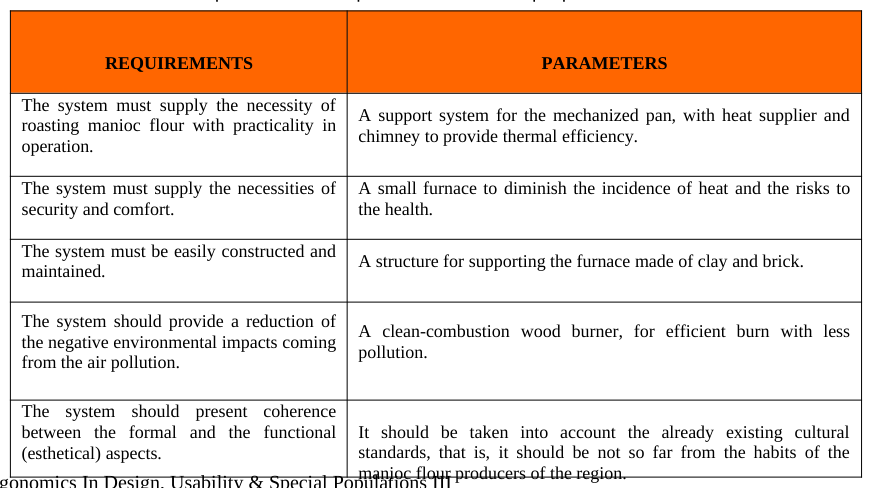
The evaluation tests of the new system had as objective to verify whether the expected results were achieved. The experiments evaluated the system response concerning the requirements earlier established and listed in Table 1.
Table 1: Requirements and parameters for the proposed innovative furnace
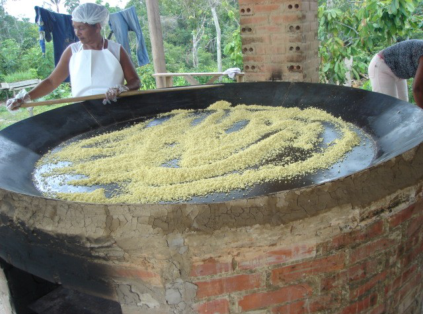
The first phase of manioc flour roasting The first phase of the manioc flour roasting process is the scalding. Its main function is to eliminate the water found in the raw manioc mass, process that occurs by means of evaporation. Figure 4 shows the first phase executed by a task executor. During the scalding process of the manioc flour roasting, we measured the furnace temperature, for the sake of verification and control.
Figure 4: Demonstration of the first phase of the manioc flour roasting process (scalding).
The second phase of manioc flour roasting The second phase of the manioc flour roasting process occurs when the water inside the mass is eliminated, and the mass becomes crunchy. This quality level is a de facto standard culturally established in the region and varies depending on the type of the manioc. This phase is characterized by a dried and crunchy mass, and it is simply called roasting. Figure 5 shows the execution during the second phase.
Figure 5: Demonstration of the second phase of the manioc flour roasting process (roasting).
Production of fish flour – piracuí Piracuí is a concentrated protein formed from the muscles of the fishes. After the piracuí has being dried and shredded, it becomes an important source of protein in the food habit of the local population, especially the population with low incoming. For each 100g, 70g provides protein of excellent digestibility. The piracuí production keeps practically the same, in a handmade and rustic manner, with technological limitations, giving rise to sanitary and commercial constraints.
People from the communities received orientations for the utilization of the innovative furnace. The objective of these orientations was to make clear the procedures for feeding the combustion room, temperature control, and system maintenance, including the withdrawal of the remaining ashes after the wood burning process. The piracuí mass was sifted and put on the furnace, where it was roasted during approximately 60 minutes at the temperature around 90ºC. This procedure is demonstrated in Figure 7. The temperature control was made manually, and the measured values conditioned the feeding of the combustion room.
Figure 7: Roasting of fish flour.
Figure available in the original PDF paper.
RESULTS AND FINAL REMARKS The results of this project were evaluated taking into account the indexes considered essentials for the achievement of the established objectives.
Among them, we can list the improvement of the production process; the evaluation, project and construction of an innovative furnace, aiming to get both productive and energetic efficiency; to make more comfortable the task execution, respecting the cultural concepts of the system use, as well as offering an economically feasible alternative for the small, medium and large producer.
According to the analyses done in the manioc flour houses, the environment temperature resulting from the traditional burning process after the begin of the combustion varies from 35,2ºC a 41,1ºC, that is, during the roasting process the task executor is steadily exposed to temperatures above the comfort standard to heat exposition that establishes an average around 25,1ºC and 25,9ºC.
The temperature analysis took by making use of some prototypes of the innovative furnace indicated a temperature in the lateral face very close the environment temperature, which means that the improvements provided a positive change with strong influence over the conditions of the task execution.
We observed that innovative furnace reduce the baking time, also, the mechanized process diminishes the time that the producer is involved with the activity, and this time can be used for a more productive activity as there is less fatigue and better work conditions.
While the technology of adiabatic combustion theoretically produces no smoke, our adaptation promoted a significant reduction of smoke in the environment. The gain reduced the risk of burns due to the reduction of the temperature of the walls of the furnace and decreased the area where occurs the combustion of firewood.
Traditionally, electricity produced in the Amazon region comes from diesel-based generators, though it represents the most incompatible option with the reality of the region.
A challenging alternative to this scenario is the deployment of photovoltaic panels. Commonly, this technology has a restricted application associated with comfort and entertainment due its inherent high costs.
The investigated solution presented in this work will change this context by introducing a technology that uses renewable energetic resources, since the mechanized alternative of the manioc flour roasting furnace uses photovoltaic cells to put in movement the shovels of the pan.. Ergonomics In Design, Usability & Special Populations III
The wood utilized in the traditional furnaces comes from tree downfalls without reposition. The proposed innovative furnace reduced this quantity since preliminary tests pointed out that the deployment of pieces of kindling would be sufficient, and they can be found around the communities. This way, it was possible to evaluate comparatively the wood consumption though measurements during the tests.
For the sake of comparison, the traditional surfaces consume approximately 50 kg of wood to produce a backing while the innovative furnace consumes around 16 kg of wood, representing an economy of 30%. This information confirms that the downdraft burning guarantees a more efficient wood combustion that is, one can obtain more heat with the same quantity of raw material.
In summary, we verified that the deployment of the innovative furnace in the execution of the roasting productive process of both the piracuí and the manioc flour, yielded positive improvements since there was no alteration of the product quality. Moreover, it was possible to find that implementation of the innovative furnace offers significant advantages in terms of task execution as well as comfort and efficiency of the task execution.
Most of the requirements for human systems integration are derived from requirements for performance, efficiency,
REFERENCES
Baxter, Mike. Projeto de Produto – Guia Prático para o Design de Novos Produtos, 2ª. Edição, Editora Edgard Bluecher. 2000. Bonsiepe, Gui e outros. Metodologia Experimental: Desenho Industrial. Brasília: CNPq/Coordenação
Editorial, 1986. Borges, T. P. F., Fogão a Lenha de Combustão Limpa. MSc. Thesis. Universidade Estadual de Campinas.
1994. Cia, G. O conceito do produto, mercadoria e iguaria na cadeia dos alimentos, II Congresso Brasileiro de Gestão de Desenvolvimento de Produto, São Carlos, Anais do II CBGDP, p.309-310, 30-31 ago. 2001. Cleland, D. I. e Ireland, L. R. Gerência de projetos, Traduzido de Project Manager’s Portable Handbook,
Rio de Janeiro: Reichman & Affonso Editores, p. 179 -180, 2002. Iida, Itiro. Ergonomia: projeto e produção. São Paulo. 2a edição. Edgar Blucher LTDA 2005.465p. Moraes, A., Mont'Alvão, C. Ergonomia – Conceitos e Aplicações. Editora iUsEr. 2003. Ramos, Jaime. Alternativas para o projeto ecológico de produtos. Florianópolis, 2001. Toledo, J.C., Gestão da qualidade na agroindústria, In: Batalha, M.O. (org), Gestão Agroindustrial, São Carlos: Ed. Atlas, 2001, segunda edição, Vol. 1.
LISTED IN THE AHFE DIGITAL BOOKSTORE CATALOGUE
Explore the complete digital volume
Advances in Ergonomics In Design, Usability & Special Populations: Part III
Read this individual research paper free through the original publisher, or explore the full digital proceedings book.
ISBN 978-1-4951-2108-1
Explore this ISBN in the AHFE Bookstore ↗Listed in the July 2026 bookstore catalogue; search by ISBN to confirm current availability · Digital book purchase optional