Nattaporn Rodjanapanurat, Orawan Buranruk (2018). Ergonomic Analysis of Rice Basketwork. In: Advances in Physical Ergonomics and Human Factors: Part I. AHFE Open Access, vol. 1. https://doi.org/10.54941/10018
Punsa Wongchai, Kulwarang Wongwilairat Back, Neck and Other Joint Pain Research Group School of Physical Therapy, Faculty of Associated Medical Sciences Khon Kaen University, Khon Kaen, 40002 Thailand ↗↗
A survey of the Thai National Statistical Office in 2012 indicated the number of informal employment was about 24.8 million, which was as high as 62.6% of the total number of employed persons (39.6 million persons) in . Considered by the work regions, the informal employment mostly worked in the Northeast of Thailand, approximately 41.5% of all informal workers. In general, these workers are rice farmers who involve rice cultivation processing as their main occupation. Previous studies found most of them to have rice basketwork as the major supplement of career. Most tasks in rice basketwork are performed with prolonged sitting on the floor and using repetitive movements of hands, fingers, wrists and shoulders for more than 6 hours a day, were likely to increase the musculoskeletal disorders (MSDs). A task analysis was conducted on basketwork tasks at a large area in the Khon Kaen and was then used to structure a job screening for ergonomics-related risk factors. The basketry process was divided in to six steps, including: 1) scrape bamboo skin, 2) cut a piece of bamboo, 3) tear strips of bamboo, 4) sharpen the bamboo, 5) weave the strips of bamboo and, 6) form the rice basket. The activities in each step were associated with different tools, for example, some steps included using a knife to slit bamboo or a bamboo cylinder for lifting. Subjective ratings of risk of injury, as part of job screening, were then made for each basketry step in each body part, focusing on motion, force, and posture. The screening tool used in this study was based on the Hand Activity Level (HAL) and Rapid Upper Limb Assessment (RULA) methodologies. The screening results revealed worker exposure to repetitive motion, high forces and extreme postures at the neck, shoulders, hands, and legs when performing in each step of basketry. The results indicated the basketwork procedure to pose ergonomics risk to workers. The highest risk was due to awkward work postures. Results also revealed continuously repetitive motion of upper limbs for long periods of time and inappropriately use of load and force at upper body parts. Therefore, this study suggested that ergonomics interventions, using engineering, administration and/or personal protection controls, should be applied in order to reduce risk of occupational injury of informal workers in .
Basketwork was found in geographical areas of Mediterranean countries, Eastern and Central Europe, Africa and Asia (Novellino et al., 2006), especially in southeast Asia such as Thailand, Laos, Malaysia, Indonesia and Philippines (Novellino, 2006). A survey of the Thai National Statistical Office in 2012 found that the total number of employed persons was 39.6 million persons. The number of informal employment was about 24.8 million or 62.6%. Considering by region, informal employment worked in the Northeast was the highest accounted for 41.5% of all informal workers (National Statistical Office, 2012). The population in Khon Kaen province in the northeast of Thailand found that the employed population was about 70.9% of the population. In general, these workers are rice farmers who involve rice cultivation processing as their main occupation and found most of them to have rice basketwork as the major supplement of career (Statistical Office, Khon Kaen province, 2012). Rice basketwork is the wisdom to keep the heat and the famous One-Tambon-One-Product Physical Ergonomics I (2018)
(OTOP) product in the northeast of Thailand. Consequently, Rice basketwork workers health and safety have become increasingly important issues to ensure a sufficient work to meet high production demands.
Rice basketwork involves many process steps. Most tasks in rice basketwork are performed with prolonged sitting on the floor and using repetitive movements of hands, fingers, wrists and shoulders for more than 6 hours a day, were likely to increase the musculoskeletal disorders (MSDs). MSDs are injuries and disorders of the soft tissues such as muscles, tendons, ligaments, joints, and cartilage and nervous system (OSHA, 2000) that can result in pain with or without movement, swelling, tenderness, reduced range of motion and/or stiffness, and tingling and/or numbness in nerve-related injuries or disorders (OHSCO, 2007). Several factors, such as excessive repetition, awkward postures, (Punnett et al., 2004; OHSCO, 2007; Da Costa, 2010), physical workload or force (Malchaire et al., 2001; Punnett et al., 2004) and static work (OSHA, 2000; Nunes et al., 2012) are associated with MSDs. Body regions most commonly involved are the low back, neck, shoulder, forearm, and hand, most reviewers agree that the epidemiology linking physical ergonomic exposures at work with risk of MSDs (Punnett et al., 2004). The previous study have found the prevalence of musculoskeletal problem of women bamboo basket workers in Madurai city of India in the last month were low back pain 99%, upper arm 98%, and shoulder pain 93% (Parimalam et al., 2006). Previous epidemiologic studies have indicate MSDs is common in the working population (Leroux et al., 2005), that is a major source of disability and lost work time (Buckle, 2005) and a significant cause of morbidity (Caruso et al., 2008). Thus, MSDs are a common health problem and a major cause of poor functional activity.
There is a need to conduct structured and systematic screening of Rice Basketwork procedure for ergonomics- related risk factor exposures. Thus, this study is set up to investigate the level and ergonomic risk all steps of Rice Basketwork procedure among Rice Basketwork workers to be used as guidelines for create the ergonomics interventions, using engineering, administration and/or personal protection controls, should be applied in order to reduce work-related musculoskeletal disorders of informal workers in Thailand.
METHODOLOGY
A field investigation of Rice Basketwork procedure was performed at Yang Khum Subdistrict, Nong Rua District, Khon Kaen province, Thailand. Our team visited the Rice Basketwork group and made observations on Rice Basketwork procedure and motion patterns at joints. Interviews were also conducted with the Rice Basketwork group manager and workers regarding musculoskeletal pain during Rice Basketwork, intensity of discomfort, including identification of the worst areas of pain, and methods used by the Rice Basketwork workers in an attempt to reduce discomfort in work.
Physical Ergonomics I (2018)
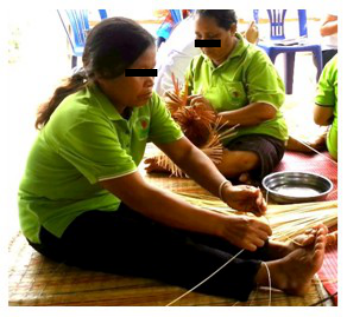
Figure 1. Scrape bamboo skin Figure 2. Cut a piece of bamboo
Figure available in the original PDF paper.
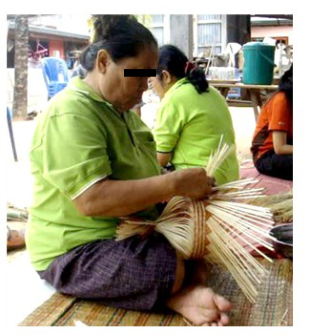
Figure 3. Tear strips of bamboo Figure 4. Sharpen the bambooFigure 5. Weave the strips of bamboo Figure 6. Form the rice basket
The steps of Rice Basketwork will be divided in to six steps to assess the ergonomics risk all steps. Based on the video analysis, two views of motion were recorded including front and side (left and right side) for each step. The camera will be set at the groups of basketry enterprises at the distance that can see the images of basketry of subjects obviously and natural as possible to make subjects feel relaxed. The point for setting the camera and sitting to make a basket of subjects will be the same spot every time in video recordings.
The screening tool was based on the Rapid Upper Limb Assessment (RULA) method developed by Corlett and McAtamney of University of Nottingham’s Institute for Occupational Ergonomics, published in the journal Applied Ergonomics (1993). RULA has been used to investigations of workplaces where work-related upper limb disorders. This tool assessment of the postures of the neck, trunk, Leg and upper limbs along with muscle function and the external loads experienced by the body.
The screening tool was applied in a lab setting by three analysts (ergonomists and physiotherapists) for each of the steps appearing in the Rice Basketwork task analysis. Several scores evaluating the posture of different body parts, Physical Ergonomics I (2018) the posture risk scores of the upper arms, neck, and trunk ranged from 1 to 6, the lower arms and wrist risk scores ranged from 1 to 4, the leg risk scores ranged from 1 to 2, the muscle use risk scores ranged from 1 to 2 and the force/load risk scores ranged from 1 to 3. A score of 1 indicates the best or most natural posture and higher scores show the worst position. The grand score of 1 or 2 (action level 1) indicates that the work posture was acceptable if it is not maintained or repeated for prolonged periods, grand scores of 3 or 4 (action level 2) indicated further investigation is needed and changes may be required, grand score of 5 or 6 (action level 3) indicated investigation and changes required soon, and grand score of 7 (action level 4) indicated that work investigation and changes required immediately required (McAtamney and Corlett, 1993). RESULT
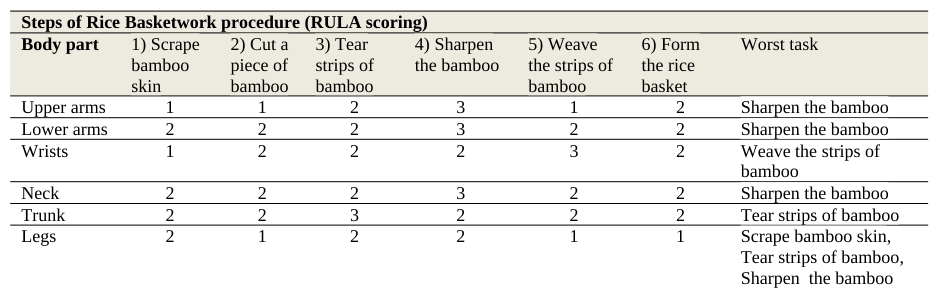
In general, the function in each step will have different ways in working, such as some steps use devices in the works by using a knife to slit bamboo or bamboo cylinder lifting force. But some characteristics of many works were similar, such as sitting on the floor without the backboard continuously for long periods of time. The majority is in the awkward postures and repetitive movement. The screening results revealed the step of Rice Basketwork procedure to pose an overall risk for MSDs (see Table 1). Specifically, sharpen the bamboo step was rated to be the worst task for body parts, including the upper arms, lower arms, neck and legs, followed by tear strips of bamboo step was considered to be the worst task for body parts, including the trunk and legs, scrape bamboo skin step including the legs, and weave the strips of bamboo step including the wrists. Several scores evaluating the posture of different body parts, score of 1 indicates the best or most natural posture and higher scores show the worst position. This study the upper arms high score was 3 indicated degree of shoulder flexion 15 to 45 degrees add abduction, while the lower arms high score was 3 indicated degree of elbow flexion more than 90 degrees add working across midline of the body. The wrists high score was 3 indicated degrees of wrist flexion and extension 0 to 45 degrees add deviation. The neck high score was 3 indicated degree of neck flexion 10 to 20 degrees add twisted. The trunk high score was 3 indicated degree of trunk flexion 20 to 60 degrees. The legs high score was 2 indicated legs and feet not supported and balance.
Table 1: Worst task identification for each body part based on risk of injury
When considering the aggregate risk levels of Rice Basketwork procedure (see Table 2). The grand scores are obtained by adding posture scores to the muscle use and force scores. The postures, muscle function and the external loads were considered the main underlying factors in the injury risk to the body parts. From the risk ratings, the grand scores of 3 or 4 (action level 2) in scrape bamboo skin, cut a piece of bamboo, tear strips of bamboo, weave the strips of bamboo and form the rice basket indicates that the workers postures at their work step need to be further investigation is needed and changes may be required, grand score of 5 or 6 (action level 3) in sharpen the bamboo indicated investigation and changes required soon.
Table 2: Risk levels for steps of Rice Basketwork procedure Steps Grand scores Action level
Physical Ergonomics I (2018)
1) Scrape bamboo skin 4 2 2) Cut a piece of bamboo 3 2 3) Tear strips of bamboo 4 2 4) Sharpen the bamboo 5 3 5) Weave the strips of bamboo 3 2 6) Form the rice basket 3 2
DISCUSSION
The results indicated the Rice basketwork procedure to pose ergonomics risk to workers. According to an assessment of ergonomic risk using the RULA method, one-six of the Rice Basketwork procedure were found to have an action level 3 in sharpen the bamboo, needed an investigation and changes required soon, while half of them, at action level 2 indicates that the workers postures at their work step need to be further investigation is needed and changes may be required. In addition to the high RULA scores, the main underlying risk factor for each step of Rice Basketwork procedure was awkward posture, repetitive movement combined with external loads during Rice Basketwork work affect the MSDs of Rice Basketwork workers. Specifically, sharpen the bamboo step was rated to be the worst task for body parts, including the upper arms, lower arms, neck and legs. In this overall Rice Basketwork procedure, the analysts considered the upper limb to be at high risks for MSDs. Previous studies on MSDs in women bamboo basket workers in Madurai city of India in the last month found prevalence to be highest for the low back pain 99%, upper arm 98%, and shoulder pain 93% (Parimalam et al., 2006). In Thailand, the similarities characteristics of job in “Rom Suk” broom weaving workers in Khon Kaen province found prevalence of musculoskeletal and upper limb disorders was 83.7% (Chaiklieng et al., 2011) and prevalence of musculoskeletal pain in the textile occupation in Khon Kaen province in twelve months were shoulder pain 49.8%, low back pain 46.6%, and neck pain 42.6% (Keawduangdee et al., 2010). The findings from current study on the similarities characteristics of job are in agreement with the trends of these prevalence rates. High risks of MSDs were observed for similarities characteristics of job in the same areas of the body as reported by the previous studies.
The steps of Rice Basketwork procedure found that postures, muscle function and the external loads were considered the main underlying factors in the injury risk to the body parts, especially awkward posture and repetitive movement. Work-related MSDs occur when the physical capabilities of the worker do not match the physical requirements of the job (OSHA, 2000). Activities leading to these disorders feature one or more of the following: excessive force, repetitive movement, awkward posture or prolonged static posture, and vibration (George, 2010), when continued task performance is superimposed upon injured and inflamed tissue a vicious cycle of injury, chronic or systemic inflammation, fibrosis, and perhaps even tissue breakdown may occur (Barbe et al., 2006). In Thailand, the health effects of computer use among Thai Commercial Bank Workers in Khon Kaen province found that the repetitive movement strain of the wrist and hands and used computers at least 5 hr/day were found to increase risks of MSDs (Chaiear et al., 2005). Furthermore, the study of ergonomic analysis of rice field plowing found that the repetitive motion and extreme posture were considered the main underlying factors in the MSDs (Swangnetr et al., 2012).
The highest risk was due to awkward work postures that stretch physical limits, can compress nerves and irritate tendons (OSHA, 2000). Results also revealed continuously repetitive motion of upper limbs for long periods of time and inappropriately use of load and force at upper body parts. The hypothesis performance of repetitive and/or forceful tasks may induce MSDs through three primary pathways: (1) Central nervous system (CNS) reorganization result from the performance of highly repetitive tasks, both in the presence and the absence of chronic pain, peripheral tissue inflammation, and/or peripheral nerve compression, (2) tissue injury result from highly repetitive and/or forceful motions cause injury to the musculoskeletal system and peripheral nerves, and (3) tissue reorganization result from repetitive loading of bones, muscles, and tendons leads to adaptive remodeling of these tissues (Barr et al., 2004). The symptoms generally include pain with or without movement, swelling and tenderness reduced range of motion and/or stiffness, and tingling and/or numbness in nerve-related injuries or disorders (OHSCO, 2007) and loss of motor function (Barbe et al., 2006). Which usually develop from Cumulative Trauma Disorders (CTD) resulting from months or years (Kroemer, 1989).
Physical Ergonomics I (2018)
The strong correlation between the incidence of work-related musculoskeletal disorders and the working conditions is the physical risk factors associated with jobs such as awkward postures, high repetition, excessive force, static work, cold or vibration (Nunes, 2009; Nunes et al., 2012). However, some confounding factors or co-factors such as age, seniority, gender, sport, smoking habits, etc. (Malchaire et al., 2001). These factors may lead to MSDs.
CONCLUSIONS
The findings of this study revealed the Rice Basketwork procedure, especially sharpen the bamboo step to lead to a high potential for MSDs, especially the upper limb disorders. These findings can be used to guide MSD prevention efforts for Rice Basketwork workers in Thailand. There is a need to conduct detailed ergonomic analyses on these tasks, including postures, muscle function and the external loads. Therefore, this study suggested that ergonomics interventions, using engineering, administration and/or personal protection controls, should be applied in order to reduce risk of occupational injury of informal workers in Thailand. Based on the findings of the present study, such interventions should including Instruction on appropriate work methods to prevent awkward whole-body posture. Development and implementation programs using ergonomic and industrial hygiene improvement are needed to prevent MSDs.
ACKNOWLEDGMENTS
This study was supported by grants from the Back Neck and Other Joint Pain Research Group and Khon Kaen University. The author is grateful to thank Assistant Professor Dr. Sunisa Chaiklieng, Department of Environmental Health Sciences, Faculty of Public Health, and Dr. Manida Swangnetr, Department of Production Technology, Faculty of Technology, Khon Kaen University, Khon Kaen, Thailand for suggestion about ergonomic analysis and all their help.
REFERENCES
Barbe MF, Barr AE. (2006). “Inflammation and the pathophysiology of work - related musculoskeletal disorders”. Brain Behav Immun 20(5): 423-9. Barr AE, Barbe MF, Clark BD. (2004). “Work-related musculoskeletal disorders of the hand and wrist: epidemiology,
pathophysiology, and sensorimotor changes”. J Orthop Sports Phys Ther 34(10): 610-27. Buckle P. (2005), “Ergonomics and musculoskeletal disorders: overview”. Occup Med (Lond) 55(3): 164-7. Caruso CC, Waters TR. (2008). “A review of work schedule issues and musculoskeletal disorders with an emphasis on the healthcare sector”. Ind Health 46(6): 523-34. Chaiear N, Buranruk O, Pinitsoonthorn S, Boonma M, Leelathanapipat S, Sujinprum C, Durongkhadet P, Leelamanotham S, Moonthawee K. (2005). “Health Effects of Computer Use Among Thai Commercial Bank Workers, Khon Kaen, Thailand” Srinagarind Med J 20(1): 1-7. Chaiklieng S, Homsombat T. (2011). “Ergonomic Risk Assessment by RULA among Workers of Rom Suk Broom Weaving”. Srinagarind Med J 26(1): 35-40. [in thai] Da Costa BR, Vieira ER. (2010). “Risk factors for work-related musculoskeletal disorders: A systematic review of recent longitudinal studies”. Am J Ind Med 53(3): 285-323. George E. (2010).“Occupational hazard for pathologists: microscope use and musculoskeletal disorders”. Am J Clin Pathol 133(4): 543-8. Keawduangdee P, Puntumetakul R, Boonprakob Y, Wanpen S, Siritaratiwat W. (2010). “The prevalence of musculoskeletal Physical Ergonomics I (2018) disorders in the textile occupation in Khon Kaen province”. J Med Tech Phy Ther 22(3): 292-301. [in thai] Kroemer KH. (1989). “Cumulative trauma disorders: their recognition and ergonomics measures to avoid them”. Appl Ergon 20(4): 274-80. Leroux I, Dionne CE, Bourbonnais R, Brisson C. (2005). “Prevalence of musculoskeletal pain and associated factors in the Quebec working population”. Int Arch Occup Environ Health 78(5): 379-86. Malchaire J, Cock N, Vergracht S. (2001). “Review of the factors associated with musculoskeletal problems in epidemiological studies”. Int Arch Occup Environ Health 74(2): 79-90. Mc Atamney, L. & Corlett, E.N. (1993). “RULA: a survey method for the investigation of work-related upper limb disorders”. Applied Ergonomics 24(2): 91-99. National Statistical Office. (2012). “THE INFORMAL EMPLOYMENT SURVEY”. Accessed September, 2013, http://service.nso.go.th /nso/nsopublish /themes/theme_2-2-4.html . [in Thai] Novellino D, Ertug F. (2006). “BASKETS OF THE WORLD” THE SOCIAL SIGNIFICANCE OF PLAITED CRAFTS: “Baskets of the World” the Socia l Significance of Plaited Crafts”. IVth Internationa l Congres of Ethnobotany (ICEB 2005), Yeditepe University, cIstanbul – Turkey 619-620. Novellino D. (2006). “BASKETS OF THE WORLD” THE SOCIALSIGNIFICANCE OF PLAITED CRAFTS: An introduction to basketry in Island Southeast Asia”. IVth International Congres of Ethnobotany (ICEB 2005), Yeditepe University, cIstanbul – Turkey 621-625. Nunes IL, Bush PM. (2012). “Work-Related Musculoskeletal Disorders Assessment and Prevention”. Accessed September, 2013, http://www.intechopen.com/books/ergonomics-a-systems-approach/work-related- musculoskeletal-disorders- assessment-and-prevention Nunes IL. (2009). “FAST ERGO_X-a tool for ergonomic auditing and work - related musculoskeletal disorders prevention”. Work 34(2): 133-48. Occupational Health and Safety Council of Ontario (OHSCO). (2007). “Part 2: Resource Manual for the MSD Prevention Guideline for Ontario”. Accessed September, 2013, http://www.osach.ca/misc_pdf/ MSDResource.pdf Occupational Safety and Health Administration (OSHA). (2000). “Ergonomics: The Study of Work”. Accessed September, 2013, http://www.fop.org/downloads/OSHA%20Ergonomics.pdf Parimalam P, Balakamakshi K, Ganguli AK. (2006). “Musculoskeletal problems of women bamboo workers in Madurai, India”. Human Factors and Ergonomics Society of Australia 42 nd Annual Conference; Australia. Punnett L, Wegman DH. (2004). “Work-related musculoskeletal disorders: the epidemiologic evidence and the debate”. J Electromyogr Kinesiol 14(1): 13-23. Statistical Office, Khon Kaen province. . (2012). “Statistics data”. Accessed September, 2013, http://khonkaen.nso.go.th /nso/project/search _ option/search_result.jsp. [in Thai] Swangnetr, M., Namkorn, P., Phimphasak, K., Saenlee, K., Kaber, D. B., Buranruk, O., & Puntumetakul, R. (2012). “Ergonomic Analysis of Rice Plowing”. Taylor and Francis, LLC, for use as a contribution to a collective work (tentatively) entitled 4th International Conference on Applied Human Factors and Ergonomics (AHFE 2012), 565-74.
Physical Ergonomics I (2018)
LISTED IN THE AHFE DIGITAL BOOKSTORE CATALOGUE
Explore the complete digital volume
Advances in Physical Ergonomics and Human Factors: Part I
Read this individual research paper free through the original publisher, or explore the full digital proceedings book.
ISBN 978-1-4951-2104-3
Explore this ISBN in the AHFE Bookstore ↗Listed in the July 2026 bookstore catalogue; search by ISBN to confirm current availability · Digital book purchase optional