Piia Tint, Viiu Tuulik, Ada Traumann, Viive Pille (2025). Development of initial data for AI Models for the Improvement of Computer Workers Health Status. In: Human Interaction and Emerging Technologies (IHIET-AI 2025): Artificial Intelligence and Future Applications. AHFE Open Access, vol. 161, pp. 243–251. https://doi.org/10.54941/ahfe1005915
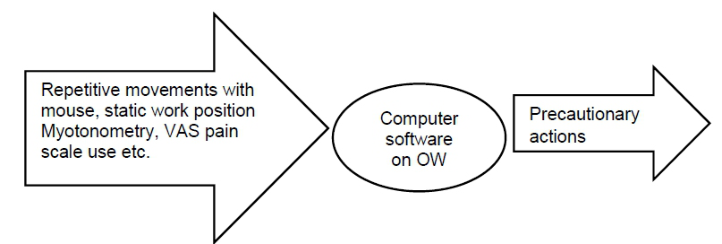
To assemble the AI model for implementation for office workers’ occupational health improvement, different data connected with work environment and human body ailments are needed. The current paper gives the data of 116 office workers health disturbances (musculoskeletal disorders) measured with myotonometry. The Nordic musculoskeletal questionnaire was used. For the initial data for AI, the scientific literature review is given. The results contain the data from myotonometry and VAS pain scale. Work-related musculoskeletal disorders are the most common workplace health hazards. The results show that trapezius muscle’s stiffness had high numbers, otherwise the thumb muscle’s stiffness was low, considered with the patients with occupational disease. On the basis of measurements and questionnaire analysis the model for AI initial data was compiled which consists of 3 parts: 1) operating working environment factors influencing on people, influence of them to the organ systems, functional stages of occupational disorders, loss of work capacity; 2) computer software on computer workers; 3) possible preventive actions. At the end of the paper the recommendations for managing of workplace ergonomics are given. Balneotherapy is one of the possible rehabilitation methods in Estonia.
Musculoskeletal complaints in the neck and upper extremities connected with computer work are common in modern society and both show the increasing trend. Several previous reviews have indicated a possible causal relationship between computer work and musculoskeletal complaints in the neck and arm (Ming and Zaproudina, 2003; Wahlström, 2005; Gerr et al., 2006). Occupational use of computers has increased over recent years and has caused a lot of musculoskeletal disorders which are diagnosed as occupational diseases (Oha et al., 2014) or work-induced diseases in Estonia (Pille, 2016). The focus of the paper is to compile the initial data system to artificial intelligence (AI) model for implementation in offices. The initial data were gathered from: 1) the scientific literature in this field over the world
2) considering the climate conditions in the workplaces and 3) the assessment of the work-related musculoskeletal disorders; 4) the opinion of the workers on the working conditions and their health complaints connected with work.
In 2020, the European Agency for Safety and Health (EU-OSHA 2022) initiated a four-year research programme on digitalisation of occupational safety and health (OSH). Basing on this document, the current paper is focused on the Estonian computer users’ health state, mainly basing on the investigations of office workers. The occupational health doctors in Estonia use three-stage model of development the health complaints connected with repetitive and monotonous work. Occupational disorders develop by stages. At the first, early stage, the rehabilitation is effective, and the worker can return to work after a short time of treatment. At the next stage, treatment is possible, but it takes more time and sometimes the worker has to change the character of work in order not to be disabled in the future. In the case of occupational diseases, complaints and musculoskeletal changes are usually irreversible, but it is possible to use some rehabilitation methods to alleviate the sufferings of patients (Pille, 2016).
The work-related MSDs affecting the upper body and limbs are recognized as one of the leading causes of pain and disability in occupational health in Estonia (Kahn et al., 2007; Zheltoukhova and Bevan, 2011; National Labor Inspectorate, 2015).
Computer work cause health disorders already at an early age (Palm et al., 2007) in the form of headache, eyestrain and the beginning of musculoskeletal disorder. The stiffness, frequency and decrement of muscles are possible to determine with myotonometry. The statistical values (validity, reliability of measurement) are also important in the choose of the measuring method (Pruyn et al., 2015). Computer work not only results in static muscle loading, but also in static spine loading. Although a relation between sitting and low back pain could not be confirmed in a systematic review (Hartvigsen et al., 2000), prolonged sitting has been associated with development of disc degeneration. It has also been shown that static loading during sitting can affect lumbar spine stiffness (Beach et al., 2005). Furthermore, continuous compression on an intervertebral disc causes fluid outflow from the intervertebral disc (Kingma et al., 2000) and may negatively affect tissue nutrition.
The aim of the AI model is to get better ergonomic conditions for computer workers as presented by EU-OSHA in 2022 (EU-OSHA, 2022). Information on AI in ergonomics, particularly musculoskeletal disorders in office-rooms were carried out using the following databases: ChatGPT, Microsoft Bing Image Creator, Midjourney.
MATERIAL AND METHODS 116 office workers were involved in investigations of myotonometry, pain location determination and use of balneotherapy for rehabilitation.
The workers’ musculoskeletal complaints were assessed based on the Nordic musculoskeletal questionnaire (Kuorinka et al., 1987). The intensity
Development of Initial Data for AI Models for the improvement 245
of pain was assessed using the Visual Analogue Scale (VAS, a scale from one to ten). The workers filled the questionnaire forms.
The VAS scale description: The Visual Analogue Scale (VAS) is an instrument for measuring the characteristics or attitudes that are believed to range across a continuum of values and cannot easily be measured directly, e.g. the amount of pain. The pain, a patient feels, ranges across a continuum from none to an extreme amount of pain (Wewers and Lowe, 1990). The VAS scale consists of a 10 cm horizontal line with written descriptions at either end (not at all; very much); the subjects were asked to mark on the line the point that they felt represented their perception of their current state of pain in the respective body region. The patients were asked about the pain duration, letting them fill out the Nordic Questionnaire’s four duration groups: pain lasting for 1–7 days, 8–30 days, more than 30 days or pain felt every day.
The myotonometric method gives the possibility to evaluate muscle conditions. Myotonometric method is based on creating the mechanical impulses in the examined muscle and determining muscle stiffness and flexibility according to the muscle’s mechanical response.
The device “MYOTON-3” enables easy repetition of measurement, processes the data at the same time and gives statistical ratings in real time. Muscle stiffness (N/m) reflects the ability of a muscle to resist external force, natural frequency (Hz) shows tone and the logarithmic decrement expresses the character of the damping of its oscillation related to muscle elasticity. The parameters may be compared to the standard value of a corresponding individual muscle as well as statistically determined population standards may be used to evaluate the health disturbances potentially caused by work (Pille, 2016).
The following muscles were measured: M. add pollicis (left and right hand, thumb muscles); M. trapezius medialis, both sides of the spine in sitting and lying position. The adductor pollicis muscle is a muscle in the hand that functions to adduct the thumb. The trapezius medialis is a large paired trapezoid-shaped surface muscle that extends longitudinally from the occipital bone to the lower thoracic vertebrae of the spine and laterally to the spine of the scapula.
Statistical analysis: The mean and standard deviation (SD) were calculated in the course of the measurements. The Student’s t test was used. The statistical significance of the t test was p = 0.05.
RESULTS
The office workers (OW) have a high frequency of neck pain (Table 1). 55% of office workers complain about neck pain. The hand pain significantly differs between the office workers and the patients with occupational disease (OW, ODP). Right wrist pain is mentioned only by 20% of office workers, but 76% of the patients of occupational disease (ODP).
The pain intensity in the investigated groups (OW, ODP) in different body regions is presented in Table 2. The patients with occupational disease (ODP) feel the severest pain (7.0–8.0 on the 10-point scale). For the office workers
(OW), the pain in the neck, shoulders, back and wrists can be treated mostly within 1–7 days. The pain duration is longest in the ODP group.
Table 1. Number of health complaints from the Nordic musculoskeletal questionnaire (pain occurrence during 12 months (% of all investigated)).
Table available in the original PDF paper.
p-Value
Anatomical Region Office Workers (Workers Number: 60+56)
The results of the measurements of M. adductor pollicis show that the frequency and the stiffness of the muscles are increasing from office workers to the patients with occupational disease; the muscles lose their elasticity as a great overuse and working in the static posture. In the case of M. trapezius med, the muscle is exposed to greater load during computer work (Table 3).
Development of Initial Data for AI Models for the improvement 247
Lying position M. trapezius med (L): 193 (OW) 213 (ODP) M. trapezius med (R): 192 (OW) 207 (ODP)
17.4 (OW) 18,6 (ODP) (OW) 20,6(ODP)
1.3 (OW) 1,8 (ODP) (OW) 1,6 (ODP)
M. adductor pollicis (L): 264 8(OW) 293,8 (ODP) M. adductor pollicis (R): 267,2 (OW) 310 8 (ODP)
17,4 (OW) 15,2 (OW) 1,3 (OW) 1,5 (OW)
Sitting position M. trapezius med (L): 337 (OW)- M. trapezius med (R): 283 (OW) L- left; R- right OW-office workers, ODP- patients with occupational disease
THE AI MODEL COMPONENTS FOR COMUPER WORKERS
Figure 1: Artificial intelligence (AI) model considering the work environment conditions and the possible precautionary actions (OW = office workers).
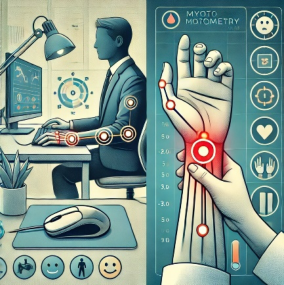
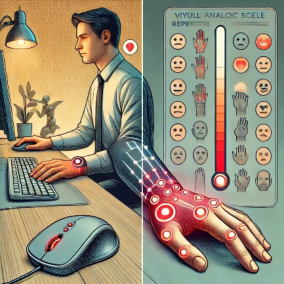
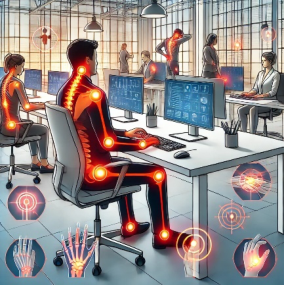
AI technology is advanced, you can enter relevant search words and an image will be created using the corresponding software. Using Microsoft Bing Image Creator there were asked next words to create the images “operating factors (repetitive movements, static and uncomfortable work positions)”
and “influence on organ systems, functional stages, loss of working capacity” (Fig. 2a, b, c).
Figure 2a: Image creation by ChatGPT1.Figure 2b: Image creation by ChatGPT2.Figure 2c: Image creation by ChatGPT3.
Development of Initial Data for AI Models for the improvement 249
DISCUSSION AND CONCLUSION The results of the other scientists in the field of musculoskeletal disorders connected with computer-work have shown the similar results as the current study.
In the Estonian study (Oha et al., 2016), the most respondents (77%) reported musculoskeletal pain (MSP) in at least one anatomical region. A high prevalence of MSP in the neck: (51%), low back (42%), wrist/arm (35%) and shoulder (30%) was observed among Estonian computer users. Psychosocial risk factors were broadly consistent with those reported by other scientists. Older age, right-handedness, not currently smoking, emotional exhaustion, belief that musculoskeletal problems are commonly caused by work, and low job security were the statistically significant risk factors for MSP in different anatomical sites. The observed a year-long prevalence of neck pain (51% of workers) was similar to that reported in New Zealand office workers (Harcombe et al., 2009) and somewhat higher than among a sample of UK office workers (38%) (Madan et al., 2008).
Although neck pain is mentioned as the most prevalent musculoskeletal complaint of office workers (Blagsted et al., 2008), pain symptoms in other body regions are reported as well (Juul-Kristensen et al., 2008). The number of workers studied by Andresen et al. (2010) was 544. The areas of pain were as follows: the neck: 53% (of the people studied), lower back: 43%, right shoulder: 36%, upper back: 33%, knees: 20 %, right hand: 22%, left shoulder: 24%, feet: 18%, right elbow: 16%, hips: 15%, left hand: 10% and left elbow: 10%. Pain intensity was rather unvaried: 4.18…4.93 (on the scale of 0 to 9).
Based on the current study, it may be concluded that, in the case of MSDs, myotonometry is a readily available and non-invasive tool for early detection of changes in muscle tone. The measuring of muscles is not a procedure requiring much time or conditions differing from a regular visit to a doctor or a nurse. As a result of the myotonometric study, we can assess the muscle condition and symptoms of an effect of physical overload in a particular worker. Myotonometric study can also be used for assessing muscle state under dynamic conditions, e.g. after a treatment or a change in the working order, as well as during physical examinations over a number of years. When conducting the study, it is also necessary that the person conducting the study has passed previous training, has a good knowledge of musculature and can choose the muscles subjected to a larger load in the given work process.
By reference to this study, we can conclude: during a workday (8 hours) it is recommended to make regular rest breaks, stand up and stretch yourself and need to do exercises for eyes; very important is exercise after a working day; more attention has to be paid to exercises, aimed at the neck, shoulders and wrist, as those parts present most distress of the body for office workers equipped with computers. It is very important to approach to the workers individually, considering the employee’s musculoskeletal ailments and the seriousness of the health complaints. One of the rehabilitation methods is using balneotherapy. As we cannot stop the ageing process, it is possible to take care of our body and minimize the risk of back pain at work (and after
working hours). We can use the AI technology to gain preventive information to minimize the hazards in the work environment, particularly in offices, working with computers. The importance of occupational health and safety in the everyday work environment is continuously important in the future work environment.
The education of workers to use ergonomic work methods is one of the possibilities to reduce the health disorders (Pun et al., 2004; Reinhold et al., 2008; Rempel et al., 2007). A systematic approach to MSDs is the key to optimizing the workplace ergonomics.
REFERENCES
Andersen, L. L., Christensen, K. B., Holtermann, A., Poulsen, O. M., Sjogaard, G., Pedersen, M. T. and Hansen, E. A. (2010). Effect of physical exercise interventions on musculoskeletal pain in all body regions among office workers: A one-year randomized controlled trial. Manual Therapy, 15, 100–104. Beach, T. A., Parkinson, R. J., Stothart, J. P. and Callaghan, J. P. (2005). Effects of
prolonged sitting on the passive flexion stiffness of the in vivo lumbar spine. Spine Journal, 5, 145–154. Blagsted A. K., Sogaard, K., Hansen, E. A., Hannerz, H. and. Sjogaard, G. (2008).
One-year randomized controlled trial with different physical-activity programs to reduce musculoskeletal symptoms in the neck and shoulders among office workers. Scandinavian Journal of Work and Environmental Health 34, 55–56. Demissie, B., Bayih, E. T., and Demmelash, A. A. (2014). A systematic review of work-related musculoskeletal disorders and risk factors among computer users. Heliyon 10 (2024) e25075 https://doi.org/10.1016/j. Heliyon. 2024. e25075. European Agency for Safety and Health at Work, EU-OSHA. (2022). Policy Brief.
Artificial intelligence for worker management: Prevention measures. 7 pp., https:/osha.europa.eu. Gerr, F., Monteilh, C: P. and Marcus, m. (2006). Keyboard use and musculoskeletal outcomes among computer users. J Occup Rehabil, 16: 265–277. Harcombe, H., McBride, D., Derrett, S. and Gray, A. (2009). Prevalence and impact
on musculoskeletal disorders in New Zealand nurses, postal workers and office workers. Aust N Z J Public Health, 33(5): 437–44. Hartvigsen, L., Leboeuf-Yde, C., Lings, S. and Corder, E. H. (2000). Is sitting-whileat work associated with low back pain? A systematic critical literature review. Scand. J. Public Health, 28, 230–239. Juul-Kristensen, B., Kadefors, R., Hansen, K., Bystrom, P., Sandsjo, L. and
Sjogaard, C. (2006). Clinical signs and physical function in neck and upper extremities among elderly female computer users: The NEW study. European Journal of Applied Physiology, 96, 136–145. Kahn, H., Moks, M., Pille, V. and Vain, A. (2007). Work-related overload diseases are, 44–47. The actual problem in the Estonian occupational health. Estonian Occupational Health, 44–47. Kingma, I., van Dieen, J. H., Nicolay, K., Maat, J. J. and Weinans, H. (2000).
Monitoring water content in deforming intervertebral disc tissue by finite element analysis of MRI data. Magn. Reson. Med., 44, 650–654. Madan, I., Reading, I., Palmer, K. T. and Coggan, D. (2008). Cultural differences in musculoskeletal symptoms and disability. Int. J Epidemiol, 37:1181–1189ooher, Harold, ed. (2003). Handbook of human systems integration. New Jersey: Wiley.
Development of Initial Data for AI Models for the improvement 251
Ming, Z. and Zaproudina, N. (2003). Computer use related upper limb musculoskeletal (ComRULM) disorders. Pathophysiology, 9: 155–160. National Labour Inspectorate. (2015) . Annual Report 2014. Oha, K., Animägi, L., Pääsuke, M. and Merisalu, E. (2014). Individual and work-related risk factors for musculoskeletal pain: a cross-sectional study among Estonian computer users. BMC Musculoskelet Disord., May 28:15:181. doi: 10.1186/1474-15-181. PMID: 24884911. PMC4049436. Palm, P., Hanson Risberg, E., Mortimer, M., Palmerud, G., Toomingas, A. and
Tornqvist, E. W. (2007). Computer use, neck and upper-extremity symptoms, eyestrain and headache among female and male upper secondary school students. Scandinavian Journal of Work, Environment and Health, Suppl.3, 33–41. Pille, V. (2016). Development of a Model for the Prevention of Work- Related Musculoskeletal Disorders in Upper Extremities. Tallinn University of Technology, PhD thesis. 147 pp. Pruyn, E. C., Watsford, M. L. and Murphy, A. J. (2015). Validity and reliability of three methods of stiffness assessment. Journal of Sports and Health Science, 1–8. Walhlström, j. (2005). Ergonomics, musculoskeletal disorders and computer work.
Occup Med (Lond), 55: 168–176. Waersted, M., Hanvold, T. N., and Veiersted, K. B. (2010). Computer work and musculoskeletal disorders of the neck and upper extremity: A systematic review. BMC Musculoskeletal Disorders 11, Article number: 79. http://www.biomedcent ral.com/1471-2474/11/79 Zheltoukhova, K. and Bevan, S. (2011). Töövõimeline Eesti? Luu- ja lihaskonna
vaevused ja Eesti tööturg. Eesti Haigekassa (in Estonian). Fit for work? Musculoskeletal disorders and the Estonian labour market.
LISTED IN THE AHFE DIGITAL BOOKSTORE CATALOGUE
Explore the complete digital volume
Human Interaction and Emerging Technologies (IHIET-AI 2025): Artificial Intelligence and Future Applications
Read this individual research paper free through the original publisher, or explore the full digital proceedings book.
ISBN 978-1-964867-37-3
Explore this ISBN in the AHFE Bookstore ↗Listed in the July 2026 bookstore catalogue; search by ISBN to confirm current availability · Digital book purchase optional