Magdalena Diering, Agnieszka Kujawińska (2020). Human Aspects of the Measurement System Analysis. In: Advances in The Ergonomics in Manufacturing: Managing the Enterprise of the Future. AHFE Open Access, vol. 12. https://doi.org/10.54941/ahfe100447
Quality control in manufacturing process means checking the consistency of the process or product with the internal or external customer requirements. Most often it is done by direct measurement or observation. The main objective of the quality control is to increase the chance that the product (process) is free from defects when passing it on further stages of the production process or on to use. It is difficult to find the type of industry, which is not performed by the demands resulting from quality control. In many industries, quality control plays a special role, especially where the manufacturing outcome is important for the client. The pharmaceutical and medical industries are examples of a situation in which quality status of manufacturing process has a direct impact on the patients health and even – in some cases – their lives. Alternative control is a special case of quality control. It can be performed by measuring or checking and classifying the object (product) into one of a number of states (in the specific case – into one of two, for example: good/bad or OK/No OK). Alternative quality control may be carried out with – for example – use of specialized equipment that automatically classify the items (for example, with use of machine with pattern recognition module to verify circuit boards or machine for printing color evaluation) or with the use of human senses (as visual control, control), man knowledge and his experience (know-how). To assure that quality control of manufacturing is a reliable process and its outcomes are on accepted level, measurement system must be evaluated (variation of the measurement system should be known and accepted). There are many procedures to assess the capability and reliability of measurement system. The most common and widely used procedure to assess alternative measurement system is – on the base of authors experience – KAPPA method. It allows to assess the impact of factors such as: human factors, instrument/gauge, environment etc. on the reliability of the control.The paper presents some possible directions of development of attribute measurement systems procedures. These challenges derive from need to assess the impact of factors related to the determinants of human psychophysical on the results of the statistical evaluation of measurement systems.
Various aspects of methods and techniques of quality control are widely discussed in the scientific literature. To a large extent these considerations also concern the control of manufacturing processes, in which the requirements primarily relate to the characteristics of the geometry of the product, therefore to measurable quantitative traits.
The concept of quality control process or product quality can be understood in several ways. Many authors [Hamrol, 2008] [Diering, et.al., 2014] define quality control as checking the process or product compliance with the requirements of the internal or external client. Nevertheless, the concept of process quality control is a much wider and includes the assessment of the product quality. Therefore, in the following part of the paper, when the authors talk about the quality control, it is meant about assessment of compliance with the requirements of the process.
Due to the manner of process assessment quality control can be divided into:
– assessment of measurable characteristics (quantitative), – assessment of unmeasured characteristics (qualitative, assessed alternative). – Control of the measurable characteristics is achieved by direct or indirect measurement and gives a numerical value output of the measured process features. In the case of attribute characteristics the control is performed by checking or observing the properties, which in turn allows to classify the object into one of several possible states. This can be explicit assignment, for example: good product-defective product, or as an assignment to the assessed unit one of several categories defining a degree of fulfillment of requirements, such as: the product of class I, II, III.
Control of attributive characteristics can be performed by type tests measuring instruments and templates and/or using knowledge and human senses – the so-called organoleptic control, such as visual inspection (checking color printouts), tactile (flow evaluation of the motion of the ratchet surgery tool), sound, scent or flavor (food industry, FMCG).
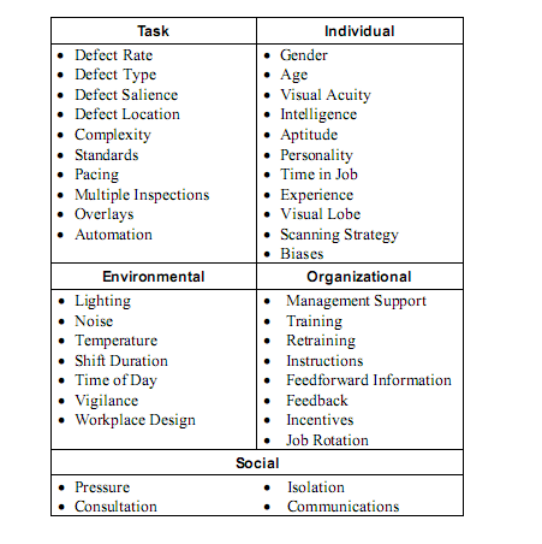
Process quality control performed by a man using his senses is widely described in the literature [Hamrol&Kowalik &Kujawińska, 2010] [Almgren, 2012] [Battini, 2011]. Research on the efficiency of this type of inspection focuses mainly on the analysis of the impact of human factors and the work organization [Bo Hu&Wei Zhang and Gavriel Salvendy, 20112] [Erdnic, 2008] [Falck, 2002] [Górska 2009] [Hamrol, et.al., 2006] [Jasiulewicz-Kaczmarek, 2013] [Helander, 2012] [Pacholski, 1977]. These two groups of factors can be divided into 5 categories: task, individual, environmental, organizational and social (Figure 1).
Figure 1. Factors affecting the efficiency of the alternative control performed by the human [Judi E. See, 2012] Technical factors are factors related to the physical implementation of the checks in the production process. For example, this group includes factors related to the actual level of defects, with features that are evaluated (the availability of features for evaluation), the standards under which the product is controlled, the availability of the tools used during the inspection, etc.
Psychophysical factors relate to controllers mental and physical determinants. These include age, gender, intelligence, temperament, health, etc. Research in this area are intended to identify the characteristics that make up the perfect controller profile [Drury, 1999] [Bożek&Rogalewicz, 2013] [Duphrate, 2004] [Eklund, 1997].
Another group of factors are organizational ones. These include support factors in decision-making during the inspection and the acquisition of skills by the controller, the number and types of controls, information on the performance and efficiency of the checks carried out, the factors affecting controller stress, such as the time, the consequences of bad judgment (no premiums, loss company image, etc.).
Work environment factors are associated with the workplace, in which control is performed. Environmental factors include the physical components, such as lighting, noise, temperature as well as the organization of the workstation. Research on these factors conducted Drury (1999) – analysis of the impact of lighting on the results of visual inspection, Hancock (1984) – the noise impact on the efficiency of control, Hamrol, Kowalik and Kujawińska (2010) – light, noise, Murgatroyd, Worrall and Waites (1994) – ambient temperature and McCallum et al. (2005).
The last group of factors are factors related to the enterprise community in which controllers work. In their work they frequently meet with the pressure which is caused by persons whose interests are in conflict with the controller job. An example might be pressure from the production staff (often colleagues) who expect the acceptance of the work done (payment of salaries, bonuses) or the pressure exerted by the board staff and managers whose goal is to minimize re-inspections related to products for which there is no clear assessment. Thus, in many works can be found recommendation to separate control functions from production functions [Judi E. See, 2012]. Placement the visual control in manufacturing may adversely affect its performance due to the relationships between the controllers and other employees.
One of the causes of errors in alternative assessment is imprecise description of the requirements for manufactured products. An example may be assessment of the quality of galvanized sheet [Almgren, 2012] – for class A surface some scars, pores, varied surface structure, dark spots, blemishes a striped and small patches of the passivation process are allowed, while improved class B surface, obtained in the process of cold rolling smoothing , it is allowed for "(...) small cracks caused by straightening the winding, rolling prints of smoothing, minor scratches, diverse structure of surface waviness of the process and the slight coloration of the passivation process (...)." Based on the above description, it is difficult to qualify controlled surface quality as A or B. The formulation "slightly", "minor", "small" disqualifies these guidelines as a basis for quality assessment . Therefore, in such situations, the quality control is determined by number of defects which are acceptable, for example: how many stains zinc on the coating?, how many paint coating discontinuities on the product? The word "how many" is the key here, because in order to properly assess the characteristics associated with visual evaluation it is necessary to describe the problem quantitatively.
Inaccuracy of the terms of requirements can cause problems in the correct control implementation and its application in practice. It seems that the solution to this problem brought mathematical apparatus – by applying in the quality assessment methods and techniques the theory of fuzzy logic. From the 80's been an increase in applications of fuzzy logic techniques in supporting human decision making in the alternative control, where evaluation is expressed imprecise[Jieng, 2003] [Jhonson, 1980] [Master, 2005].
However, it turns out that the development of assessment techniques of alternative processes is not parallel with the development of assessment techniques of measuring systems. Namely, well known and described in literature [MSA, 2010] measurement systems analysis methods (MSA) for alternative assessments provide only a situation in which a person classifies process (object) to one of two states. There is no other possibility, although at the same quality control of such a possibility exists.
Measurement systems analysis and conformity assessment systems ensures reliability of the data, so the development of instrumentation associated with this analysis should be parallel with the development of measurement techniques and methods to support decision-making.
VISUAL INSPECTION OF MANUFACTURING Control in the ordinary sense means the test or measurement of specific characteristics of the product and/or process and the evaluation on the basis of the obtained results, whether a characteristic meets the specified criteria for compliance. Also the term of verification or inspection may be used in the literature and are designed to assess the conformity of attributes data of the product, production settings of the machine or process parameters of the requirements defined in the specification by the client, or the internal arrangements which company. Many authors interpreted the quality control as a regulatory process, whose activities are aimed at bridging the gap between the defined standard and the actual results of the process [Hamrol, 2008].
Among the group of alternative control techniques the most commonly used is assessing the quality of the products by visual inspection. The visual inspection is particularly important for processes where repeatability and reproducibility are limited and outcomes are different and require an individual approach when assessing the quality of their performance.
On visual inspection, knowledge of the errors which potentially can be found during the control is very important. Also, an experts (engineers, appraisers) clear definition of the control criteria (how many and what type of defects means that the product is considered to be defective) are important. This standardization facilitates the work and, on the other hand, restricts, narrows the area of errors search. The operator focuses on recognizing the defined potential errors (using the list of potential errors). The risk of omission not listed errors (even errors which are visible without any magnification) might be large. Stereotyped approach to the inspection process often does not stimulate creativity and often is related to the passive attitude of the operator in relation to his work performed. In such a case he can very easily takes the wrong decision as omission (in the terminology of statistics that is type II error) or incorrect classification (type I error) [Więcek-Janka, 2011]. The final stage of the inspection process is the operator decision about the product and/or process – does the product may be passed on to the next steps of the production process?, or whether should it be separated from the good (coherent) products?
ATTRIBUTE MEASUREMENT SYSTEMS STUDY The main function of the measurement system or evaluation system (hereafter – when talking about the process of deciding the question of compliance with the specifications – the concept of the measurement system is also used for the system or method of the assessment, the analogy also for the measurement process and measurement) is the realization of the measurement process. Understanding the variation resulting from the interaction of the elements of the measurement system and understanding their contribution to the total observed variation are fundamental for actions and decisions undertaken on the basis of measurements taken from manufacturing process or manufactured products. This is also a basis for problems solving in the production process. In case of significant variation of the measurement process, the observed from the manufacturing process results are not reliable. The variation of the system can therefore be the cause of the loss of time and resources, or customer dissatisfaction (eg. complaints). One component of the evaluation system – as already mentioned – may be human (eg. operator of the machine, appraiser). Furthermore, there are processes in which the human is more effective "measurement tool" than the instrument, gauge or measuring device. In systems in which one of the element affecting its variation is the human factor, above all, it should be controlled. To this serve the MSA methods and procedures [MSA, 2010].
In practice, production companies use different methods of MSA, both in case of systems for measurable characteristics as well as systems for characteristics evaluated alternative.
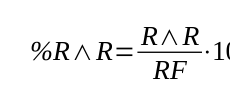
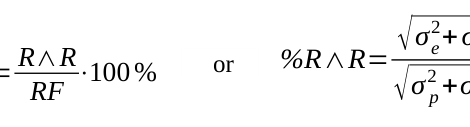
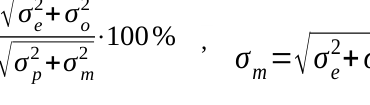
For measurable characteristics literature suggests developed by the automotive industry procedures and methods for estimating the variation of selected measurement process properties that use statistics and/or probability for testing the accuracy of measurement – correctness (eg. bias) and precision (repeatability and reproducibility) of the system and also its linearity and stability. They are based mostly on the analysis of variance. Evaluation of the usefulness of the measurement system is mainly done on the basis of the ratio %R&R (formula 1). The designation of this index is the last "step" in almost all of MSA procedures for measurable characteristics [MSA, 2010].
2+σo 2
Equation reproduced from the original PDF.
2+σo 2 (1)
Equation reproduced from the original PDF.Equation reproduced from the original PDF.
√σ p
where: – %R&R – the rate (index) of the usefulness of the measurement system,
– σm, R&R – standard deviation which describes the variation of the measurement system (combined effects of repeatability and reproducibility), – RF – accepted reference value (usually it is part of the tolerance or TV – the total variability of the process),
– σe, EV – standard deviation describing the repeatability, – σo, AV – standard deviation describing the reproducibility,
– σp, PV – standard deviation describing the manufacturing process variation.
Equation reproduced from the original PDF.
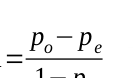
where: – KAPPA – compliance rate for pairs of operators or pairs of type operator-expert,
– po – the sum of the observed consistent decision type 0-0 i 1-1 in relation to the number of possible pairs of decision 0-0 i 1-1, – pe – the sum of the expected frequency of compatible type of decision 0-0 i 1-1 in relation to the number of possible pairs of decision 0-0 i 1-1.
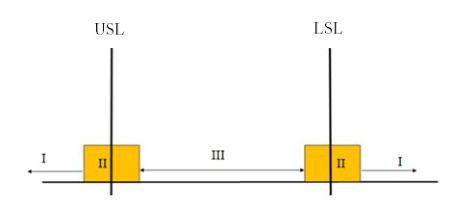
The signal detection method, as one of the alternative assessment methods, is also widely used for measurable characteristics – when the measurement characteristics is difficult or economically unjustified (unprofitable), or when the measurement characteristics is more time-consuming than the evaluation of the product (for example, measure the diameter of the shaft can be made ruler or evaluate test). Then, if the appraiser decision is not a rate (good/bad) but the measured value obtained by measuring, those, in this case, the most common is a signal detection method. The overall objective of this method is not – as in the case of KAPPA – assessment of the compatibility between the operators and the expert, and the appointment of the so-called ambiguous decision area (an area about Ergonomics in Manufacturing (2020) the results, in which evaluators are different because of the decisions about the state of the characteristic) (Fig. 6) . Here, the number of evaluations undertaken in the framework of the study are also 450 (n = 50 , k = 3 and r = 3 is the most commonly accepted test system).
Figure 2. Areas of decision-making in the attribute measurement system studies: USL/LSL – upper/lower specification limit, I – the area of decision: "bad/wrong/defective product" (out of specification), II – the area of ambiguous decision (it is difficult to make a clear decision “good” or “bad”), III – the area of decision: "good product" (within the limits of the specification). Source: [MSA, 2010]
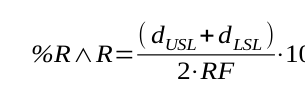
Knowing the range of zone II, the value of R&R can be determined and from this, the usefulness of measurement system indicator %R&R (formula 3).
Equation reproduced from the original PDF.
2⋅RF ⋅100% . (3) In practical approach for alternative measurement systems analysis and approach for its evaluation of and possibility of its conduct of using computer aided states Bower in [Bower, 2002].
ATTRIBUTE MEASUREMENT SYSTEMS STUDIES – CHALLENGES AND TRENDS As a result of the literature review, discussion and research in many enterprises, as well as on the basis of authors own thoughts and experiences, a number of issues are pointed which – according to the authors – can determine the direction of the development of measurement systems analysis for alternative assessment (for attribute studies). In the world around us the phenomenon of the imprecision of information is universal and indelible. Man naturally uses imprecise terms such as: low temperature, high speed, etc. What is more, he can effectively use them to transfer knowledge, argue and conclude. People naturally express their understanding of the phenomena and their mechanisms using imprecisely defined rules in the form of and this way of handling information is the basis of human intelligence [Diering, et.al., 2013].
The theory called fuzzy sets was proposed by Zadeh in [Zadeh, 1965]. It allows to describe an imprecise concepts in mathematical language (and hence in a way which is understood by computers). This theory also allows to operate on those sets effectively and use them in decision-making process. He described his theory as a precise description of the imprecise phenomena. Mamandi [Mamandi, 1974] described a method of using these collections to make decisions and control processes. The first of its application appeared in the years 80 of the XX century, among others: control of furnace cement (Denmark), sewage treatment plants (Fuji), train control (Hitachi) [Faraz, 2007] [Goldboy, 2006]. In the years 90 of the XX century became the Japanese "fuzzy logic boom" – fuzzy controllers began to be widely used in household appliances, automotive system (ABS, fuel injection), in cameras and camcorders, etc., and in decision support systems, for example, production planning and estimating insurance risk. More about the theory of fuzzy sets can be found in [Wygralak, 2013] [Dyczkowski, 2012] [Grzegorzewski, 2006] [Kacprzyk, 2006], on fuzzy systems, decision-making and control – in [Bower, 2002, 2003] and on industry applications, and the production of recommendation systems – in [Kumuru, 2013] [Klir, 1994]. According to the authors, an important issue seems to be the development of methodologies for systems in which the assessment of the level of compliance of the product specific requirements is made using natural language, ie. the assessment with using a linguistic terms (eg. very low, low, medium, much, very much). Within the attribute measurement systems methods development the fuzzy logic should be taken into consideration. So far the fuzzy approach is more widely used in the manufacturing processes control and product quality evaluation as a method of decision support. Studies conducted by the authors suggests that the issue of fuzzy MSA is almost not discussed in the scientific literature – for attribute characteristics, in general, and for measurable features they found only a few work.
SUMMARY
The paper presented some possible directions of development of attribute measurement systems procedures. Proposed procedures derive from need to assess the impact of factors related to the determinants of human psychophysical on the results of the statistical evaluation of measurement systems.
REFERENCES
Almgren J, Schaurig C., (2012), “The influence of production ergonomics on product quality”, Chalmers Reproservice, Sweden. Battini D., (2011), “New methodological framework to improve productivity and ergonomics assembly system design”, International Journal of Industry Ergonomics, USA. Bo Hu, Wei Zhang and Gavriel Salvendy, (2012), “Impact of multimodal feedback on simulated ergonomic measurements in a
virtual environment: A case study with manufacturing workers”, Human Factors and Ergonomics in Manufacturing and Service Industry, pp. 145–155. Bower Keith M., (2002), “Measurement system analysis with attribute data”, Trainer`s Corner, Minitab Inc., p. 10-11. Bożek M., Rogalewicz M., (2013), „Nieskuteczność kontroli końcowej przyczyną niskiej efektywności procesu wytwarzania”, Inżynieria Maszyn, rocznik 18, zeszyt 1; pp. 84-96. Diering M., Kujawińska A., Dyczkowski D., Rogalewicz M., (2014), „Fuzzy logic in the assessment of alternative measurement
systems as one of the MSA development directions” (in Polish: Logika rozmyta w ocenie alternatywnych systemów pomiarowych jako jeden z kierunków rozwoju MSA), Innowacje w zarządzaniu i inżynierii produkcji, tom II, Oficyna Wydawnicza Polskiego Towarzystwa Zarządzania Produkcją, Opole, ISBN 978-83-930399-6-8, pp. 348-360. Douphrate D., (2004), “The Economics and Cost Justification of Ergonomics”, Colorado State Univeristy, USA. Drury, C.G. (1999). Human reliability in civil aircraft inspection. Paper presented at the RTO HFM Workshop on “The Human Factor in System Reliability— Is Human Performance Predictable?”, Siena, Italy. Dyczkowski K, Stachowiak A. , (2012), “A Recommender System with Uncertainty on the Example of Political Elections,
Advances in Computational Intelligence”, Communications in Computer and Information Science, vol 298, pp. 441- 449, Springer, Berlin Heidelberg. Eklund J., 1997, “Ergonomics, quality and continuous improvement - Conceptual and empirical relationships in an industrial context”, Ergonomics. Vol. 40. Issue 10. 982-1001. Erdinc O., (2008), “Quality improvement through ergonomics methodology: conceptual framework and an application”,
International Journal of Productivity and Quality Management, Volume 3, Number 3, 311-324. Falck A., (2002), “The influence of assembly ergonomics on product quality and productivity in car manufacturing - a cost benefit approach”, Nordic Ergonomic Society Conference, Finland. Faraz A., Bameni Moghadam M., (2007), “Fuzzy Control Chart: A Better Alternative for Shewhart Average Chart.
Quality & Quantity”, 41, 375–385. Golbay M., Kahraman C., (2006), “An alternative approach to fuzzy control charts: direct fuzzy approach”, Information sciences, 77(6), 1463-1480. Gorman D., Keith M., (2002), “Measurement Systems Analysis and Destructive Testing”, Six Sigma Forum Magazine, vol. 1, nr
4, str. 16-19. Górska E., Smagowicz J., (2009), “Ergonomic assement of organizational improvements in manufacturing process, Ergonomics – the tool of innovation”, The 5th International Conference of Ergonomics, Warszawa, 12-13. Grzegorzewski P., (2006), Wspomaganie decyzji w warunkach niepewności. Metody statystyczne dla nieprecyzyjnych danych,
EXIT. Hajipour V, Kazemi A., Mousavi S., (2013), “A fuzzy expert system to increase accuracy and precision in measurement system analysis”, Measurement, Volume 46, Issue 8, Pages 2770–2780. Hamrol A., (2008), “Zarządzanie jakością z przykładami”, PWN, Warszawa. Hamrol A., Kowalik, D., Kujawińska A., (2010), “Impact of chosen work condition factors on quality of manual assembly
process”, Human Factors and Ergonomics in Manufacturing, 1-8. Hancock, P.A., (1984), “Environmental stressors”, in J.S. Warm (Ed.), Sustained Attention in Human Factors (pp. 103-142).
Chichester: Wiley. Helander M., (2012), “Handbook of Human Factors and Ergonomics”, John Willey and Sons Inc., USA. Jasiulewicz-Kaczmarek M., (2013), “The role of ergonomics in implementation of the social aspect of sustainability, illustrated with the example of maintenance”, Arezes, P, Baptista, JS, Barroso M, Carneiro, P, Lamb P, Costa N, Melo, R, Miguel, AS & Perestrelo, G (eds.) (2013), London, pp. 47-5
Jiang X., Gramopadhye A.K., Melloy B.J. and Grimes L.W., (2003), “Evaluation of best system performance: Human, automated, and hybrid inspection systems”, Human Factors and Ergonomics in Manufacturing and Service Industry, Volume 13, Issue 2, pages 137–152. Johnson S., Funke D., (1980), “An analysis of humand reliability measures in visual inspection”, Journal of Quality Technology,
vol. 12, no. 2, 71-74. Judi E. See, ( 2012), “Visual Inspection: A Review of the Literature”, Sandia National Laboratories. Kacprzyk J., (2006), „Wieloetapowe sterowanie rozmyte”, WNT, 2006 Klir G., Yuan B., (1994), “Fuzzy Sets and Fuzzy Logic: Theory and Applications”, Prentice-Hall. Kumuru M., (2013), “Assessing the visual quality of sanitary ware by fuzzy logic”, Applied Soft Computing, vol 13, s. 3646- 3656, Elsevier. Mamandi E., (1974), „Application of fuzzy algorithms for control of simple dynamic plant”, Proceedings IEEE, 121,12; 1585-
1588. Master R., Jiang X., Khasawneh M.T., Bowling S.R., Grimes L., Gramopadhye A.K. and Melloy B.J., (2005), “Measurement of trust over time in hybrid inspection systems”, Human Factors and Ergonomics in Manufacturing & Service Industries, Volume 15, Issue 2, pages 177–196. McCallum, M., Bittner, A., Rubinstein, J., Brown, J., Richman, J., & Taylor, R. (2005), „Factors contributing to airport
screener expertise”, Proceeding of the Human Factors and Ergonomics Society Annual Meeting, 49, 922-926. “MSA - Measurement Systems Analysis”, 4th ed., Reference manual, (2010), AIAG-Work Group, Daimler Chrysler Corporation, Ford Motor Company, General Motors Corporation. Murgatroyd, R.A., Worrall, G.M., & Waites, C, (1994), “A study of the human factors influencing the reliability of aircraft
inspection”, Warrington, UK: AEA Technology. Pacholski L., (1977), „Metodologia diagnozowania ergonomicznego w przedsiębiorstwie przemysłu meblarskiego”, Rozprawy nr 81, Wydawnictwo Politechniki Poznańskiej. Więcek-Janka E., (2011), „Decisions and games”, Wydawnictwo Politechniki Poznańskiej, Poznań. Wygralak M., (2013), “Intelligent Counting under Information Imprecision, Applications to Intelligent Systems and Decision
Support”, Studies in Fuzziness and Soft Computing, Springer.
LISTED IN THE AHFE DIGITAL BOOKSTORE CATALOGUE
Explore the complete digital volume
Advances in The Ergonomics in Manufacturing: Managing the Enterprise of the Future
Read this individual research paper free through the original publisher, or explore the full digital proceedings book.
ISBN 978-1-4951-2103-6
Explore this ISBN in the AHFE Bookstore ↗Listed in the July 2026 bookstore catalogue; search by ISBN to confirm current availability · Digital book purchase optional