Agnieszka Kujawińska, Katarzyna Vogt, Adam Hamrol (2020). Analysis of Shift Work System Influence on Visual Inspection Effectiveness. In: Advances in The Ergonomics in Manufacturing: Managing the Enterprise of the Future. AHFE Open Access, vol. 12. https://doi.org/10.54941/ahfe100444
In paper influence of shift work preferences on quality control effectiveness is examined. Shift work indicated as one of key work organizational parameters that decrease visual control [Kujawińska, Vogt 2013]. Adjustment to work hours rotation in weekdays results in problems with regards to day and night activation cycle (day and night disturbances - sleep) as according to environmental interview also private, social disturbances and medical problems. In paper research results based on experiment performed in company manufacturing electronics for automotive industry. Shift work impact on visual inspections that placed sequentially in chosen technological process was examined. Single operator day and night cycle effectiveness was analyzed. Correlation strength between preferences indicated by operators to work on particular production shifts, and in particular days and real control effectiveness.
In age of high technological progress, continuously appearing new customer requirements and need of being competitive on market, companies quite often decide to maintain production within day and night. Three shifts working system has to secure products accessibility on time as also in demand amount. With production approach three shifts working system is preferred by employers because of for example big production output. However it creates many risky situations, especially if we take into considerations natural human biorhythm disturbances as also negative social and cultural consequences.
WORK SYSTEMS ORGANIZATION One of the key work organizational factors is job evolvement, determined by work mode. Work can be analyzed in different modes as follows:
• temporary (initiated by a need of execution selected, mostly single task) [Equation or mathematical symbol available in the original paper PDF] steady (initiated by list of needs/tasks, enquiring continuous evolvement) Job mode and evolvement are closely related to production schedules created on the basis of customer demands for particular products and/or services. With regard to production capabilities of production orders execution and production lines capacities various work organization systems can be mentioned with leading shift work system. Job load can change accordingly to job mode.
Different job modes can be accordingly noticed: Ergonomics in Manufacturing (2020)
• one shift, [Equation or mathematical symbol available in the original paper PDF] two shifts, [Equation or mathematical symbol available in the original paper PDF] three shifts, [Equation or mathematical symbol available in the original paper PDF] on order Advantages and disadvantages of different modes are presented in Tab.1. Job systems were classified with regard to time accessibility/flexibility and disturbances of natural twenty four hours human activity rhythm (biorhythm).
Table 1: Advantages and disadvantages of different job modes [own study] Work mode Time independency level Biorhytm disturbances level
In most of production companies shift work systems are organized in below mentioned time ranges: [Equation or mathematical symbol available in the original paper PDF] first (morning) - since 6 am to 2 pm, [Equation or mathematical symbol available in the original paper PDF] second (afternoon) - since 2 pm to 10 pm, [Equation or mathematical symbol available in the original paper PDF] third (night) - since 10 pm to 6 am (next day)
With reference to operator time flexibility and risk of biorhythm disturbance production on order is without any doubts the most comfortable job mode. It gives flexibility in time scheduling as also private and job duties reconciliation [Furnham 1999]. Rest of work modes needs operator adjustment to fixed time frames. Working hours are the basis to day scheduling. Additionally working hours flexibility (fixed or flexible working hours) impact on job motivation. Flexible starting and finishing time, which normally does not relate to operators, have positive impact on human as also quality of executed work.
In most of manufacturing companies producing goods in series, especially in big series, the most common working time system includes three shifts. Operators perform their job in precisely defined time frames (steady working hours) within twenty four hours. Work continuity on selected production shift is maintained within whole week. It means that every employee perform job in the same working time during entire week and next shift comes with week change. Two shift change sequences in three shift working system can be noticed as follows: [Equation or mathematical symbol available in the original paper PDF] decreasing, [Equation or mathematical symbol available in the original paper PDF] increasing.
Shift rotation does not itself have positive influence on job quality with regards to direct impact in life biorhythm. Although it is stated that decreasing sequence has bigger negative impact on human and its job effectiveness comparing to increasing sequence [Khalaque 1999]. On the basis of experiment with 60 men working in company manufacturing cigarettes was proofed that easier to get used to time frame changes in job of increasing trend.
"decreasing" "increasing" Fig.1 Production shift sequences in three shifts working system [own study]
According to Harrington`s opinion [11] only 10% of people have positive approach to work in shift system, 20-30% is oriented negatively and rest is neutral. Quality of life without any doubts depends not only on work organizational Ergonomics in Manufacturing (2020) factors (ex. shift working system) which directly disturb day and night human rhythm but also on psychological factors as for example opinions/preferences are presented in next section of that article.
PREFERENCES AND EVALUATION METHODS Preference is defined as emotional state that describes inclination and willingness execute defined actions. It could have many sources and mostly are created as response to stimulus/ impact from external environment. On one side needs fulfillment explained by lack results in continuous, not insisted actions aimed at particular need fulfillment, on the other side giving opinion (ex. related to shift system working system), preparing offers, person characteristics evaluation indicate only direction of thinking and approaching to issues, as also strength of activation need. The more difference between preferences and real situation (regardless of fact if it initiates fast reaction on need/stimulus, or create a way of thinking/giving opinions) the bigger psychological and/or physical human discomfort.
Work organizational factors (among of other time and work methods adjusted by law and regulations) not dependent on worker`s opinions and to which operator needs to adjust assume undoubtedly to be in area of limited interaction with human preferences and independent to each other. There are so many methods and tools dedicated for human preferences evaluation. With reference to its handling, communication type between research moderator (ex. interviews) and respondent can be listed methods as follows: [Equation or mathematical symbol available in the original paper PDF] direct, [Equation or mathematical symbol available in the original paper PDF] indirect.
In direct researches respondent participation is necessary and due to that fact cost of research carrying is higher comparing to indirect methods. Direct researches have an advantage over indirect considering educational value (informative) and personal contact with interviewee. In most common used methods can be mentioned interview, questionnaire and psychological tests.
In researches focused on operator shift and day preferences in company producing electronics, environmental interview with employees was used. Each operator answered for fourteen open and six closed questions. Questions presented in Appendix 1. Interview lasted fifteen minutes. Operators answered questions orally and interview was carried out of working hours. Interview resulted present in section of this paper focused on researches.
VISUAL INSPECTION AND EFFECTIVENESS EVALUATION Visual inspection is one of the most common and cheapest quality control methods. Its aim is check of process and/or product consistency with internal and external customer requirements [Kujawińska, Vogt 2013]. It is analysis based on sensors and it concern not measureable products attributes, difficult during evaluation. Control object is human so it is not free of faults. That faults especially relate to knowledge, abilities, skills, possibilities as also human limitations. The most common control methods in current production systems in presented in Fig.1.
Ergonomics in Manufacturing (2020)
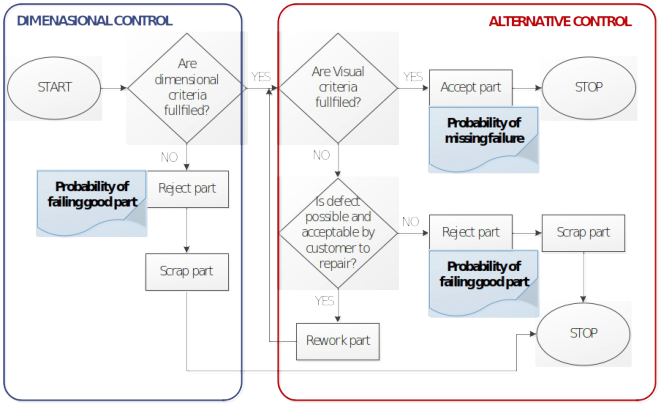
Figure 2. Visual inspection diagram with indicated types of human failures [own study] Each control is several step process (products screening, searching for defects, defects classification, product evaluation). Decision making process about product disposal is combined with risk of two types of failures [Kujawińska, Vogt 2013]. Product physically nonconforming can be classified as conforming. Such as fault is named in statistics as second type fault. Adverse situation means classification of physically conforming product as nonconforming is defined as first type fault. Both faults can appear in variable control (dimensional criteria - Fig.2) as also in alternative control (ex. visual criteria- surface quality evaluation - Fig.2).
There are many indexes that can present visual control effectiveness in variables as also in percentage. Two antagonistic indexes was chosen [Kujawińska, Vogt 2013]. Both indexes can vary in ranges from zero to hundred percent (0-1): [Equation or mathematical symbol available in the original paper PDF] FPY (First Pass Yield) = number of found nonconformance / total number of nonconformance available to find1, [Equation or mathematical symbol available in the original paper PDF] Fraction p = number of nonconformance on particular control station / total number of nonconformance.
RESEARCHES Researches examining influence of shift working system on visual control effectiveness are continuation [Kujawińska, Vogt 2013] of examinations of organizational factors (not dependent on operator) on visual control effectiveness. Influence of shift working system on control effectiveness performed by single operator, not the whole team dedicated for station is evaluated.
Researches carried out in company producing electronics for automotive industry, on selected technological line, for five sequentially placed controls (Fig.3). Printed boards was checked under magnification (to fourth the size).
1 total number of nonconformance available to find is interpreted as sum of nonconformance to be found on particular station (nonconformance not found by previous controls) Ergonomics in Manufacturing (2020)
Figure 3. Controls location in production process [own study]
Figure available in the original PDF paper.
Data related to inspection effectiveness collected from thirty three weeks. Nonconformance is divided into types and attributed to inspections that should be able to detect them according to criteria presented in instructions. They are presented in Tab.2.
Table 2. Nonconformance types, creation and detection location in process [own study] Nonconformance type Nonconformance creation Nonconformance detection assembly failures process 1 inspections:1,2,5 soldering failures process 1 inspections:1,2,4,5 conformal coating coverage failures process 2 inspections:3,4,5 contamination not known inspections:1,2,4,5 not accepted quality of components supplier process inspections:1,2,5
Additional research tool used for operator preferences evaluation of working in shift working system was direct interview. In Tab.3 is presented basic information, operators in inspection 1 preferences about desired production shift weekdays.
Table.3 Basic information and operator preferences for shift working system and weekdays [own study] Operato Se The most preferred
Analyzing shift working system influence on visual inspection effectiveness special attention to night working shift is paid. Third shift is indicated as the most disturbing natural biorhythm. With reference that operators working in visual inspection 1 defined night shift as the most preferred the following section of this paper present results for that operators. Influence of below mentioned factors on visual inspection effectiveness is analyzed: [Equation or mathematical symbol available in the original paper PDF] preference of working in selected production shifts and weekdays, [Equation or mathematical symbol available in the original paper PDF] shift working system (operator`s level), [Equation or mathematical symbol available in the original paper PDF] nonconformance type (repeatable - steady /not repeatable - accidental location on product.
RESEARCH RESULTS AND DISCUSSION Summarizing interviews carried out with all visual inspection operators concerning preferences of shift working system and weekdays, it can be concluded that most of operators is willing to work on night shift, slightly less on morning shift and the least on afternoon shift (Fig.4).
Night shift is defined by operators as least stress shift because of supervisors or third persons absence. One of third shift advantage that operators stated is continuous/not disturbed working time and possibility of bigger attention to inspected products in contrast to the rest of production shifts. Counterargument for night shifts is worse mood, faster tiredness, fatigue [Hamrol, Kowalik, Kujawińska 2013], bigger risk of failure during inspection and less time for Ergonomics in Manufacturing (2020) private aims.
It was also noticed relatively big share of operators not willing to work on morning shift. This phenomenon is undoubtedly caused by limited attention to inspected products, penchant and/or need to splitting at the same time attention into few objects (ex. talks with other operators, additional activities accompanying inspection - ex. quality data about nonconformance registry in forms) and bigger reactivity.
Figure. 4 Operator preferences with reference to production shift [own study]
Weekday preferences analysis (Fig.5) shows that operators are the most willing to work on Friday, so a day before weekend and the least on Monday. Based on that observations it can be stated that private life dominated on job life and determine job evolvement and motivation. Taking into consideration real raw data from inspection (Fig.6) can be noticed equal inspection effectiveness. Slightly bigger effectiveness is on Thursday and Friday.
Figure.5 Operator preferences with reference to weekday [own study]
Positive and negative preferences with reference to production shifts are combined with behaviorist aspect, differentiate in population individuals of "larks" (morning typed) or "owls" (evening typed) [Khalaque 1999] by nature. They differ with day and night effectiveness. "Larks" much prefer morning working hours, adjusted to biorhythm. For "owls" in a row according to author`s opinion is easier to adapt to work in late afternoon and night hours.
For author of this paper the most interested research area relates to analysis of impact night shift on inspection effectiveness. Based on that for in-depth analysis inspection with highest rate of positive preference to night shift. was chosen (Fig.2). Analysis is based on assumption that on night shift would be visible biggest difference between shift preference and current results. Confirmation of hypothesis about the worst inspection results on morning shift induced to statement that most of operators are "larks" by nature.
Evaluating dependency between inspection effectiveness and operator`s shift preferences (Fig.6) appears conclusion that operators are much more aware of the biggest job effectiveness that the smallest one. Self-awareness of possessed, already mastered and acquiring abilities and skills indirectly influence on preferences rightness and results from individual development level. It is easier to indicate production shift with the biggest evolvement than the one with the biggest risk of failure. Additionally should be mentioned that there are individuals who are not aware of skills and abilities as also limitations (negative correlation between preferred shift and inspection Ergonomics in Manufacturing (2020) effectiveness).
Legend: positive production preferences negative production preferences
According to analysis of age, job experience length and education impact on inspection effectiveness statistical significance is not confirmed. Risk of human error appearance (especially second type) is determined by unique biorhythm and does depend on characteristics describing human (Tab.2, Fig.6). Shorter job introduction time needed for persons with longer job experience length is visible (ex. for operators 5 & 6 - Fig.11 & 12). On the other hand shorter experience length, more fresh approach/view unable detect not typical, not repeatable, new failures that require big perceptiveness. Among dominant inspection aspects should distinguish proper inspection methods, measuring aids accessibility as also knowledge and operator vigilance.
Based on day and night operator effectiveness evaluation can be stated that operators aware of working hours with the biggest and the smallest effectiveness are minority. Most of preferences statements is not consistent with real inspection effectiveness. It can be concluded that biorhythm determines activities effectiveness and is dominant individual preferences and opinions. It can be also noticed that operators perform less failures within last working hours that within starting hours. There are two local inspection effectiveness minimums within whole production shift for all operators.
Figure.7 Day and night operator 1 in inspection 1 effectiveness [own study]
Ergonomics in Manufacturing (2020)
Figure.8 Day and night operator 2 in inspection 1 effectiveness [own study]
Figure.9 Day and night operator 3 in inspection 1 effectiveness [own study]
Figure.10 Day and night operator 4 in inspection 1 effectiveness [own study]
Ergonomics in Manufacturing (2020)
Figure.11 Day and night operator 5 in inspection 1 effectiveness [own study]
Figure.12 Day and night operator 6 in inspection 1 effectiveness [own study]
Visual inspection operators are motivated mostly external motives, lower level needs. Operator declaration about positive and negative shift preferences and weekdays are subjective. Direct correlation between individual abilities and limitations evaluation and real inspection effectiveness is not confirmed (Fig.7-12). According to author of this paper internal motivation interpreted among of others by self-awareness of skills and abilities to standard/repeatable inspection, self-inspection need, full responsibility for performed job allow effectively inspect and evaluate products. Self-inspection is important from inspection effectiveness point of view. With reference to lack of methods applicable to self-inspection analysis, form, or improve and as also unique approach to individuals there is a need to handle researches in that area.
Analyzing impact of production shifts on inspection effectiveness special attention is paid to night shift. If so operator not willing to work on night shift can be combined with awareness of "lark" by nature, far as night shift acceptance is not consistent with natural day and night rhythm. Liking to work on evening and night hours justified with ability of better focusing on inspected products can be rational explained with contrast to lack of support and ability to consult with experts suspected products. According to Furnham`s opinion [Furnham 1999] along with human aging becomes more "lark" by nature, so better adapt to morning working hours. Research results analysis does not confirm that statement. Inspection effectiveness determinant is defined with biorhythm (day and night activation cycle) and development level of individual characteristics such as vigilance, perceptiveness, reactivity and attention division.
Ergonomics in Manufacturing (2020)
Based on weekday influence on inspection effectiveness analysis (Fig.5) can be stated that this factor in not statistically significant. Direct correlation between factors is not confirmed. Relatively steady inspection effectiveness within whole week is noticed, with slightly bigger level on Thursday and Friday. Impact of human basic data (age, education, job experience length) on inspection effectiveness is also not confirmed.
Based on evaluation of inspection effectiveness with day and night approach (Fig.7-12) can be stated that day and night effectiveness distribution with positive and negative trends are consistent with human effectiveness curve presented by REFA commission [Seiwert 1998]. Effectiveness growth trend on the beginning of every production shift and drop trend at the end of shift can be noticed (Fig.7-12). There are at least two local inspection effectiveness minimums within all production shifts. Additional fact observed during inspection effectiveness analysis is effectiveness drop (second type failures) within hours of regenerative breaks (about 9 am for morning shift, about 5 pm for afternoon shift and about 1am for night shift). Moreover observed fluctuations of effectiveness on morning shift can be a result of production rhythm disturbance by third persons.
Important aspect in author of this paper opinion, that needs to be emphasized and continued with researches is combination of visual inspection with extra operations that disturb control activities and increase risk of human failure [Hansen 2006] during inspection.
REFERENCES
Arif M., Inooka H.(1999), Iterative manual control model of human operator. Biological Cybernetics, 81, p.445-455 Brzeziński J. (2010), Psychological studies methodology, PWN, Warsaw Cepin M. (2007), Importance of human contribution within the human reliability analysis, Journal of Loss Prevention in the Process Industries, 21, p.268-276 Fox J.G. (1975), Ergonomics contribution to subjective inspection in industrial quality control, The Production Engineer Furnham A., Hughes K. (1999), Individual difference correlates of nightwork and shift-work rotation, Personality and Individual
Differences 26, p.941-959 Graeber C. (1999), The Role of Human Factors in Improving Aviation Safety, Aero Magazines, No 9. Hamrol A. (2005), Quality Management with examples, PWN, Warsaw Hamrol A. , Kowalik D., Kujawińska A. (2013), Impact of selected work condition factors on quality of manual assembly process Hansen F.D. (2006), Human error: A concept analysis. Journal of Air Transportation, 11 (3), p.61-77 Harrington J. M. (1978), Shift Work and Health. A critical review of the literature. London, HMSO Jasiulewicz-Kaczmarek M., Drożyner P. (2011), Preventive and Pro-Active Ergonomics Influence on Maintenance Excellence
Systems.Human Factors and Ergonomics in Manufacturing, 13 (2), p.137-152 Jo Y-D., Park K-S. (2003), Dynamic management of human error to reduce total risk.Journal of Loss Prevention, 16, p.313-321 Juchnowicz M. (2007), Operator job engagement. Evaluation, and motivation methods, PWE Kalaykov I, Wide P. (2003), Intelligent Feature Estimation, Based on Human`s Perceptual Features, SCIMA, International
Workshop on Soft Computing Techniques, Measurements and Related Applications Khalaque A. (1999), Sleep deficiency and quality of life of shift workers, Social Indicators Research 46, p.181–189 Khan F. (2008), Human factors special issue. Journal of Loss Prevention in the Process Industries, 21, p.225-226 Kujawińska A., Vogt K. (2013), Analiza wpływu wybranych czynników pracy na skuteczność kontroli wzrokowej, Inżynieria Maszyn Liu Z., Xiao J., Huang Y. (2009), Proactive product quality control: An integrated product and process control approach to
MIMO systems. Chemical Engineering Journal, 149, p.435-446 Maslow A. (2006), Motivation and personality, PWN, Warsaw Przytocki M., Jakubiec K. (2011), Psychophysical performance rhythms vs. Production shift work, www.wsiz.rzeszow.pl/kadra/lstoklosa/.../Rytmy%20wydolności.ppt Seiwert L. J. (1998), How to organize time, Job studies commission results, Warsaw, Sekuła Z. (2007), Motivation to work. Theory and instrument, PWN Skrzypek E. (200), Quality and efficiency, UMCS, Lublin Ergonomics in Manufacturing (2020)
Skrzypczak Z. (2007), Job and organization psychology, PWN, Warsaw Więcek-Janka E. (2007), Sylwetka psychofizyczna polskiego Mikroprzedsiębiorcy, Ekonomika i Organizacja Przedsiębiorstwa.
Numer specjalny, p. 116-120 Więcek-Janka E. (2011), Decisions and games, wydawnictwo Politechniki Poznańskiej, Poznań
Appendix 1. Questionnaire about opinions and production shift working system preferences for visual inspection operators [own study]
1. What is your today mood? 2. What is your most preferred production shift? 3. Why do you prefer the most working on selected production shift? 4. What is your the least preferred production shift? 5. Why do you prefer the least working on selected production shift? 6. Which weekdays do you prefer the most for work? 7. Why do you prefer the most working in selected day/days? 8. Which weekdays do you prefer the least for work? 9. Why do you prefer the least working in selected day/days? 10. Are you willing to work during weekends? 11. What are the main explanations for work during weekends? (if only answer for 11st question was positive) 12. What is your personal approach to job? ("want, have to, should") 13. What the most does motivate you? 14. Are any factors that have negative influence on you and your job? 15. What do demotivate you in job the most? (only if answer for 14th question was positive) 16. Do you think that workplace that you are working needs any modifications (working time and place organization)? 17. What do you think needs to be changed to perform your work better and more comfortable (if only answer for 16th question was positive). 18. Do you like news, not typical and not known cases? 19. Are you willing to take job risk (nevertheless I am not sure if particular product is consistent with criteria I decide that it is acceptable with awareness that next inspection will catch it if possible)? 20. Do you prefer if you job results are inspected by third persons (following controls)?
Ergonomics in Manufacturing (2020)
LISTED IN THE AHFE DIGITAL BOOKSTORE CATALOGUE
Explore the complete digital volume
Advances in The Ergonomics in Manufacturing: Managing the Enterprise of the Future
Read this individual research paper free through the original publisher, or explore the full digital proceedings book.
ISBN 978-1-4951-2103-6
Explore this ISBN in the AHFE Bookstore ↗Listed in the July 2026 bookstore catalogue; search by ISBN to confirm current availability · Digital book purchase optional