Fryderyk Wachowiak, Agnieszka Kujawińska (2018). Influence of Selected Ergonomics Factors on the Effectiveness of Quality Control: Case Study. In: Advances in Human Factors and Sustainable Infrastructure. AHFE Open Access, vol. 3. https://doi.org/10.54941/ahfe100113
In this article the authors discuss the results of the influence of selected factors on the effectiveness of ergonomic quality control in production plants of the plastics processing and wood industry. Unsatisfactory performance of the one hundred per cent, visual inspection of products provided a starting point to undertake research. Analysis of workstations using the Pacholski checklist, surveys of subjective feelings of employees and methods of experts, showed a low level of selected ergonomic factors. Considering the fact that the main aim of the company is profit, to urge employers to interest in ergonomics, profitability of the investment should be presented. Validity of the project can be shown by the growth of such indicators as effectiveness, efficiency control, productivity, etc. The analyzed literature, including nearly one hundred and fifty scientific publications, the problem of the impact of ergonomics on the effectiveness of one hundred percent quality control has not been taken. An attempt to determine the relationships between working conditions and the effectiveness of the quality control process presented in this article, is a case study.
Managers in production plants responsible for the production, strive to achieve the best results (Górska, 2007). Customers, both indirect and final, are interested in receiving full value products which meet their expectations. The requirements of stakeholders should be possible to achieve in accordance with the new paradigm of post-industrial era - do no harm to man and nature. Providing safe, healthy and convenient, so ergonomic working conditions, should be a priority of every employer. Awareness of benefits of the application of ergonomics in the prevention of costly in its effect musculoskeletal disorders is quite common (Mac Leod, 2006), but still rarely used. To convince employers to interest in ergonomics, the benefits of its use should be provided. Measurable indicators, the growth of which shows the validity of the project can be effectiveness, efficiency, productivity etc.
Many authors present the results of work indicating there is a relationship between the implementation of ergonomic solutions and the improvement of performance indicators of production, quality and others.
Hamrol and Kowalik (2006) determined the effect of some environmental factors on the quality of work the manual assembly of automotive wire harnesses. Battini et al. (2011) demonstrated effect on productivity ergonomic assembly processes. Helander and Burri (1995) measured the cost-effectiveness of ergonomics and quality improvement in the production of electronics. Słowikowski (2003) defined the conditions for the application of ergonomics system in the enterprise, defining the relationships in the management of activities in the field of ergonomics in the enterprise. Talib and Rahman (2008) presented the issue of integration of ergonomics of TQM. MacLeod (2013) in their work demonstrates how to achieve growth in profits thanks to ergonomics. Reifur (2008) rating conditions ergonomic mounting positions with respect to the performance of work under stress. Falck et.al. (2002) specify the effect of the ergonomics of the assembly station on the product quality and productivity in the automotive industry. Almgren and Schaurig (2012) check the influence of production ergonomics on product quality, Douphrate (2004) shows the economics and cost justification of ergonomics. Eklund (1997) was described the ergonomics, quality and continuous improvement - conceptual and empirical relationships in an industrial context. Erdinc (2008) was working on quality improvement through ergonomics methodology: conceptual framework and an application. Lógó (2007) shown the value chain and the benefits of ergonomics projects. Jasiulewicz-Kaczmarek and Drożyner (2011) measure the preventive and pro-active ergonomics influence on maintenance excellence level, and also (2013) the role of ergonomics in implementation of the social aspect of sustainability, illustrated with the example of maintenance. Więcek Janka (2007) try to find the psychophysical figure of Polish microentrepreneurs, and also (2011) show the decisions problems in the quality control.
In the analyzed literature, including nearly 200 of scientific publications, the problem of application of ergonomics in one hundred percent quality control has not been yet completed. An attempt to determine the relationships between working conditions and the effectiveness of quality control described in the article on the basis of case studies is an attempt to fill this gap.
CHARACTERISTICS OF THE SUBJECT OF RESEARCH An object of the study were two production plants from the sector of small and medium-sized enterprises. The first of the analyzed entities manufactures wooden elements for beds. Second produce plastic blocks for children. Both plants are faced with the problem of low efficiency of a hundred percent quality control.
Production plant A, wood industry Quality control workers collect elements after the last part of semi-finished products treatment in order to perform one hundred percent quality control. Machine tray is positioned on the left side of the operator (Fig. 1). Elements are deposited on the working table placed in front of the controller. Products are subjected to organoleptic evaluation. If there are no defects found, detail is deposited on a place for conforming products placed on the left side of the workstation. During operations, the employee is forced to perform body turns to a height of 10 cm above the floor level. Inclination angle decreases with increasing amounts of stored elements. In case of non-conforming products - the procedure is identical. Palette with defects is located next to pallets with conforming products, which creates the risk of error. Checking of one semi-finished product is limited in time to 10 seconds. Observations show that the time of the operation broken down into activities is as follows: it takes 3 seconds to transfer three parts from the tray to the table, 4 seconds - evaluation of parts, 3 seconds – putting the three parts back to the right return place.
1-maschine. 2-tray, 3 storage areas, 4-operators, a 5-working table, 6-lighting Figure. 1. Quality control workplace. Source: Authors’ elaboration.
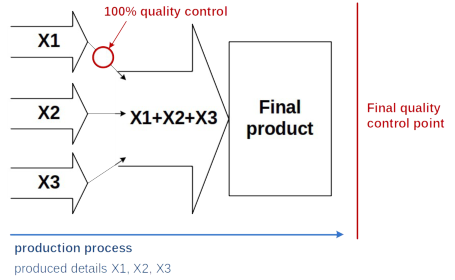
This control is carried out for the finished blank during the manufacturing process (Figure 2).
Figure 2. Place of the quality control in the analyzed manufacturing process. Source: Authors’ elaboration.
Production plant B – plastic processing Employees of quality assurance and confectioning department are meant to evaluate the quality and completing of sets of blocks. To do this, they go through the completing cycle from the start point to stop (Fig. 3). During the performance of this task, employees bend to collect a specified number of eighteen kinds of products marked alphabetically A – Q, control their quality and put in a box. Non-conforming elements are deposited into designated box.
During the transition of one cycle controllers overcome distance of 20 meters. They do approximately 15 takes, so 300 meters in 1 hour. It means that during the eight hour day at work they make 2500 meters. Weight of an empty box carried in hand is 465 g, at the end of the cycle it is 2378 g.
At the final stage the set is weighted, in order to confirm its completeness. Conforming products get on palette with finished goods and then to the warehouse. If there is deviation from the weight tolerance, the products are deposited into the defects zone.
4-weight, 5-non-conformities, A-Q - types of elements
Figure 3. Completion and quality control workstation. Source: Authors’ elaboration.
Figure available in the original PDF paper.
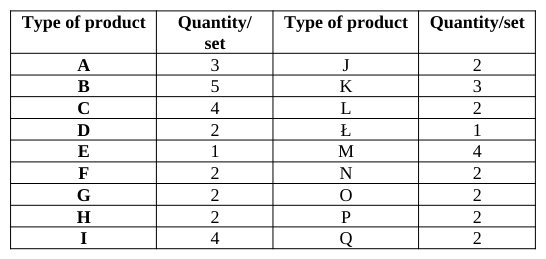
One set includes 45 elements, consisting of 18 types of blocks (Table 1). Number of elements to be collected is placed on the packaging labels of the type of detail. Work performance is an average of 105 sets per hour, so 840 per shift.
Table 1. The types and number of pieces in the set. Source: Authors’ elaboration.
Quality level Historical data collected in the tested production plants for three months, indicate a low level of effectiveness of the organoleptic, one hundred percent quality control in the controlled products (Table 2).
Table.2 Product features subject to quality control. Source: Authors’ elaboration.
CORRECTIVE AND PREVENTIVE ACTIONS In order to improve the efficiency of quality control analyzes of workstations for ergonomics have been conducted. Ergonomic factors that could negatively affect process have been specified. There has been a survey on the subjective feelings of employees carried out. Then the workstation was analyzed by an expert, using ergonomic list of problems by prof. Leszek Pacholski (1977). Summary of results from both sources indicated factors which should be measured and adjusted to the requirements and recommendations of ergonomics.
The questionnaire survey The survey of subjective feelings of employees conducted in a group of employees on the analyzed workstations. The study aimed to diagnose the well-being of respondents, their musculoskeletal disorders and subjective evaluation of working conditions.
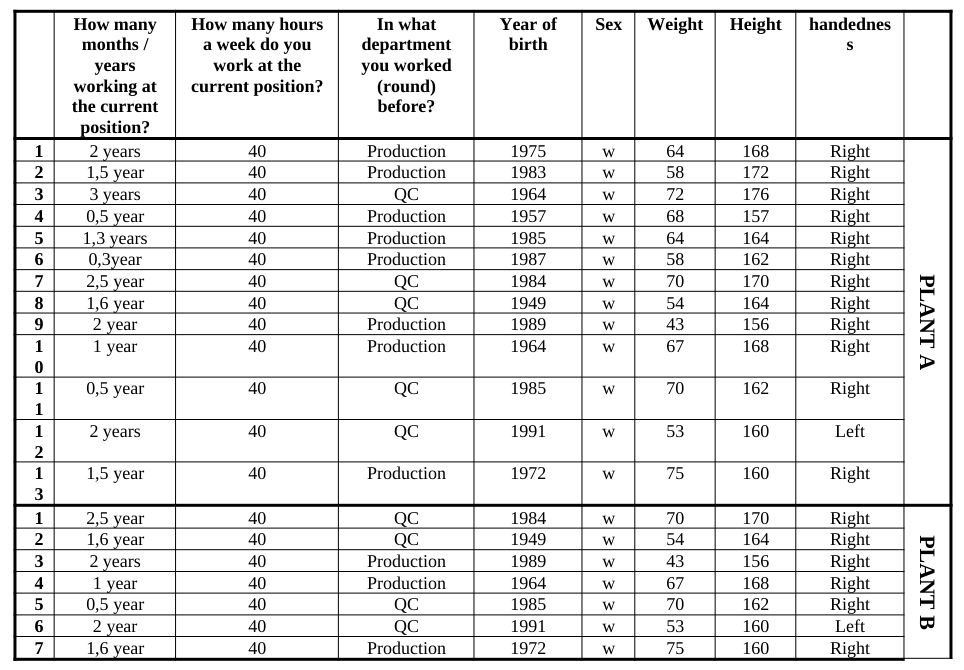
The first part of the survey is characteristic of respondents (Table 3).
Table 3. Characteristics of the study. Source: Authors’ elaboration.
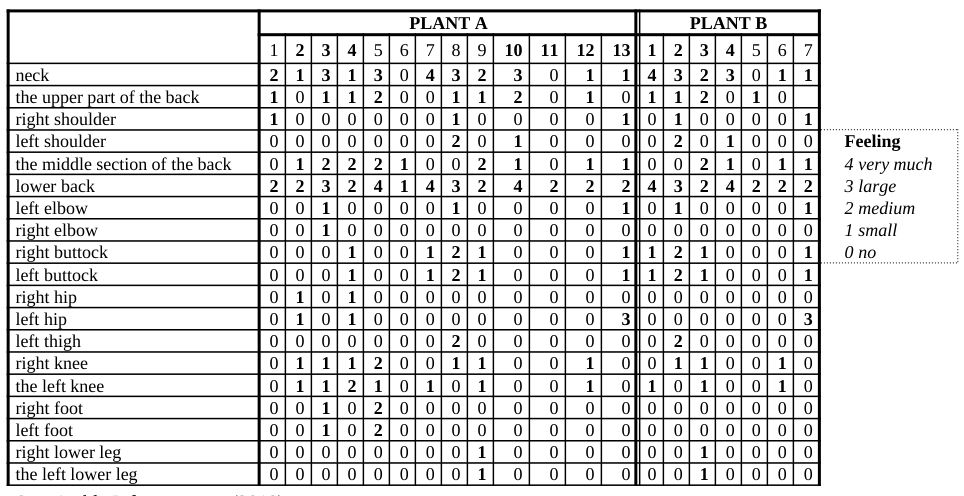
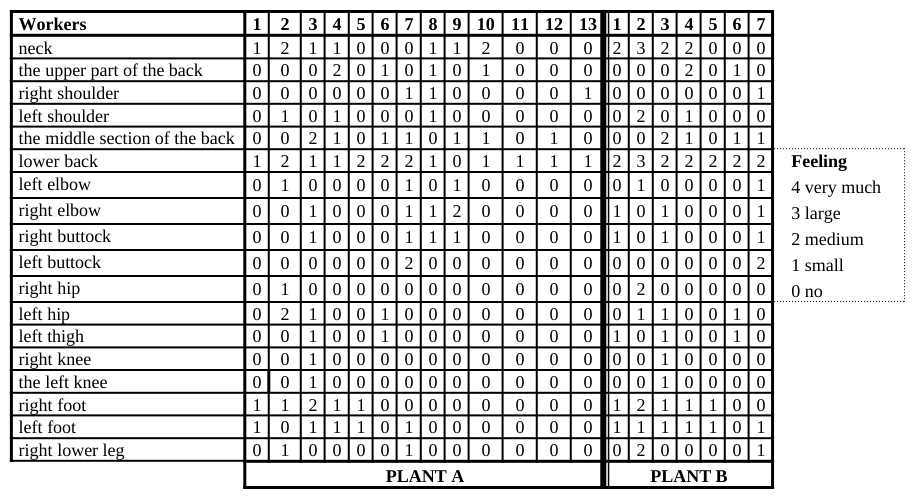
The second part of the form focuses on the perceived musculoskeletal symptoms, giving an image of comfort at work (Table 4), which is the starting point for the diagnosis of ergonomic.
Respondents clearly indicated on the perceived pain in the neck area, lower back, middle back, right knee, right wrist and left hip (Table 4). This is a signal that workstation is not adapted to human, causing discomfort.
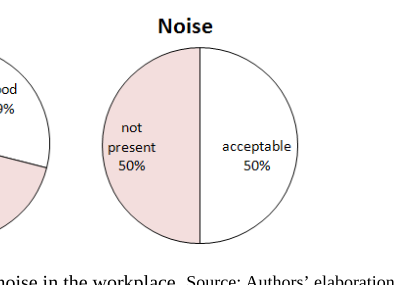
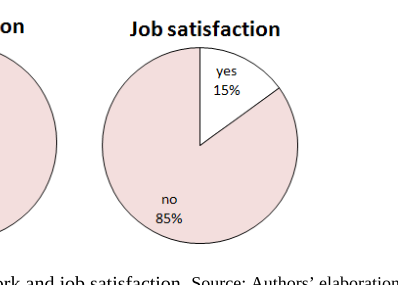
The third part of the questionnaire is about the impact of working conditions on performed tasks at work (Fig. 4, 5). Most of the employees at the wood plant - A believes that the lighting of the work is insufficient. Noise, respondents evaluated as tolerable, or no noticeable (Fig. 4). All respondents evaluated the workplace negatively. The vast majority are not satisfied with their work (Fig. 5).
Figure 4. Rating lighting and noise in the workplace. Source: Authors’ elaboration.Figure 5. Assessment of the work and job satisfaction. Source: Authors’ elaboration.
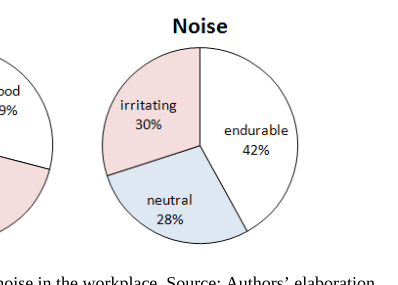
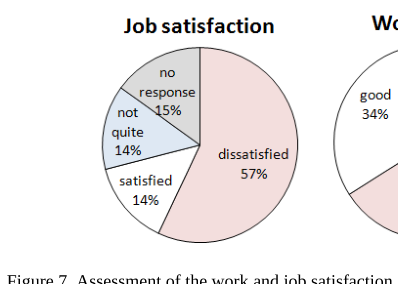
The plastics processing plant - B, the majority of respondents believe that lighting of workstations is insufficient (Fig. 6). Noise, according to the respondents is rather tolerable (Fig. 6). The vibrations do not occur at the workplace. The organization of work was evaluated the lowest (Fig. 7). More than half of employees are not satisfied with their work (Fig. 7).
Figure 6. Rating lighting and noise in the workplace. Source: Authors’ elaboration.Figure 7. Assessment of the work and job satisfaction. Source: Authors’ elaboration.
Following that diagnosis using the ergonomic problem-list by prof. L. Pacholski (1977) it was found that analyzed workstations do not meet the requirements and recommendations of ergonomics in terms of number of factors in the following table (Tab.5).
Tab.5. Requirements and recommendations for ergonomics. Study on the basis of own research
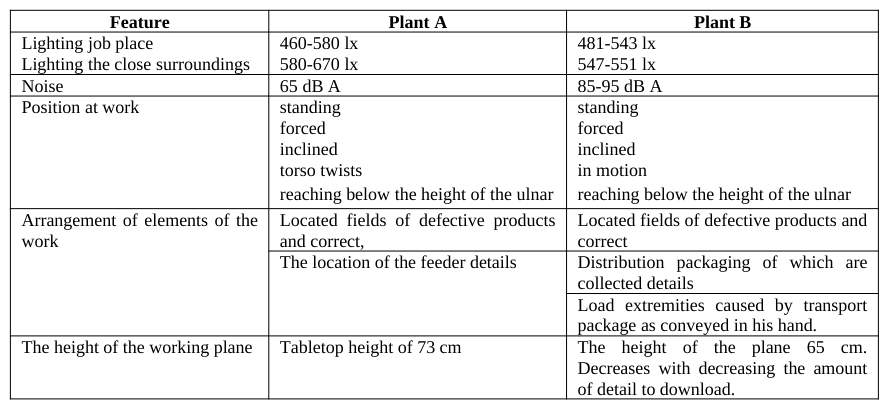
SELECTED ERGONOMIC FACTORS Comparison of the results of the expert ergonomic evaluation of workstations with information received from employees indicated areas of work requiring further analysis. Light measurements were made on the basis of the standard PN-EN 12464 (2012). Analysis of the work area based on the standard PN-80/N-8001 with regard to ergonomic data to design workstations and within arm's reach, concerned the height of the location of the working plane and the position engaged during operation (Table 6).
Table 6. Performance measurement and evaluation of ergonomic workstations. Source: Authors’ elaboration.
Measurements of workstations clearly indicated that the requirements and recommendations of ergonomic have not been matched. In order to increase the effectiveness of quality control in terms of increasing detection of deficiencies, it was recommended to introduce corrective actions in the workstation area to adapt to the psycho- physical conditions of workers.
ADJUSTMENT OF WORK STATIONS TO REQUIREMENTS AND RECOMMENDATIONS OF ERGONOMICS Production plant A
Suggested corrective action have been implemented. Work space for the operators has been adapted. Three independent working tables with adjustable height have been used, according to PN-80/N-8001, providing free, anatomical position at work. Tray machine has been extended, located below the height of the elbow, which eliminated the need for twisting the body and reduced the time of working movements. The location of return areas has been changed and their height - on both sides of the work place, eliminating the risk of making a mistake and the need to tilt the body (Fig. 8). The workstation has been lit up to 1000 lux (at a distance of 0.5 meters - 750 lux) in accordance with BS EN 12464 . Hearing protection has been used, according to PN-84/N-01307. “Bar” type chairs have been provided, allowing any change of working position from standing to sitting or supported, as well as height adjustable seat and footrest. Job rotation has been implemented to eliminate the monotony of work. Break has been decreased after 4 hours, from 30 minutes to 20 minutes. Saved 10 minutes have been divided into two 5 minute breaks after every two hours of work. Time of working moves has been reduced from 3/4/3 to 2/4/2 seconds. This prevents the production cycle to be disturbed.
1-machine. 2-tray, 3 storage areas, 4-operators, a 5-working table, 6-lighting Figure 8. Quality control workplace after correction. Source: Authors’ elaboration.
After a month in the improved conditions, re-surveys and analysis of defects in finished products have been conducted.
Defects level decreased from 8% to 4%. The results of re-surveys indicate an increase in employee satisfaction, reducing discomfort.
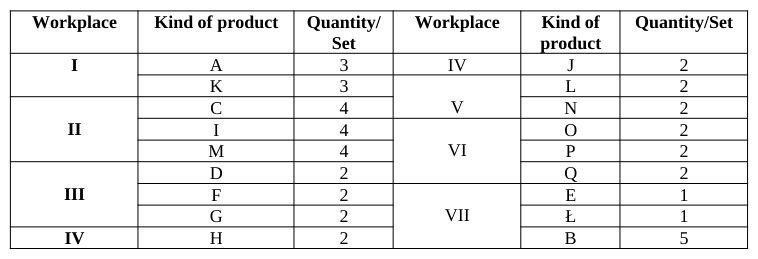
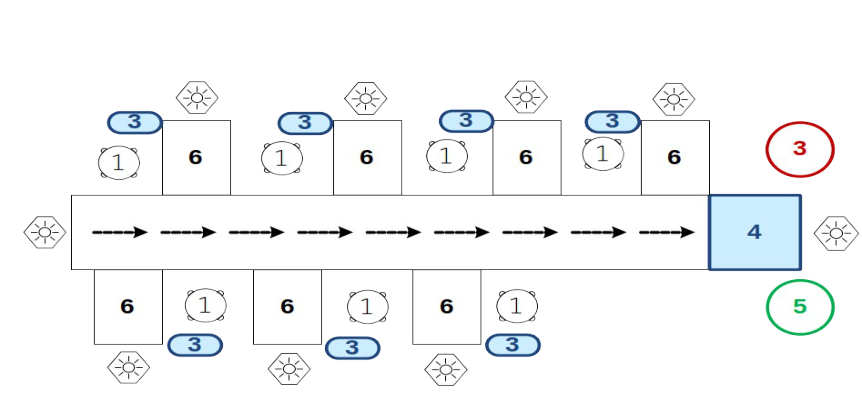
The production plant B Suggested changes have been implemented. Workstations have been reorganized - a kind of production line equipped with work tables with seats has been introduced. This made it possible to work in a standing and sitting position. Dimensions of equipment have been adapted to the population between 5 and 95 percentiles, using Giedliczka anthropometric atlas (2001). Over the entire length between the work stations of employees there was a transporter created to move boxes equipped with wheels. At the end of the line there is weight control. Workers collect, control and complete the 2-3 types of items. Details were assigned to work stations in terms of the number included in the set (Table 5). This made it possible to reduce the risk of making a mistake in the number of elements of the given type.
Table 5. The types and quantities of products at position. Source: Authors’ elaboration.
Employees are situated diagonally, which allows them to communicate freely during work. Workstations have been lit to the level of 1000 lx and 750 lx in close proximity - directly above workstations there have been additional lighting points installed. At each work table there is a place to put non-conforming products. This gives the ability to immediately determine the most defective products and to take appropriate corrective actions (Fig.9).
Figure 9. The position of quality control and completion of the correction. Source: Authors’ elaboration.
After a month of working in improved conditions, re-surveys and analysis of defects in finished products have been conducted. Reduction of defects from 9.5% to 4.5% and an increase in productivity by 25% have been observed.
The results of re-surveys indicate an increase in employee satisfaction, reduced discomfort (table 6).
Table 6. Felt discomfort after the adjustment. Source: Authors’ elaboration.
Conclusions from the study indicate the ongoing relationship between the adaptation of workstations to the requirements and recommendations of ergonomics and efficiency of quality control.
SUMMARY The article presents the role that selected ergonomic factors play in the effectiveness of the quality control process. The results of this study refer to the process of quality control in selected production companies. They can be generalized to quality control processes in other factories, where the quality is measured in fractions of defects in finished products, dependent mainly on the man. It is important to remember that compliance with the requirements and recommendations of ergonomics is individual for each workstation.
REFERENCES
Almgren J, Schaurig C., (2012) “The influence of production ergonomics on product quality”, Chalmers Reproservice, Sweden,. Battini D., (2011.) “New methodological framework to improve productivity and ergonomics assembly system design”, International Journal of Industry Ergonomics, USA, Douphrate D. (2004), “The Economics and Cost Justification of Ergonomics”, Colorado State Univeristy, USA,. Eklund J. (1997), “Ergonomics, quality and continuous improvement - Conceptual and empirical relationships in an industrial
context”. Ergonomics. Vol. 40. Issue 10.. 982-1001. Erdinc O. (2008), “Quality improvement through ergonomics methodology: conceptual framework and an application”, International Journal of Productivity and Quality Management, Volume 3, Number 3, 311-324. Falck A. (2002)., “The influence of assembly ergonomics on product quality and productivity in car manufacturing - a cost
benefit approach”. Nordic Ergonomic Society Conference, Finland,. Giedliczka A (2001)., „Atlas miar człowieka. Dane do projektowania ergonomicznego”. CIOP, Warszawa.. Górska E. (2007), „Ergonomia. Projektowanie, diagnoza, eksperymenty”. Oficyna Wydawnicza Politechniki Warszawskiej, Warszawa,. Górska E., Smagowicz J.( 2009), “Ergonomic assement of organizational improvements in manufacturing process, Ergonomics –
the tool of innovation”, The 5th International Conference of Ergonomics, Warszawa, 12-13. Hamrol A., Kowalik D., (2006), „Wpływ wybranych czynników środowiska pracy na jakość procesu ręcznego montażu samochodowych wiązek kablowych”, Archiwum Technologii Maszyn i Automatyzacji, vol. 26, nr 2, , 229-238. Helander M. (2012), “Handbook of Human Factors and Ergonomics”, John Willey and Sons Inc., USA, Hellander m, Burri G. (1995), “Cost effectiveness of ergonomics and quality improvements in electronics manufacturing”,
International Journal of Industrial Ergonomics, vol.15, Issue 2, , 137–151. Jasiulewicz-Kaczmarek M., (2013), “The role of ergonomics in implementation of the social aspect of sustainability, illustrated with the example of maintenance”, Arezes, P, Baptista, JS, Barroso M, Carneiro, P, Lamb P, Costa N, Melo, R, Miguel, AS & Perestrelo, G (eds.) (2013), London, pp. 47-5 Jasiulewicz-Kaczmarek M., Drożyner P, (2011), “Preventive and Pro-Active, Ergonomics Influence on Maintenance Excellence
159-165 MacLeod D. (2006), “The ergonomic kit for general industry”, Taylor and Francis, USA. MacLeod D., (2013) “The rules of work. The practical engineering guide to ergonomics”, Taylor and Francis, USA. Pacholski L., (1977) „Metodologia diagnozowania ergonomicznego w przedsiębiorstwie przemysłu meblarskiego”. Rozprawy nr 81, Wydawnictwo Politechniki Poznańskiej,. PN-80/N-8001. „Dane ergonomiczne do projektowania. Granice zasięgu rąk. Wymiary”. PN-81/N-01306. „Hałas. Metody pomiaru. Wymagania ogólne”. PN-EN 12464-1:(2012). „Światło i oświetlenie. Oświetlenie miejsc pracy. PKN, 2012”. Reifur B. (2008), „Metoda oceny uwarunkowań ergonomicznych stanowisk montażowych a wydajność pracy w warunkach
stresu”, Technologia i Automatyzacja Montażu, 3/2008, Warszawa,. Słowikowski J. (2003), „Zastosowanie ergonomii w przedsiębiorstwie – przesłanki systemowe”, Bezpieczeństwo Pracy nr 9, CIOP,. Talib F., Rachman Z. (2008), “Integration total quality management and ergonomics: an approach to enhanced organization
performance”, Indian Institute of Technology, India,. Więcek-Janka E., (2007)„Sylwetka psychofizyczna polskiego Mikroprzedsiębiorcy”, Ekonomika i Organizacja Przedsiębiorstwa.
Numer, specjalny, s. 116-120, Więcek-Janka E.( 2011) , „Decisions and games”, wydawnictwo Politechniki Poznańskiej, Poznań,
LISTED IN THE AHFE DIGITAL BOOKSTORE CATALOGUE
Explore the complete digital volume
Advances in Human Factors and Sustainable Infrastructure
Read this individual research paper free through the original publisher, or explore the full digital proceedings book.
ISBN 978-1-4951-2092-3
Explore this ISBN in the AHFE Bookstore ↗Listed in the July 2026 bookstore catalogue; search by ISBN to confirm current availability · Digital book purchase optional