Rafał Janowicz (2018). The Role of Ergonomics in Architectonic and Marketing Operations. In: Advances in Human Factors and Sustainable Infrastructure. AHFE Open Access, vol. 3. https://doi.org/10.54941/ahfe100090
The 20th century, along with the development of mass culture, brought a rapid increase of marketing communication significance. At first, this branch of art had an informational function associated with advertising operations. Nowadays, an increase of marketing specialists’ interest in influencing a human being by the space they stay in may be observed. Ergonomics plays an important role in such operations. The aim of this article is to show the association between ergonomics, marketing communication and architecture. Examples of using ergonomics in designing buildings with chosen utilitarian functions will be presented. This issue will be discussed, among others, on examples of marketing terms functioning in architectonic design, such as: customer’s path shaping, speed of moving, sight leading, and influencing the comfort of using the space.
Architecture of contemporary buildings comes to life with a strong influence of economic factors. During the whole designing and construction process the financial aspect of the investments connected with architecture constitutes an essential element which influences the investor’s and designer’s decisions. Managing the control of investment costs during last one hundred years has become an important sphere supporting different branches of economy. In architectural branch a methodology of project management has developed and it controls every step of an undertaken construction investment: Initiating, Planning, Executing, Monitoring and Controlling, Closing (PMI, 2013).
The power of money influence on architecture shaping was noticed by the modernists already at the beginning of the 20th century. Nowadays, along with consumer society’s development, to the triad of Vitruvius (durability, usability, beauty) economy has been added, whose role in the creation process is a complex, multi-faceted and highly controversial element.
In the context of abovementioned considerations, a question is justified: in what relation is ergonomics to the architecture–economy system? Looking for the answer, one has to analyze premises dominating in all three branches.
ARCHITECTURE, ERGONOMICS AND MARKETING Regarding architecture as the art of space shaping, it is necessary to find the reasons for interest the economists show in it. From the economic perspective, architecture is treated as a product, therefore it is subjected to similar financial analyses as other elements of production. From such a point of view, the costs incurred during the production process have to return and bring profit. Because of it, actions connected with pursuit after an optimal investment are included naturally in the investment process. On the one hand, it creates an aim to minimize the cost, yet on the other hand, it provokes readiness to engage gigantic funds following the rule of “can be expensive, but must be profitable”.
One aspect of architecture, which loses the most during the decision process is the beauty. Apart from this fact, the degree of adjustment of designing solutions to the expectations and demands of future users is also lowered – users, that is the people for whom the space is designed. It causes a dangerous departure from traditionally understood architecture as a branch subjected to man. From the economic point of view architecture may become a product bringing profit. Such a solution makes architecture refer to ergonomics as the branch allowing to create space stimulating particular kind of recipients’ behavior.
Treating architecture as a product provokes applying analogous tools in the process of creation and analyzing its value as in designing other products, which are connected to economy in a much wider sense.
Apparently, ergonomics understood as: “a theoretical and practical branch in which knowledge about human psycho-physical capabilities is applied to design utility products, machines, devices, tools, and material working environment in order to remove any danger to health and life of a human being, to optimize biological costs of work, and ensure proper efficiency and comfort during work and satisfaction from work [Górska, 2007]” does not refer to marketing operations, however ergonomic research results from the psycho-physical capabilities of a human being are used by marketing specialists and in a natural way they interfere with architecture of commercial character and they transform it into a manipulation tool. Among assumptions characteristic for ergonomics there is no aiming at influencing architecture as a system of human-technical object relation for commercial purposes. “Basic significance in actualizing the demand of technology humanization has development and common use of such designing methods which regard the designed system human–technical object–environment and accept humanocentric designing criteria as a priority in relation to technical and economic criteria” [Górska 2007]. However, it may be accepted that, going the other way, marketing can use ergonomics for its own purposes as it does with the experience gathered by other scientific branch, architecture psychology, whose primary aim “is to act in favor of adjusting architecture to psychological human needs and examining behavioral relations between human and shape of space of his activity” [Złowodzki, 2001].
Therefore, marketing specialists, by treating architecture as a product led to integration of knowledge from ergonomics and architecture psychology using it to generate profit. After first analyses it can be claimed that ergonomics and marketing communication are scientific branches lying far from each other in the range and topic of research. Connections between these branches become visible when research on architecture shaping, in particular this with commercial functions, is conducted. Contemporary marketing communication uses meta-system research including architecture, architecture psychology and ergonomics. As a result of marketing operations there occurs an integration of these branches for the purpose of assumed marketing aims realization and in consequence, commercial aims realization. Marketing communication treats architecture as a tool (Janowicz, 2012) and, analogously, can use the knowledge worked out by ergonomics, which becomes a tool used in marketing game.
While analyzing contemporary civilizational reality it may be observed that primary ergonomic and architectonic assumptions give way for economic directives which are now beginning to have a dominating function in designing, in accordance with the efficiency paradigm.
Marketing specialists, as a result of research and analyses conducted on influence of architectonical solutions on human psyche, try to shape space to make it foster the assumed consumers’ and recipients’ behavior. These actions have a stimulating character, and their application can be found in an increasing number of architectonic objects. Examples of such integration and application of ergonomic elements in architectonic objects can be easily traced both in commercial properties and those less connected with commerce and economy. An architect, Daniel Libeskind, in his proprietary project of expansion of the Jewish Museum in Berlin applied integrating techniques and knowledge coming from ergonomics and architecture. In this realization, the architectonic solution of the interior was subjected to changes aiming to influence the recipients to visualize emotions helping them to consider aspects of the history of the Jewish nation functioning in Europe, with a particular emphasis put on the Holocaust. The ergonomic techniques applied, connected with proper space shaping were subjected to the aim of providing psychological incentives, such as uncertainty, disorientation, and even fear [Gębczyńska-Janowicz, 2010]. These incentives do not determine the recipients’ behavior, but introduce statistically significant differences in feelings and behavior of the recipients. Users’ reactions should be in accordance with the concept author’s assumptions, and not with the real needs of the recipient. The analysis of the example of solutions applied in the Berlin museum makes the ways of using ergonomic solutions by marketing to manipulate customers’ reactions in architectonic objects of commercial functions more visible.
Globalization made commercial companies seeking optimal model solutions use ergonomic knowledge. The way of realization of economic aims in commercial space is discussed in many publications on economics. A very good example may be the work of Wilhelm Kreft „Ladenplanung”. This book defines marketing aims, potential profits, and appropriate for them architectonic techniques for their realizations. The techniques discussed by Kreft constitute an integration of several scientific branches, including architecture and economics, based on knowledge from ergonomics and psychology [2002]. The practice of their application brings various effects, and in the context of changing consumers’ expectations and their characteristics, it demands the space to subject to continuous transformations. Therefore, a contemporary commercial property tries to look for optimal solutions while keeping the awareness that the architecture, which came into being in accordance with the discussed principles will continuously change. Marketing, before any designing process, defines the target profile of a consumer. Statistically described consumer becomes also an object of ergonomic and psychological analyses. At the same time, it becomes possible to optimize solutions based on knowledge from the abovementioned scientific branches and other statistical research.
Nowadays, in the process of building architectonic shaping, including commercial properties, there are many solutions introduced to realize marketing communication of a persuasive character. Implementation of such solutions is characteristic for large commercial companies possessing investment budgets high enough both for necessary research and for construction of specialized designing teams consisting of many people. Commercial properties are objects, which traditionally became the space of marketing policy. This specific marketing game is connected with inspiration by knowledge coming from integrating many various and scientific branches apparently lying far from each other.
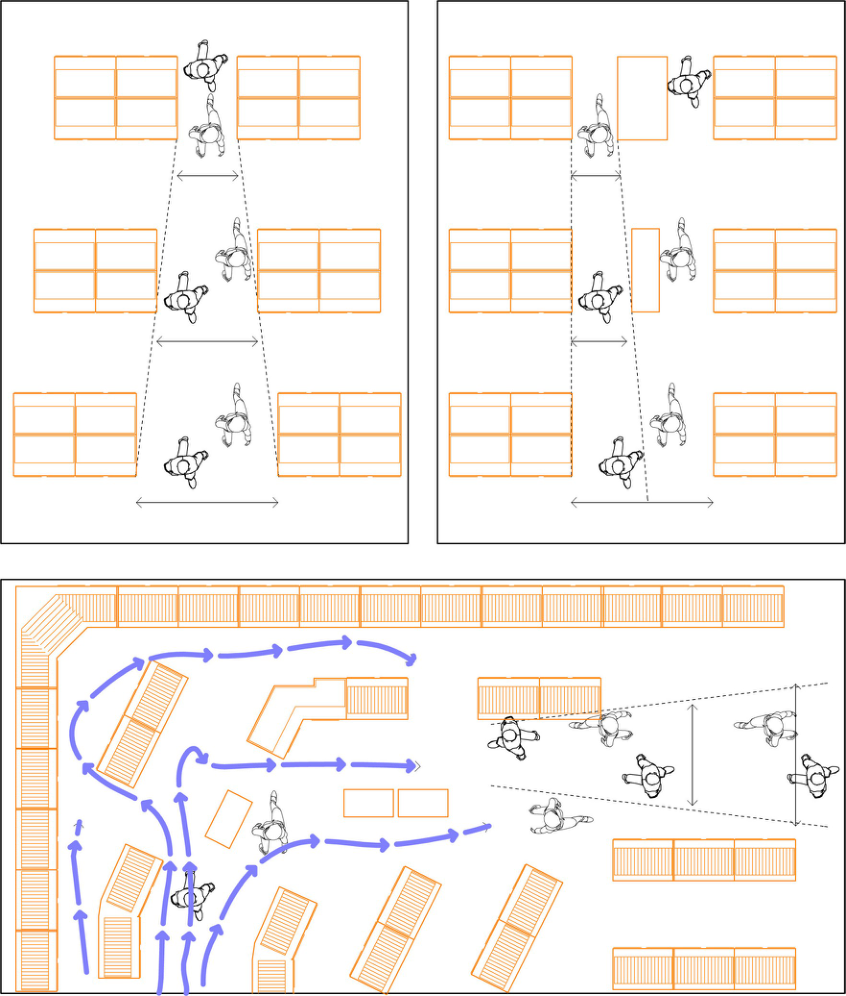
ERGONOMICS AS TOOL OF MANIPULATING THE CUSTOMER (Figure 1) An example of influence on the speed of moving in a building using the ergonomic elements by narrowing the width of the passage with additional obstacles or limiting the visibility scope, etc.
This figure visualizes architectonic actions which allow to influence the speed of moving, e.g. a worker or consumer in a commercial property.
From the point of view of marketing concepts, these actions are essential. Particularly because they allow to guide the consumer through the display area in such a way, that will provide optimal contact with goods offered, both concerning the distance from the shelf and the time of the visual contact with the product.
Using the knowledge from ergonomics in architecture shaping made guiding the recipient in a planned space not only physical, defining such elements as speed and path. It influenced also their perception by leading their sight and defining places and content important from the point of view of marketing operations.
Figure 1. Manipulating the customer’s speed and movement direction (author: R. Janowicz).
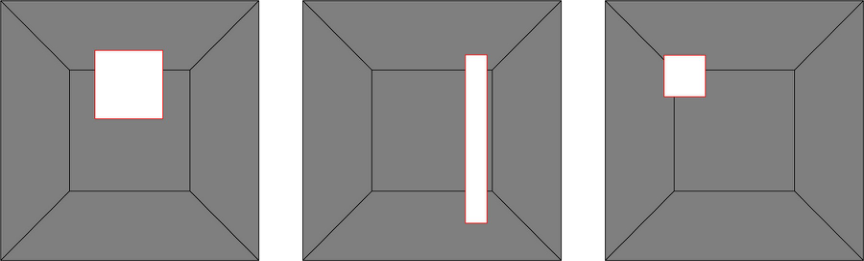
(Figure 2) An example visualizing the actions connected with using light as a tool influencing the customer. By manipulating the illuminance and the color of the light it is possible to influence a person: by using the natural tendency of paying attention to lighter places. The effect is similar to this of lighting a candle in a dark room. People in the room will pay more attention to lightened elements. The result of it is, e.g., lightening up the display windows in shops which can be encountered mainly in shopping malls. On the stage of designing a permission from the National Labor Inspectorate is often obtained to limit the access of natural light. Such actions significantly deteriorate the safety and comfort of work, but are more marketing effective, because they allow to effectively guide the recipient’s sight. A wide spectrum of effects is caused also by proper color manipulation, which is the subject of some separate research.
Figure 2. (author: R. Janowicz).
(Figure 3) An example of manipulating the consumer’s path realized by arrangement of obstacles, planning the path from the entrance to the property, to the exit. The communication arrangement demarcated by the walls, shelves, stairs and other architectonic elements makes the statistical recipient unconsciously move along the path assumed by the authors. The model of guiding the consumer is developed at the stage of property concept and constitutes its basis.
Figure 3. (author: R. Janowicz).
Figure available in the original PDF paper.
This system may be realized both by letting the customer use only one path and by letting the customer choose from several paths. The latter choice is more profitable concerning customers’ behavior because it creates an illusion of certain freedom of choice. Seeking an optimal system adjusted to target customers group is a complex task. This is because there is a psychological factor which makes the reactions hard to predict. For example: for certain groups a big open space with single loosely arranged shelves is associated with prestige. This strategy is used by shops of, e.g., Apple and, in this way, ergonomic assumptions are realized differently than in, e.g., typical beauty supply stores.
CONCLUSIONS
The turn of the 20th and 21st centuries brought a rapid development of many economic scientific branches, including marketing. Integration of knowledge from research on relations between marketing and ergonomics, psychology and architecture is a relatively new phenomenon. In this context, there are some justified questions concerning various aspects connected with the way of using the knowledge from these branches for economic needs and purposes. A certain paradox is using researches aiming at, just like ergonomics, learning parameters allowing a human being to safely exist in the environment for activity based on consumers’ behavior manipulation.
Marketing communication realized with the use of ergonomic research is particularly attractive from the marketing point of view, because in contrast to information actions it is not usually read by the recipients as conscious marketing action. The effectiveness of those actions on the unconscious level, in accordance with the research on commercial psychology, is connected with remembering and learning processes, which is visualized e.g. by the model of shallow information processing [Heath 2006].
A rapid development of globalization provokes the pursuit to standardize and create model solutions. Emerging global communication strategies create space for high budgets allotted for research on optimization of model solutions. Shifting the effectiveness paradigm to architecture results in optimal solutions implementation. It also means using knowledge from ergonomics to create spatial solutions aiming to direct architecture users’ behaviors to marketing assumptions. Understanding the occurrence of such relations will allow to differentiate the practices of conscious breaking ergonomic principles by marketing conceptions from design mistakes.
REFERENCES
A Guide to the Project Management Body ofKnowledge (2013), FifthEdition, PMI/MT&DC. Gębczyńska-Janowicz, A. (2010), „Polskie założenia pomnikowe. Rola architektury w tworzeniu miejsc pamięci od połowy XX wieku”, Wydawnictwo Neriton Górska, E. (2007), “Ergonomia. Projektowanie, diagnoza, eksperymenty”, Oficyna Wydawnicza Politechniki Warszawskiej. Heath, R. (2006), „Ukryta moc reklamy”, Gdańskie Wydawnictwo Psychologiczne. Janowicz, R. (2012), „Komunikacja marketingowa w architekturze“, Narodowe Centrum Kultury. Kreft, W. (2002), “Ladenplanung: Merchandising - Architektur. Strategie für Verkaufsräume: Gestaltungs-Grundlagen,
Erlebnis-Inszenierungen, Kundenleitweg-Planungen”, Verlagsanstalt Alexander Koch GmbH. Złowodzki, M. (2001), “Przemiany cywilizacyjne końca XX wieku jako tło rozwoju architektury” in: Uwarunkowania kulturowe architektury wobec przemian cywilizacyjnych końca XX wieku, Winskowski P.(ed.), Wydawnictwo AND, pp.61.
LISTED IN THE AHFE DIGITAL BOOKSTORE CATALOGUE
Explore the complete digital volume
Advances in Human Factors and Sustainable Infrastructure
Read this individual research paper free through the original publisher, or explore the full digital proceedings book.
ISBN 978-1-4951-2092-3
Explore this ISBN in the AHFE Bookstore ↗Listed in the July 2026 bookstore catalogue; search by ISBN to confirm current availability · Digital book purchase optional