Alessandro Jatobá, Hugo Cesar Bellas, Mario Cesar R. Vidal, Paulo Victor R. de Carvalho (2021). A Fuzzy AHP Approach for Risk Assessment on Family Health Care Strategy. In: Advances in Human Aspects of Healthcare. AHFE Open Access, vol. 13. https://doi.org/10.54941/ahfe100529
This paper presents an approach to support decision making in assigning risk rates for patients of spontaneous demands in the Brazilian Family Healthcare Strategy. This approach was elaborated based on concepts of the Fuzzy Set Theory and AHP - Analytical Hierarchy Process and implemented in a Primary Healthcare Facility in the City of Rio de Janeiro. Thus, the proposed approach can be used as an additional tool to support the work of healthcare professionals, providing further criteria for their decision making.
Decision making in health care appears in many ways. Practice shows that rules, decision models and clinical information are much more complex than we have imagined, and consequently, clinical decision support technology has not been as successful as designers expected.
The increasing computerization of work processes without considering workers' current information requirements produces gaps between workers and their objects of work, resulting in urgent decisions without prior knowledge about the variables involved in the problem and without adequate time for planning and selecting options. The adoption of assistive devices inevitably transforms the way people work. If we consider the use of Information and Communication Technologies (ICTs), these devices may also entail the emergence of new possibilities of action and hence new types of process failures. These new possibilities for action increase the number of feasible variations in the process, making the system more complex, increasing the probability that new types of imperceptible faults. In complex systems work is necessarily underspecified, so operators make use of adaptations, improvisations and creativity in tasks performance. In most cases these adaptations lead to expected results, but sometimes their combination can bring unpredictable results (WOODS e HOLLNAGEL, 2006).
The approach proposed in this work is inspired on Primary Healthcare Facilities (PHF) that performs the Family Healthcare Strategy in the City of Rio de Janeiro. Work in these environments has essential characteristics of complex socio-technical systems, like strong presence of variability and adaptability, and freedom in arrangement of work by professionals, in addition to cooperative joint in performing activities. The Family Healthcare Strategy (FHS), part of the healthcare framework of the Brazilian Unified Health System (SUS) involves the work of multidisciplinary teams in direct assistance, health promotion and disease prevention in defined territories that typically suffer from major health problems and low sanitary conditions. In this paper we suggest an approach to provide more inputs to an important decision making instance in the reception process of the Family Healthcare Strategy – the Risk Assessment Process. This proposal makes use of concepts of Fuzzy Logic and Analytical Hierarchy Process (AHP) to contribute to the standardization of this process, in order to minimize discrepancies on evaluations of patient risk between teams, improving the quality of decision.
MOTIVATION The Brazilian Constitution states that the Government has the duty to ensure "universal and equal access to healthcare services for its promotion, protection and recovery," adding "comprehensive care, with priority given to preventive activities, without prejudice to assistance services." If we consider that last part of the text, when it comes to "priority to preventive activities without prejudicing care services", the role of the Family Healthcare Strategy (FHS) as part of the healthcare framework proposed by the Brazilian Unified Healthcare System (SUS) becomes clear.
Healthcare systems are quite complex. On these systems, work requires a huge cognitive effort, either because of the nature of human contact or because of all technological devices already in use (Crandall, Klein, & R. Hoffman, 2006). According to its National Policy, Primary Health Care is characterized by a set of care actions, both individual and collective, to cover promotion and protection of health, disease prevention, diagnosis, treatment, rehabilitation and maintenance of health (Ministério da Saúde, 2006). Primary care is developed through the exercise of participatory management and sanitary practices, by population-driven teamwork in delimited territories, for which each team bears responsibility for health care, considering social aspects of the territory in which these populations live.
On Primary Healthcare Facilities (PHF) that perform FHS, work should be characterized in preventive care and thus presents a great distinction to Emergency Care. In PHFs, consultations must be scheduled. However, this is not what really happens. On data extracted from the computerized system used on the PHF where this work has been performed, analyzing 2,800 consultations in November 2013, 53% of the nursing care visits are spontaneous statements, i.e., those in which the patient comes to the facility without an appointment, complaining of some symptoms, like pain or fever, for example. In the case of medical care visits, this proportion rises to 76.6%. Only in dental care visits that number is below half, and still reaches 23.4%. This information highlights the mischaracterization of the service provided by FHS, which departs from its fundamental principles of health promotion and disease prevention. It is also worth mentioning that patients on spontaneous statements necessarily undergo a process entitled "Risk Assessment" in which its severity is measured and the decision to provide care or not is made. This article suggests a way to improve this process, increasing its stability, helping to standardize it and thus improving the accuracy of cases referred from spontaneous statements.
Developing devices to support work in complex systems, especially when it comes to collaborative team work, requires deep understanding of how people work, their principles, their shared processes and strategies. The way these aspects are described decisively affects the final product (Ashoori & Burns, 2013). Given the set of decisions taken by professionals in the performance of their activities, the complexity of the system in which their work is Human Aspects of Healthcare (2021) performed, which involves, literally, life and death of people - the approach presented in this article can bring important contributions to the improvement of work conditions, providing more inputs to decision making.
RELATED WORK
From Myopic Coordination to Resilience in Socio-technical Systems Patient care occurs in a multidimensional way. Providing health to the user cannot be responsibility of only one professional – not even of a single healthcare facility -. This brings to light the challenges of coordination between levels of the organization and thus becomes necessary to consider the resilience in these levels.
We must then consider four dimensions of coordination situations:
Compatible objectives between each agent involved in the task;
Sharing of resources;
Agent skills in relation to the task;
Types of interaction (personal and remote communication with synchronous or asynchronous communication).
According to Nyssen (2011), all of these dimensions have potential to generate tensions in socio-technical systems. The author presents a case in which a patient moves to different hospitals looking for care and ultimately dies, even having been handled at all times he attended a healthcare facility. Each hospital has made an approach, each of them, however, as if it were the first service received by the patient. This illustrates that, in the case presented, the patient behaved as an agent, adopting a strategy that added variability to the system. The patient sought care at other hospitals, causing a restart of his treatment, adapting to conditions imposed by the context.
Although the fact that juxtaposition of agents adds redundancy to the system is beneficial, bringing more information and interaction, this does not necessarily add skills. This redundancy, which in some cases may cause an agent to detect the error of others, may not be appropriate in all cases. In the case of healthcare, the delivery of appropriate services depends on obtaining information from different sources to identify the cause of the symptoms and it often needs to be done iteratively through repetitions.
What makes this more complex is the fact that sources of information are distributed in space and time. When a patient seeks another healthcare facility he involuntarily creates a disruption in the system, affecting its integrity, causing the system to lose its resiliency.
Centralized tools such as procedures, work processes or automated systems can fail when they are not prepared for any possibility in particular. Sometimes agents are not familiar with all tools, or computerized systems do not cover aspects related to coordination, losing it, or failing to transmit critical information.
On unexpected situations each agent is organized in relation to their work environment. One approach to handle these situations is to develop mechanisms to increase situational awareness. When people have well-developed situational awareness, it becomes easier to make any necessary adjustments to cope with the dynamics of the situation.
Nyssen points out longitudinal coordination as an essential aspect of working in complex and cooperative socio- technical systems. The author also studies the healthcare system and indicates coordination as a source of resilience for these systems.
Decision Making in Complex Systems Given the complexity and criticality of decision making in health care, understand the mental models that healthcare professionals construct in carrying out their technical duties gains significant importance to the development of Human Aspects of Healthcare (2021) mechanisms to properly support their work (Nemeth, O’Connor, Klock, & Cook, 2006).
Carvalho and colleagues (2005) examined the cognitive process employed by experienced professionals who make decisions while working in a complex system (in their case a nuclear power plant), to find out if decision making occurs in a naturalistic or normative way. The authors studied whether experienced operators performing a particular task consider this task familiar, responding in a naturalistic way, or if they compare options before selecting the best possible solution, in a normative way. The authors say that most abnormalities are preceded by regular work regimen. Therefore, it is necessary to understand how people work during regular operation. Carvalho and colleagues (op. cit.) make use of an approach called Naturalistic Decision Making (NDM), which refers to how people make decisions in complex systems in the real world (Klein, 2000). The NDM approach considers the cognitive work of how individuals resolve conflicts and contradictions that emerge between goals and the ways to achieve respective desired goals. The analysis of artifacts produced and consumed during the performance of work reveals cognition not only of the individual but of the group to which he belongs. The results of this analysis can be used to guide the development of technology to support work on complex systems such as health care (Nemeth, O’Connor, Klock, & Cook, 2006). NDM approach can be used to discover how contextual factors affect the process of decision making, given that this process takes into account specific situations, i.e., to understand how some decision has been made it is necessary to know the situation in which it was made.
PROPOSED APPROACH Risk assessment is a dynamic process for the identification of patients who require immediate treatment, according to their potential risk, health problems or degree of distress, giving priority to care according to the clinical severity of the patient, and not to the order of arrival at the facility. The evaluation of risk and vulnerability cannot be considered sole prerogative of healthcare professionals. Users and their social network should also be considered in this process. Assess risk and vulnerability involves being aware of patient’s both physical and mental suffering degree. For example, the user who comes walking without visible signs of physical problems, but very distressed, may be more in need of service, with a higher degree of risk and vulnerability than other patients with visible symptoms (Ministério da Saúde, 2004). It is also important to emphasize that on the assessments made in healthcare work, professionals of different levels of experience and different fields of activity need to solve problems of various levels of complexity. Also, according to the development of such expertise, practitioners are more dependent upon clinical experience, which is in turn dependent on the analogy between the cases that have occurred (Patel, Kauffman, & Arocha, 2002).
Multiple Criteria Decision Making is the one that involves multiple attributes and multiple objectives (Carlsson & Fullér, 1996). Evaluate the behavior of a complex system through expert opinion and a basic set of attributes is to represent the process of decision making done by these people. This process depends on several factors, like selecting among available alternatives. Whereas the reliability analysis is constantly undetermined by the unpredictable behavior of operators at work in complex systems - like public healthcare system - the probabilistic approach is not the most appropriate one for solving such problems. The assignment of degrees of risk to the patient fits the description of multi-criteria decision-making in that it involves the possibility of multiple outcomes depending on the combination of multiple available attributes and their values. Making decisions is an essential and integral part of medical and nursing practice, and performing this work, or express clinical judgment about the patient care requires both intuition and reflection, that are based upon professional knowledge and skills (Manchester Triage Group, 2005).
In order to understand how work is carried out in the PHF, Ergonomic Work Analysis has been performed (Vidal, 2008), in which professionals involved in risk assessment were observed and interviewed on their workplace. The field study was done in a PHF that performs FHS in Rio de Janeiro. A survey was conducted through semi- structured interviews with 10 professionals engaged in the risk assessment process in the PHF. During these interviews, professionals should, from a set of symptoms indicated in the Reception Booklet of the Brazilian Ministry of Health (Ministério da Saúde, 2004), point which color should be assigned to each symptom if a patient attended the PHF. From there, professionals were asked to assign a degree of importance for such symptoms, starting from most important to least important, within the color scale that determines the risk rates. This study was conducted according to the ethical principles and the norms of Resolution Nº. 466/2012 of the National Board of Health / Brazilian Ministry of Health on research involving human subjects and was approved by the Ethics Committee of the National School of Public Health / FIOCRUZ .
Reception with Risk Assessment on Family Healthcare Strategy Reception is considered the gateway that patients use to access the set of services provided by Family Healthcare Strategy. Without such reception plus the establishment of close relations between patients and professionals, it’s not possible to materialize neither the accountability nor the technological optimization processes which impacts the social production of health and disease. It is a process of human relations done by all healthcare workers in all sectors of care, not only receiving, but performing a sequence of attitudes and modes that make healthcare, listening to the needs of the patient (Silveira, Félix, Araújo, & Silva, 2004). In summary, the result of a complete flow of reception is fulfilling a care agenda to the patient. Along the way, various health care activities are carried out. Because of that, the Reception is the key process of the Family Health Strategy (Jatobá, Carvalho, & Cunha, 2012).
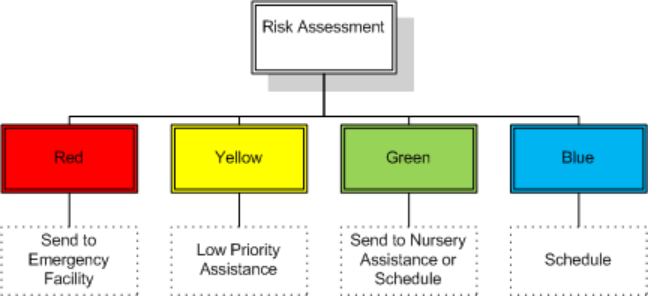
The assignment of risk levels for patients at the PHF where this work has been carried out is done according to the model suggested by the Brazilian Ministry of Health (Ministério da Saúde, 2004), in which colors are assigned to patients according to the severity of their symptoms, similar to Manchester Risk Rating Scale (Manchester Triage Group, 2005). However it is important to note that these facilities are free to implement this process and thus adopt the criteria and respective color scale which are more appropriate to the situation of the territory where the PHF is located. Figure 1 shows the hierarchy of risk assessment used in PHF this work was carried out and their respective outputs.
Figure 1: Risk Assessment Hierarchy
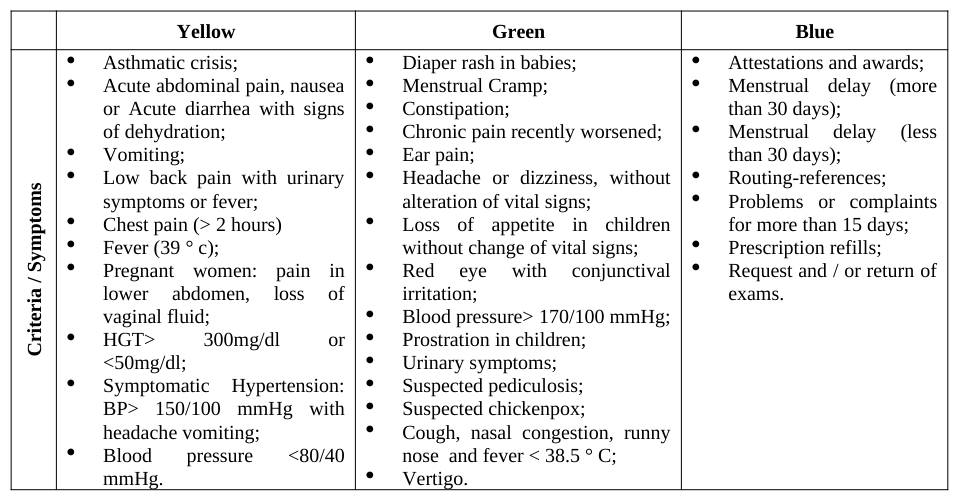
The same risk assessment scoring system is suggested for all the healthcare framework of SUS, not only for Family Healthcare. So Roncato, Roxo, & Benites (2012) suggest a set of criteria / symptoms that, when noticed, are related to each color of a family healthcare specific scale. This set of criteria / symptoms suggested by the authors was submitted to the professionals working in the PHF. They could suggest the inclusion and/or exclusion of symptoms as well as the correlation of symptoms with colors, according to the reality of the population they assist at the PHF, resulting in the set of criteria and respective colors shown in . During the fieldwork, there were no significant relations to symptoms to the Red color rating. Patients receive a Red rating when they have severe symptoms and need emergency care and are therefore referred to the nearest Emergency Facility.
Some testimonials made during the interview: "Of the symptoms that you listed as Red, the majority is actually Yellow for us"; "Sometimes a patient appears with symptoms of a Red, but is serviced anyway, as he may have other symptoms".
At the PHF this study was conducted, risk rating is performed by a team of two people, on rosters - each day of the week the team has different formations. These teams interact freely with other professionals during the performance of their tasks, either to ask questions or to obtain new information that may be relevant for the assignment of patient risk. In the PHF, although the color system is used by all teams, each team applies the criteria its own way, making this process unstable. During interviews, it was possible to identify the need for standardization of this process, as can be seen in some testimonials:
"The Risk Assessment process is the subject of the greatest suffering in our practice"; "When the patient is assisted by the nurse who does the rating herself, many times she/he does not assign any color to him";
"Sometimes I forget to assign color and just assist the patient"; "Sometimes we receive a patient complaining of a symptom and we are not warned that it is not a first application but a return to the clinic."
Table 1: Symptoms and Respective Risk Rating. (mm Hg - mm Hg, mg / dL - milligram per deciliter) Yellow Green Blue
Scenario To illustrate the application of the approach suggested in this article, we present the results obtained in the case of a patient - a child - is welcomed at PHF complaining of abdominal pain.
Once received by the Communitarian Healthcare Agent – in his booth - that verifies that no appointment is scheduled, the patient is forwarded to the risk assessment team.
A preliminary evaluation performed by the nurse detected four symptoms
Problems or complaints for more than 15 days;
Depletion in children;
Acute diarrhea with signs of dehydration;
Inadequate breathing.
As can be seen in , each symptom presented by the patient is characteristic of one specific color rating in the scale used in the PHF. The symptom referring to the color Red - Inadequate breathing - is suggested by the Manchester Risk Rating Scale (Manchester Triage Group, 2005). Human Aspects of Healthcare (2021)
Assigning Degrees of Risk through Fuzzy Logic and AHP The set of alternatives and output options is the center of decision making. In the construction of a decision framework, we first need to organize the elements into hierarchically arranged groups according to their effects and influence on the context.
In Analytical Hierarchy Process (AHP), the problem must be "broken" and the solution of the resulting "sub- problems" should be aggregated into a logical conclusion (Saaty, 1990). Also according to Saaty, perceptions, feelings, judgments and memories are concentrated in a framework that describes the forces that influence decision making, facilitating it.
In this study, we used the Fuzzy Sets Theory (Zadeh, 1965) applied to the framework provided by AHP, to bring this approach further the context of imprecision that involves decision making in the complex health care system in which the Family Healthcare Strategy is included.
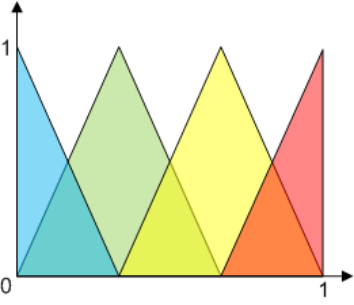
In the case shown in this work, for each degree of risk represented by a color, there are a number of criteria. The importance of one color in relation to another is already determined - for example, the Yellow rating is less critical than Red - and thus the criteria for each color were not compared with criteria of each degree of risk. The relevance of a criterion at a given level of risk can be demonstrated by means of the Fuzzy Sets Theory, as shown in Error: Reference source not found.
Figure 2: Relevance of Criteria / Symptoms to Degrees of Risk
Fuzzy Logic allows logical values in the range between 0 and 1, allowing indeterminate states to be treated by technological devices and / or inference mechanisms to assess non-quantifiable terms.
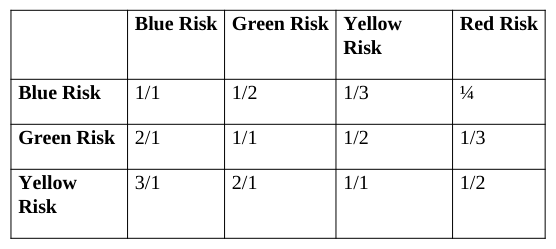
Table 1 presents the evaluation matrix of all four criteria / symptoms used in this article. In the evaluation matrix is shown the importance of criteria / symptoms, one over the other, as determined by the risk assessment model (Ministério da Saúde, 2004) (Roncato, Roxo, & Benites, 2012). This ranking will be used in the next steps for obtaining the cumulative rank in relation to output options.
Table 1: Pairwise matrix of assessment criteria.
Red Risk 4/1 3/1 2/1 1/1
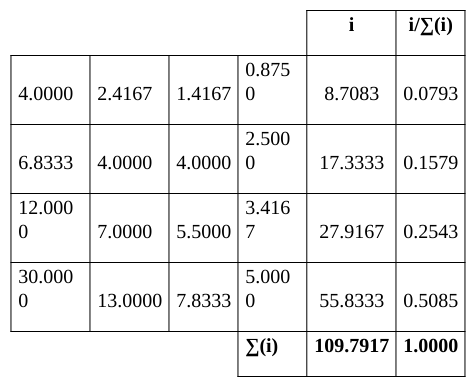
O The next step is to obtain a ranking of priorities from the pairwise matrix. For this, fractions are converted to decimal numbers, and by squaring the matrix and normalizing column sums, we have the prioritization vector shown in Table 2
Table 2: Obtaining de prioritization vector i i/∑(i)
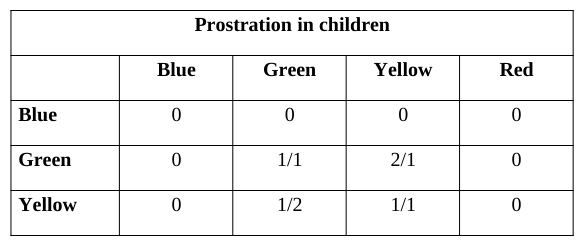
The prioritization vector indicates that the highest value of the normalization is the most important criteria/symptom, and so on. However, in the case studied this order has no surprises, as the patient has a criteria /symptom of each degree and the importance of each color rating is given by the scale used in the PHF. However, the index obtained – i/Σ(i) - is important to calculate the cumulative prioritization of each output option. Then, criteria / symptoms should be compared with alternative output options (decisions). The possible outputs in the case study are the degrees of the proposed Risk Assessment Scale Risk: Red, Yellow, Green and Blue, as shown in Figure 1. From this, the suggested approach appropriates the opinions issued by healthcare professionals, expressed in natural language, relating criteria to output options. The criteria is not made in exact terms, and thus, the evaluation of a symptom may have greater relevance to a given degree of risk in some cases and have greater relevance to another level of risk in others. It all depends on the assessment of the healthcare professional that performs the diagnosis. Each professional had the opportunity to assess the relevance of each symptom in relation to the risk degree. According to its incidence, the suitability of each color to a symptom was established. Error: Reference source not found illustrates this situation, the opinion of professionals for the symptom "prostration in children", ie, among the respondents, there were twice as many Green assignments than Yellow for this symptom. The columns with 0 (zero) mean that no professionals have indicated the related colors for the assessed symptom.
Table 4: Evaluation of the symptom "prostration in children" by professionals
Red 0 0 0 0
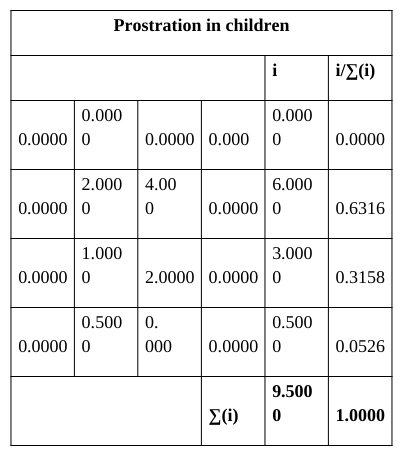
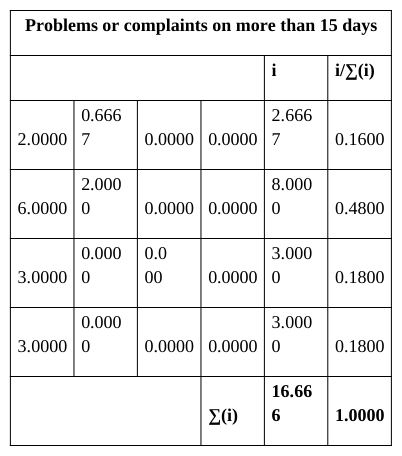
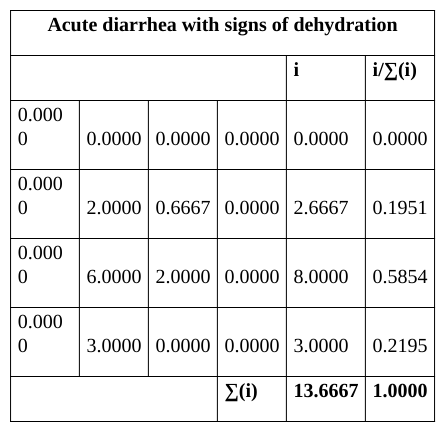
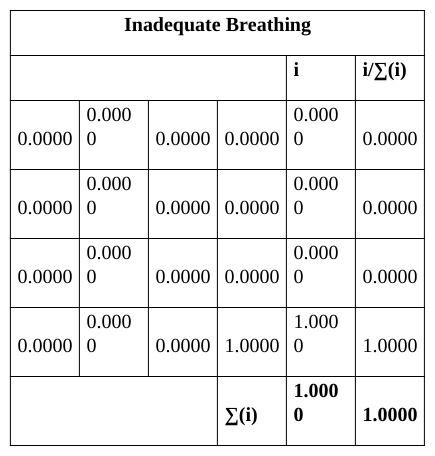
The same operation used to generate the prioritization vector should be repeated, creating pairwise matrices for each criteria/symptom as can be seen in Tables 5, 6, 7 and 8.
Table 5: Prioritization for "Problems orTable 3: Prioritization for "Prostration..."
complaints..."
Just as the prioritization index has been obtained from the pairwise matrix of output options on Table 2, to assess the relevance of each symptom in relation to output options, the fractions are converted to decimal numbers and, by squaring the matrix and normalizing column sums, prioritization vectors for each criterion / symptoms presented by the patient are obtained.
Table 4: Prioritization for "Diarrhea..."Table 5: Prioritization for "Inadequate Breathing"
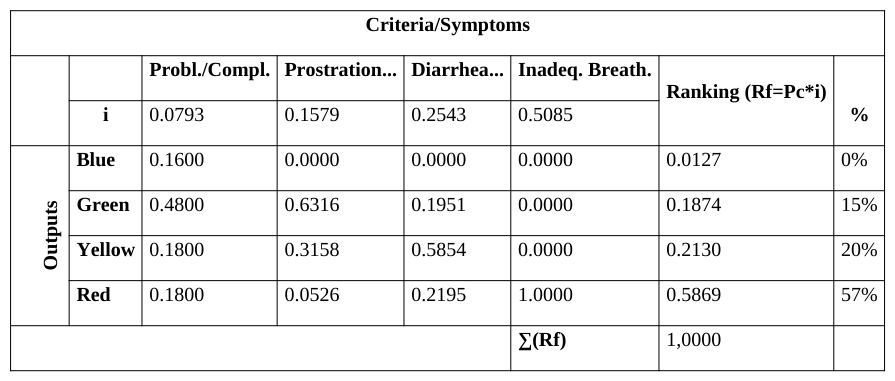
Through the values found for the prioritization vectors, multiplying matrices by the ranking, we get to the cumulative ranking of output options. Table 6 shows these operations:
Table 6: Cumulative ranking of output options Criteria/Symptoms
The cumulative prioritization described in Table 6 demonstrates that according to the combination of criteria / symptoms, the patient has 57% chance to rate Red, 20% chance of Yellow and a 15% chance of having Green Risk. These results are illustrated graphically in Error: Reference source not found.
16%
22%
62%
Figure 3: Suggested allocation of the patient's degree of Risk The suggested approach shows the use of an inference mechanism that may be implemented in information technologies, and fit as an additional input for decision-making in the complex healthcare system.
Figure available in the original PDF paper.
CONCLUSIONS AND FURTHER WORK Healthcare facilities are characterized by a paradox: in the same way that work is marked by repetition, there is enormous variability, since the occurrences always have different characteristics. What sort of health problem needs to be dealt every day is unpredictable. These factors denote the great cognitive effort made by healthcare professionals in carrying out their activities, exacerbated by the criticality of the decisions which are taken in these environments. Thus, this paper presents an approach that provides another input to support decision making in a major process on Brazilian Family Healthcare Strategy – the Risk Assessment process. In this process, professionals decide what kind of care a patient should receive in a Primary Healthcare Facility without an appointment, requesting, in principle, prompt service, something that should not be ordinary on FHS.
This approach uses concepts of the Fuzzy Sets Theory to establish the pertinence of the criteria / symptoms on each degree of a risk scale and Analytical Hierarchy Process (AHP) to prioritize the possible decisions according to the symptoms seen in patients. The notion of a Fuzzy Set Theory provides an interesting starting point for building a framework for the classification of standards dealing with the inaccuracy or lack of strict criteria for the definition of membership of an object within a group. With this one more input available, the risk assessment on Family Healthcare Strategy could reduce, as well as increase the possibility of equal application of criteria, improving decision making. Moreover, the proposed approach can be used in information technologies to support work in healthcare facilities. Still, it is important to note that the approach described in this article was not used to establish the priority of a patient in relation to others when they have the same degree of risk. During field research, several occurrences of this type were observed and thus this would be an interesting work to be developed in future research. The development of a computerized system to assist risk assessment using the inference mechanism shown in this paper - and its proper trial - is also an important suggestion for future work. Thus, healthcare professionals involved in this kind of work can carry out their activities more comfortable and confident, and get closer to the fundamentals of all healthcare systems: to provide healthcare services that meet the needs of their target population.
ACKNOWLEDGMENTS
The authors would like to acknowledge the Conselho Nacional de Pesquisas - CNPq and the Fundação de Amparo a Pesquisa do Rio de Janeiro - FAPERJ for support to this research.
REFERENCES
Ashoori, M., & Burns, C. M. (2013). "Team Cognitive Work Analysis: Structure and Control Tasks." Journal of Cognitive Engineering and Decision Making, 7, pp. 123-140. Carlsson, C., & Fullér, R. (1996). "Fuzzy multiple criteria decision making: recent developments". Fuzzy Sets and
Systems, 78, pp. 139-153. Carvalho, P. V., Vidal, M. C., & Luquetti, I. S. (2005). "Nuclear Power Plant Shift Supervisor's Decision-Making during Micro Incidents." International Journal of Industrial Ergonomics, 35, pp. 619-644. Crandall, B., Klein, G., & R. Hoffman, R. (2006). "Working Minds: A Practitioner's Guide to Cognitive Task
Analysis". Florida: A Bradford Book. Jatobá, A., Carvalho, P. V., & Cunha, A. M. (2012). "A method for work modeling at complex systems: towards applying information systems in family health care units." Work (Reading MA), 41. Klein, G. (2000). "Sources of Power." Cambridge, Massachusetts: MIT Press. Manchester Triage Group. (2005). "Emergency Triage". Manchester: Wiley-Blackwell Publishing. Ministério da Saúde. (2004). "Acolhimento com Avaliação e Classificação de Risco". Brasília - DF, MS. (in
Protuguee). Ministério da Saúde. (2006). "Política Nacional de Atenção Básica". Brasília - DF, MS. (in Protuguee). Nemeth, C., O’Connor, M., Klock, P., & Cook, R. (2006). "Discovering healthcare cognition: the use of cognitive artifacts to reveal cognitive work." Organization Studies, 27. Nyssen, A. S. (2011). "From Myopic Coordination toResilience in Socio-technical Systems. A Case Study in a
Hospital." In: E. Hollnagel, D. D. Woods, J. Pariés, & J. Wreathall, Resilience Engineering in Practice: A Guidebook (Vol. 1, pp. 219-233). Farnham, Surrey, England: Ashgate Publishing Limited. Patel, V., Kauffman, D., & Arocha, J. (2002). "Emerging Paradigms of Cognition in Medical Decision Making."
Journal of Biomedical Informatics, 35, pp. 52–75. Roncato, P. A., Roxo, C. O., & Benites, D. F. (2012). "Acolhimento com classificação de Risk na estratégia de saúde da família". Revista da AMRIGS, pp. 308-313 (in Portuguese). Saaty, T. L. (1990). "How to make a decision: The analytic hierarchy process." European Journal of Operational
Research, 48, pp. 9-26. Silveira, M. d., Félix, L. G., Araújo, D. V., & Silva, I. C. (2004). "Acolhimento no Programa de Saúde da Família: um caminho para a humanização da atenção à saúde". Cogitare, 1, pp. 71-78. (in Portuguese). Vidal, M. C. (2008). "Guia para analise ergonômica do trabalho (AET) na empresa". Rio de Janeiro, Editora virtual
cientifica LTDA. Zadeh, L. A. (1965). Fuzzy Sets. Information and Control, 1.
LISTED IN THE AHFE DIGITAL BOOKSTORE CATALOGUE
Explore the complete digital volume
Advances in Human Aspects of Healthcare
Read this individual research paper free through the original publisher, or explore the full digital proceedings book.
ISBN 978-1-4951-2093-0
Explore this ISBN in the AHFE Bookstore ↗Listed in the July 2026 bookstore catalogue; search by ISBN to confirm current availability · Digital book purchase optional