Valentina Solera (2022). Living Aboard with Kids and Pets. In: Advances in Human Aspects of Transportation: Part III. AHFE Open Access, vol. 17. https://doi.org/10.54941/ahfe100722
This research has a key focus on yachting as a popular family recreation with the middle classes that explains how the performance of the yachting industry remained stable vis-à-vis the luxury segment during this economic crisis. Today, the average middle class family has two children, and companion animals are an integral part of this organization. Animals and children share similar ergonomics, psychology ad behaviors, which facilitates the definition of ad-hoc designs for both. Good ergonomics in yacht design enhances the enjoyableness of the yachting experience for families and pets. The bottom line is a Design for All concept of an inclusive spatial environment. In this research we argue that ad-hoc design helps dismiss the stereotype that people quit yachting when a child is born or a dog is taken in. Behavioral rules tend normally to focus more on survivability than on livability: ergonomics must consistently tackle issues in this respect.
Unlike the superyacht segment, yachting for family entertainment seems virtually unaffected by current adverse economic conditions, and boating as a family recreation continues to be very popular. Our focus is on small size craft of between 10 to 15 meters, for weekend getaways in a relaxed, natural atmosphere, to enjoy a little respite from the hustle and bustle of everyday life. Recreational boating is increasingly seen as a way to break away from daily routine and unwind after a busy work week, and a pleasant way to spend free time with the family.
Today, the average middle class family has two children, and companion animals are an integral part of this organization. A survey by Assalco-Zoomark and Professione Veterinari of January 2013 reports that 42 per cent of Italian families own at least one pet, nearly one in two families (Fig.1). Also, pet legislation has long existed in common law countries.
Accordingly, to design family spaces requires the same focus on both pets and people. And, to design spaces that are both kid and pet friendly poses new ergonomic challenges to designers, considering the small size of recreational craft with minimized interior spaces.
Figure 1. Evocative image of family-type
Figure available in the original PDF paper.
OBJECTIVES/METHODS As we earlier discussed, our focus is on an analysis of key operational aspects of yachting for the recreation of families and pets on board a 10 to 15 meter sailing or motor boat on a day cruise or a weekend out. Our analysis intentionally excludes larger boats, in that the core aspects of our discussion are more challenging in reference to smaller craft. Because larger yachts replicate the comfort of home interiors, there is a lesser need to question their ergonomics in respect of specific user comfort and safety than on board smaller craft. Also, our analysis centers on recreational boating for middle income families, who are more likely to afford boats no larger than 10 meters, for no more than a day or two, as opposed to longer cruises requiring a more complex logistics than is desirable with kids and pets.
While these aspects deserve specific focus, we only address key cases that are easy to solve and provide a context for further discussion. Because we may not solve all criticalities in this respect, we only address significant issues in terms of movements and behaviors as observable on board a day cruiser. Our initial focus is on the state of the art of design in regard to issues as earlier discussed, also with an emphasis on major criticalities in this respect. Research is further articulated in terms of an analysis of users who are core to our discussion. Finally, we look to define indications on what to do and not to champion good design practices in respect of our core discussion.
We focus on the common features of kids and pets rather than on their individual characterization, at the same time that we examine traits that are specific to each user group, of kids and pets. Both user groups are small in size and their behavior is typical of the developmental stage they are in. We analyze these aspects in respect of the following:
- physical and cognitive functionality and mobility → ergonomics, how kids and pets use space aboard, what they do and how they live spaces.
- psychology → their behavior in various instances (e.g. boat at anchor, at sea); their perception of “space” (perspective, view, vantage point, exploration).
Kids are classified by age group and pets into cats and dogs. Dogs are further categorized by size.
We analyze daily routines as follows: eating, sleeping, playing, bathroom routine We analyze activities of kids and pets:
- while the boat is in motion (indoor spaces to sit safe while en route)
- while the boat is at anchor or docked (outside spaces to get active) We also analyze criticalities in respect of the following: boarding and water access systems, moving on deck, aft and fore, access to lower deck spaces (stairs).
Safety is the key design issue to address. Our study considers potential risks, including entrapment, suffocation, impacts, falls, slipping on wet surfaces, sea sickness.
Current state of the art: key design issues To provide ‘undisputed guidance’ for the design of kid and pet friendly boats is beyond the scope of this research. Our aim is to highlight the common features of kids and pets in terms of behavior and size. Kids and pets are identified as users with specific emotions and needs. Our research is not in support of the definition of general standard requirements for design concepts that are necessarily all kid and pet friendly. We only aim at recreating good and beautiful design projects that contribute to enriching industrial design with artifacts valuable for many years to come and for manifold potential future uses.
Babies, children and pets are users who require special design focus in the delivery of projects that enable functionalities aligned with contemporary lifestyle. Inputs are provided to supplement the creativity and professionalism of designers and enable a connection with their design concepts and the philosophy underlying their approach.
There is an inherent wrong in a design that sees kids as small adults and pets as unrelated creatures forced to adapt to environments that do not meet their needs. To think this means to design boats for adults only, with spaces that are dangerous for kids and pets and cause them to feel distress and fear.
Good ergonomic design defines objects based on an analysis of users, of their characteristics and real needs, to deliver spaces that are pleasant and, more importantly, safe, to enable the psychological and physical well-being of users. We often hear people say "I’m selling the boat because we’ve had a baby", or “we don’t go boating because we have a dog”. People say so because adults see the boat as an insidious place for little ones who are unaware of where they are and of dangers unless they are in places designed for them. Adults who agree with these statements see kids and pets as simply unfit for yachting. Conversely, making boats comfortable and fit for all needs is not impossible. It only requires ergonomic and commonsensical considerations. Good ergonomic design can make the boat a place for people to spend time with their loved ones and enjoy it. Four-legged friends make crew members who play with kids and turn a weekend getaway in a splendid time for all. After all, we are Mediterranean people, aren’t we? We can try and act like one and not just say it, and be more thoughtful of our kids and furry friends. Some little tips will make it much easier than we think. There is a number of Web logs and bloggers who offer various advice on how to best handle kids and pets on a boat, but except for the usual ‘things to do’ posts, there is not much valuable information in respect of correct livability issues. There is a need to provide guidelines that help designers identify and address key aspects to deliver family friendly projects.
Prior to scientifically observe their body related dimensions, designers need to analyze behaviors and routine activities of kids and pets. To look into what they do, their behaviors and needs provides helpful design indications. Kids and pets behave differently than adults. This anticipates and helps define the ergonomics of design.
User Analysis In the midst of creative chaos, designers may forget the basic rules that are at the foundation of ‘good’ design, the “5W’s” rules :
What - what the product is for (primary and secondary functions, goals, user categories, types of use).
Who – who the user is (age, gender, background, position, sensory and cognitive capacities etc.)
Why – why the product is used (e.g. what you do with the product or inside it) Where - where the product is used
When – when the product is used (in what time of the year and for how long) To the 5W’s add an “H” that stands for How - how the product is used.
Answering these simple questions helps designers set out on the right foot in the design of spaces that are appropriately sized and arranged, ensure safety and comfort for little ones and adults alike, and deliver family friendly products.
An analysis of users must follow, in terms of body related dimensions and actions. Adults are aware of where they are, of spaces surrounding them and, particularly, of potential risks. Kids and pets are not. Little ones climb aboard to play and explore. The novelty of this experience impacts their ability to process the dangers of risky behaviors, which may jeopardize their safety.
Our analysis shows that there are few things that kids and pets do aboard and surprisingly they show commonalities in the way they feel and spend time on a boat. Kids and pets have common psychological traits and other features (e.g. tactile, hearing, motor characteristics, similar view elevation) that call for similar ergonomics. The most ‘visible’ commonalities are that they are both short sized, that kids crawl and pets move on four legs. Notably, they experience space in psychologically similar ways: kids and pets are both curious, keen to explore and experiment interior spaces, everything is playful and a discovery to them. Their curiosity and exploration expose them to numerous risks unless the environment they are in is thoughtfully designed in ergonomic terms. Kids and pets learn based on a trial and error process, and this is how they increase their self awareness. Kids learn by falling and hurting themselves. Exploration and learning by experience are the cornerstones of pet training. We can say that, all in all, young mammals are very similar. As they grow up pets become more manageable in a boat’s small environment. On a boat, we cannot allow kids and pets to learn by themselves, as they may get hurt or put their safety seriously at risk. Letting them be unsafe and discover without the right level of control may lead to physical or psychological trauma. They may take fright or hurt badly and come to associate the boat and boating with a negative experience, a painful memory, became fearful and reluctant to go on a boat or even refuse to ever set foot on a boat again. As they are instinctive and spontaneous they may easily be frightened if they are not at ease with the boat and its spaces. In fact, it is recommended to have kids and pets experience the boat since their early years, let them acclimatize with the boat while at dock and only later, when they are confident with the boat, out on the water.
Movement aboard a rocking deck is not easy, but, because both kids and pets are short sized they have a lower center of gravity and balance more easily than adults, even when the going gets rolly and pitchy. They hardly ever get sea sick, the boat rocks them to sleep. Generally speaking dogs acclimatize more easily to life aboard than cats. Unlike cats, most dogs are not afraid of water. Notwithstanding, cats can feel comfortable on a boat if they find comfortable spaces for them.
Based on these considerations we develop user centered design issues under the parallel guidance of a geometrical and ergonomic analysis, on the one hand, and, on the other hand, of a psychological and behavioral analysis of users. In the case that is at issue, these analyses provide directions for an ergonomic design of interior and exterior spaces on board a yacht. To paraphrase a concept extolled by Bruno Munari, a space designed for children will easily fit adults too1.
Based on the information and data of these analyses designers deliver their concepts of boat spaces, their interior décor and objects and whatever else is needed to ensure the safety of children and the peace of mind of parents to enjoy life at sea with their loved ones and pets. Correct ergonomics ensures safety and helps avoid boredom. When kids or pets get bored they begin to look for something exciting, something new to discover or play with. This increases the chances of unsafe activities or behaviors. Smart design helps fend off boredom, or handle it at least: integrated interior décor and surfaces to play with, areas where kids can rest , take a nap or have a meal safely and having fun. For example, from birth to one year and a half, boating is a passive experience for babies, and ergonomic focus should be on the small spaces where they sleep and eat. Children aged 2 to 5 see the boat as a playhouse and are all taken up by the excitement of discovery and play. This is when they are exposed to the most feared risks also due to their height being level with tables, instrumentation etc. They are keen to explore but are unaware of dangers, so for them to enjoy life aboard safely but joyfully and continue to do so as adults their boating experience should start on board properly designed craft. Kids need to find harmony on the boat and for this to happen it is important to involve them in activities aboard from the moment they take their first steps so that being on a boat comes natural to them and needs no explanation. Teaching kids the basic rules of navigation since their early years will make them perfect sailors. Assigning tasks to them will teach them to be responsible, appreciate danger and be alert as even the wildest child is going to proudly show his parents he knows how to do things right. This dramatically reduces risks for their safety onboard.
The same applies to pets. Dogs are more problematic and fall into two categories, small size and large size. Small Human Aspects of Transportation III (2022) sized dogs take fright easily and, like kids, like to play and explore. Large sized dogs are more exposed to risks, need more space and are not at ease in places where their movements are limited. Spaces aboard need to be as much as possible homelike to be recognizable by dogs as homely and familiar. Dogs are methodical and they hardly accept changes in their routine. Females are much quieter, do not have an innate drive to explore so they are the ideal pet to have on board. However, even the most agitated male dogs can be quiet and sociable if they find spaces appropriate to them on the boat.
That said, there is no necessity to include short-lived elements in yacht design, that are specifically designed to accommodate a baby who will grow up. Modular design elements both reflect the needs of kids and pets and adjust to changes as kids and pets grow. This means spaces, furnishings or other elements that are also useful to parents. It is important that parents on deck, especially when underway, know their kids or pets left sleeping or playing below deck are safe in thoughtfully designed spaces.
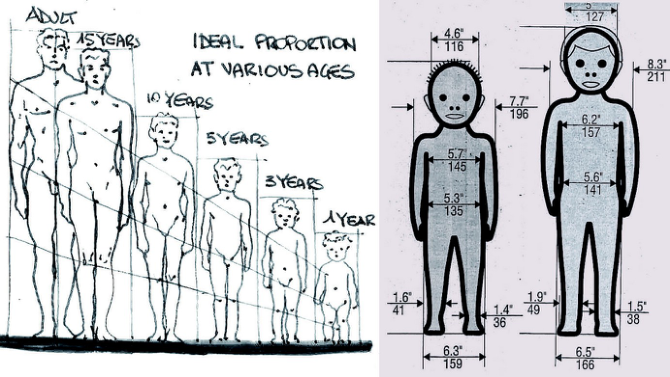
Kids and pets: user in a development stage (geometrical and ergonomic analysis + psychological and behavioral analysis Kids are analyzed by age group, from infants aged months to 11-12 years. Given their average height, kids of this age can safely sit below deck. When older than 12, children are not much different from adults in terms of behavior and ergonomics-wise. Kids aged 10 today already behave as young adults, appreciate danger, are conscientious and enjoy helping their parents. Children today grow faster than in the past when fourteen-year-olds were still little kids. In terms of geometric measures and size, 11-12-year-olds are taller than 1.5m so their height is no longer a risk factor for life aboard and they behave like adults. Infancy is when children are most vulnerable and exposed to risks due to both their size and behaviors. One fundamental rule is that safety is the starting point of all ergonomic analyses. To search for safety provides fundamental design inputs (Fig.2.)
Figure 2. Diagram of proportions related to the growth of a child. Example of patterns (percentiles) useful to define the measures ergonomic in different age groups. (in this example the case of a child of 6 months, and a child of one year
Children’s emotional expressiveness and conscious movements begin at 3-4 months of age when for the first time they express anger, surprise, sadness. In this early stage in life children begin to grasp toys and show participation. At 6 months they can sit upright without support, show a range of emotions like joy and fear, try to communicate, interact and begin to become aware of themselves. When they are 9 to 12 months old, children intentionally grab things and clearly communicate to the person they intend to relate to. At 12 months ends the first stage of development, which is seemingly the quieter one. Babies in this age group can be 70 to 75cm tall and wenn can easily infer how space for them should be designed.
Worries begin when children are past 1 year of age, can stand and toddle. When they are 12 to 18 months they develop curiosity and eagerly explore their surroundings (height: 80-85 cm). They experiment with things around them, in an independent trial and error process and become aware of things. An important stage, yet fraught with dangers for kids, is when children are 14 to 22 months old, at this age they can climb steps (height: 85-90 cm). As they near age 2, they can jump in place, walk, run, talk and communicate, and have a stronger sense of self.
In this phase everything can be dangerous on a boat and parents need to be watchful. When 2.5 to 5-6 year old (height: 110-120 cm) children develop reasoning, they begin to remember things of the past, are capable of mental representation and begin to appreciate what is dangerous and what is safe. Until they are 4 years old, kids do not have full control of their movements, they stop and turn their head with difficulty, this is important information for space design. When they are past 4 years of age (height: 100-102 cm) they have full control of their body and movements and parents know they can safely leave them alone for short periods.
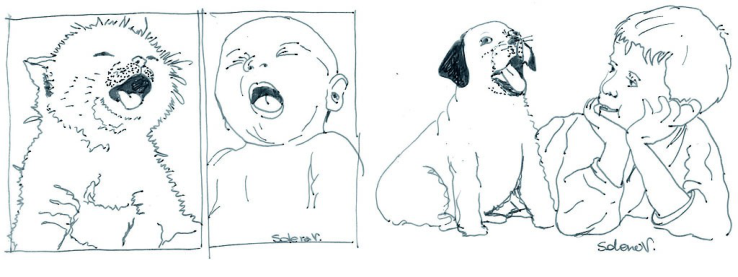
Like children, for both cats and dogs, it’s all about imprinting (first two months of life for pets and few months for children). As noted earlier, the younger they are, the easier it will be for them to acclimatize to the boat environment, to its interior décor, the limited spaces below deck, the cockpit, moving about the boat deck, going aft and fore. Having them familiarize with life aboard gradually and smoothly is crucial (even before worrying about ergonomics) when dealing with users who are in a development stage of their life, as kids, puppies and kittens are both physically and mentally, and adult pets only mentally. Although they grow physically, cats and dogs never lose their lust for exploration and although they become quieter and more obedient, they continue to act more like children than adults even when they are adult. Each stage in life has its own characteristics. While adults just continue their life, young go through stages of mental and physical development. While in their development stages children are curious, creative and spontaneous. They learn about the world by playing and movements are crucial for their physical education. Human or animal, young show similar behaviors. (Fig.3)
Dogs: When dealing with dogs, size is an important aspect, physically and behaviorally. The smaller they are, the more playful, agitated and louder they will be. Bigger dogs are gentler, quieter and more obedient. Clearly, these are general rules, as much depends on the dog’s personality and character and how it is raised. If raised in a quiet, loving environment the dog will be calm and quiet. Some breeds are more suited than others to life at sea (e.g. Labrador, Newfoundland, Cao de Agua, Lagotto Romagnolo) but even the least suited ones can adapt quickly as dogs are naturally comfortable with water. As they grow, puppies develop their personality and physical built. To grow up healthy, they need suitable spaces where they can eat, live, play and learn, sleep comfortably. Breeder tables are available based on their experience showing various development milestones of cats and dogs by breed. These tables can be helpful when designing ergonomic spaces for pets. For a vague idea of differences and changes, the weight of an adult dog from a small-sized breed can be about 25 times his birth weight, the weight of a dog from an extra large-sized breed can be even 100 time more his birth weight2.
Dogs have conditioned responses triggered by various stimuli: smells, sounds, movements or more complex situations. Dogs cannot respond to two different stimuli at the same time, in other words each stimulus cancels the previous one. This information can turn out to be very useful when a dog becomes uncomfortable in a place unfamiliar to it: if distracted it he will soon forget. Unlike cats, dogs do not like being left alone as they feel abandoned. It is therefore advisable that owners do not to leave their dogs alone below deck in a place where they cannot see them. Owners can leave their dog alone inside, in a place where the dog can see them, for example through the companionway or a porthole or other deckhouse opening. The owner has just to make eye contact with his dog and the dog will be calm and obedient. Cuddling and comforting the dog to calm it and help it acclimatize to the new space works better than any ergonomic tips. A description of specific situations and related design Human Aspects of Transportation III (2022) indications follows below, including suggestions to enhance the comfort and ease of boating with pets.
Cats: Unlike dogs, regardless of breed, cats have similar size and behaviors with no substantial differences between a tabby and a Mediterranean cat or other breeds. Cats grow and age at a much faster rate than human beings: a cat of one month is like a 5-6 month baby; a cat of 3 months like a 2-3 year-old child; a cat of one year like an 18-year old. At 1 year, cats become sexually mature and stop growing in size. As they near age 3 cats are fully mature like 30- year-old people. Cats aged 5-8 years are in their forties. When they are 9-10 year old, cats become seniors (equivalent to 55-60 years of age for human beings). Although cats do not like water, they can be ideal travel companions. They do not suffer if left alone and just need a comfy place to sleep and areas where they can play on their own for hours on end, below deck, while the boat is in motion.
There is a need to favor a boat experience of cats early in their development and train them to be aware of dangers below deck such as holes, double bottoms and anything else that may be dangerous for tiny kittens playing and exploring aboard. Clearly, it is safer for cats to sit below deck during navigation. When the boat is at anchor and especially when it is docked, owners should keep an eye on them as they may leave or get on other boats.
In developing good ergonomics solutions for cats the focus should be on sleeping, eating and playing. It is not recommended to let them get into the water for a swim- and cats wouldn’t like it- so care must be taken to avoid a sudden dunk. Cats have great balance which helps them move about the boat deck, go fore and aft, and they are comfortable laying on the foredeck. Cats can safely run about the boat deck as this poses no danger to them, clearly while at dock. Cats naturally adapt to new situations and they will easily acclimatize to the small space below deck. Cats like to snuggle in small, cozy places so they may choose the dinette or a cabin to curl up. They are also curious though and may look for hide-outs, so there is a need to make sure that any area that may not be safe for them or they should not access is closed with well-fixed panels or doors. Like dogs, as they grow up cats become quieter and older kittens are gentle and like to lie down idling the hours away. Like dogs, female and male cats are widely different. Females need less space than males, are more sociable and collaborative, are not too curious, play safely without looking for dangerous hide-outs.
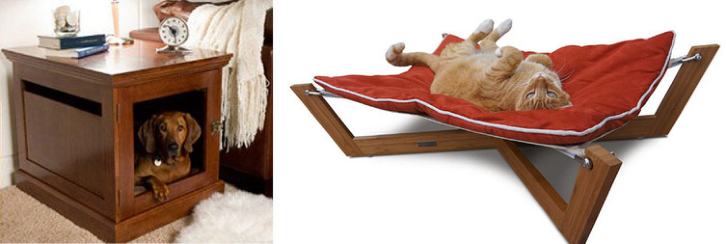
Sleeping Sleeping en route: It is advisable that kids and pets rest inside during navigation. The boat rocks them to sleep and they rarely get sea sick. Cats and dogs like sleeping on soft mats or plush pet beds with something above their head that makes the place cozy and warm and make they feel safe and comfortable. A good solution could be an integral décor that can be used as pet beds below deck, so that the beds of our four-legged friends do not stand in the way while we move around. Cats like being up off the floor so a hammock-like kitten bed would be a good solution as it is comfortable, stable and off the floor. (Fig.4)
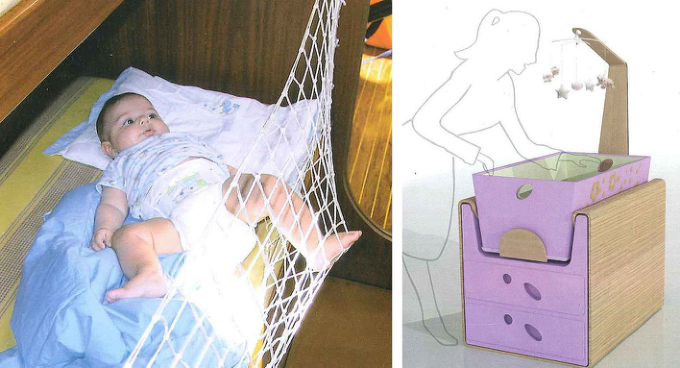
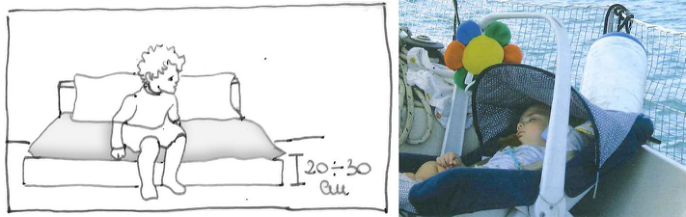
Figure 4. Pet-beds integrated with the furniture. Pet's bed comfortable and stable for animal. (www.bravacasa.rs) With kids safety is paramount. A good thing is to have them stay in ad-hoc space below deck. When they are little safety nets would do between bunks or around cushions in the salon or the dinette to form a sort of enclosed area to play or sleep in like a playpen at home. It is important that there is ad-hoc space for kids that is safe where they cannot roll off/fall out and get hurt. Toddlers are easily accommodated in a cabin berth, protected from falling with safety nets. Notwithstanding, it is advisable that infants and toddlers are never left alone. Design concepts may Human Aspects of Transportation III (2022)
consider integrated décor that is both pet and child friendly, as with the dinette in (Fig. 5).
Older kids who are independent and refuse protection gear may rather go for accommodation on the dinette or cabin floor, that eliminates the need to climb up and down a bunk and risk to fall. (Fig.6).
Figure 5. Left: thanks to a network, the bed of a cabin can become a box (Cestari A.)
Right: integrated cot. "Sleeplay" project designer G. Pavanello. (Giraldi L.)
Figure 6. Left: small bed for a child. The ergonomic dimensions of the bed facilitate its use.
Right: the chair by the machine becomes useful on a boat. (Cestari A.)
While the boat is at anchor or docked there are much fewer risks than while at sea. Under adult attendance, children can be comfortably accommodated in the cockpit as there is normally not much draft. Alternatively, they can also sleep on deck in a shaded area, enjoying the air and the sea breeze. Large-base beds are good for little children in terms of stability and comfort. Car seats can also be arranged on the cockpit bench. (Fig.6) Pets. Unlike dogs that enjoy the sea breeze and the warmth of the sun, cats rarely sleep on deck, they prefer interiors. They can find comfy places for them that vary according to their size. Safety nets attached to railing’s jacklines protect furry friends from falling overboard.
Playing For kids and pets there is plenty to play with on a boat. Attention is needed because hazard lurks. For their safety adults (parents/pet owners) should block all dangerous openings such as portholes, skylights, double bottoms and install safety nets to provide protection against the risk of falling overboard. Safety nets should be installed aft if the boat has an open stern, as sometimes is the case on board sailboats. Kids should not leave the cockpit and venture out on deck when the boat is in motion, ideally they should stay below deck where they are safe. Human Aspects of Transportation III (2022)
At times it is advisable to install non-slip glue matting on side walkways and deck for secure footing. Certainly, all these modifications impact the boat style and design, but diminish danger for little guests on board. When the boat is in motion: Toddlers who walk and play on their own and are independent may stay in the cockpit under parents’ careful watch; older kids aged 5 to 7 can be assigned boating tasks. As they stay focused on accomplishing them near their dad, they are watched and run no risk. Cabin space may be arranged for little children to play in safely as in a playpen, using safety nets.
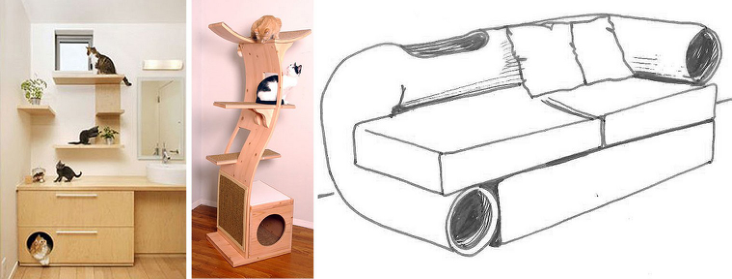
Pets. Ideally cats and small-sized dogs should sit below deck. Cats are independent, they play on their own. Kittens prefer to play on elevated spots, so cat gyms and brackets in the dinette keep them busy and away from dangers. Being on a elevated spot facilitates communication with their owner. These are important aspects to keep in mind when designing onboard spaces for kittens. Again, good design incorporates play elements into interior décor solutions. Dogs are content when they are with their owner, so they can sit in the cockpit, if they are used to boating they will understand the situation and cause no trouble. (Fig.7)
Figure 7. Game elements integrated with the decor, such as gyms for cats, raised floors, or furniture with playful elements may become useful for the welfare of the pet. (Some examples can be found on-line, or you can design with fantasy)
When the boat is at anchor or at the dock there are plenty of opportunities for both kids and pets to play. They can stay with adults in the cockpit and enjoy nature outside on deck. Ropes and gears that may stand in their way and cause injuries are to be taken care of. Ropes, sheets and halyards should be covered with proper bags as kids may trip on them while playing. Large centerline cockpit tables should be removed to enable larger play areas. Small inflatable fresh or salt water pools, aft for kids and dogs – small sized only - are useful and much appreciated. The foredeck would make a good area for playing and resting. However, it may be dangerous for kids to be there with no grab bar or handrail to hold on to. Installed central to the sun lounge, interrupting its large cushioned area or on both its sides, handrails provide support and increase a child’s safety. Kids should be able to hold on to them, minimizing their uneasiness with the yacht’s floating movement. (Fig.8)
Figure 8. The sun-area, results easy to access by an child, thank to a central element, as a handle.
Figure available in the original PDF paper.
Eating When the boat is in motion, kids and pets should not eat. Never have liquid food or mugs full of milk.
When the boat is at anchor or at the dock, kids and pets can have their meals. Comfy seats that are integrated in the boat’s design would make a good solution for infants and can be used also to feed them in the cockpit. There are various concepts to adapt a boat’s existing décor to children’s use. For example, bag style slings are available that, properly fastened to chairs, turn them into a child’s seat.
Pets need two bowls, one for water and one for food, secured to the lower deck floor. To prevent spitting up and vomiting caused by the boat rolling and pitching it is advisable to place the bowls on a slightly elevated surface (centimeters only) depending on the pet’s height, so that pets (cats or dogs) don’t need to bend their neck and lower their head too much when eating.
Bathroom routine Pooping and peeing is not much different at home or on the boat for babies as they wear diapers. There is no advice to give for good ergonomics other than reminding parents to bring as many diapers as possible. For an older child using the boat head is like using the toilet at home, so, equally, no big deal.
With pets it can be an issue. Cats that are trained to use a litter box at home can use it on the boat as well. The same as with bowls, there is a need to secure litter boxes so that they don’t move and their content is not scattered all over the floor while the boat is in motion. With dogs it may be more complicated. With smart dogs it may be easy to train them to “do their business” at command and they may hold it until they are ashore.
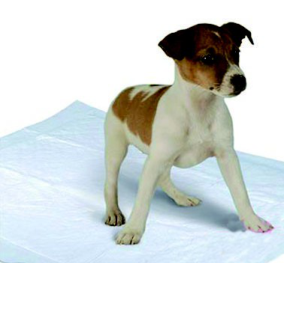
But, this is not easy for the dog and we don’t want to make it tough for our beloved pets. So, dog diapers exists, sized 60x90 cm (Fig.9), to be laid on the floor below deck or, better still, on the head floor. Dog diapers are just some odorless flat square pads that may be very helpful as dogs can smell them and understand they can ‘do their business’ on them. It is advisable to use flat diapers as pets do not understand what pants are for and hardly learn to use them. Train the dogs to go to the boat head and use the flat diaper on the floor. The head door should be a swinging door so that dogs can go in and out independently. Doors should be locked while the boat is in motion so that they don’t fling open: to train dogs to go to the head only when the boat is at anchor or docked also helps.
If the boat has a large head, part of it may be designated to serve pets needs. This area may host litter box for cats and diapers for dogs. There is a need to combine ergonomic design skills and smartness to find tools that can be adapted for use on the boat by little guests, on two legs or four, and make life aboard easier for them.
Figure 9. Absorbent diapers for pets. (Produced, for example, by “ALCA”)
Moving fore and aft (transit stern-bow) Their small size facilitates little users who are core to our analysis in moving on narrow side walkways on board a
10 meter boat. To fix nets to jacklines also ensures safety. Also a design solution to improve safety could be to open the boat’s windshield centrally and let kids easily walk through to fore. This is a possibility on board sports or open motorboats. Parent supervision is clearly required at all times when at sea. Small gates can be installed on both sides to keep kids and dogs out of certain deck areas when it is not safe for them to move freely about the boat deck. In certain cases, it is of great help to use tethers and harnesses clipped to the boat fittings. This gives kids and pets the freedom to move about the boat and yet be reined-in enough for them to be safe. Kids should be encouraged to use harnessing systems playfully and not be forced to.
Aft platforms: getting on and off the boat/in and out of water Kids and dogs only are central to this analysis. Cats do not like water and prefer to sit below deck in slumber while the rest of the family enjoys bathing and swimming.
The ideal situation is a boat with a generous stern swim platform clear of outboard engine and featuring modern comforts. Inboard engines allow larger beach deck spaces. Larger swim platforms facilitate boarding and water access. Automated technology exists, that includes Italy based Opacmare’s Transformer. Thanks to a double pantograph hinge, Transformer hydraulically motions a platform that turns into a ramp or automatically adjustable stairs. Transformer opens vertically and extends onto the water surface to facilitate boarding and water access. This technology exists, is successful and versatile, but pricey, which can be a major issue for small boat owners. This system clearly needs handrails to facilitate access in and out of water of swimmers and adults with a kid or a dog in their arms . Beach decks exist that lower down underwater also to facilitate access. Also, to fix safety nets all around the boat’s transom and swim platform helps protect children and pets from accidentally falling overboard. It is also advisable to have fresh water shower near and a compartment to stow kids toys.
A big dog will happily jump into the water, knowing how to keep water out of his nose. A small dog may find it more difficult to swim, because small size breeds are no water dogs and may be at a loss in the water. For small dogs a lift type device made with ropes would do that may help lower the dog slowly down into the water while assisted by adults who are also in the water. Plastic non skid ramps exist, anchored to the transom with weights like fenders attached that keep them underwater. Non slip dog boots would also help for good grip, available from any good pet store. A dog will quickly learn how to get back on board on his own. (Fig.9)
Figure 10. Walkway to the dog. Right (Siviero N., Giacon A.) And, the Opacmare’s Transformer, hydraulic gangway. (www.opacmare.com) Moving up and down the stairs to below deck (Lower-Deck)
Figure available in the original PDF paper.
Moving up and down the boat’s stairs to below deck may not be easy for short-legged users like kids and pets, especially in a small boat. Climbing steep stairs is no easy task for 4 legged users. Stairs to below deck are usually pretty steep, typically four 25cm riser steps with a pitch angle of about 60 degrees. Access is generally from the cockpit where building code rules require that there is a 15 cm rise step to stop water from going below deck where the cabins are. Our inexperienced little ones may trip on this step. Side handrails at kid friendly elevation would help, that are normally non standard on board. A non-skid ramp anchored to the cockpit floor would facilitate pet access to and from below deck. Because companionway steps normally have no riser, it is even more dangerous for kids and pets to move up and down as they may get a hand/foot or their head stuck between steps and get hurt. It is recommended that vertical boards are installed as stair risers to avoid risks in this respect.
RESULTS AND CONCLUSIONS This kid and pet friendly boat design is no special or unusual, nor is it different than designs that already exist. This short study illustrates a few suggestions only, to ensure that little seafarers move aboard safely and independently. Nothing but basic technical devices, combined with proper, logic adult behaviors, these solutions deliver safety and peace of mind for a perfect day at sea. Utilized as standard technology in yacht design and construction, this ergonomics would likely have no impact on the architectural style of day cruiser. The results of this research consist in design indications for ergonomically calibrated onboard spaces. Adaptability, safety and easy usability will make life aboard a pleasant experience for kids and furry friends alike. There is a need for designers to deliver concepts with a focus on spacious aft platforms to facilitate boarding and water access; no skid, no slip walkway and deck surfaces; easy access below deck via comfortable stairs; safety nets installed where needed to prevent falls. Adding toys, safe and playful décor will keep kids and pets entertained. These details and attentive adult behaviors combine to meet the need of kids and pets. Kids and pets are no longer regarded as hindrances to yachting as a family entertainment. To enhance the accessibility of recreational boating to families and pets provides an opportunity for the development and growth of the yachting industry, that designers and shipbuilders should consider as a new growth strategy for the day cruise sector, with the development of new baby and pet design segments in the yachting industry. These segments are increasingly evolving and developing. This is an opportunity that the yachting world may not miss.
FOOTNOTES 1 Innovating a time-tested product -a boat in this case- an absolute necessity to improve its quality , adapt to changing lifestyles and product uses. Account is to be taken of the different users: adults, kids and pets. Many areas of product design are focusing on children (Baby Design) and pets (Pets Design), in line with this trend, the scope is to be broadened to include boats.
2 Full development (approx. age): small dogs, 10 months; medium-sized dogs, 12 months; large dogs 18 months; huge dogs 24 months. Weight: small dogs within 10 kg; , medium-sized dogs, 10 to 25 kg; large dogs over 25kg; huge dogs 45 kg or more.
REFERENCES
A.A.V.V. (2001), “International Encyclopedia of Ergonomics and Human Factor”, by Waldermar Karwowski, Taylor & Francis, London Anselmi, L., Tosi, F. (2004), “L'usabilità dei prodotti industriali”, Moretti e Vitali (Ed.), Bergamo. Bandini Buti, L. (2008), “Ergonomia olistica”, Franco Angeli, Milano.
Cestari, A. (2005), “Bimbi a bordo”, Magenes, Milano. Dreyfuss, H. (1994), “Le misure dell'uomo e della donna”, Be-Ma, Milano. Fubini, E. (2009), “Ergonomia antropologica” (Vol.I),Franco Angeli, Milano. Giraldi, L. (2012), “Baby design”, Alinea, Firenze. Giacon, A., Siviero, N. (2008), “Il mio cane in barca”, il Frangente, Verona. Lueder, R., (2003),”Are children just little adults?”, ErgoSolutions, Dec 2003, pages 32-34 Lueder R., Berg Rice, V. (2008), “Ergonomics for children”, Taylor & Francis, London & N.Y. Montessori, M., (1950), “La scoperta del bambino”, Garzanti, Milano Nowak E. (2001), ”Antropometry of Children”, in: “International Encyclopedia of ergonomics and human factors”, By Waldemar Karwowski, Vol. I and II, Taylor Francis, 2001, London. Pittamiglio F., Poggi F. (2003), “La città alta un metro”, Franco Angeli, Milano. Tosi, T. (2004), “Ergonomia & Design”, Edizioni Poli.design, Milano
www.caninamente.it http://who.int/violence_injury_prevention/child/injury/world_reporter/en/ World Health Organization (WHO) http://www.childergo.com/childrenadults.htm#ergonomics
LISTED IN THE AHFE DIGITAL BOOKSTORE CATALOGUE
Explore the complete digital volume
Advances in Human Aspects of Transportation: Part III
Read this individual research paper free through the original publisher, or explore the full digital proceedings book.
ISBN 978-1-4951-2099-2
Explore this ISBN in the AHFE Bookstore ↗Listed in the July 2026 bookstore catalogue; search by ISBN to confirm current availability · Digital book purchase optional