Mika Isobe, Yoshikuni Edagawa (2026). Creative Activity as a Self-Regulating Human System: An EEG-Based Study of Oscillatory Dynamics. In: Human Systems Engineering and Design (IHSED2026): Future Trends and Applications. AHFE Open Access, vol. 237, pp. 821–831. https://doi.org/10.54941/ahfe1008220
This study extends prior exploratory research (Isobe and Edagawa, 2025) to reconceptualize creative activity as a self-regulating human system and to clarify its psychophysiological dynamics. Creativity has often been examined as a cognitive state, such as flow or insight, or in relation to psychological traits; however, integrative approaches that incorporate temporal fluctuation and embodied processes remain limited (Csikszentmihalyi, 1996; Fink and Benedek, 2014; Sawyer, 2012). From the perspective of embodied cognition, cognitive processes are inseparable from bodily states and sensorimotor interactions (Shapiro, 2011). This suggests that creative activity should be understood not only as a mental process but as an embodied phenomenon grounded in ongoing physiological and environmental coupling. In design research, creativity has been framed as a practical and relational process (Cross, 2001; Dorst, 2015; Kimbell, 2011), yet its physiological grounding has been insufficiently explored. This study conducts a secondary analysis of EEG data collected during a LEGO® Serious Play® workshop to examine the dynamics of Interest and Stress and their relationships with psychological resources, including PERMA, general self-efficacy, and sleep. Results show that Interest follows an inverted U-shaped trajectory, while the relationship between Stress and Interest dynamically shifts from positive to negative across phases. PERMA and self-efficacy function as buffering mechanisms, and sleep provides a restorative foundation. Based on these findings, creative activity is conceptualized as an oscillatory process between arousal and recovery, modeled as an “Arousal–Recovery Loop.” This process is further structured as a multilevel framework consisting of (1) psychological resources that support orientation toward creative engagement, (2) creative practice, and (3) embodied dynamics. Within this framework, EEG oscillations are interpreted as observable manifestations of regulatory processes rather than isolated physiological events. These findings suggest that creativity should be understood as a rhythmically regulated process, offering theoretical and empirical contributions to creativity research and human-centered design.
Creativity is widely recognized as a fundamental driver of innovation, learning, and well-being (Csikszentmihalyi, 1996; Sawyer, 2012). However, the psychological and physiological processes that occur within creative
Received May 12, 2026 Revised June 20, 2026 Accepted July 10, 2026 Available online September 25, 2026
822 Isobe and Edagawa activity remain insufficiently understood (Dietrich, 2004; Fink and Benedek, 2014). Prior research has tended to conceptualize creativity as a cognitive state, such as flow or insight, with limited attention to temporally evolving dynamics and embodied aspects.
Recent advances in electroencephalography (EEG) have made it possible to capture real-time changes in cognitive and affective states during creative activity (Fink and Benedek, 2014). In parallel, research in positive psychology has demonstrated that psychological resources such as PERMA and self- efficacy support sustained engagement in creative processes (Bandura, 1997; Seligman, 2011). However, these lines of research have developed largely in isolation, and an integrative framework that conceptualizes creative activity as a process combining psychological, physiological, and temporal dynamics has yet to be fully established. Furthermore, while design research has framed creativity as a practical and relational process (Cross, 2001; Dorst, 2015; Kimbell, 2011), empirical insights into its embodied and physiological foundations remain limited.
To address these gaps, this study aims to conceptualize creative activity as a psychophysiologically self-regulating human system and to elucidate its dynamic structure. In this study, a human system is defined as a dynamic structure in which psychological, physiological, and behavioural processes interact through feedback mechanisms to regulate and adapt human activity over time. Building on prior exploratory research (Isobe and Edagawa, 2025), this study analyses oscillatory dynamics in creative activity using EEG data and presents an integrated model.
By reconceptualizing creativity not as a stable state but as a self-regulating oscillatory system integrating psychological, physiological, and practical dimensions, this study offers a novel contribution to creativity research. This perspective also has implications for design research, particularly for understanding design attitude not as a fixed cognitive trait but as a dynamic process emerging through creative practice and embodied regulation.
Background
In creativity research, perspectives that conceptualize creative activity as a temporal process have been developed, particularly in studies of flow and creative processes (Amabile, 1996; Csikszentmihalyi, 1990; Sawyer, 2012). These studies suggest that creativity involves fluctuations such as divergence and convergence, or focus and relaxation. However, they have primarily focused on cognitive and psychological aspects, with limited integration of embodied and physiological dynamics.
Recent studies using EEG have demonstrated that variations in alpha and beta waves are associated with creative thinking (Dietrich, 2004; Fink and Benedek, 2014). In parallel, research in positive psychology has shown that psychological resources, such as PERMA and self-efficacy, support sustained engagement in creative processes (Bandura, 1997; Fredrickson, 2001; Seligman, 2011). While these findings indicate that creative activity involves both psychological and physiological factors, their interaction has not been sufficiently integrated.
Creative Activity as a Self-Regulating Human System 823 In design research, creativity has been framed as a practical and relational process rather than merely problem-solving (Kimbell, 2011). In particular, design attitude has been discussed as an orientation that engages with uncertainty through iterative exploration and reframing (Boland and Collopy, 2004; Buchanan, 1992; Dorst, 2015; Michlewski, 2015). While these discussions emphasize cognitive and strategic dimensions, design attitude is enacted through practice and interaction, involving embodied engagement (Avital and Boland, 2007). However, its relationship with psychophysiological dynamics in creative activity remains insufficiently examined.
Taken together, prior studies have illuminated partial aspects of creative activity, yet an integrated framework that captures the interaction between psychological, physiological, and practical dynamics has not been fully established.
Research Gap Building on the prior literature, three key research gaps can be identified.
First, the temporal dynamics of creative activity have not been sufficiently integrated. Although creativity has been conceptualized as a process, many studies rely on comparisons of discrete states at single time points (Dietrich, 2004), leaving the overall structure of change across the activity insufficiently understood. In particular, while fluctuations within creative activity have been suggested, their oscillatory structure has not been comprehensively theorized. Oscillatory patterns are often understood as fundamental forms of coordination in complex systems (Kelso, 1995). However, such perspectives have not been sufficiently integrated into creativity research.
Second, there is a lack of integrative understanding between psychological resources (e.g., PERMA and self-efficacy) and physiological indicators (e.g., EEG). Although these factors have been examined independently, their interaction within creative activity remains underexplored.
Third, a theoretical framework that conceptualizes creative activity as a human system is lacking. Despite the fact that creativity emerges through the interaction of cognitive, psychological, and embodied processes, few models have been proposed to explain these dimensions in an integrated manner. In particular, the relationship between creative activity as practice and the embodied dynamics that arise within it remains insufficiently understood.
This study addresses these gaps by modelling creative activity as a psychophysiologically self-regulating dynamic system. Its novelty lies in conceptualizing creative activity as oscillatory process and theorizing it as a self-regulating mechanism that integrates psychological, physiological, and practical dimensions.
METHOD
Participants Six adults (aged 20s–50s) affiliated with companies and higher education institutions participated in this study. All participants volunteered and provided informed consent prior to participation. This study is positioned as exploratory research, aiming to provide an initial examination of psychophysiological dynamics in creative activity.
A creative workshop using LEGO® Serious Play® (LSP) was conducted.
LSP is recognized as a method that facilitates meaning-making and reflection through hands-on engagement, enabling participants to externalize and reconstruct tacit knowledge, thereby eliciting creative thinking processes (Roos and Victor, 1999; Kristiansen and Rasmussen, 2014).
The experiment consisted of three phases representing different stages of the creative process:
Warm-up phase
Creative phase (creative production)
Explain phase (explanation and reflection) Each phase lasted approximately 20 minutes, resulting in a total session time of about 60 minutes. Throughout all phases, psychological and physiological fluctuations during creative activity were continuously measured.
EEG Electroencephalography (EEG) was continuously recorded from the frontal regions (Fp1, Fp2). The analysis focused primarily on alpha (8–13 Hz) and beta (13–30 Hz) frequency bands, and variations in these bands were used to index changes in cognitive and affective states. In this study, fluctuations in Interest and Stress were derived from these EEG indicators. These indices are interpreted based on established mappings between EEG frequency bands and cognitive–affective states (Fink and Benedek, 2014). Rather than treating EEG measures as direct indicators of specific psychological states, this study employs them as proxies to capture relative patterns of fluctuation during creative activity. Accordingly, the interpretation of Interest and Stress in this study focuses not on their absolute values, but on their temporal patterns and phase-dependent relationships.
Self-Report Measures To assess psychological resources associated with creative activity, self-report questionnaires were administered prior to the experiment. The measures included:
PERMA (well-being)
General Self-Efficacy (GSE)
Creative Self-Efficacy (CSE)
Optimism
Sleep All items were evaluated using a five-point Likert scale.
Creative Activity as a Self-Regulating Human System 825 Data Analysis
Data were analyzed using IBM SPSS Statistics (Version 31). To examine changes in EEG indices across phases, repeated-measures analysis of variance (ANOVA) was conducted. In addition, correlation analysis was performed to investigate the relationship between Stress and Interest.
To assess the influence of psychological resources, a general linear model (GLM) was applied with PERMA, GSE, CSE, and Optimism as covariates. The level of statistical significance was set at 5%.
This study is positioned as an exploratory analysis, aiming to describe observed patterns and provide theoretical interpretations based on the relationships identified. It does not seek to establish causal relationships.
RESULTS
The analysis revealed that Interest exhibited a significant inverted U-shaped trajectory across phases (F(2,10) = 19.20, p < .001), reaching its peak during the Creative phase.
The relationship between Stress and Interest varied across phases. In the Normal phase, a weak positive correlation was observed (r = .32, p = .54). In the Creative phase, the relationship shifted to a negative correlation (r = −.28, p = .59), and in the Explain phase, a strong negative correlation was found (r = −.93, p = .006).
The exploratory GLM analysis showed that PERMA and general self- efficacy (GSE) were significant covariates (p < .05), whereas creative self- efficacy (CSE) and optimism were not significant.
Sleep did not exhibit a significant main effect (F(1,14) = 0.06, p = .81), while the overall model was significant (F(3,14) = 5.63, p = .010, R² = .55). The main effect of phase remained significant (F(2,14) = 8.41, p = .004).
Modelling Creative Activity as a Human System Building on the results presented in the previous section, this section develops a conceptual model of creative activity.
The observed patterns indicate that creative activity is not merely a cognitive state but is constituted by temporally evolving psychophysiological processes. These patterns indicate a feedback mechanism in which physiological states influence creative engagement, while engagement in turn modulates physiological states over time. Furthermore, the inverted U-shaped trajectory of Interest and the dynamic reversal in the relationship between Stress and Interest suggest that this feedback process does not remain stable but develops as a rhythmic oscillation between arousal and recovery.
Based on these characteristics, this study proposes a reconceptualization of creative activity as a self-regulating human system characterized by the interaction of physiological regulation and behavioral dynamics (Hancock and Warm, 2003; McEwen, 2007; Senge, 1990). In this view, creativity is not sustained by a continuously heightened state of arousal; rather, it emerges as a cyclical process that oscillates between arousal and recovery. Such oscillatory dynamics can be understood as a fundamental pattern of adaptive regulation
826 Isobe and Edagawa in human systems, in which activation and down-regulation alternate to sustain engagement. In this study, recovery is conceptualized as a process of physiological down-regulation supported by psychological resources, such as PERMA, self-efficacy, and sleep.
This dynamic structure is conceptualized as the “Arousal–Recovery Loop.” This loop provides an integrative framework for understanding the generation, depletion, and regeneration of energy in creative activity, thereby explaining the sustainability of creative engagement.
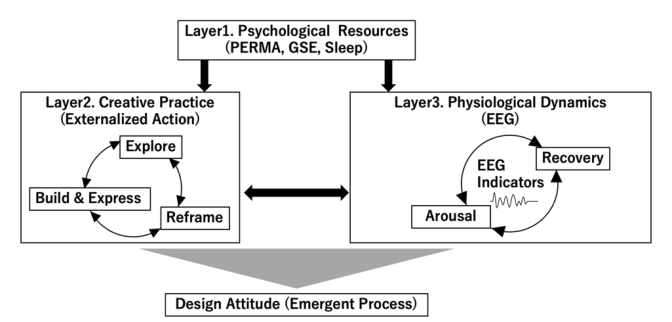
Importantly, this loop does not operate at a single level but emerges through interactions across multiple levels. This study conceptualizes creative activity as a three-layered structure: (1) psychological resources that support orientation toward creative
engagement, (2) action processes as creative practice, including iterative engagement and reframing, and (3) embodied dynamics as physiological fluctuations observable through
EEG.
These three layers do not function independently but interact to regulate creative activity. In particular, the oscillatory patterns observed in EEG may be associated with psychophysiological regulatory processes that form the Arousal–Recovery Loop, which in turn manifests as concrete actions within creative practice.
From this perspective, creative activity cannot be reduced to psychological factors alone but should be understood as the interaction between physiological regulation and practical action. Observable creative practices are thus not separable from physiological dynamics but are generated through their interplay.
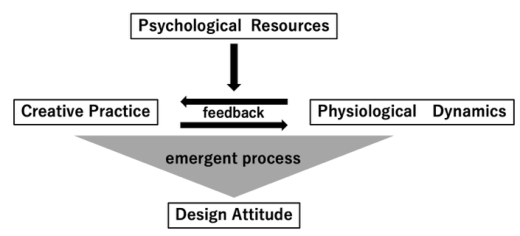
Such an interactional process provides a new perspective for understanding design attitude. This study positions design attitude not as a fixed cognitive trait but as a dynamic process emerging from the interaction between physiological regulation and creative practice (see Figure 1).
Figure 1: Design attitude as an emergent process of physiological regulation and creative practice.
Creative Activity as a Self-Regulating Human System 827 Based on this premise, this study proposes a framework for understanding creative activity as an integrated, multilevel system (see Figure 2).
Figure 2: A multilevel framework of creative activity as an arousal–recovery system.
DISCUSSION
The findings of this study suggest that creative activity is not sustained by a continuously heightened state of arousal, but rather by a rhythmic process that oscillates between activation and recovery (Yerkes and Dodson, 1908; Hancock and Warm, 2003). This challenges the conventional view of creativity as the maintenance of a high level of concentration and instead calls for its reinterpretation as a dynamic regulatory process. It should be noted that this study does not claim causal relationships, but offers an initial theoretical interpretation based on observed patterns.
This perspective provides important implications for human-centered design. Traditional design approaches have often sought to enhance creativity by increasing stimulation or cognitive load. However, the present findings indicate that appropriate phases of recovery and release are essential for sustaining creative activity (Sonnentag, 2018; Loehr and Schwartz, 2003; Meijman and Mulder, 1998; Yerkes and Dodson, 1908). Accordingly, creative environments should be reconsidered not solely in terms of stimulation, but in terms of rhythms of engagement and recovery (Foster, 2017).
This shift moves the focus of human-centered design from optimizing static conditions to designing dynamic rhythms of engagement and recovery. In doing so, it extends human-centered design from an approach centered on optimizing user states to one that designs the broader process of human activity, including cycles of engagement and recovery.
Furthermore, this study provides a theoretical positioning of oscillatory dynamics in creative activity. The observed oscillatory patterns may be interpreted not as mere physiological fluctuations, but as psychophysiological regulatory patterns associated with adaptive regulation processes (McEwen, 2007) that mediate transitions between states such as engagement, tension, and release. This perspective enables creativity to be understood not as a singular state but as a continuously evolving system (Guastello, 1995).
828 Isobe and Edagawa These regulatory processes correspond to the forms of practice discussed in design research, particularly iterative engagement and reframing in response to uncertainty (Boland and Collopy, 2004; Dorst, 2015). In this sense, oscillatory regulation functions as a rhythm of generation and reconfiguration of action, manifesting concretely within creative practice.
Importantly, this study does not equate physiological dynamics with design attitude; rather, it focuses on their interaction. The findings suggest that design attitude may be understood as emerging through the interplay between physiological regulation and creative practice. From this perspective, design attitude should be understood not as a static cognitive orientation, but as a dynamic process continuously shaped through the interaction of psychological resources, practice, and embodied states. In other words, design attitude does not reside as an internal individual trait, but is generated as a temporal and embodied process within creative activity.
Therefore, this study proposes a theoretical framework for reinterpreting design attitude based on observed oscillatory dynamics. The findings indicate that creative activity is not maintained as a stable cognitive state, but is constituted through an oscillatory regulatory process between activation and recovery—implying that creativity itself is a continuously regulated process enacted through practice.
CONCLUSION AND IMPLICATIONS This study conceptualizes creative activity as a psychophysiologically self-regulating human system and provides preliminary evidence of its dynamic structure. Based on EEG analysis, creative activity is shown to operate as an oscillatory process that transitions between arousal and recovery.
The first contribution of this study lies in theorizing oscillatory dynamics in creative activity not as isolated physiological phenomena, but as regulatory processes that shape creative engagement. This study models this regulatory mechanism as the “Arousal–Recovery Loop,” demonstrating that creative activity is sustained through a cyclical process of energy generation, depletion, and recovery.
Second, this study proposes an integrative framework that conceptualizes creative activity as a three-layered structure: (1) psychological resources that support orientation toward creative engagement, (2) action processes as creative practice, and (3) physiological regulation as embodied dynamics. These three layers interact to constitute creative activity, redefining creativity not as a singular ability or state, but as a dynamic system composed of multiple interconnected layers.
Third, this study offers a theoretical reinterpretation of design attitude. Rather than equating physiological dynamics with design attitude, it highlights their interaction, suggesting that design attitude emerges through the interplay between physiological regulation and creative practice. From this perspective, design attitude is understood not as a fixed individual trait, but as a dynamic and embodied process generated through the interaction of psychological resources, practice, and bodily states.
Creative Activity as a Self-Regulating Human System 829 These findings have important implications for human-centered design. While traditional approaches have focused on optimizing stimulation or cognitive load, this study indicates that sustaining creative activity requires the design of rhythms that incorporate recovery. Accordingly, creative environments should be reconsidered not as the optimization of static conditions, but as the design of dynamic rhythms of engagement and recovery.
Overall, this study proposes a theoretical framework that conceptualizes creative activity as an oscillatory process, offering a new perspective that bridges creativity research, neuroscience, and design studies. By framing creativity as a self-regulating dynamic system, it contributes to a broader understanding of human systems.
LIMITATIONS This study has several limitations. First, the sample size is small (n = 6), and thus the generalizability of the findings is limited. As an exploratory study, the present research aims to identify initial patterns of psychophysiological dynamics in creative activity; future studies should validate these findings with larger and more diverse samples.
Second, this study focuses primarily on individual-level dynamics captured through EEG and self-report measures, and does not fully address processes of meaning-making or collaborative interaction. Creative activity involves not only cognitive and physiological fluctuations but also the construction of meaning within individual and social contexts, as well as co-creative processes through dialogue and interaction. Future research should therefore integrate qualitative approaches (e.g., interviews and SCAT) and research designs that capture multi-person interactions to better understand the relationship between subjective experience, physiological dynamics, and relational processes.
Given these limitations, this study provides an initial framework for understanding creative activity as a psychophysiologically self-regulating human system. Future research should extend this framework by integrating quantitative and qualitative methods and incorporating a relational perspective.
ACKNOWLEDGMENT
This research was supported by JSPS KAKENHI Grant Number JP25K23152 (Research Activity Start-up Support, Mika Isobe). We would like to thank all the participants who cooperated in this research.
REFERENCES
Amabile, T. M. (1996). Creativity in context. Westview Press. Avital, M., and Boland, R. J., Jr. (2007). Managing as designing with a positive lens.
In M. Avital, R. J. Boland, Jr., & D. L. Cooperrider (Eds.), Designing information and organizations with a positive lens (Advances in Appreciative Inquiry, Vol. 2, pp. 3–14). Emerald Group Publishing Limited.
830 Isobe and Edagawa Bandura, A. (1997). Self-efficacy: The exercise of control. New York: Freeman. Boland, R. J., and Collopy, F. (2004). Managing as designing. Stanford University
Press. Buchanan, R. (1992). Wicked problems in design thinking. Design Issues, 8(2), 5–21. Creswell, J. W. (2014). Research design: Qualitative, quantitative, and mixed methods approaches (4th ed.). Sage. Cross, N. (2001). Designerly ways of knowing: Design discipline versus design
science. Design Issues, 17(3), 49–55. Csikszentmihalyi, M. (1990). Flow: The psychology of optimal experience. Harper & Row. Csikszentmihalyi, M. (1996). Creativity: Flow and the psychology of discovery and
invention. New York: Harper Collins. Dietrich, A. (2004). The cognitive neuroscience of creativity. Psychonomic Bulletin & Review, 11(6), 1011–1026. Dorst, K. (2015). Frame innovation: Create new thinking by design. MIT Press. Fink, A. and Benedek, M. (2014) ‘EEG alpha power and creative ideation’,
Neuroscience and Biobehavioral Reviews, 44, pp. 111–123. Foster, R. G. (2017). Circadian rhythms: A very short introduction. Oxford University Press. Fredrickson, B. L. (2001). The role of positive emotions in positive psychology.
American Psychologist, 56(3), 218–226. Gero, J. S. (2010). Design prototypes: A knowledge representation schema for design.
AI Magazine, 11(4), 26–36. Guastello, S. J. (1995). Chaos, catastrophe, and human affairs: Applications of nonlinear dynamics to work, organizations, and social evolution. Psychology Press. Hancock, P. A., and Warm, J. S. (2003). A dynamic model of stress and sustained
attention. Human Factors, 45(3), 349–358. Isobe, M., and Edagawa, Y. (2025). Exploratory study on psychophysiological dynamics in creative activity. In Proceedings of the AHFE International Conference on Human Factors in Design, Engineering, and Computing (Vol. 199). AHFE International. Kelso, J. A. S. (1995). Dynamic patterns: The self-organization of brain and behavior.
MIT Press. Kimbell, L. (2011). Rethinking design thinking: Part I. Design and Culture, 3(3), 285–306. Kristiansen, P., and Rasmussen, R. (2014). Building a better business using the
LEGO® Serious Play® method. Wiley. Loehr, J., and Schwartz, T. (2003). The power of full engagement. Free Press. McEwen, B. S. (2007). Physiology and neurobiology of stress and adaptation.
Physiological Reviews, 87(3), 873–904. Meijman, T. F., and Mulder, G. (1998). Psychological aspects of workload. In P. J. D.
Drenth & H. Thierry (Eds.), Handbook of work and organizational psychology (Vol. 2, pp. 5–33). Psychology Press. Michlewski, K. (2015). Design attitude. Gower. Roos, J., and Victor, B. (1999). Towards a new model of strategy-making as serious play. European Management Journal, 17(4), 348–355. Sawyer, R. K. (2012). Explaining creativity: The science of human innovation (2nd
ed.). Oxford University Press. Seligman, M.E.P. (2011). Flourish: A visionary new understanding of happiness and well-being. New York: Free Press.
Creative Activity as a Self-Regulating Human System 831 Senge, P. M. (1990). The fifth discipline: The art and practice of the learning
organization. Doubleday. Shapiro, L. (2011). Embodied cognition. Routledge. Sonnentag, S. (2018). The recovery paradox. Research in Organizational Behavior, 38, 169–185. Yerkes, R. M., and Dodson, J. D. (1908). The relation of strength of stimulus to
rapidity of habit formation. Journal of Comparative Neurology and Psychology, 18(5), 459–482.
FIND THE COMPLETE VOLUME IN THE AHFE DIGITAL BOOKSTORE
Explore the complete digital volume
Human Systems Engineering and Design (IHSED2026): Future Trends and Applications
Read this individual research paper free through the original publisher, or explore the full digital proceedings book.