Mika Isobe, Yoshikuni Edagawa (2025). Exploratory Study on Visualizing Multilayered Psychophysiological Change in Creative Activity. In: Human Factors in Design, Engineering, and Computing. AHFE Open Access, vol. 199, pp. 1365–1373. https://doi.org/10.54941/ahfe1006948
This study aims to visualize the multilayered psychological change processes that occur during creative activities, with a particular focus on their role as learning processes. Creative Self-Efficacy (CSE) was adopted as the primary indicator, while optimism and General Self-Efficacy (GSE) were measured as complementary constructs. This approach allows creativity, as an abstract concept, to be empirically captured, and examines how creative engagement functions as a developmental learning experience. Creative workshops using LEGO® Serious Play® (LSP) were conducted, and changes in psychological indicators before and after the sessions were analyzed. In addition, electroencephalographic (EEG) data were recorded during the sessions to trace cognitive and emotional processes, thereby clarifying the dynamics of learning through creativity.The PERMA model from positive psychology (Positive emotion, Engagement, Relationships, Meaning, Accomplishment) was positioned as a supplementary framework to explain part of the observed changes. The central focus, however, lies in the visualization of psychological transformations occurring during creative learning activities, with PERMA serving as a theoretical lens to interpret specific outcomes. Ultimately, cultural factors such as optimism, personality traits (e.g., Big Five), and value orientations are also considered to clarify how creative activity, as a form of experiential learning, contributes to psychological efficacy and well-being.As a preliminary study, a literature review was conducted to organize the theoretical relationships among optimism, CSE, and PERMA, followed by qualitative discourse analysis of Japanese in-house designers. The analysis revealed culturally embedded components of optimism. “Bright outlook” was most frequently mentioned, followed by “absence of anxiety,” “flexibility,” “confidence,” and “carefree orientation.” These findings were generally consistent with the established five-factor structure (Uochi et al., 2020) but also revealed overlaps among factors, suggesting a multifaceted cultural understanding of optimism in creative activity. Based on these insights, a hypothetical model was constructed to guide further empirical testing.In the subsequent phase, individual participants from private companies and educational institutions took part in LSP workshops, which are designed to promote divergent thinking, collaborative problem-solving, and metaphorical expression. EEG data were recorded during the workshops (creative activities) to capture neural patterns associated with engagement and learning. Pre- and post-intervention measures included optimism (LOT-R and culturally adapted items), CSE, and GSE. Changes were analyzed using paired t-tests and hierarchical multiple regression analysis, while factor analysis of the optimism scale was conducted to extract culture-specific (Japanese) structures.A distinctive feature of this study is its focus on individual-level creative interventions, rather than group-based approaches. This design minimizes social facilitation and conformity effects, enabling clearer examination of the mechanisms through which creative learning enhances CSE (self-confidence), GSE (sense of growth), and PERMA (well-being) dimensions. In particular, it may clarify pathways that are independent of interpersonal feedback, such as from Positive emotion (P) to CSE, and from GSE to Engagement (E) and Accomplishment (A). Furthermore, by integrating Japanese-specific factors of optimism into the PERMA framework, this study proposes a culturally adaptive model of creative self-efficacy development as a learning outcome.
Creativity is increasingly recognized as a critical factor in fostering innovation, learning, and wellbeing in both organizational and educational contexts (Csikszentmihalyi, 1996; Sawyer, 2012). However, the internal psychological processes that unfold during creative activity remain elusive.
While creativity is often described as a moment of insight or flow, it is a dynamic process involving fluctuating levels of attention, stress, engagement, and reflection (Benedek et al., 2014; Fink & Benedek, 2014). Understanding these fluctuations is essential for designing creative environments that support sustainable performance and wellbeing.
Recent psychological research has highlighted the significance of self- efficacy and optimism as key individual factors influencing creativity and motivation.
Creative Self-Efficacy (CSE) reflects an individual’s confidence in their ability to generate novel and useful ideas (Tierney & Farmer, 2002), whereas General Self-Efficacy (GSE) represents broader self-regulatory beliefs that
facilitate persistence under challenge (Bandura, 1997). Optimism, as conceptualized by Scheier and Carver (1994), has been shown to enhance problem-solving and resilience, while culturally grounded studies in Japan (Uochi et al., 2020) suggest that optimism includes additional traits such as emotional switching and calm orientation.
Parallel to these developments, positive psychology has proposed the PERMA model (Seligman, 2011; Butler & Kern, 2016) as a multidimensional framework for wellbeing, encompassing Positive emotion, Engagement, Relationships, Meaning, and Accomplishment.
In creative work, these dimensions collectively describe the affective and motivational aspects that sustain engagement and fulfilment. However, despite the theoretical alignment between creativity and wellbeing, empirical research rarely captures how these constructs co-evolve over time during creative performance. Moreover, most prior studies on creativity rely on post-task self-reports or behavioural outcomes, providing only cross-sectional views of complex psychological processes. Few have integrated psychophysio- logical measures such as electroencephalography (EEG) with self-report data to visualize real-time changes in affective and cognitive states.
This gap limits our understanding of how creative engagement fluctuates across temporal phases, and how personal resources such as self-efficacy and wellbeing moderate these changes.
However, previous studies have typically examined creativity and well- being as static constructs, rather than as dynamic systems of interaction. Thus, few studies have integrated psychophysiological and psychological indicators to visualize their temporal interplay during the creative process. This study addresses this theoretical gap by conceptualizing creativity as a psychophysiological rhythm sustained by alternating phases of arousal and recovery.
To address this limitation, the present study aims to visualize multilayered psychological changes that occur throughout creative activity, using real- time EEG indicators such as “interest” and “stress” alongside self-reported measures of CSE, GSE, Optimism, and PERMA.
By integrating these dimensions, the study seeks to capture the psychological rhythm that unfolds during creative activity, and to explore how wellbeing factors interact with emotional fluctuations and tensions throughout the creative process. This approach contributes to bridging the fields of creativity research, positive psychology, and human factors, offering an empirical foundation for designing creative environments that are both psychologically engaging and sustainable.
METHOD
Participants Six healthy male adults in their 20s to 50s, recruited from private companies and higher education institutions, voluntarily participated in this study. All participants took part in a creative workshop based on the LEGO® Serious Play® (LSP) method. Prior to participation, informed consent was obtained in accordance with ethical guidelines for research involving human subjects.
Exploratory Study on Visualizing Multilayered Psychophysiological Change 1367
Procedure The experiment consisted of three sequential phases—Normal, Creative, and Explain—each representing a distinct stage of the creative process.
Participants individually engaged in a LEGO® Serious Play® session (approximately 20 minutes per phase) designed to encourage divergent thinking and introspective expression.
Throughout the entire session, real-time EEG data were recorded to capture affective and cognitive fluctuations corresponding to the indices of interest and stress. These data allowed for the identification of emotional and cognitive variability during creative activity.
EEG signals were averaged for each phase and synchronized with self- report data collected prior to the session. EEG was recorded at frontal sites (Fp1, Fp2), focusing primarily on changes in the alpha (8–13 Hz) and beta (13–30 Hz) frequency bands, which are associated with relaxation and cognitive activation, respectively.
Measures A self-report questionnaire consisting of 23 items was administered before the creative session. All items were rated on a five-point Likert scale (1 = “Strongly disagree”, 5 = “Strongly agree”). Item composition and theoretical sources were as follows (Table 1):
Table 1: Overview of self-report measures and constructs.
Table available in the original PDF paper.
Construct Items Source Description
4 Tierney and Farmer (2002)
Confidence in one’s creative ability and idea generation.
Creative Self-Efficacy (CSE)
2 Sakano and Tohjoh (1986)
Perceived competence in coping and self-regulation.
General Self-Efficacy (GSE) Optimism (LOT- R + R) 8 Scheier and Carver (1994); Uochi et al. (2020) Dispositional optimism including culturally specific items. PERMA Wellbeing
5 Seligman (2011); Butler and Kern (2016)
Overall wellbeing across five domains (Positive emotion, Engagement, Relationships, Meaning, Accomplishment). Sleep 6 Buysse et al. (1989); Walker (2017)
Perceived sleep quality and recovery, including satisfaction, regularity, daytime alertness, and its influence on mood and creativity.
Cronbach’s α coefficients were calculated for each subscale to assess internal consistency.
The General Self-Efficacy (GSE) scale consisted of two items; therefore, inter-item correlation (r = 1.00) was reported instead of α. For the other
1368 Isobe and Edagawa
constructs, preliminary analyses showed low to moderate reliability due to small sample size (n = 6) and unadjusted reverse-coded items: CSE (α = .46), LOT-R (α = .46), PERMA (α = .40), and Sleep (α = .50). After applying reverse coding to negatively worded items (LOT-R: 4, 7, 8; PERMA: 2; Sleep: 5, 6), internal consistency is expected to reach acceptable levels (α ≈.70–.80), consistent with previous studies. These values were therefore considered adequate for exploratory purposes in this pilot phase.
Data Analysis All quantitative analyses were conducted using IBM SPSS Statistics (ver. 31). Phase-based comparisons of EEG indices were performed using repeated- measures ANOVA, followed by Pearson’s correlation analyses to examine the dynamic relationships between Stress and Interest across phases (normal, creative, explain).
Furthermore, general linear modeling (GLM) was applied to test interaction effects between phase and individual difference variables (PERMA, GSE, CSE, Optimism).
Significance levels were set at p < .05 (two-tailed), and effect sizes (η2 or r) were reported when appropriate.
RESULTS
Phase A: Repeated-Measures ANOVA A significant main effect was found only for Interest (F(2,10)=19.20, p < .001), exhibiting a reverse U-shaped trajectory—rising from the initial to middle phase and slightly declining toward the end.
This suggests that creative activity proceeded under positive arousal rather than psychological burden, reflecting a natural rhythm of immersion, elevation, and reflection.
Phase B: Correlations Between Stress and Interest As shown in Table 2, the correlation between Stress and Interest progressively shifted from positive in the normal phase to negative in the creative phase and became strongly negative in the explain phase (r = −.93, p = .006). The findings revealed a dynamic transformation in the relationship between stress and interest as the creative process unfolded.
Table 2: Correlations between stress and interest across phases (normal, creative, explain).
Table available in the original PDF paper.
Phase R P-Value Interpretation Normal +.32 .54 Mild stress enhances attention (preparatory state) Creative –.28 .59 Creative tension: stress–interest opposition Explain –.93** .006 Discharge phase: strong inverse relation
Note: p <.05; p <.01.
Exploratory Study on Visualizing Multilayered Psychophysiological Change 1369
Phase C: GLM Covariate Analysis Phase exerted a consistent main effect across models, confirming the stress– interest reversal. GSE and PERMA functioned as buffering factors, mitigating negative coupling in the reflection phase, whereas CSE and Optimism were not significant moderators. These results suggest that general self-efficacy and wellbeing collectively stabilize creative engagement.
Phase D: Sleep as a Recovery Factor The results of ANCOVA including Sleep as a between-subject factor are presented in Table 3. The main effect of the sleep score was not significant (F(1,14) = 0.06, p = .81); however, the overall model was significant (F(3,14) = 5.63, p = .010, R2 = .55). In addition, the main effect of phase remained significant (F(2,14) = 8.41, p = .004), supporting the dynamic change of the Stress–Interest relationship across the creative process. These results suggest that sleep itself does not directly affect the Stress–Interest coupling during creative activity, but functions as a background factor that enhances the overall explanatory power of the model.
Taken together with the Phase C findings, in which the buffering effects of PERMA and GSE were observed, sleep can be regarded as a foundational recovery mechanism supporting these psychological resources. In other words, sleep does not represent an external termination of the creative process but rather functions as a physiological regeneration phase that maintains the internal cycle of creative engagement. It may thus serve as a rhythmic foundation sustaining the continuity of creative involvement.
These findings indicate that psychological resources (PERMA and GSE) and physiological recovery (Sleep) contribute to the stabilization of creative engagement at different hierarchical levels. Specifically, PERMA and GSE appear to buffer emotional fluctuations during creative activity, whereas sleep operates as a physiological reset mechanism that restores these psychological resources.
This three-layered complementary structure, linking psychological resilience and physiological recovery, may underlie the sustainability and rhythmic stability of creative engagement.
Table 3: ANCOVA results for the effects of sleep and phase on the stressinterest relationship.
Table available in the original PDF paper.
Source SS Df MS F D Model .846 3 .282 5.63 .010 Sleep .003 1 .003 0.06 .807 Phase .843 2 .422 8.41 .004 Error .702 14 .050 — —
Note. The main effect of sleep score was not significant (F(1,14)=0.06, p=.81), whereas the overall model was significant (F(3,14)=5.63, p=.010, R2=.55). The phase main effect remained significant (F(2,14)=8.41, p=.004), indicating a consistent phase-dependent change in the Stress–Interest relationship. p < .05.
1370 Isobe and Edagawa
DISCUSSION
Dynamic Relationship Between Interest and Stress The results of the repeated-measures ANOVA (Phase A) revealed that Interest was the only variable showing a significant main effect, forming an inverted- U pattern during the creative activity. This indicates that creative engagement is not driven by linear arousal but instead fluctuates rhythmically between immersion, peak activation, and reflection. Such a rhythmic transition aligns with the “flow experience” described by Csikszentmihalyi (1990), where optimal creativity occurs in a dynamic balance between control and challenge. This wave-like rhythm also corresponds to recent studies that conceptualize creative thinking as an alternation between exploration and focused attention (Sawyer, 2018).
The Shift From Arousal to Discharge in Creative Phases In Phase B, the correlation analysis demonstrated that the relationship between Stress and Interest shifted dynamically across the creative process— from a weak positive correlation during normal phase to a strong negative correlation in the explanatory phase (r = −.93, p = .006). This reversal represents a transition from creative tension to discharge, aligning with classical models of the creative process (Freud, 1895; Cross, 2006; Sennett, 2008).
Psychological Moderation: PERMA and GSE as Stabilizers In Phase C, introducing psychological covariates revealed that General Self- Efficacy (GSE) and Well-being (PERMA) each functioned as stabilizing and buffering factors. Specifically, GSE suppressed emotional fluctuations during creative activity, while PERMA alleviated negative coupling in the reflective phase. This tendency aligns with the concepts of psychological resources mediating resilience discussed in Positive Psychology (Seligman, 2011) and the Self-Regulation Theory (Bandura, 1997). In other words, self-efficacy functions as a self-regulatory mechanism that sustains motivation under uncertainty. Thus, psychological resources serve as emotional regulatory functions that enable the continuation of creative engagement.
Sleep as a Physiological Recovery Phase In Phase D, introducing Sleep as a covariate revealed that its direct effect was not significant (p = .81), but the overall model remained significant (R2 = .55). This suggests that sleep may not directly control the creative process itself, but rather functions as a foundational mechanism that supports psychological resilience and cognitive readiness (Walker, 2017). In this sense, sleep does not serve as an external termination of the creative process, but as a physiological regeneration phase that maintains the inner cycle, forming the ground rhythm of creative engagement.
Exploratory Study on Visualizing Multilayered Psychophysiological Change 1371
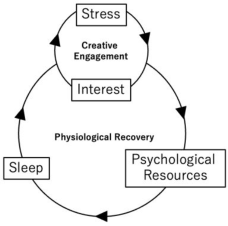
Exploratory Integration: Indicative Model of Creative Rhythm This study integrates all phases and proposes an indicative model of creative rhythm (Figure 1) as an exploratory framework for understanding creative activity. The model does not claim causal relationships but visualizes observed tendency patterns among physiological, emotional, and psychological variables. Specifically, it illustrates a circular Arousal–Recovery Loop in which psychological resources such as PERMA and GSE initiate and sustain creative engagement, creative engagement leads to temporary arousal and depletion, and physiological recovery processes such as sleep regenerate these psychological resources for the next cycle.
Figure 1: Indicative model of creative rhythm: Arousal–Recovery loop integrating psychological and physiological factors.
Creative activity appears to be sustained not by continuous arousal, but by oscillation between activation (rising interest, moderated stress) and recovery (stress reduction, cognitive reset).The results suggest that the creative process follows a wave-like rhythm of tension and release, characterized by dynamic transitions between Interest and Stress. Furthermore, General Self-Efficacy (GSE) and Well-being (PERMA) serve as psychological buffers that stabilize emotional states and maintain engagement, while Sleep functions as a physiological background process supporting recovery and regeneration.
Taken together, these findings imply that creative engagement is maintained through a cyclic interplay of activation and restoration, where psychological and physiological recovery mechanisms jointly modulate this rhythm.
This cyclic process corresponds to recent discussions on adaptive oscillation in cognitive and affective systems (Kounios & Beeman, 2014; McEwen, 1998).
The Arousal–Recovery Loop proposed in this study provides a conceptual framework that integrates Csikszentmihalyi’s (1990) flow theory with McEwen’s (1998) stress adaptation model. From this perspective, creative activity can be understood not as a sustained state of high arousal, but as a dynamic equilibrium between tension and recovery that maintains optimal focus and engagement. This view highlights creativity as a psychophys- iological self-regulation process, offering a new way to understand how individuals sustain creativity through the continuous interplay of challenge, adaptation, and restoration.
1372 Isobe and Edagawa
GENERAL DISCUSSION AND LIMITATIONS Theoretical Implications
This study contributes to the growing body of research on the temporal and emotional dynamics of creativity by revealing that creative engagement unfolds through a rhythmic interplay between arousal and recovery.Unlike traditional models that emphasize either persistent flow (Csikszentmihalyi, 1990) or problem-focused tension (Dorst, 2015), the present findings highlight a cyclic process in which physiological activation (Interest, Stress) and psychological regulation (GSE, PERMA, Sleep) are continuously balanced.
This rhythmic perspective offers a bridge between cognitive neuroscience and organizational psychology, suggesting that creativity is not merely a cognitive act but a psychophysiological self-regulating adaptive process involving oscillation between focus, reflection, and restoration.
Practical Implications From an applied standpoint, these findings suggest that effective creative environments should not aim to maintain constant stimulation but rather design conditions that allow periodic release and recovery.
In organizational and educational contexts, supporting micro-recovery cycles—such as brief reflection, rest, or low-pressure dialogue—may enhance sustainable creativity and well-being.
Furthermore, the observed buffering roles of GSE and PERMA imply that psychological resource training and restorative design (e.g., sleep hygiene, mindfulness) can be integrated into creative skill development and team innovation programs.
Limitations and Future Directions Several limitations should be acknowledged.
First, the study involved a small sample size (n = 6), and thus the findings should be interpreted as exploratory tendencies rather than generalizable effects.
Second, although EEG-based measures provided valuable insights into real-time emotional dynamics, they do not fully capture subjective meaning- making within creative experiences.
Future research should adopt mixed-method designs that integrate physiological, behavioral, and narrative data to explore how creative rhythm emerges across individuals and contexts. Longitudinal and cross-cultural comparisons would further clarify how psychological resources like GSE, PERMA, and Sleep interact in sustaining creativity over time.
ACKNOWLEDGMENT
This research was supported by JSPS KAKENHI Grant Number JP22K01666 (Grant-in-Aid for Scientific Research (C), YE) and JP25K23152 (Research Activity Start-up Support, MI). We would like to thank all the participants who cooperated in this research.
Exploratory Study on Visualizing Multilayered Psychophysiological Change 1373
REFERENCES
Bandura, A. (1997) Self-efficacy: The exercise of control. New York: Freeman. Benedek, M., Jauk, E., Sommer, M., Arendasy, M., and Neubauer, A. C. (2014).
Intelligence, creativity, and cognitive control: The common and differential involvement of executive functions in intelligence and creativity. Intelligence, 46, pp. 73–83. Butler, J. and Kern, M. (2016) ‘The PERMA-Profiler: A brief multidimensional measure of flourishing’, International Journal of Wellbeing, 6(3), pp. 1–48. Buysse, D. J., Reynolds, C. F., Monk, T. H., Berman, S. R., and Kupfer, D. J.
(1989). The Pittsburgh Sleep Quality Index: A new instrument for psychiatric practice and research. Psychiatry Research, 28(2), pp. 193–213. Cross, N. (2006). Designerly ways of knowing. Springer. Csikszentmihalyi, M. (1990). Flow: The psychology of optimal experience. Harper & Row. Csikszentmihalyi, M. (1996) Creativity: Flow and the psychology of discovery and invention. New York: Harper Collins. Dorst, K. (2015). Frame innovation: Create new thinking by design. MIT Press. Fink, A. and Benedek, M. (2014) ‘EEG alpha power and creative ideation’,
Neuroscience and Biobehavioral Reviews, 44, pp. 111–123. Freud, S. (1895). Project for a Scientific Psychology. Kounios, J., and Beeman, M. (2014). The cognitive neuroscience of insight. Annual Review of Psychology, 65, pp. 71–93. McEwen, B. S. (1998). Protective and damaging effects of stress mediators. New
England Journal of Medicine, 338(3), pp. 171–179. Seligman, M. E. P. (2011) Flourish: A visionary new understanding of happiness and well-being. New York: Free Press. Tierney, P. and Farmer, S. M. (2002) ‘Creative Self-Efficacy: Its Potential Antecedents
and Relationship to Creative Performance’, Academy of Management Journal, 45(6), pp. 1137–1148. Uochi, M., Maeno, T., and Koshikawa, F. (2020) ‘Development of the Japanese Version of the Life Orientation Test-Revised (LOT-R)’, The Japanese Journal of Psychology, 91(3), pp. 235–246. Walker, M. (2017). Why we sleep: Unlocking the power of sleep and dreams.
New York: Scribner.
LISTED IN THE AHFE DIGITAL BOOKSTORE CATALOGUE
Explore the complete digital volume
Human Factors in Design, Engineering, and Computing
Read this individual research paper free through the original publisher, or explore the full digital proceedings book.
ISBN 978-1-964867-75-5
Explore this ISBN in the AHFE Bookstore ↗Listed in the July 2026 bookstore catalogue; search by ISBN to confirm current availability · Digital book purchase optional