Da Eun Lee, Seung Hyun Seo, Yejin Lee, Kwangtae Jung (2025). Designing Mudflat Fishing Mobility for Worker Safety and Reduced Physical Strain. In: Human Factors in Design, Engineering, and Computing. AHFE Open Access, vol. 199, pp. 555–562. https://doi.org/10.54941/ahfe1006867
Haerujil, a traditional shellfish-gathering practice on Korea’s tidal flats, has recently grown as a form of leisure, yet it poses persistent safety risks due to soft and heterogeneous terrain, nighttime activity, and the aging profile of participants. These conditions frequently lead to disorientation, tidal entrapment, and slips or falls. To address these challenges, this study proposes a human-centered mobility design concept that integrates autonomous driving technologies to enhance both safety and convenience in mudflat environments.Drawing on user analysis and environmental constraints, three key design requirements were identified: reducing physical workload, ensuring stable movement on weak terrain, and preventing isolation accidents. To meet these needs, a suspension-equipped track wheel system was developed to minimize ground pressure and enable stable transport of tools and harvested shellfish. An RTK-GPS–based tracking system provides centimeter-level positioning, while a tide-linked alarm delivers staged visual and auditory alerts for stranding prevention. Ergonomic features such as storage compartments and safety handles reduce strain and support user interaction.The design concept was realized through both full-scale mock-ups and scaled functional prototypes, incorporating autonomous navigation, signaling, and safety interfaces. Findings demonstrate the feasibility of mudflat mobility not only as a transport device but as an integrated work-assistance platform that collaborates with users throughout the harvesting process.This research highlights the importance of combining mobility engineering, autonomous navigation, and human factors design to improve the safety and sustainability of traditional coastal practices. Future work will refine the system through field trials, validation of autonomous functions, and deeper integration with wearable interfaces.
Haerujil (intertidal foraging) has long been practiced along the coastal areas of South Korea as a traditional method of collecting marine shellfish. In recent years, its popularity has surged due to media exposure and the growing demand for leisure activities. However, haerujil typically takes place at night during low tide, where participants are exposed for extended periods to soft and heterogeneous terrain composed of mud, gravel, and rocks. These
conditions inherently pose risks of safety accidents and physical strain. Such risks are particularly pronounced among older participants, who are more vulnerable to disorientation, isolation due to rising tides, and slip-and-fall accidents. The UK HM Coastguard’s safety guidelines specifically highlight the dangers of tidal entrapment and limited night visibility, emphasizing the importance of preparation and emergency communication systems (HM Coastguard, 2025).
The rapid spread of haerujil has consequently raised significant safety concerns. Kim et al. (2024) identified—through analyses of news articles, social media, GIS data, and expert interviews—that the increasing prevalence of haerujil has exposed critical vulnerabilities in safety management. Kang (2022) further argued that understanding the cultural and environmental contexts—such as the traditional background of haerujil, the use of tidal cycles, and the tools and work patterns involved—is essential, stressing the need to integrate these user-specific contexts into the early design stages.
In recent robotics and mobility research, efforts have been made to enhance both mobility and operational capability on soft ground such as tidal flats. Bae et al. (2025) proposed an amphibious reconnaissance robot platform that combines screw wheels and bogie suspension, presenting integrated design principles for propulsion, buoyancy, and suspension across mixed terrains including sand, gravel, and shallow water. Similarly, Hatano et al. (2023) developed an autonomous tidal-flat robot equipped with SSD-based object recognition, mud-surface navigation, and sediment-sampling mechanisms, demonstrating the feasibility of integrating autonomous driving and task execution in such environments.
From a human factors perspective, the aging population of haerujil participants means that carrying heavy harvests, slipping, and reduced visibility collectively amplify both physical burden and accident risk. Yoon et al. (2018) proposed an energy-harvesting safety suit integrating lightweight self-powering and lighting elements, which enhances nighttime visibility and demonstrates practical potential for wearable interfaces. In the field of mobility design, user-centered system perspectives have established design principles that connect people, space, and infrastructure (Krajewski et al., 2023; Eckart et al., 2022).
Previous studies collectively indicate that three interrelated issues—an increasing number of isolation and distress incidents, the physical burden on elderly fishers, and instability of movement on tidal flats—jointly threaten the safety and accessibility of haerujil. However, conventional safety guidelines and personal protective equipment alone are insufficient to address the combined challenges of nighttime conditions and soft-ground mobility, where visibility, load reduction, and stability must be achieved simultaneously.
To address these issues, this study proposes a design for an integrated work-assistance robot aimed at improving worker safety and reducing physical strain. The study analyzes the risks and workload factors inherent in haerujil activities and derives design directions for a mobility system that accommodates the characteristics of elderly users and the unique environmental conditions of tidal-flat foraging.
Designing Mudflat Fishing Mobility for Worker Safety and Reduced Physical Strain 557
RESEARCH In this study, an analysis was conducted on the working environment, characteristics of elderly fishers, and work processes involved in haerujil to inform the design of a mobility system suitable for intertidal foraging. Since haerujil takes place on tidal flats, the work environment consists of heterogeneous terrain—including mud, rocks, and puddles of water—which presents considerable challenges for movement. Therefore, it is essential to design a mobility device capable of smooth locomotion under such complex conditions. To this end, various domestic and international mobility devices developed for tidal-flat environments were examined.
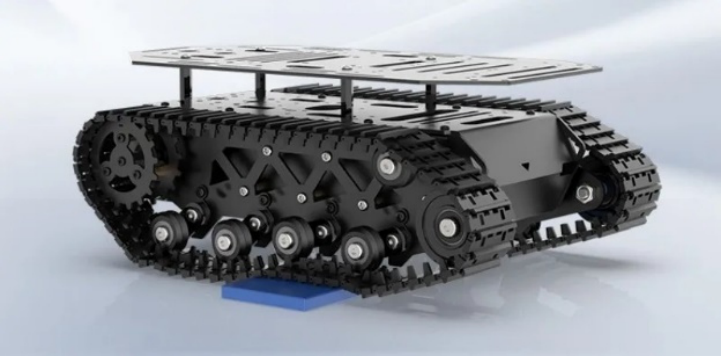
The survey included tidal-flat bicycles, tidal boats, and amphibious vehicles. Analysis of their commonalities and limitations revealed that reducing ground pressure is a critical factor in ensuring mobility on soft tidal-flat terrain. Ground pressure is defined as the load divided by the contact area; thus, the larger the contact area, the more evenly the load is distributed across the ground, reducing the likelihood of sinking into the mud and enabling stable movement. Based on this finding, the present study adopted a tracked wheel system with a wide contact surface to ensure stable and continuous mobility even on uneven and soft ground (see Figure 1).
Figure 1: Suspension track wheel.
In addition, haerujil is often performed in low-light or nighttime conditions, making it difficult to locate workers and increasing the risk of isolation or accidents. Therefore, it was determined that the mobility system must accurately track the user’s position, accompany the user, and provide warning signals in potential distress situations. Through literature review and case analysis, it was confirmed that RTK-GPS (Real-Time Kinematic GPS) has been widely applied in shellfish aquaculture, smart agricultural machinery, and unmanned surface vehicles, providing high positional accuracy within 2–3 cm. This technology is particularly suitable for wide, obstacle-free environments such as tidal flats. Accordingly, this
study incorporated RTK-GPS to enable the autonomous driving function of the mobility device, allowing it to follow the user precisely through high-accuracy position tracking.
Furthermore, task analysis and interviews with haerujil participants confirmed that the activity imposes significant physical strain on workers. Considerable effort is required to carry work tools to the tidal area and transport collected shellfish to nearby markets, often over long distances while bearing heavy loads. Therefore, it was concluded that the mobility system should provide dedicated storage compartments for both work tools and harvested shellfish, thereby reducing the physical burden on elderly users during field operations.
DESIGN In this study, a mobility system for tidal-flat environments was designed to reflect both the working conditions of tidal flats and the characteristics of elderly fishers, with the aim of simultaneously achieving functionality, durability, usability, and worker safety.
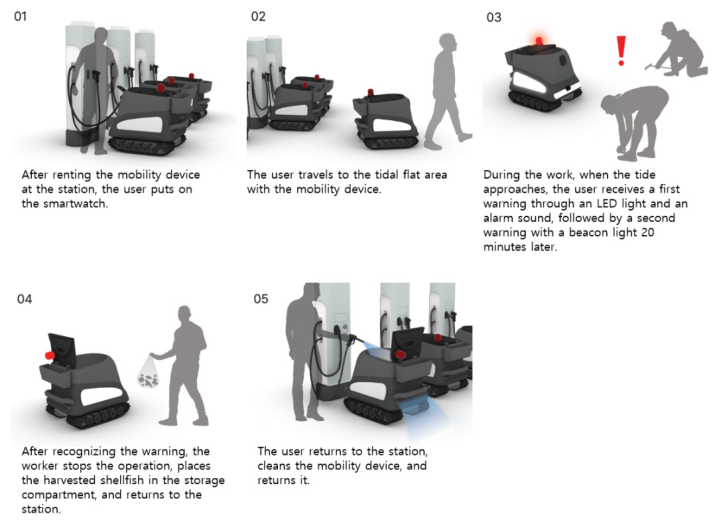
Figure 2 illustrates the use scenario of the proposed mobility system. The user rents the mobility unit and a smartwatch at the mobility station, loads the necessary tools into the onboard tool compartment, and then moves to the tidal area to perform haerujil operations. After collecting shellfish during the low-tide period, the user loads the harvested catch into the mobility device and returns to the station for cleaning and return procedures.
Figure 2: Use scenario.
The main features and structural elements of the proposed system, as shown in Figure 2, are described below.
Designing Mudflat Fishing Mobility for Worker Safety and Reduced Physical Strain 559
(1) Suspension Track Wheel for Mobility and Load Reduction To reduce the physical strain on workers during haerujil, a suspension track wheel system was applied to ensure stable transportation of tools and harvested shellfish, even under muddy and uneven tidal-flat conditions. The track-type wheel is made of durable rubber material, providing strong traction on soft surfaces. The internal space between the wheels is efficiently utilized for the motor and battery assembly, lowering the center of gravity and maximizing spatial efficiency. The suspension system connects the wheels and the body frame, effectively absorbing shocks from irregular surfaces and ensuring stable movement. This design enables users to safely transport tools and shellfish across complex terrain consisting of mud and rocks. Furthermore, the track configuration evenly distributes the vehicle’s load, minimizing the risk of sinking or immobilization on soft ground. (2) Safety and Autonomous Tracking Functions To prevent potential distress incidents and enable real-time user tracking, the mobility system incorporates both warning and tracking features. One hour before high tide, the system issues a first warning through LED lights and sound alerts, followed by a second warning via a beacon light 20 minutes later. This function is implemented using TIDE- API technology, which provides accurate tidal information. In addition, an RTK-GPS (Real-Time Kinematic GPS) module was integrated to allow the mobility device to autonomously follow the user’s movements. The system synchronizes with a smartwatch worn by the user, ensuring precise and responsive motion tracking based on real-time positional data. (3) Ergonomic Storage Design for Tools and Harvested Shellfish To reduce physical workload, the mobility device is equipped with a shellfish storage compartment on the upper section and a tool storage compartment at the rear. The shellfish compartment features a hinged lid for easy access and reduced fatigue during extended operations. Drainage holes allow seawater discharge, maintaining hygiene and product quality. The rear tool compartment is positioned low for easy reach and stability, with a reinforced handle designed to serve as a support point should the user slip or become partially submerged in the mud, thereby enhancing overall safety.
As a result, the proposed product was designed to integrate ergonomic elements of mobility, transport, safety management, and work efficiency based on the unique environment of haerujil (clam digging at the seashore) and the real needs of its users. It was conceived not merely as a means of transportation but as a collaborative work partner that interacts with the user throughout the entire haerujil process, supporting every phase of the operation.
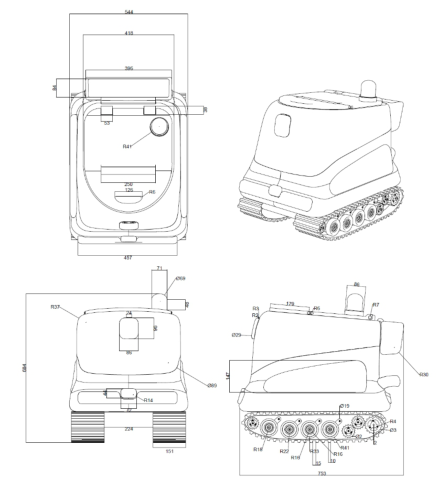
To develop the most appropriate form of haerujil mobility, various design configurations were explored and tested, including the placement of LEDs and the size and height of the shellfish container, to identify the most stable and user-friendly structure. Figure 3 presents the design schematic of the proposed model.
Figure 3: Engineering drawing.
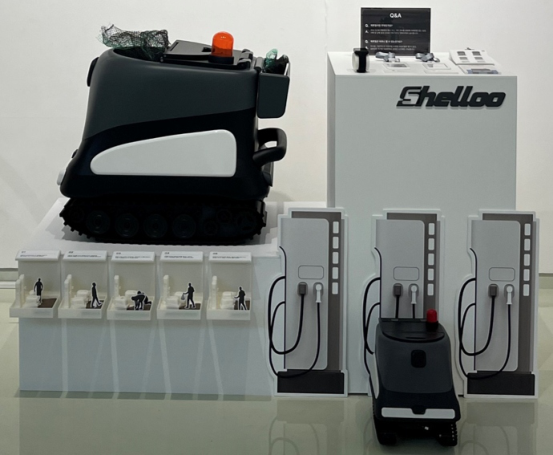
Figure 4 shows the final prototype, which was produced both as a full-scale mock-up and as a 1:4-scale working model. The prototype was fabricated using CNC machining, 3D printing, and translucent resin materials. LED components were embedded beneath translucent resin surfaces with light- diffusion films to ensure clear visual signaling in dark environments, while sound sensors were added for use in bright or noisy conditions.
Figure 4: Prototype model.
Designing Mudflat Fishing Mobility for Worker Safety and Reduced Physical Strain 561
For the working prototype, Arduino and circuit modules were used to simulate motion and interactivity. The model was powered by 12V motors and motor drivers, enabling realistic movement, and was programmed to signal tidal timing through LEDs and sound sensors. Rechargeable lithium- ion batteries were employed to prevent overload of the Arduino system while ensuring a stable power supply.
CONCLUSION
This study proposed and developed a concept and prototype for an autonomous mobility system designed to assist shellfish gathering (haerujil) on tidal flats, taking into account the unique environmental characteristics of the activity and the safety and convenience needs of elderly fishers. Conventional approaches centered on safety guidelines and personal protective equipment have shown clear limitations under the complex conditions of nighttime operations and soft, unstable terrain. In response, this study presented a mobility design framework that integratively supports movement, visibility, and load reduction.
First, by applying ground pressure distribution and a suspension track wheel system, the proposed mobility device enables stable driving and transportation across mixed tidal-flat terrains composed of mud, gravel, and rocks. This design alleviates the physical burden on elderly fishers and significantly improves the efficiency of transporting harvested shellfish and work tools.
Second, through the integration of RTK-GPS–based precise positioning and a tide alert system, the mobility platform can monitor the user’s location in real time and prevent potential distress incidents. In particular, the smartwatch synchronization and multi-stage warning system provide a practical solution for ensuring safety during nighttime or rising-tide conditions.
Third, ergonomic design features—such as the shellfish container, tool storage compartment, and safety handle—were incorporated to enhance user convenience and safety. These elements allow the mobility system to function not merely as a transport device but as a comprehensive work partner that assists the user throughout the entire haerujil process.
Through prototype fabrication and functional testing, the study verified the feasibility of the proposed system in realistic operational contexts. The haerujil mobility demonstrates strong potential to enhance the sustainability of tidal-flat foraging and improve the quality of life of elderly fishers by integrating mobility, safety, and work efficiency.
Future research should focus on refining the system through field-based user evaluations, validation of autonomous driving algorithms, deeper integration with wearable user interfaces, and further improvements in energy efficiency and durability. With such developments, the haerujil mobility system can evolve beyond an experimental concept into a practical, field-deployable platform for safety enhancement and work assistance in tidal-flat environments.
ACKNOWLEDGMENT
This result was supported by the “Regional Innovation System & Education (RISE)” through the ChungNam RISE Center, funded by the Ministry of Education (MOE) and the Chungcheongnam-do.
REFERENCES
Deusdado, P., Pinto, E., Guedes, M., Marques, F., Rodrigues, P., Lourenço, A., Mendonça, R., Silva, A., Santana, P., Corisco, J., Almeida, M., Portugal, L., Caldeira, R., Barata, J. and Flores, L., “An aerial-ground robotic team for systematic soil and biota sampling in estuarine mudflats,” In Reis, L. P., Moreira, A. P., Lima, P. U., Montano, L. and Muñoz-Martinez, V. (Eds.), Robot 2015: Second Iberian Robotics Conference, Advances in Intelligent Systems and Computing, Vol. 418, Springer, Cham, 15–26, 2016. https://doi.org/10.1007/ 978–3-319–27149-1_2. Eckart, P., Knöll, M., Lanzendorf, M. and Vöckler, K. (Eds.), Mobility Design:
Shaping Future Mobility. Volume 2: Research, JOVIS, Berlin, 264 pp., 2022. (Open-access edition available). Hatano, M., Senzaki, M., Kawasaki, H., Takasu, C., Yamazaki, M. and Hoshigami, Y., Robots traveling on muddy terrain for sampling bottom sediment in tidal flats, Artificial Life and Robotics, 29(1), 155–160, 2024. https://doi.org/ 10.1007/s10015–023-00920–9. HM Coastguard, Safety advice, HM Coastguard UK, https://hmcoastguard.uk/ safety-advice (retrieved September 3, 2025). Kang, S. B., The tradition and changing patterns of “Haerujil”on Korea’s west coast:
Focus on Wonsando, DBpia (listing), (retrieved September 3, 2025). Kim, Y., Lee, S., Hwang, T. and Choi, I., An analysis of conflict issues in marine leisure activities surrounding Haerujil (recreational fishery), Journal of the Korean Regional Development Association, 36(5), 151–174, 2024. https:// doi.org/10.22885/KRDA.2024.36.5.151. Krajewski, A., Reitmaier, S., Vöckler, K. and Eckart, P., Mobility Design Guide:
Making future mobility tangible and experienceable, In Vöckler, K., Eckart, P., Knöll, M. and Lanzendorf, M. (Eds.), Mobility Design: Shaping Future Mobility. Volume 2: Research, JOVIS, Berlin, 58–70, 2022. https://doi.org/10.1515/ 9783868597943–006. Yoon, J. A., Oh, Y. J., Oh, H. W. and Lee, Y. H., Development of energy-harvesting based safety apparel for night workers, The Research Journal of the Costume Culture, 26(4), 503–518, 2018. https://doi.org/10.29049/rjcc.2018.26.4.503.
LISTED IN THE AHFE DIGITAL BOOKSTORE CATALOGUE
Explore the complete digital volume
Human Factors in Design, Engineering, and Computing
Read this individual research paper free through the original publisher, or explore the full digital proceedings book.
ISBN 978-1-964867-75-5
Explore this ISBN in the AHFE Bookstore ↗Listed in the July 2026 bookstore catalogue; search by ISBN to confirm current availability · Digital book purchase optional